New Year Sale Special - Limited Time 70% Discount Offer - Ends in 0d 00h 00m 00s - Coupon code: sntaclus

Refer to the exhibit.
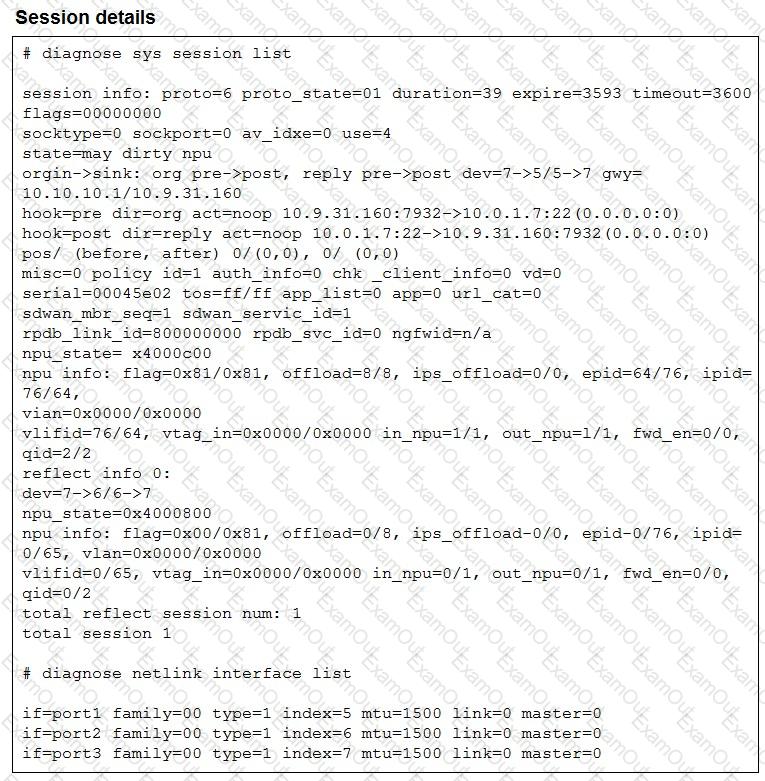
The exhibit shows the details of a session and the index numbers of some relevant interfaces on a FortiGate device that supports hardware offloading.

Based on the information shown in the exhibits, which two conclusions can you draw? (Choose two.)

A.

By default, FortiGate offloads symmetric and asymmetric flows.

B.

The original direction of the symmetric traffic flows from port3 to port2.

C.

The reply direction of the asymmetric traffic flows from port2 to port3.

D.

The auxiliary session can be offloaded to hardware.

You have configured the performance SLA with the probe mode as Prefer Passive.

What are two observable impacts of this configuration? (Choose two.)
A.

FortiGate passively monitors the member if TCP traffic is passing through the member.

B.

After FortiGate switches to active mode, the SLA performance rule falls back to passive monitoring after 3 minutes.

C.

FortiGate passively monitors the member if ICMP traffic is passing through the member.

D.

During passive monitoring, the SLA performance rule cannot detect dead members.

E.

FortiGate can offload the traffic that is subject to passive monitoring to hardware.

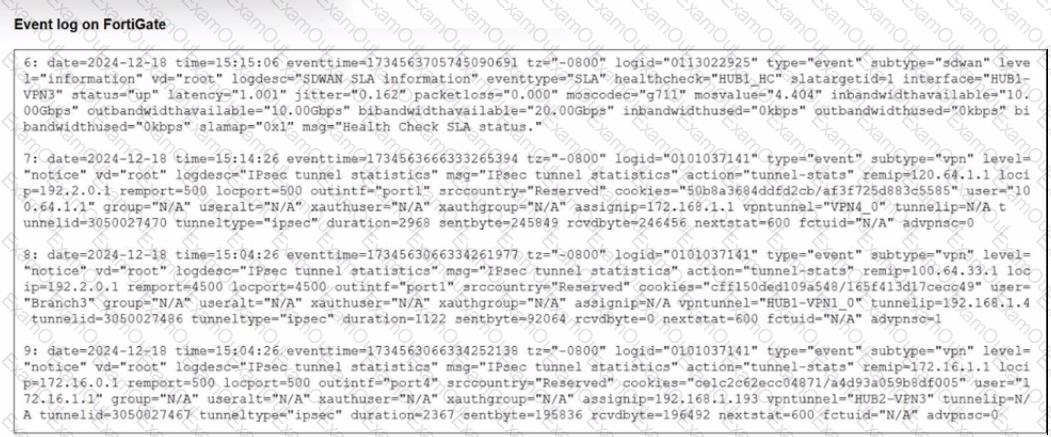
Refer to the exhibit that shows event logs on FortiGate.

Based on the output shown in the exhibit, what can you say about the tunnels on this device?

A.

The master tunnel HU82-VPN3 cannot accept ADVPN shortcuts.

B.

The device steers voice traffic through the VPN tunnel HUB1-VPN3.

C.

The VPN tunnel HUB1-VPN1_0 is a shortcut tunnel.

D.

There is one shortcut tunnel built from master tunnel VPN4.

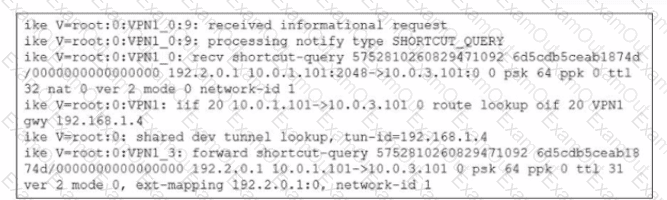
Refer to the exhibit.

Which statement best describe the role of the ADVPN device in handling traffic?

A.

This is a hub that has received a query from a spoke and has forwarded it to another spoke.

B.

This is a hub in a dual-region topology. The remote hub tunnel ID is 10.0.2.101.

C.

This is a spoke that has received a shortcut query from another spoke and has forwarded the response to its hub.

D.

This is a spoke. The kernel received a shortcut request and forwards the query to another spoke.

Which statement describes FortiGate behavior when you reference a zone in a static route?

A.

FoftiGate installs ECMP static routes for the first two members of the zone.

B.

FortiGate ignores the static routes defined through members referenced in the zone.

C.

FortiGate routes the traffic through the best performing member of the zone.

D.

FortiGate installs a static route for each member in the zone.

When you use the command diagnose sys session list, how do you identify the sessions that correspond to traffic steered according to SD-WAN rules?

A.

You identify sessions steered according to SD-WAN rules with the flag vwl.

B.

You cannot identify SD-WAN sessions. You must use the sdwar. session filter.

C.

You identify sessions steered according to SD-WAN rules with the data vwl_mbr_seq.

D.

You identify sessions steered according to SD-WAN rules with the data 3dwan_service_id.

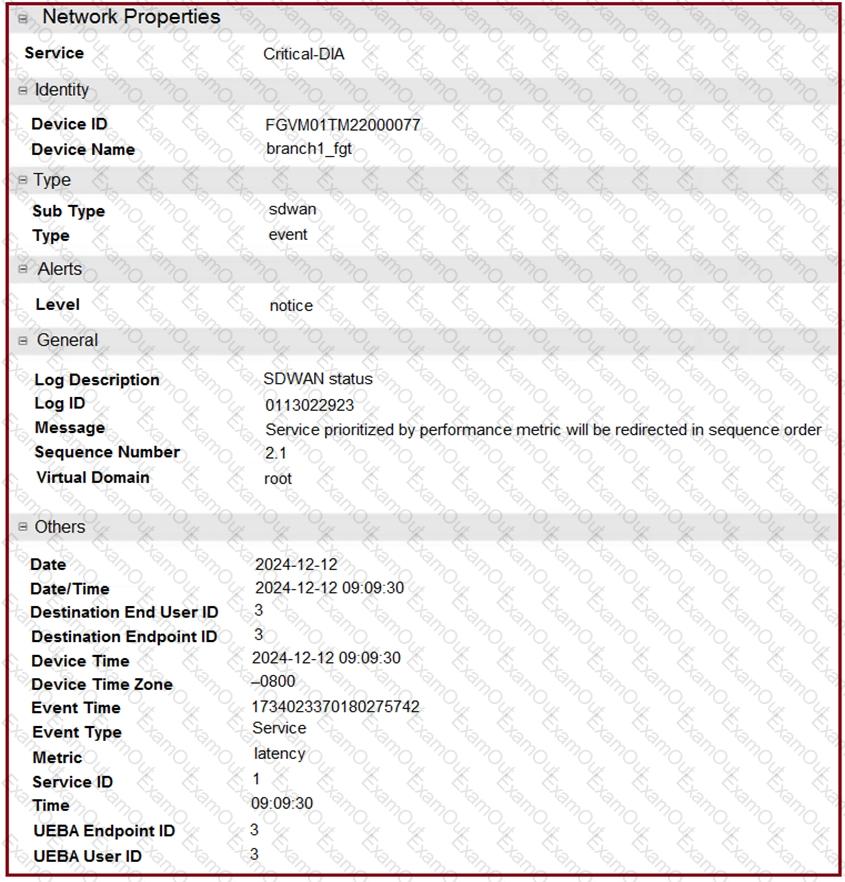
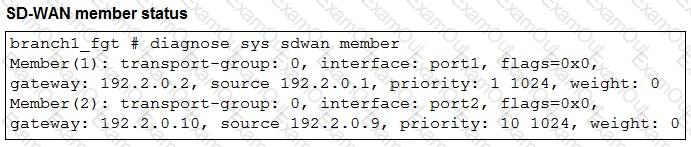
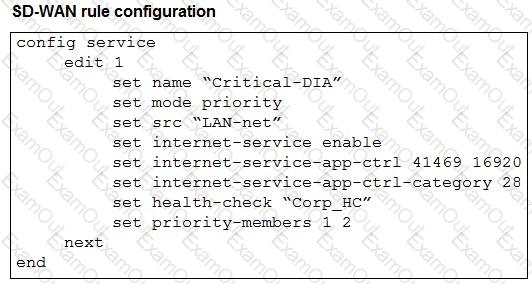
Refer to the exhibits.

The exhibits show an SD-WAN event log, the member status, and the SD-WAN rule configuration.

Which two conclusions can you draw from the information shown? (Choose two.)

A.

The administrator configured the service ID 1 with the highest priority member for port2.

B.

Port2 has a lower latency than port1.

C.

FortiGate updated the outgoing interface list on the rule so it prefers port2.

D.

The administrator configured the SD-WAN rule ID 1 with the default strategy mode.

(Refer to the exhibits. You collected the output shown in the exhibits and want to know which interface TCP traffic will flow through from the user device 10.0.1.101 to the corporate file server 10.0.0.125. All SD-WAN links are stable.
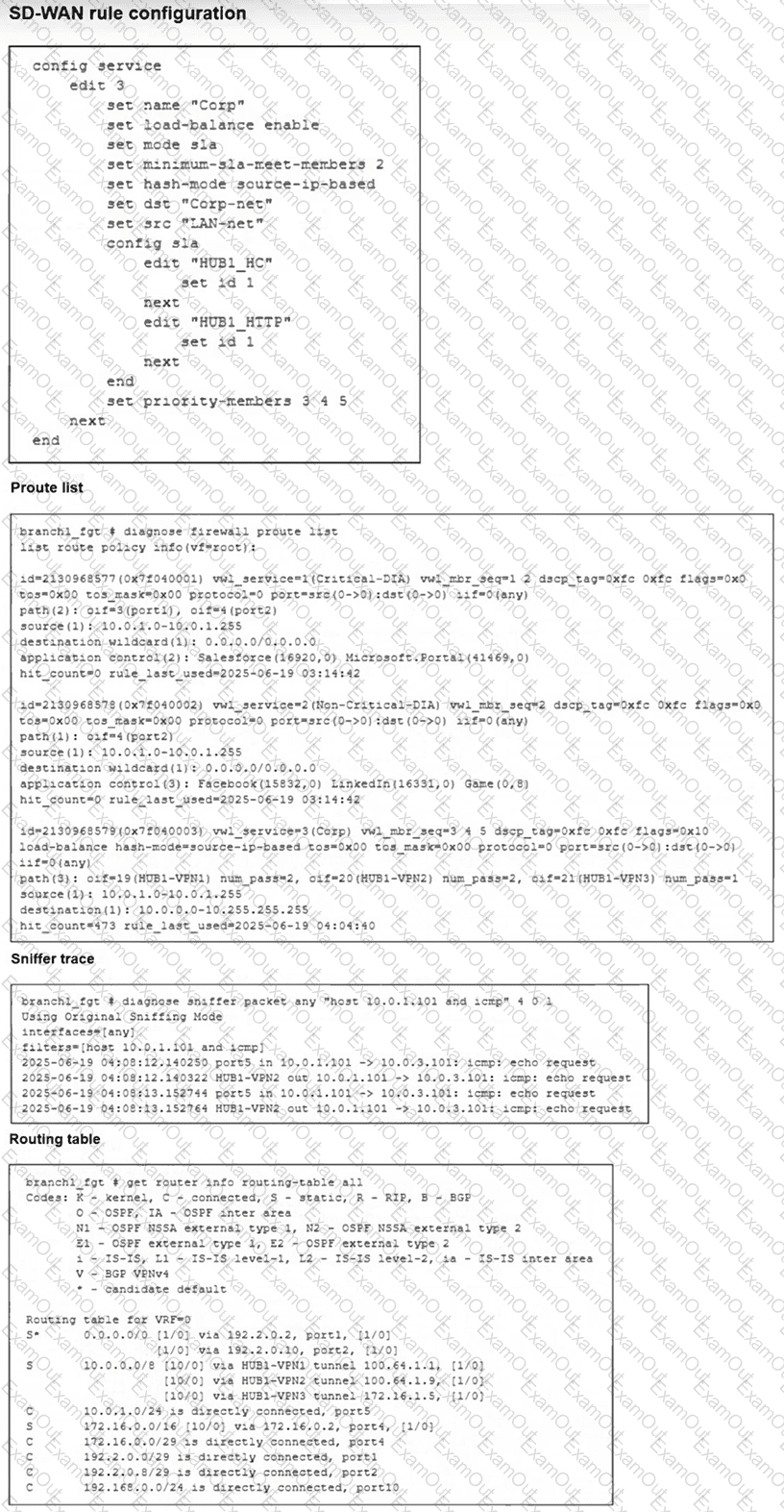
Which interface will FortiGate use to steer the traffic? Choose one answer.)

A.

Only HUB1-VPN1

B.

Either HUB1-VPN1 or HUB1-VPN2

C.

Only HUB1-VPN2

D.

Either HUB1-VPN1, HUB1-VPN2, or HUB1-VPN3

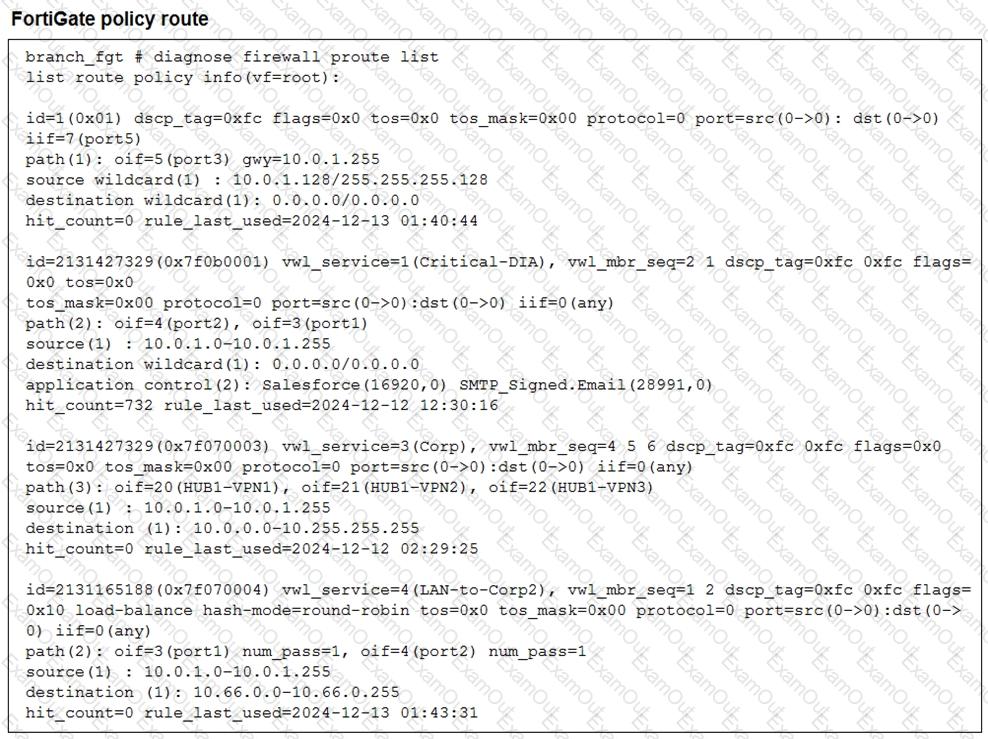
Refer to the exhibit.

What conclusions can you draw about the traffic received by FortiGate originating from the source LAN device 10.0.1.133 and destined for the company’s SMTP mail server at 10.66.0.125?

A.

FortiGate steers the traffic from the LAN device 10.0.1.133 to the company SMTP mail server 10.66 0.125 through port3.

B.

ForliGate steers the traffic from the LAN device 10.0.1.133 to the company SMTP mail server 10.66.0.125 through port2.

C.

FortiGate steers the traffic from the LAN device 10.0.1.133 to the company SMTP mail server 10.66.0.125 through the SD-WAN member ID 4.

D.

FortiGate steers the traffic from the LAN device 10.0.1.133 to the SMTP mail server 10.66.0.125 through the SD-WAN member ID 1 or 2.

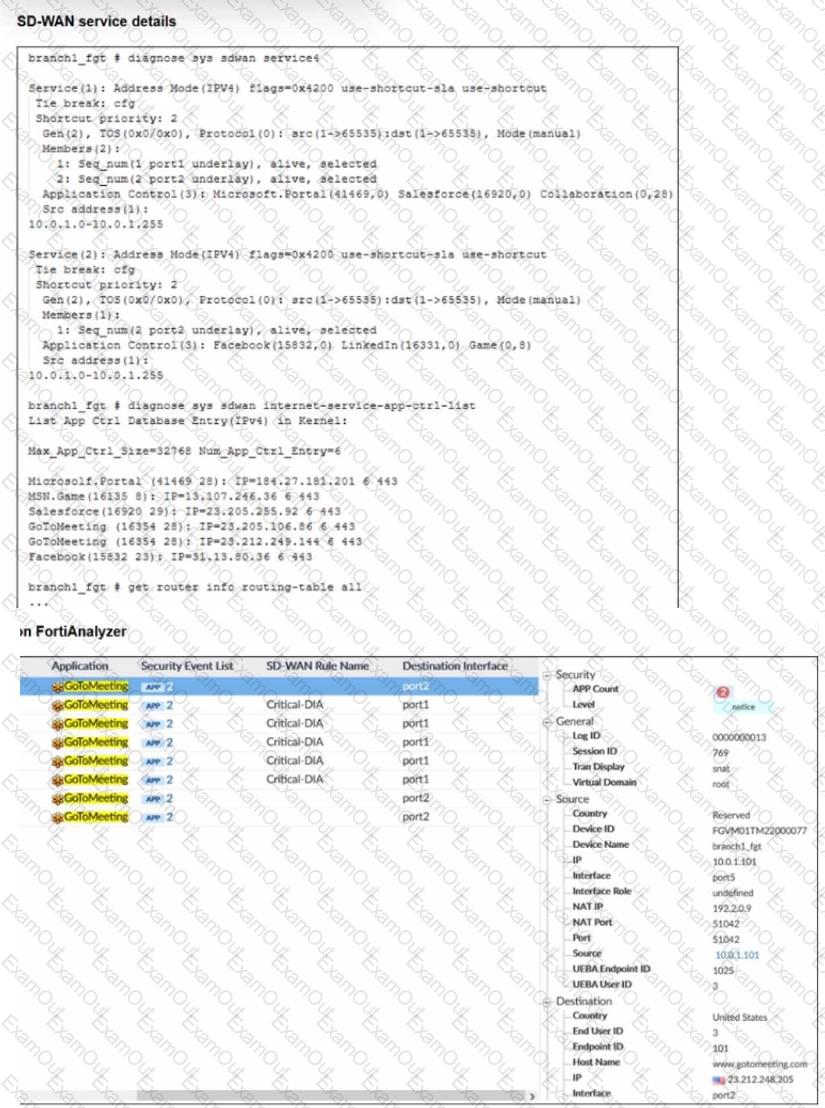
Refer to the exhibits.

An administrator is testing application steering in SD-WAN. Before generating test traffic, the administrator collected the information shown in the first exhibit. After generating GoToMeeting test traffic, the administrator examined the corresponding traffic log on FortiAnalyzer, which is shown in the second exhibit.

The administrator noticed that the traffic matched the implicit SD-WAN rule, but they expected the traffic to match rule ID 1.

Which two reasons explain why some log messages show that the traffic matched the implicit SD-WAN rule? (Choose two.)

A.

Full SSL inspection is not enabled on the matching firewall policy.

B.

The session 3-tuple did not match any of the existing entries in the ISDB application cache.

C.

FortiGate could not refresh the routing information on the session after the application was detected.

D.

No configured SD-WAN rule matches the traffic related to the collaboration application GoToMeeting