New Year Sale Special - Limited Time 70% Discount Offer - Ends in 0d 00h 00m 00s - Coupon code: sntaclus

An administrator is configuring SD-WAN to load balance their network traffic. Which two things should they consider when setting up SD-WAN? (Choose two.)

A.

You can select the outbandwidth hash mode with all strategies that allow load balancing.

B.

Only the manual and best-quality strategies allow SD-WAN load balancing.

C.

When applicable. FortiGate load balances the traffic through all members that meet the SLA target.

D.

SD-WAN load balancing is possible only using the best quality and lowest cost (SLA) strategies.

You are planning a large SD-WAN deployment with approximately 1000 spokes and want to allow ADVPN between the spokes. Some remote sites use FortiSASE to connect to the company's SD-WAN hub. Which overlay routing configuration should you use?

A.

BGP on loopback with dynamic BGP for ADVPN shortcut routing.

B.

BGP on loopback with IPsec phase2 selectors for ADVPN shortcut routing.

C.

BGP per overlay with dynamic BGP for ADVPN shortcut routing.

D.

BGP per overlay with BGP next-hop convergence for ADVPN shortcut routing.

You want FortiGate to use SD-WAN rules to steer local-out traffic.

Which two constraints should you consider? (Choose two.)

A.

By default, FortiGate uses SD-WAN rules only for local-out traffic that corresponds to ping and traceroute.

B.

By default, local-out traffic does not use SD-WAN.

C.

You can steer local-out traffic only with SD-WAN rules that use the manual strategy.

D.

You must configure each local-out feature individually to use SD-WAN.

Your FortiGate is in production. To optimize WAN link use and improve redundancy, you enable and configure SD-WAN.

What must you do as part of this configuration update process?

A.

Replace references to interfaces used as SD-WAN members in the routing configuration.

B.

Purchase and install the SD-WAN license, and reboot the FortiGate device.

C.

Replace references to interfaces used as SD-WAN members in the firewall policies.

D.

Disable the interface that you want to use as an SD-WAN member.

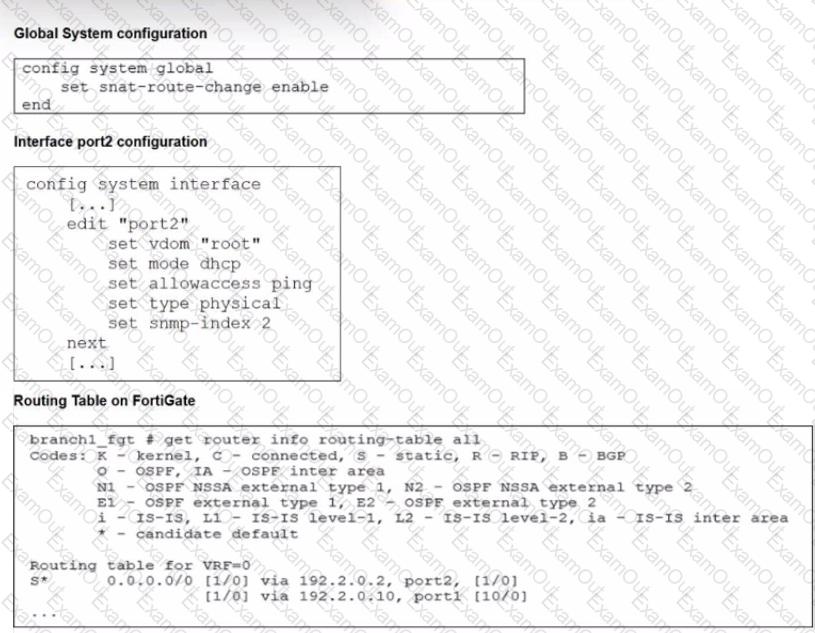
Refer to the exhibits.

The exhibits show the source NAT (SNAT) global setting. port2 interface settings, and the routing table on FortiGate.

The administrator increases the member priority on port2 to 20.

Upon configuration changes and the receipt of new packets, which two actions does FortiGate perform on existing sessions established over port2? (Choose two.)

A.

FortiGate continues routing all existing sessions over port2.

B.

FortiGate routes only new sessions over port2.

C.

FortiGate flags the SNAT session as dirty only if the administrator has assigned an IP pool to the firewall policies with NAT.

D.

FortiGate flags the sessions as dirty.

E.

FortiGate updates the gateway information of the sessions with SNAT so that they use port1 instead of port2.

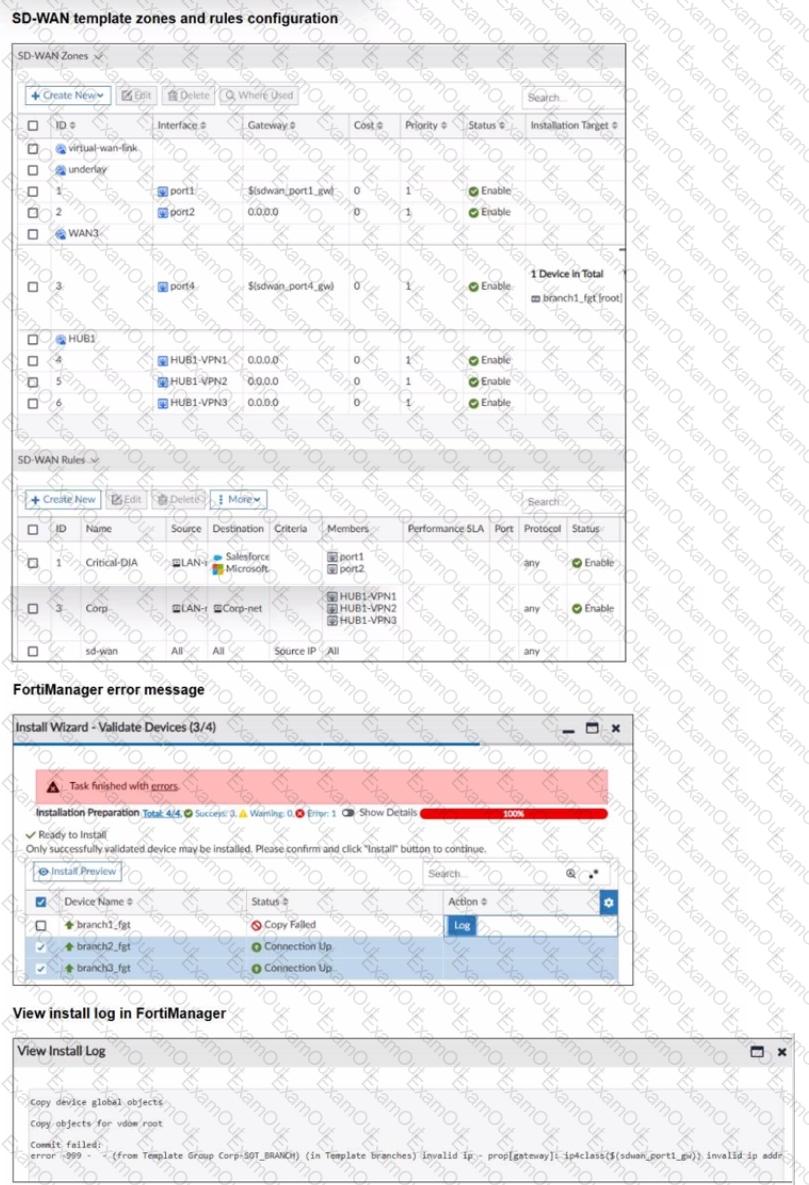
Refer to the exhibits.

You use FortiManager to configure SD-WAN on three branch devices.

When you install the device settings. FortiManager prompts you with the error "Copy Failed" for the device branch1_fat When you click the log button. FortiManager displays the message shown in the exhibit.

A.

Based on the exhibits, which statement best describes the issue and how you can resolve it?

B.

Remove the installation target for the SD-WAN member port4. You cannot combine metadata variable and installation targets.

C.

Gateways for all members in a zone must be defined the same way. Specify the gateway of the SD-WAN member port! without metadata variables.

D.

Check the metadata variable definitions, and review the per-device mapping configuration.

E.

Check the connection between branch1_fgt and FortiManager

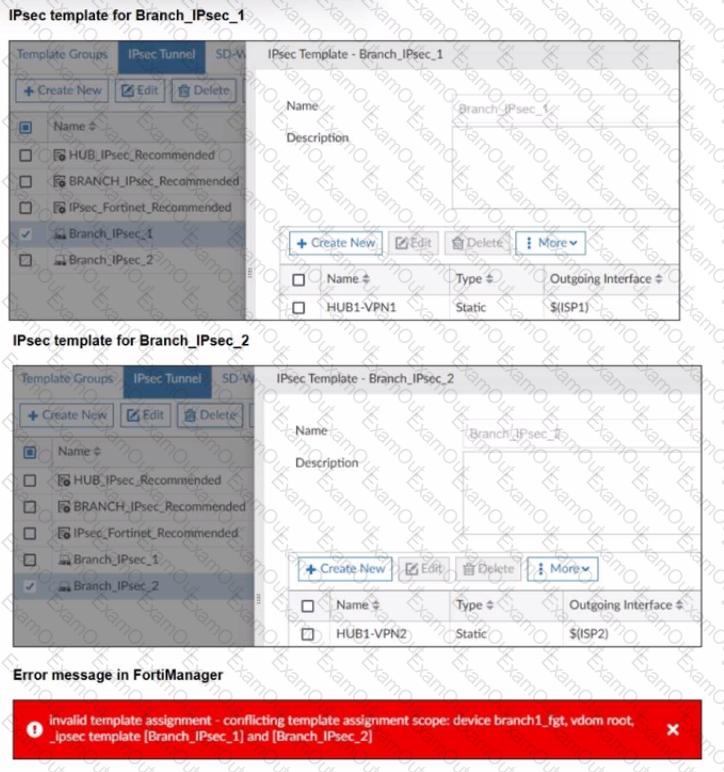
Refer to the exhibits.

The exhibits show two IPsec templates to define Branch IPsec 1 and Branch_IPsec_2. Each template defines a VPN tunnel. The error message that FortiManager displayed when the administrator tried to assign the second template to the FortiGate device is also shown.

Which statement best describes the cause of the issue?

A.

You can assign only one template with a tunnel type of static to each FortiGate device.

B.

You can assign only one IPsec template to each FortiGate device.

C.

You should review the branch1_fgt configuration for configured tunnels in the rootVDOM.

D.

You should use the same outgoing interface of both templates.

An SD-WAN member is no longer used to steer SD-WAN traffic. The administrator updated the SD-WAN configuration and deleted the unused member. After the configuration update, users report that some destinations are unreachable. You confirm that the affected flow does not match an SD-WAN rule.

What could be a possible cause of the traffic interruption?

A.

FortiGate, with SD-WAN enabled, cannot route traffic through interfaces that are not SD-WAN members.

B.

FortiGate can remove some static routes associated with an interface when the member is removed from SD-WAN.

C.

FortiGate removes the layer 3 settings for interfaces that are removed from the SD-WAN configuration.

D.

FortiGate administratively brings down interfaces when they are removed from the SD-WAN configuration.

The SD-WAN overlay template helps to prepare SD-WAN deployments. To complete the tasks performed by the SD-WAN overlay template, the administrator must perform some post-run tasks. What are two mandatory post-run tasks that must be performed? (Choose two.)

A.

Configure routing through the overlay tunnels created by the SD-WAN overlay template.

B.

Create policy packages and assign them to the branch devices.

C.

Assign a hub id metadata variable to each hub device.

D.

Configure SD-WAN rules

E.

Assign an sdwan_id metadata variable to each device (branch and hub)

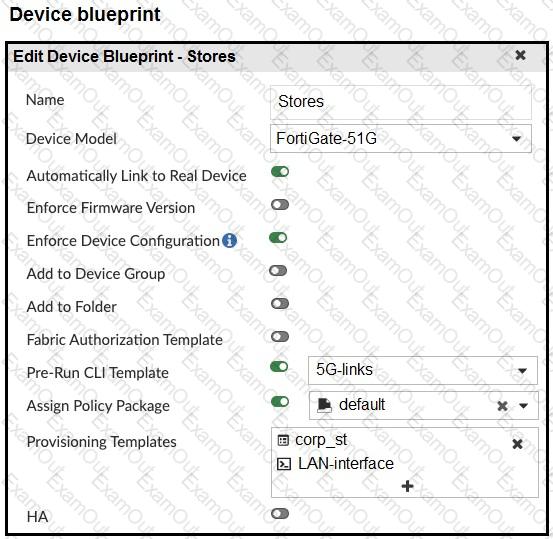
Refer to the exhibits.

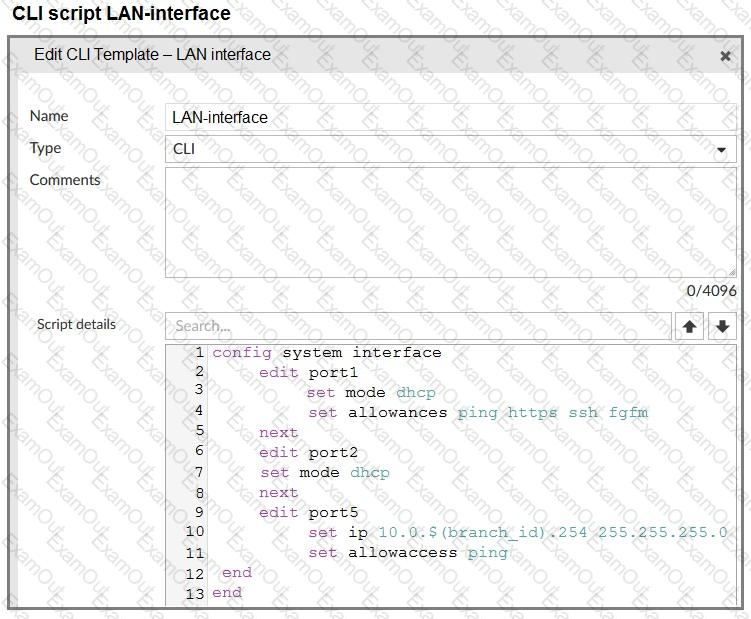
The administrator configured a device blueprint and CLI scripts as shown in the exhibits, to prepare for onboarding FortiGate devices in the company’s stores. Later, a technician prepares a FortiGate 51G with a basic configuration and connects it to the network. The basic configuration contains the port1 configuration and the minimal configuration required to allow the device to connect to FortiManager.

After the device first connects to FortiManager, FortiManager updates the device configuration.

Based on the exhibits, which actions does FortiManager perform?

A.

FortiManager updates the device configuration according to the selected templates. It applies the corp_st template first.

B.

FortiManager does not update the port1 configuration because FortiManager does not change the configuration of interfaces with fgfm access.

C.

FortiManager updates access rights only for port1. FortiManager cannot update the IP address because it was already set manually.

D.

FortiManager updates the configuration of port1, port2, and port5. The three ports might get new IP addresses.