New Year Sale Special - Limited Time 70% Discount Offer - Ends in 0d 00h 00m 00s - Coupon code: sntaclus

An engineer is integrating Cisco Secure Endpoint with Cisco Secure Firewall Management Center in high availability mode. Malware events detected by Secure Endpoint must also be

received by Secure Firewall Management Center and public cloud services are used. Which two configurations must be selected on both high availability peers independently? (Choose two.)

A.

internet connection

B.

Smart Software Manager Satellite

C.

Cisco Success Network

D.

security group tag

E.

Secure Endpoint Cloud Connection

Refer to the exhibit.

What is the effect of the existing Cisco FMC configuration?

A.

The remote management port for communication between the Cisco FMC and the managed device changes to port 8443.

B.

The managed device is deleted from the Cisco FMC.

C.

The SSL-encrypted communication channel between the Cisco FMC and the managed device becomes plain-text communication channel.

D.

The management connection between the Cisco FMC and the Cisco FTD is disabled.

Which Cisco Firepower rule action displays an HTTP warning page?

A.

Monitor

B.

Block

C.

Interactive Block

D.

Allow with Warning

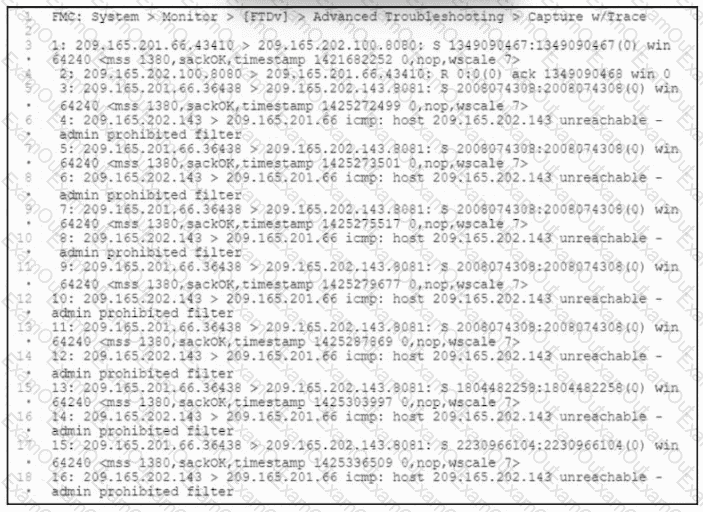
An engineer must investigate a connectivity issue from an endpoint behind a Cisco FTD device and a public DNS server. The endpoint cannot perform name resolution queries. Which action must the engineer perform to troubleshoot the issue by simulating real DNS traffic on the Cisco FTD while verifying the Snarl verdict?

A.

Perform a Snort engine capture using tcpdump from the FTD CLI.

B.

Use the Capture w/Trace wizard in Cisco FMC.

C.

Create a Custom Workflow in Cisco FMC.

D.

Run me system support firewall-engine-debug command from me FTD CLI.

An engineer installs a Cisco FTD device and wants to inspect traffic within the same subnet passing through a firewall and inspect traffic destined to the internet.

Which configuration will meet this requirement?

A.

transparent firewall mode with IRB only

B.

routed firewall mode with BVI and routed interfaces

C.

transparent firewall mode with multiple BVIs

D.

routed firewall mode with routed interfaces only

Which action should you take when Cisco Threat Response notifies you that AMP has identified a file as malware?

A.

Add the malicious file to the block list.

B.

Send a snapshot to Cisco for technical support.

C.

Forward the result of the investigation to an external threat-analysis engine.

D.

Wait for Cisco Threat Response to automatically block the malware.

An engineer must investigate a connectivity issue by using Cisco Secure Firewall Management Center to access the Packet Capture feature on a Cisco Secure Firewall Threat Defense

device. The engineer must see a real packet going through the Secure Firewall Threat Defense device and the Snort detection actions. While reviewing the packet capture, the engineer

discovers that the Snort detection actions are missing. Which action must the engineer take to resolve the issue?

A.

Specify the packet size.

B.

Specify the buffer size.

C.

Enable the Continuous Capture option.

D.

Enable the Trace option.

A network administrator manages a network with multiple firewalls in a datacenter using Cisco Secure Firepower Management Center. The administrator must change a next-generation firewall from routed to transparent mode. Which action must the administrator take next to meet the requirement?

A.

Deregister the firewall in Cisco Secure Firewall Management Center.

B.

Enter the configure transparent firewall command from the CLI.

C.

Create one or more bridge groups from the CLI.

D.

Manually delete the interface configuration from the CLI.

A user within an organization opened a malicious file on a workstation which in turn caused a ransomware attack on the network. What should be configured within the Cisco FMC to ensure the file is tested for viruses on a sandbox system?

A.

Capacity handling

B.

Local malware analysis

C.

Spere analysis

D.

Dynamic analysis

An administrator is adding a QoS policy to a Cisco FTD deployment. When a new rule is added to the policy and QoS is applied on 'Interfaces in Destination Interface Objects", no interface objects are available What is the problem?

A.

The FTD is out of available resources lor use. so QoS cannot be added

B.

The network segments that the interfaces are on do not have contiguous IP space

C.

QoS is available only on routed interfaces, and this device is in transparent mode.

D.

A conflict exists between the destination interface types that is preventing QoS from being added