Spring Sale Special - Limited Time 70% Discount Offer - Ends in 0d 00h 00m 00s - Coupon code: sntaclus

Refer to the exhibit.
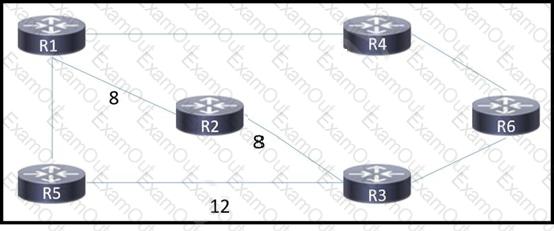
A network engineer configured routers R1 and R5 to run in IS-IS Level 1 mode and router R6 to run in IS-IS Level 2 mode. All other routers are running as Level 1 / Level 2 routers. An engineer expects traffic from R1 to R6 to pass via R2, but IS-IS routing has calculated the best path via R4. Which action corrects the problem?

A.

Configure all routers as Level 1 routers.

B.

Remove the link metric for the link from router R1 to router R2.

C.

Change the link metric for the link from router R1 to router R2 to 1.

D.

Configure all routers as Level 1 / Level 2 routers.

Refer to the exhibit.

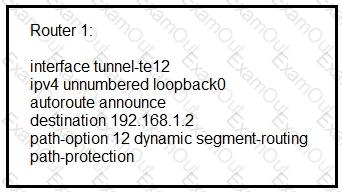
Router 1 has established an SR-TE tunnel with router 2. Which statement describes this

configuration?

A.

Router 1 has a list of labels used to explicitly lay out a path to router 2.

B.

Router 1 and router 2 have a bidirectional tunnel set up with dynamic path selection.

C.

Router 1 is the head-end tunnel and has dynamically chosen a path to router 2.

D.

Router 2 is the head-end tunnel and has explicitly set a path to router 1.

Refer to the exhibit.

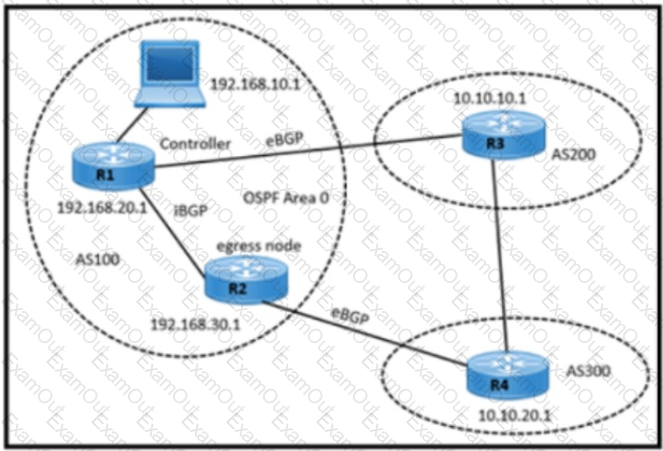
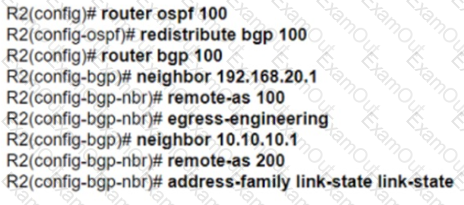
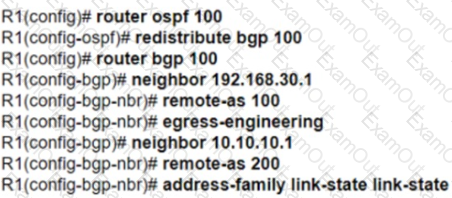
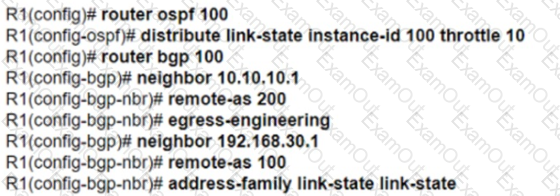
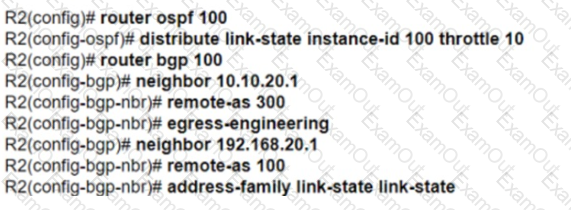
A network engineer must enable segment routing between the three autonomous systems with these requirements:

·OSPF link-state data for area 0 routers must be distributed to the controller via BGP LS.

·EPE must be enabled on the egress node in AS 100.

·Routers must advertise peer node SIDs to the controller R1 via BGP LS.

Which configuration must the engineer apply?

A)
B)
C)
D)
A.

Option A

B.

Option B

C.

Option C

D.

Option D

Refer to the exhibit.

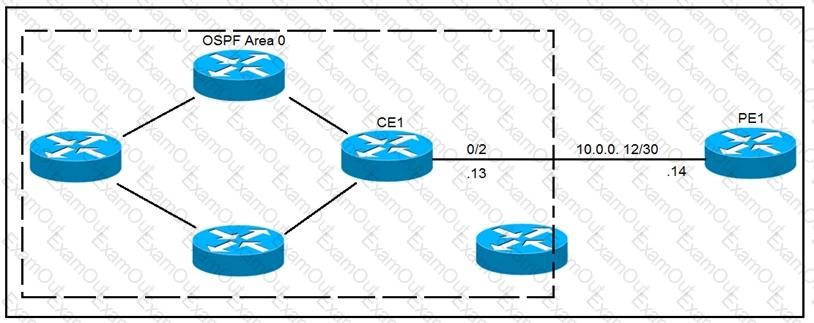
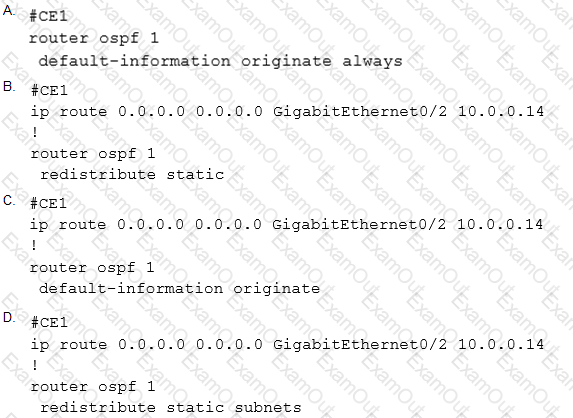
CE1 is the gateway router into the provider network via PE1. A network operator must

inject a default route into OSPF area 0. All devices inside area 0 must be able to reach PE1. Which configuration achieves this goal?
A.

Option A

B.

Option B

C.

Option C

D.

Option D

Refer to the exhibit

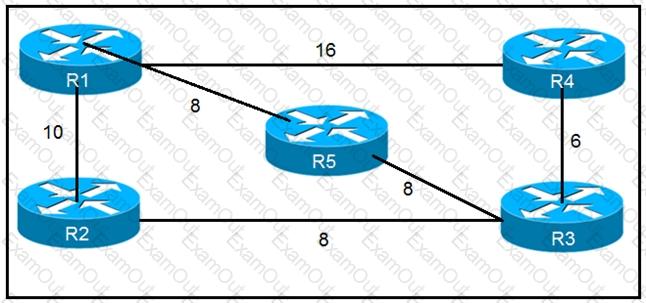
Which router does R1 install as an alternate next hop when trying to reach R3 if LFA is

enabled?

A.

R5

B.

R3

C.

R4

D.

R2

ION NO: 91

What are two major differences between OSPF and IS-IS routing protocols? (Choose two.)

A.

OSPF uses IP protocol 89 foe encapsulation and IS-IS uses an IEEE 802 3 standard-based protocol foe encapsulation

B.

The OSPF default administrative distance is 115 and the default administrative distance for IS-IS is 110

C.

The OSPF DR role can be pre-empted only when the active DR goes down, but the IS-IS DR role can be taken by a router with higher priority at any time

D.

OSPF partially refreshes the LSA database every 30 minutes, and IS-IS refreshes the complete database table every 60 minutes

E.

An OSPF-enabled router is part of only one area but an IS-IS-enabled router is part of multiple areas

Refer to the exhibit. R1 is sending data traffic to R6 using the same SRGB range as the other routers in the topology, but it is also using a non-default SRLB range. Which two configuration tasks must the engineer perform to enable normal SRGB and SRLB operations on this network? (Choose two.)

A.

Configure an adjacency SID from SRLB range 1002 to 6005.

B.

Configure router R2 with adjacency SID 4002 to enable it to reach R4.

C.

Configure router R1 with adjacency SID 1003 tcPegable it to reach R2.

D.

Set the default SRGB range to 16000 to 23999.

E.

Set the SRGB range to 1002 to 6005

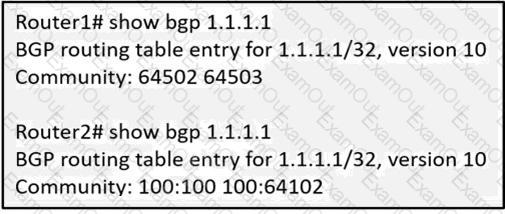
Refer to the exhibit.

An engineer working on a client’s network is trying to solve the BGP community issue on R1 and R2 routers. After displaying the BGP entries, the engineer notices that both routers still have different outputs. Which action must the engineer perform to any of the routers to correct the problem and get the same output?

A.

Execute the Ip bgp-community new-format command in Router1.

B.

Remove the Ip bgp-community new-format command in Router1.

C.

Advertise the route to Router2 as standard community.

D.

Advertise the route to Router2 as extended community.

Which difference should be considered when intradomain or interdomain multicast routing is implemented?

A.

Interdomain multicast routing requires an IS-IS or OSPF neighbor relationship between the domains but intradomain multicast routing requires only BGP

B.

Interdomain multicast routing relies on PIM-DM and intradomain multicast routing relies on PIM-SM.

C.

interdomain multicast routing uses BIDR-PIM to establish neighbor relationships between AS and interdomain multicast routing uses MSDP

D.

A network uses intradomain multicast routing without interdomain routing but networks that use interdomain multicast routing must also apply intradomain routing

What are two features of dual-stack? (Choose two.)

A.

It is implemented without excessive processing power.

B.

It supports IPv4 and IPv6 traffic on the same infrastructure.

C.

It allows an engineer to stack multiple Layer 2 switches to serve as a single switching unit.

D.

It requires tunneling IPv6 traffic over an IPv4 infrastructure.

E.

It securely routes and tunnels traffic between separate sites over the Internet.