Spring Sale Special - Limited Time 70% Discount Offer - Ends in 0d 00h 00m 00s - Coupon code: sntaclus

Refer to the exhibit.
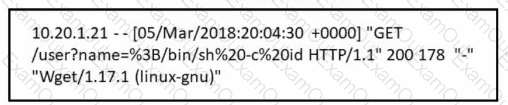
Which attack is being attempted against a web application?

A.

SQL injection

B.

man-in-the-middle

C.

command injection

D.

denial of service

What is rule-based detection when compared to statistical detection?

A.

proof of a user's identity

B.

proof of a user's action

C.

likelihood of user's action

D.

falsification of a user's identity

What is a difference between a threat and a risk?

A.

A threat is a sum of risks and a risk itself represents a specific danger toward the asset

B.

A threat can be people property, or information, and risk is a probability by which these threats may bring harm to the business

C.

A risk is a flaw or hole in security, and a threat is what is being used against that flaw

D.

A risk is an intersection between threat and vulnerabilities, and a threat is what a security engineer is trying to protect against

An engineer discovered a breach, identified the threat’s entry point, and removed access. The engineer was able to identify the host, the IP address of the threat actor, and the application the threat actor targeted. What is the next step the engineer should take according to the NIST SP 800-61 Incident handling guide?

A.

Recover from the threat.

B.

Analyze the threat.

C.

Identify lessons learned from the threat.

D.

Reduce the probability of similar threats.

A security engineer has a video of a suspect entering a data center that was captured on the same day that files in the same data center were transferred to a competitor.

Which type of evidence is this?

A.

best evidence

B.

prima facie evidence

C.

indirect evidence

D.

physical evidence

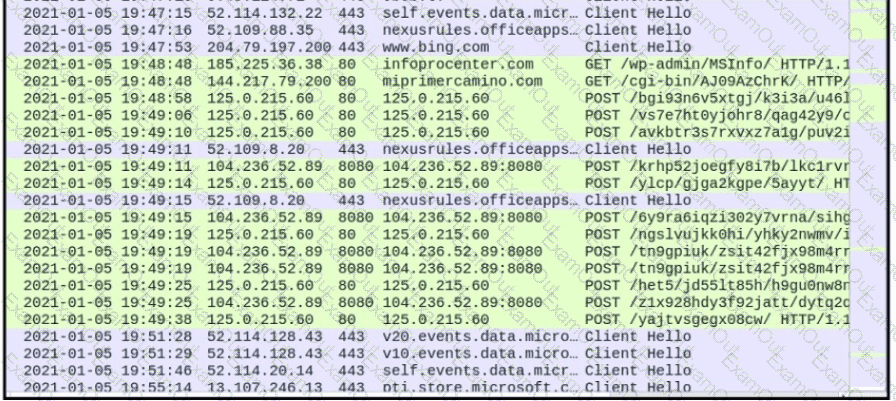
Refer to the exhibit.

What is occurring?

A.

Identifying possible malware communications and botnet activity

B.

Monitoring of encrypted and unencrypted web sessions for diagnostics.

C.

Analysis of traffic flows during network capacity testing

D.

Review of session logs for performance optimization in a distributed application environment

What is a characteristic of a temporal score in CVSS?

A.

It can change over time

B.

It depends on the environment

C.

It has a vendor fixed value

D.

It is defined by impacted users

A data privacy officer at a marketing firm has received a request from a former client to delete all personally sensitive information held by the company. The firm operates globally and follows international data protection standards. The only information retained about the client is a unique customer ID, "051473912", which is not directly tied to the name, address, or any other identifiable details. Which action should the data privacy officer take?

A.

Delete the data immediately to comply with all global privacy regulations.

B.

Retain the data, as a customer ID by itself does not qualify as PSI under international standards.

C.

Consult the legal team, as customer IDs are always considered PSI and cannot be retained.

D.

Delete the data if the customer ID is stored alongside additional information that can identify the client.

What is the difference between discretionary access control (DAC) and role-based access control (RBAC)?
A.

DAC requires explicit authorization for a given user on a given object, and RBAC requires specific conditions.

B.

RBAC access is granted when a user meets specific conditions, and in DAC, permissions are applied on user and group levels.

C.

RBAC is an extended version of DAC where you can add an extra level of authorization based on time.

D.

DAC administrators pass privileges to users and groups, and in RBAC, permissions are applied to specific groups

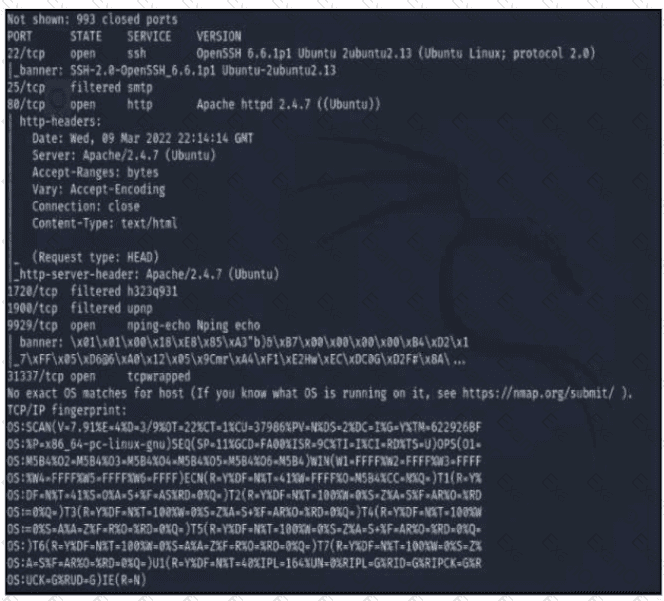
Refer to the exhibit A penetration tester runs the Nmap scan against the company server to uncover possible vulnerabilities and exploit them Which two elements can the penetration tester identity from the scan results? (Choose two.)

A.

UIDs and group identifiers

B.

number of concurrent connections the server can handle

C.

running services and applications

D.

server uptime and internal clock

E.

server purpose and functionality