An administrator has a vSphere 8 Update 1a with NSX 4.1.0.2 environment. What option can the administrator use to converge this vSphere with NSX environment into a VMware Cloud Foundation (VCF) Workload Domain?
An administrator is tasked to enable users to configure an individual VPC, but not create subnets. What three NSX roles would the administrator assign to allow access without the ability to create subnets? (Choose three.)
Which two requirements are part of the registration process for Local Manager (LM) to a Global Manager (GM) in NSX for centralized management of network and security services across different workload domains deployed in separate locations? (Choose two.)
An administrator needs to prevent the datacenter from advertising any internal prefixes toward a new VPC, while still ensuring the VPC receives a default route learned from the datacenter's upstream network. Where should the routing policy be applied?
The administrator is working to ascertain the encapsulation of GENEVE by reviewing the capture on Wireshark.
The administrator instructed VM-1 to send a continuous ICMP request directed at VM-2.
Click to highlight where the administrator should observe the GENEVE encapsulated packet.
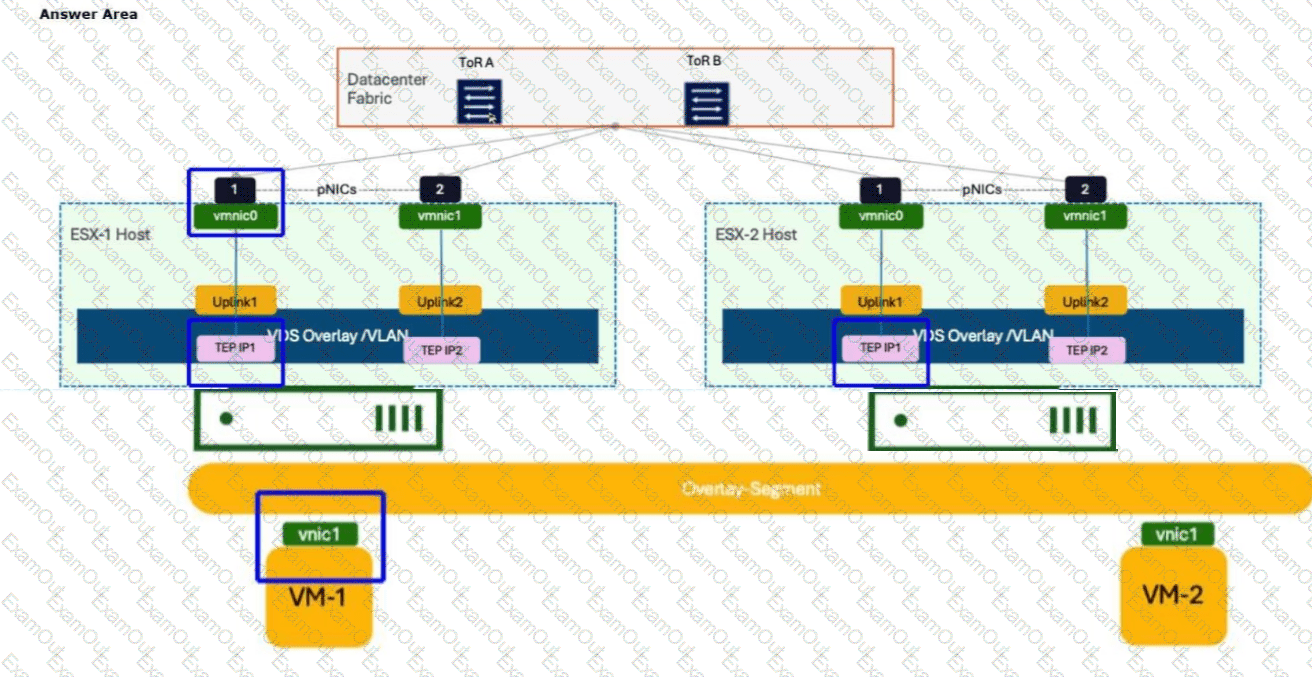
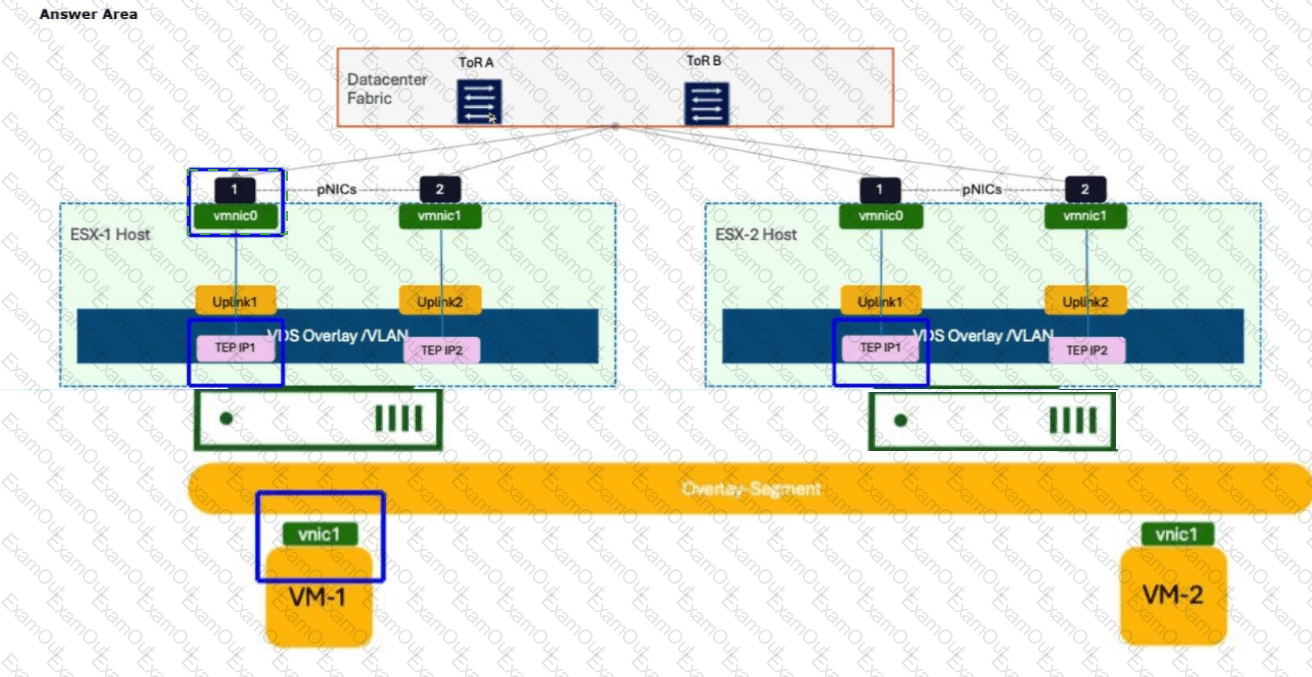
The administrator is implementing a multi-location VMware Cloud Foundation (VCF) environment. The design requires centralized security and networking policies across multiple VCF instances. What action must the administrator take to satisfy the requirements?
An administrator is enabling IPv6-to-IPv4 communication for workloads hosted in an NSX environment. The workloads use IPv6-only addressing, but the external systems they must reach are IPv4-only. To provide this translation service, the administrator decides to configure NAT64. Which two following characteristics about NAT64 are true? (Choose two.)
An administrator is troubleshooting an issue where workloads connected to a Tier-1 Gateway named T1-App can no longer reach external North/South destinations.
• The Tier-1 is connected to an Active/Standby Tier-0 Gateway named T0-Prod.
Symptoms observed:
• VMs on segments attached to T1-App can ping each other.
• VMs on T1-App cannot reach any external IP outside T0-Prod.
• From a VM on the segment, ping to the T1-App Distributed Router (DR) IP succeeds.
• Ping from the VM to the T1-App Service Router (SR) fails.
• The Edge cluster hosting the T1-App SR shows both Edge nodes Up and Healthy.
• No failover has occurred — the same Edge node is still shown as Active for T1-App.
What is the most likely cause of this issue?