Summer Sale Special - Limited Time 70% Discount Offer - Ends in 0d 00h 00m 00s - Coupon code: sntaclus

A VMware Cloud Foundation (VCF) Automation administrator is preparing to set up a new AllApps Organization.

The new Organization must access the same elements as an existing Organization:

    Storage classes

    Network settings

    Topology-aware storage policies

What two steps must be performed? (Choose two.)

A.

Export all Content Hub items and import them after creating each Organization.

B.

Utilize the exported Organization data when creating the new Organization.

C.

Import the Supervisor configuration when creating a new Supervisor and assign the new Supervisor to the new Organization.

D.

Create a new Cloud Zone with the correct storage and network mappings and assign the new Cloud Zone to the new Organization.

E.

Export the Supervisor configuration from the existing Supervisor.

F.

Export the Organization data from the Provider Portal.

What are two prerequisites to enable provisioning VMs via kubectl against tenant resources? (Choose two.)

A.

Ask the Provider to generate a token via the system APIs.

B.

Create a new extensibility Action.

C.

Generate an API token from the VCF Automation UI.

D.

Create a context via kubectl.

E.

Create a context via VCF CLI.

An Organization Administrator for an AIIApps Organization in VMware Cloud Foundation (VCF) Automation must determine which networks are used by deployed workloads.

How does the administrator view the networks?

A.

VPCs and connectivity profile assignments are visible in the Organization Portal, but the underlying NSX Tier-1 gateways and segments are not.

B.

VPCs, connectivity profiles and the associated NSX segment and Tier-1 gateway details can be retrieved with vcf-cli deployment get.

C.

The NSX Tier-1 gateway mappings for each workload in the Organization can be retrieved with kubectl get vm.

D.

The NSX segments mapped to each workload are visible by expanding deployment details for each deployed workload in the Organization Portal.

The administrator is tasked with configuring hard tenancy in VMware Cloud Foundation (VCF) Automation. Which statement reflects how multi-tenancy is configured?

A.

VMApps organizations enable hard tenancy within VCF Automation.

B.

VCF Automation 9 does not support multi-tenancy. That ' s on the roadmap for VCFA 10.

C.

Namespaces enable hard tenancy within VCF Automation.

D.

Namespace Classes enable hard tenancy construct within VCF Automation.

E.

AIIApps organizations enable hard tenancy within VCF Automation.

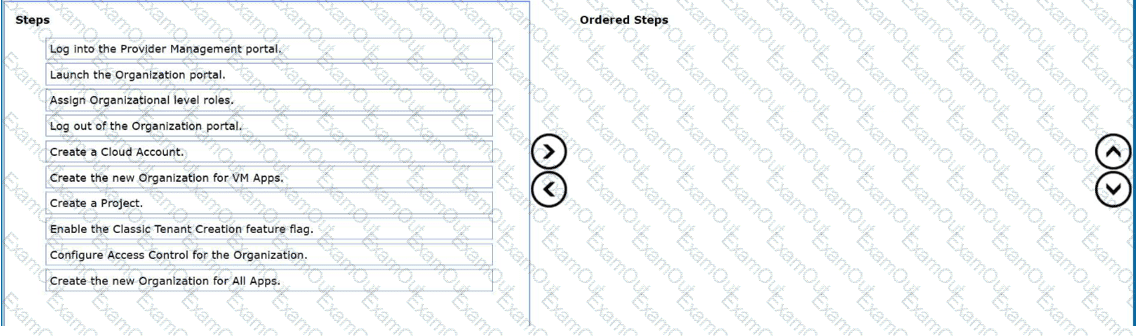
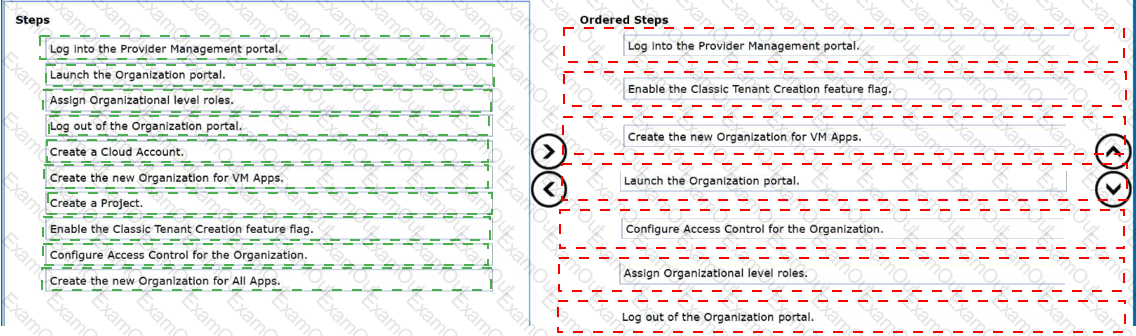
A company has deployed a new VMware Cloud Foundation (VCF) Fleet within their development environment. An administrator has been tasked with creating and configuring a

new organization for VM Apps so that other members of the team can log in using their active directory accounts and complete the tenant configuration to mirror their

production deployment.

Drag and drop the seven steps from the Steps list into the Ordered Steps list and place them in the correct order to meet the objective. (Choose seven.)
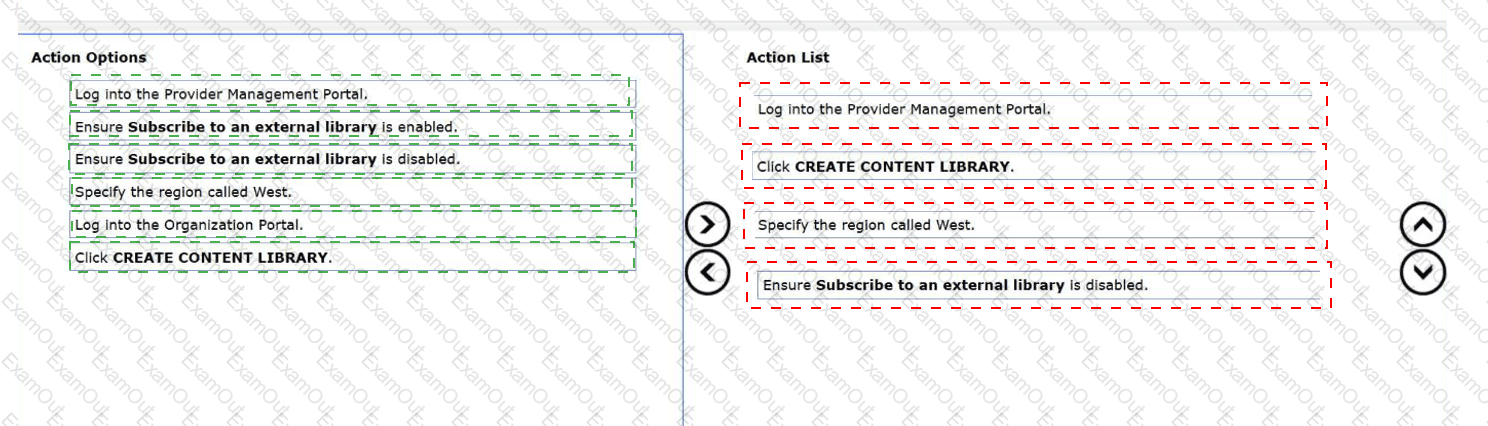
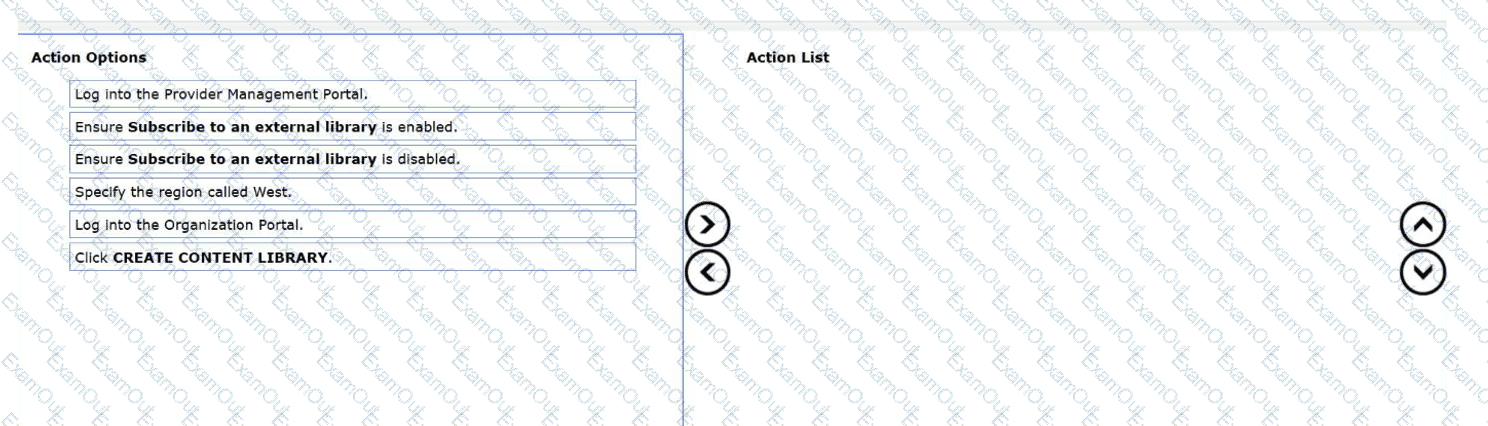
An administrator has been tasked with creating a provider content library. The following requirements must be satisfied:

    The content library must be configured as a local content library.

    The content library must be associated with the region called West.

Select the four steps involved in configuring the provider content library. (Choose four.)
The Terraform provider for VMware Cloud Foundation (VCF) Automation enables management of which two VCF Automation elements? (Choose two.)

A.

VCF Automation Pipelines

B.

VCF Operations Orchestrator

C.

Provisioning of resources with Terraform

D.

AllApps Organizations

E.

VMApps Organizations

A VMware Cloud Foundation (VCF) Automation administrator is creating a new organization for the Product Development team. The developers require self-service networking that allows them to:

• Provision workloads with virtual machines (VMs) and Kubernetes services.

• Attach these workloads to VPCs.

• Customize how ingress and egress traffic is handled.

Which configuration meets the requirement?

A.

Create an AllApps Organization and use the default VPC with VPC connectivity profiles.

B.

Create a VMApps Organization and assign multiple vSphere-backed networks for consumers to select as needed.

C.

Create an AllApps Organization and assign multiple vSphere-backed networks for consumers to select as needed.

D.

Create a VMApps Organization and use the default VPC with VPC connectivity profiles.

The product development team is rolling out several new application stacks and require a self-service option to deploy their applications quickly and consistently. The requirements are:

• Present only approved application configurations.

• No manual configuration within a blueprint.

Which VMware Cloud Foundation (VCF) Automation approach meets these requirements?

A.

Publish pre-approved blueprints to a catalog and allow the team to choose infrastructure options such as compute cluster and storage policy during deployment.

B.

Publish all available blueprints to a catalog so team members can choose what is required and adjust configurations as needed at request time.

C.

Integrate VCFA with a Git repository containing blueprint YAML files and train the team to update infrastructure parameters properly before committing changes.

D.

Publish pre-approved blueprints with all required inputs preconfigured to a catalog so team members can deploy them directly.

In VMware Cloud Foundation (VCF) Automation, which two statements identify the relationship between a storage policy and a region? (Choose two.)
A.

Regions can only use the default vSphere storage policy.

B.

Storage policies determine which datastores are available in a region.

C.

Regions automatically create storage policies based on cluster configuration.

D.

Storage policies must be replicated across all regions using the VCF Automation REST API.

E.

A storage policy can be associated with one or more regions.