
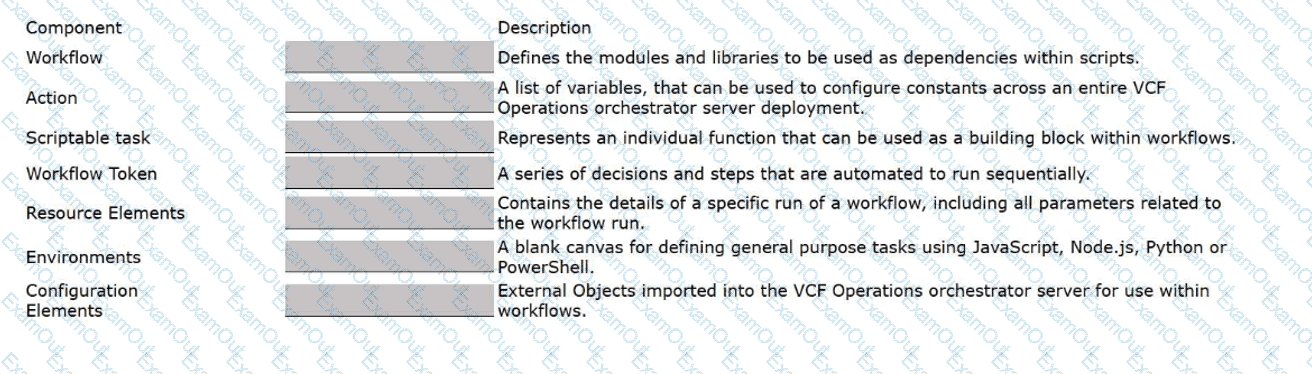
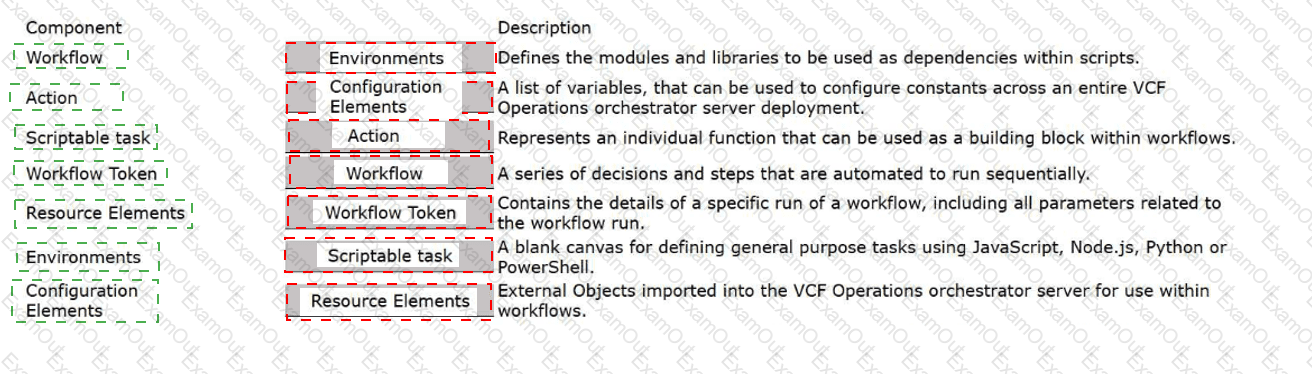
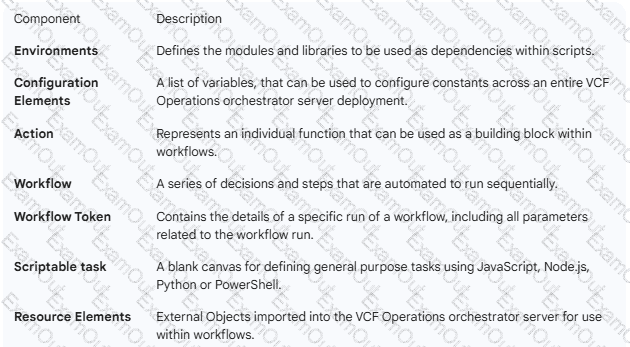
Match the VMware Cloud Foundation (VCF) Operations orchestrator component with its description by dragging and dropping the correct item from the Component list on the left and place them onto the Description list on the right.
An administrator is responsible for managing a VMware Cloud Foundation (VCF) fleet and the administrator has been tasked with the following:
• Create DNS records before each virtual machine (VM) is deployed using VCF Automation.
The administrator has already completed the following tasks:
• Created two VCF Operations Orchestrator Workflows with corresponding Event Subscriptions:
Create DNS Record
Delete DNS Record
• Created a new blueprint to deploy a VM:
Added two string inputs, hostname and domainName
Added hostname: ' ${input.hostname} ' as a custom property of the Virtual Machine resource.
Added domainName: ' ${input.domainName} ' as a custom property of the Virtual Machine resource.
What should the administrator configure within the Event subscription to ensure that the DNS record is only created when the hostname is provided?
An administrator has been tasked with creating one organization with the following characteristics:
Connect directly to one or more vSphere clusters.
Do not use the Supervisor.
No sharing of infrastructure resources with other organizations.
How can the administrator meet these requirements through the Provider Management Portal?
Which service can be used to reduce or eliminate the need to manually run commands such as kubectl apply?
An administrator has been tasked with creating a region to provide resources to an Organization in VMware Cloud Foundation (VCF) Automation.
The following information has been provided to the administrator for this task:
• Two workload domains are configured and will integrate with the region.
• All workload domains are configured to share a VMware NSX Manager.
• All workload domains are configured with VMware vSAN storage.
• All workload domain VMware vCenter instances have a Supervisor enabled.
Before creating the region, what two additional configurations should the administrator validate? (Choose two.)
Which VCF component is responsible for the automated lifecycle management (patching and upgrading) of the VCF Automation and VCF Operations appliances?
In VMware Cloud Foundation (VCF) Automation, which construct within an AIIApps organization consists of one or more Supervisors and supplies compute, memory, storage, and network resources to the organization?
An Organization Administrator notices that their public assigned IPs are being used for non-production workloads.
What should the administrator do to prevent further public IP addresses consumption?
An administrator is tasked with configuring a multi-tenant environment within the organization ' s VMware Cloud Foundation (VCF) deployment. Requirements are:
• isolated network spaces for development and testing.
• dedicated resources.
• role-based access control.
Which of the actions satisfies the requirement?
An administrator needs to configure a connection between VMware Cloud Foundation (VCF) Automation and an external system to enable the exchange of data for extensibility purposes.
Which two integration types are supported for this purpose? (Choose two.)
