
Ticking Clock Black Friday Special: 75% Off! Apply coupon code below to save on all exam bundles! - Ends in 0d 00h 00m 00s - Coupon code: estly75

A Mule application deployed to multiple CloudHub 2.0 replicas needs to temporarily persist large files over 10MB between flow executions, and routinely needs to query whether the file data exists on separate executions.

How can this be achieved?

A.

Store the contents of the file on separate storage, and store the key and location of the file using Object Store v2

B.

Use an in-memory Object Store

C.

Store the key and full contents of the file in an Object Store

D.

Use the file connector to store and read the file, caching the filename and location between requests

Which pattern should be used to invoke multiple HTTP APIs in parallel and roll back any failed requests in sequence?

A.

Scatter-Gather as central Saga orchestrator for all API requests with compensating actions for failing routes

B.

A Parallel For Each scope with each HTTP request wrapped in a Try scope

C.

VM queues as a reliability pattern with error handlers to roll back any requests

D.

A database as a transactional outbox and an Until Successful router to retry any requests

Mule application A is deployed to CloudHub and is using Object Store v2. Mule application B is also deployed to CloudHub.

Which approach can Mule application B use to remove values from Mule application A's Object Store?

A.

CloudHub REST API

B.

CloudHub Connector

C.

Object Store v2 REST API

D.

Object Store Connector

A healthcare customer wants to use hospital system data, which includes code that was developed using legacy tools and methods. The customer has created reusable Java libraries in order to read the data from the system.

What is the most effective way to develop an API to retrieve the data from the hospital system?

A.

Install the libraries in a local repository and refer to it in the pom.xml file

B.

Refer to JAR files in the code

C.

Include the libraries while deploying the code into the runtime

D.

Create the Java code in your project and invoke the data from the code

When implementing a synchronous API where the event source is an HTTP Listener, a developer needs to return the same correlation ID back to the caller in the HTTP response header.

How can this be achieved?

A.

Configure a custom correlation policy

B.

Enable the CorrelationID checkbox in the HTTP Listener configuration

C.

Enable the auto-generate CorrelationID option when scaffolding the flow

D.

No action is needed as the correlation ID is returned to the caller in the response header by default

Which pattern can a web API use to notify its client of state changes as soon as they occur?

A.

ETL data load

B.

Schedule Event Publisher

C.

HTTP Webhook

D.

Shared database trigger

Refer to the exhibit.

A developer generates the base scaffolding for an API in Anypoint Studio.

Which HTTP status code is returned while testing using the API Kit console if no values are entered in client-id and client-secret?

Exhibit:
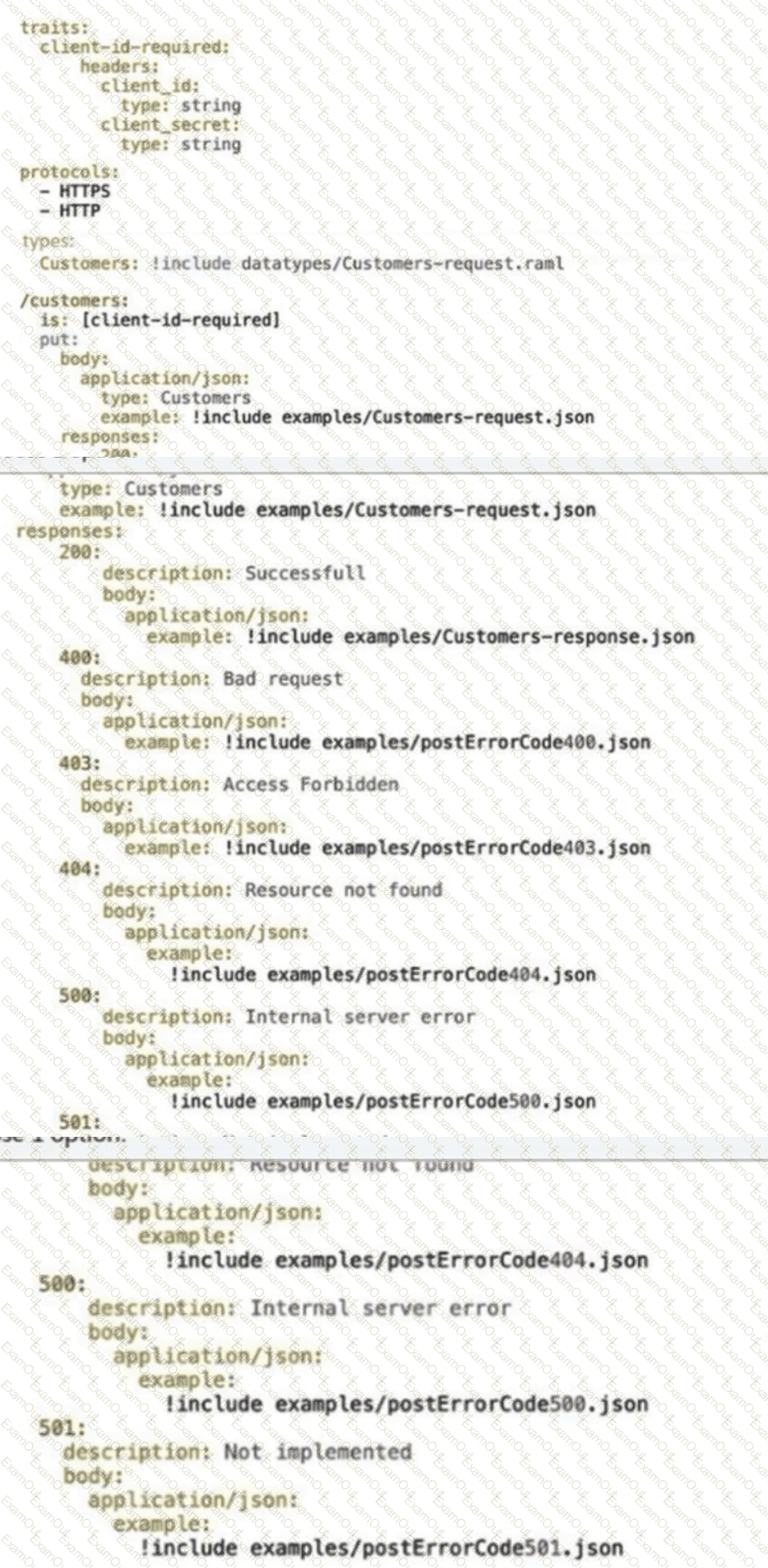
question 7

A.

HTTP status code: 403

B.

HTTP status code: 500

C.

HTTP status code: 400

D.

HTTP status code: 200

Refer to the exhibits.

The flow name is "implementation" with code for the MUnit test case.

When the MUnit test case is executed, what is the expected result?

Exhibit:
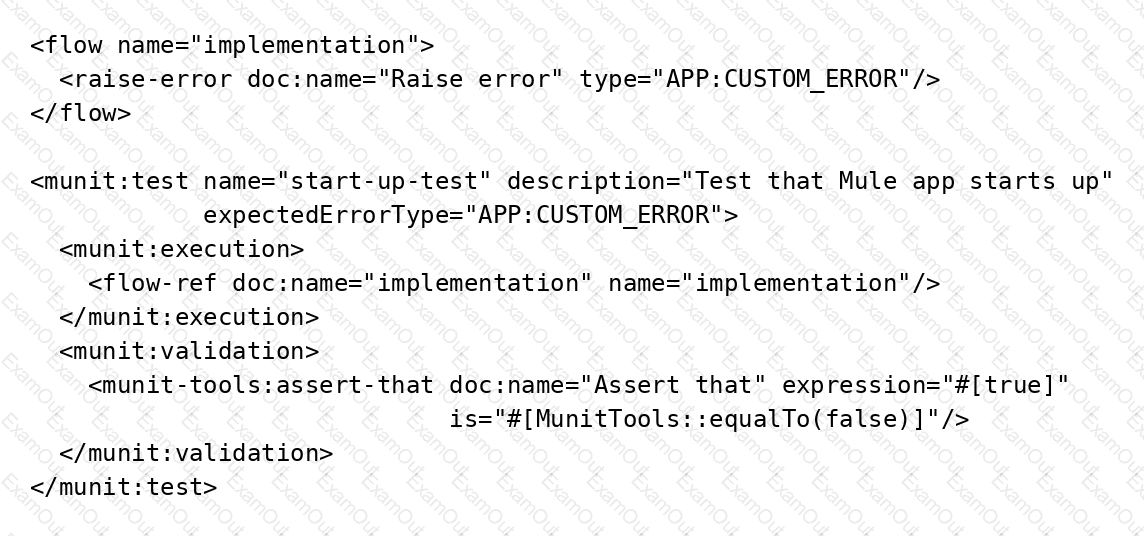
question 8

A.

The test case fails with an assertion error

B.

The test case fails with an unexpected error type

C.

The test case passes

D.

The test case throws an error and does not start

An API has been developed and deployed to CloudHub. Among the policies applied to this API is an allowlist of IP addresses. A developer wants to run a test in Anypoint Studio and does not want any policies applied because their workstation is not included in the allowlist.

What must the developer do in order to run this test locally without the policies applied?

A.

Pass in the runtime parameter "-Danypoint.platform.gatekeeper=disabled"

B.

Deactivate the API in API Manager so the Autodiscovery element will not find the application when it runs in Studio

C.

Run the test as-is, with no changes, because the Studio runtime will not attempt to connect to API Manager

D.

Create a properties file specifically for local development and set the API instance ID to a value that is not used in API Manager

A Mule implementation uses an HTTP Request within an Until Successful scope to connect to an API.

How should a permanent error response like HTTP:UNAUTHORIZED be handled inside Until Successful to reduce latency?

A.

In Until Successful configuration, set the retry count to 1 for error type HTTP:UNAUTHORIZED.

B.

Continue retrying until a MULE:RETRY_EXHAUSTED error is raised or the API responds back with a successful response.

C.

Put the HTTP Request inside a try scope in Until Successful. In the error handler, use On Error Propagate to catch permanent errors like HTTP:UNAUTHORIZED.

D.

Put the HTTP Request inside a try scope in Until Successful. In the error handler, use On Error Continue to catch permanent errors like HTTP:UNAUTHORIZED.