A project manager is assigned to a project in which the business and the technology to be used are well-known. What should the project manager do to learn about
the customer ' s needs, the complexity, and the resulting impact of the project?
A project lead is working on a large-scale, high-profile hardware development project for a new smartphone. The project sponsor has requested that a major priority feature almost fully
developed be considered optional. At the same time, a new priority feature that has never been discussed is being added.
Which two actions should the project lead take? (Choose 2)
During the execution phase of a project, a new regulation is published. A subject matter expert (SME) on the project team contacts the project manager and tells them
that the new regulation might heavily impact the project ' s delivery.
What should the project manager do?
Amigration deployment is scheduled in 2 weeks, and a stakeholder is requesting a code change. The code change requires two developers, and testing the code will
require two quality engineers. Further, the change will push the planned deployment date back by 1 week and delay the start of the next migration.
What action should the project manager take?
A project manager is leading an important development project. A key deliverable has been completed but does not meet the quality standards defined in the quality management plan.
What should the project manager do?
Solution Development Case Study
A project manager was assigned to a project to deliver a corporate IT security solution within a 12-month timeline and a budget of $2.5 million USD. To help ensure project success, the project manager established a governance framework featuring a steering committee of senior executives from relevant functional areas. The project manager conducted a detailed stakeholder analysis using a power/interest grid to prioritize engagement strategies and developed a quality management plan incorporating quality metrics, control charts, and acceptance criteria for each deliverable.
Project work required specialized security testing tools, so the project manager collaborated with the procurement team to develop vendor selection criteria and contract terms. The team used an agile approach to develop software coupled with a predictive approach to manage other aspects of the project. The project manager implemented a configuration management system to track changes and maintain version control of project information.
During execution, the project manager coordinated between various teams, including software development, cybersecurity, quality assurance, compliance, and customer experience, each with its own methodologies and tools. To address integration challenges, the project manager developed a comprehensive project management plan, with a detailed work breakdown structure (WBS), a master schedule using the critical path method, and earned value management (EVM). The team helped the project manager create and tailor a risk management plan focusing on integration points between teams, along with a communications matrix to ensure consistent cross-functional meetings with stakeholders.
During the project, challenges such as resource conflicts, scope creep, and technical integration issues arose. The project manager addressed these challenges using a resource optimization plan, a formal change control process, and technical working groups.
The project was delivered within budget and was concluded 2 months later than the original baseline due to an approved change. Stakeholders accepted the delay due to additional security features added during execution. The final product met all quality metrics and received positive feedback from beta customers. The project provided valuable lessons on early stakeholder alignment, integrated change control, cross-functional communication, and regular risk reassessment, which informed good practices for future projects within the organization.
What should the project manager do to facilitate and improve communications between the multiple teams within this project?
(Refer to the Solution Development Case Study exhibit.)
A project to upgrade high-voltage transmission lines, towers, and substations in a remote mountainous area is 50% complete at the end of April.
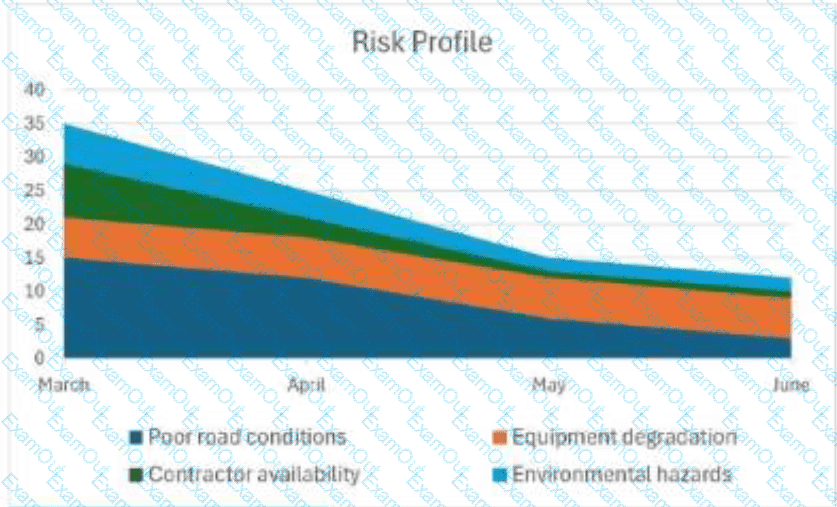
The risk manager has implemented risk responses and is projecting the probability and impact for the remainder of the project. At a monthly risk meeting, the risk manager presents the chart shown above.
What two conclusions can be determined from this chart? (Choose 2)
At the beginning of a project, a project manager forms development teams comprised of internal and external team members. Some of these team members possess
diverse experience and seniority, The project manager knows that the project work will include challenging tasks and require expert skills.
What should the project manager do?
Acustomer has agreed in a contract that interactive displays will be delivered to 14 locations by the end of the year. The contract also states that only software
approved by the customer will be installed on these displays. The customer has not approved this new software because they lack the resources to test and approve
it.
What should the project manager do?
A geographically dispersed team updates the project status report during a weekly virtual meeting. Which two changes should the project manager implement after reviewing the latest update? (Refer to the Status Report exhibit and choose 2.)