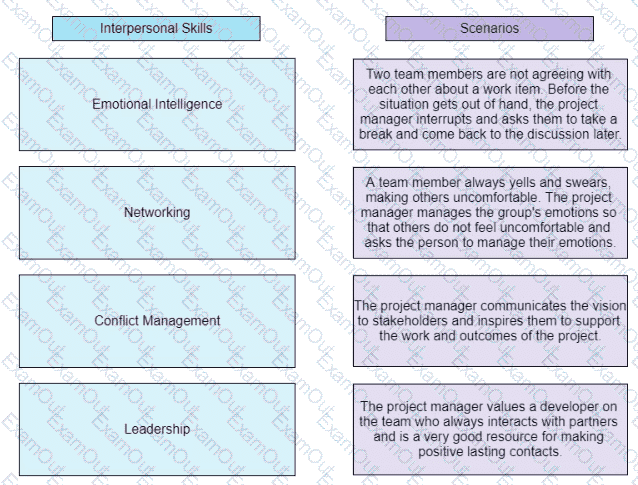
Spring Sale Special - Limited Time 70% Discount Offer - Ends in 0d 00h 00m 00s - Coupon code: sntaclus

A project manager is leading a long-term project, executed in stages, to set up a complex communications network in many rural areas. The project is being executed in stages.

What should the project manager do to ensure that monetized business value is generated as planned?

A.

Compare the estimate to complete (ETC) benefits against the project business plan

B.

Compare the benefits of the throughput analysis against the project business plan

C.

Evaluate the net promoter score (NPS) benefits against the project business plan

D.

Evaluate the generated benefits at project milestones against the project business plan

A project manager analyzes the cumulative flow chart and identifies a bottleneck in the testing activities from a self-organizing team. After discussing it with the team, a gap related to testing skills is identified.

What should the project manager do to address the issue?

A.

Onboard a new project team member who has testing skills.

B.

Provide training to the entire team so they all will be able to perform tests.

C.

Support the team to identify an approach to resolve the problem.

D.

Ask the development team to slow down so the testers can catch up.

A subject matter expert (SME) external to the project team provides a suggestion that will save the project delivery time. This SME has available

time to support the project, but was not planned to be involved in the current agile iteration.

What should the project manager do?

A.

Bring the SME on board immediately and discuss the implications later.

B.

Ask the existing team members to collaborate with the SME and complete the activity.

C.

Ask the SME to complete all of the necessary changes, which will save time.

D.

Direct the team member to ignore the SME's changes as they were not planned.

A vendor project manager and team are implementing a software solution across the organization. A customer stakeholder who was not present during the sales process is demanding that the team implement requirements that are out of scope without adding additional cost to the project.

What should the project manager do next?

A.

Escalate the issue of the additional requirements to the executive leadership team.

B.

Refer the stakeholder to the delivery specifications in the statement of work (SOW).

C.

Implement all the requirements the customer has requested.

D.

Adjust the scope baseline and schedule baseline accordingly.

A project manager is looking for ways to keep the budget on track throughout the project life cycle.

What should the project manager do to ensure that happens?

A.

Evaluate and test all budget variances.

B.

Baseline the project budget and schedule.

C.

Prioritize high-cost tasks and monitor them.

D.

Use metrics to track the cost performance.

A customer initiated a minor scope change and expects this to be completed without delays or additional costs. The project manager believes that they have adequate

authorization to make the decision themselves but is not quite sure.

What should the project manager do next?

A.

Use the project contingency and implement the change without charging the customer, since the customer's satisfaction is top priority.

B.

Exploit this change opportunity and calculate the cost, risk, and time, then add a reasonable margin and submit to the customer.

C.

Use the Perform Integrated Change Control process and submit this to the change control board (CCB) for approval.

D.

Keep the change pending and decide to take this up as part of final settlement at the end of the project.

A team is focusing on quickly developing and shipping new product features due to very aggressive market demands. The team is setting aside long-term work not directly related to the current business objective, which affects product performance and generates more customer support requests.

How can the team minimize the impact of the reduced focus on quality?

A.

Adapt the management plan to reduce the quality constraints.

B.

Reduce complexity to focus on the minimum viable product (MVP).

C.

Consider implementing test-driven methodology.

D.

Work on the technical debt at a later stage in the project.

During project initiation meetings, the project manager of a 9-month project states that a specific task would be out of schedule. At the project

kick-off meeting, a key project stakeholder strongly objects, stating that this task is the key value of the project and should be completed on time.

What should the project manager do to reduce the chances of having a strong rejection from stakeholders during the project initiation stage?

A.

Develop a stakeholder-by-stakeholder engagement assessment matrix.

B.

Send a letter to the stakeholders to inform them about the project scope and start date.

C.

Schedule meetings with key stakeholders in advance to gather feedback on the project scope.

D.

Identify stakeholder rejection as a risk in the project risk register.

A project had scheduling delays, which necessitated the team to work overtime to meet critical milestones. This led to some misunderstandings

among team members. The project sponsor has allocated a monetary award.

How should the project manager utilize the award?

A.

Meet with the team members and ask them how to spend the reward.

B.

Arrange a luncheon for all team members and include team-building sessions.

C.

Draft a points system to allocate a portion of the money for each resource.

D.

Allocate the reward to the team leaders to spend on the team as they see fit.

A project manager is leading an innovation project that is facing a lot of risks due to a high level of uncertainty. What strategy should the project

manager use to manage these risks using an agile approach?

A.

Develop an agile risk matrix to track, assess, and evaluate the uncertainty of the project.

B.

Implement a scrum risk retrospective to analyze the risks at the end of the project.

C.

Assign an agile risk manager to better understand and track the project risks.

D.

Evaluate the risks constantly and reprioritize work as the project progresses.

A project team member just informed the project manager that the license for the software that the team uses to perform calculations has just expired. As a result, the team cannot continue with their project tasks.

What should the project manager do first?

A.

Issue a formal complaint to the project sponsor claiming a lack of proper tools.

B.

Meet with the IT team to evaluate how fast the software license can be renewed.

C.

Ask the team to fast-track the project and perform tasks that do not require calculations.

D.

Ask the team members to find an alternative way to perform calculations.

A key project team member is out on sick leave in the middle of a critical project iteration. The project sponsor learns that any delay with the end-of-iteration release will displease the business stakeholders. Although all team members are cross-functional, they are also working close to full capacity.

What should the project manager do to address this situation?

A.

Discuss the issues with the sponsor to fully convey the problem of the unavailable resource and the amount of work being done. shared.

B.

Discuss this with the sponsor and hold a meeting with the stakeholders so all of the team challenges can be shared.

C.

Discuss this with the team so they can complete the work of the unavailable team member and aim for the release deadline.

D.

Discuss this with the team so they are able to reprioritize critical tasks and aim for the release deadline.

A project team has been working together for about 2 years. One of the team members has consistently shown high performance and stood out among their peers during the execution of the project.

How should the project manager recognize high performance?

A.

Thank the team member privately to avoid conflict among the team members.

B.

Acknowledge the high-performing team member in the next team meeting.

C.

Choose a reward for the team member that aligns with their personal goals.

D.

Ask the sponsor to approve a bonus for the high-performing team member.

A project manager is leading a technically complex project. The project is part of a strategic program of work and the first to use an agile approach. One of the board members is interested in attending a meeting to see how the delivery of the project scope is progressing.

What should the project lead do?

A.

Invite the board member to the next daily standup.

B.

Invite the board member to the next sprint retrospective.

C.

Invite the board member to a separate demo.

D.

Invite the board member to the next sprint review.

During a final investment decision meeting, all of the stakeholders were aligned on the project benefits, proposed budget, and schedule. Before final approval was given, the executive requested an aspirational target for the project team to obtain an enhanced benefit from the project.

What should the project manager do in this situation?

A.

Accept the request and commit to some benefit improvement opportunities for the project.

B.

Investigate the request and express willingness to find ways to obtain higher project benefits.

C.

Review the proposal and suggest optional benefit improvement opportunities for the project.

D.

Explain the planning and budgeting process and demonstrate that the project proposal maximizes benefits.

A project team has installed software for the client, passed the knowledge to operations, sent the final report, and celebrated. Then 1 week later,

the client sendsa list of requirements that have not been met. The client is requesting to fix the issues quickly and within the initial budget.

What should the project manager have done to prevent this from happening?

A.

Reviewed the acceptance criteria and obtained client approval.

B.

Allocated a risk budget for any post-release improvements.

C.

Conducted a pilot to understand the client's performance parameters.

D.

Established meetings with the client throughout the project phases.

A project manager is reviewing a draft of the project charter with key stakeholders. During the meeting, a conflict occurs between the sponsor and the product owner.

How should the project manager deal with the situation?

A.

Postpone the meeting and invite a subject matter expert (SME) to join the next meeting.

B.

Continue the meeting and ask the project sponsor and product owner to take their discussion offline.

C.

Postpone the meeting and ask the project sponsor and product owner to take their discussion offline.

D.

Continue the meeting and use facilitation techniques to improve communication within the team.

A project manager is working on a software development project for an oil and gas client using an agile approach. The project manager is having difficulty preparing the schedule because the project has various unknowns.

Which scheduling method should the project manager use to develop the schedule?

A.

Iterative scheduling

B.

Three-point scheduling

C.

Parametric scheduling

D.

Analogous scheduling

During a regular project progress meeting, the CEO informed the project manager that a major stakeholder has been unaware of recent developments on the project. The

project manager is sure that the stakeholder was duly identified and classified in the stakeholder register.

Which project document should the project manager review in order to determine the reason for this issue?

A.

Requirements traceability matrix

B.

Stakeholder register

C.

Stakeholder engagement assessment matrix

D.

Issue log

A project manager in a matrix organization has been assigned to a system solution project with tight time lines. There are two resources assigned as part of the solution

team: one who is experienced and one who is new. During development, the project manager notices that the resources disagree on the solution approach.

What should the project manager do next to deliver a reliable solution?

A.

Meet with the resources and agree that the more experienced resource's approach has proven to be effective in the past.

B.

Meet with each resource's functional manager and arrive at a common approach that is appropriate for the project's constraints.

C.

Meet with the entire project team and decide on a further course of action based on team consensus.

D.

Meet with the resources together and find common ground on viewpoints to compromise on an approach.

An organization with a new project management office (PMO) team is now undergoing a restructuring. Additionally, there is a lack of communication from the PMO to the team members.

How should the project manager handle this situation?

A.

Meet the PMO team and explain the importance of communicating with the team members for project success.

B.

Request the PMO team share updates on the restructuring with the team members on an immediate basis.

C.

Set up a meeting with the PMO and project team to discuss and clarify questions related to restructuring.

D.

Inform the team that despite the new PMO and restructuring, the team will not change.

While finalizing project management plans, a customer provides the project manager with a new set of quality standards to which the final product must adhere. What

should the project manager do to ensure a smooth delivery of the product?

A.

Involve the client in risk identification.

B.

Agree with the client on acceptance criteria.

C.

Involve the client in a performance gap analysis.

D.

Agree with the client on a new project charter.

A customer has provided excellent feedback on the project. However, a key project resource is leaving the company.

Which measure should mitigate the impact of this key resource's departure?

A.

Offer a new contract to the resource who is leaving.

B.

Establish a proactive knowledge-sharing plan.

C.

Update the risk register and inform the customer.

D.

Develop a contingency budget to replace the key resource.

A production team will soon begin their first agile project. No one in the team or management has agile knowledge. The training manager can only fund three enrollments.

Match the team role on the left to the correct training course on the right. (Use all three of the team roles.)

An organization embarking on a significant transformation initiated a project to improve and document business processes. One of the objectives of the project is to implement agile project delivery.

What is the main reason for adopting agile?

A.

Projects will be completed faster, saving time and money.

B.

Projects will deliver early and use value based on priority.

C.

Projects will be delivered with very low risk to the organization.

D.

Projects will be delivered with significant cost savings.

A company routinely outsources resources for specific core activities. Due to a sudden, unforeseen risk, all of the team members are needed to work remotely, including the outsourced ones.

How can the project manager address this challenge to assure outsourced vendors deliver?

A.

Review the coordination and communication costs with the supplier.

B.

Develop a new strategy for communication and management of resources.

C.

Review the risk management plan for the mitigation activities.

D.

Submit a change request to increase the contingency budget.

A team is preparing the closing phase and building a plan for the next phase. One of the project sponsors is complaining that the last phase had some quality deliverable issues. However, the quality acceptance document was signed.

What should the project manager do?

A.

Reopen the quality acceptance documentation to add the sponsor's complaints.

B.

Schedule a quality review meeting and include the sponsor's complaints.

C.

Review best practices and lessons learned and apply them to the project plan.

D.

Postpone the next project phase until the impact of the quality issues is assessed.

A government procurement team has been running a vendor selection process for more than 1 year, going beyond the originally planned 6 months due to a variety of factors. Two vendors have submitted proposals that were evaluated. The project manager asked for an estimated completion date 4 weeks ago, but it was not provided.

What should the project manager do?

A.

Work with the procurement team to build a high-level timeline.

B.

Explain to the steering committee that vendor negotiations are unpredictable.

C.

Ask the project sponsor to request an estimate from the procurement team.

D.

Escalate the delay issue to the project steering committee.

A project manager is working on an agile project that is within the scope of a recently announced corporate audit. The project manager was

appointed to attend the first meeting with the auditors scheduled for the following week.

What should the project manager do to prepare for the audit?

A.

Reserve story points for the next iteration if needed.

B.

Review the project information.

C.

Ask the development team to provide compliance information.

D.

Ask for a waiver during the audit.

A project manager is assigned to a yearlong project. Before the start of the design phase, a competitor announces that they will release a similar deliverable in 8 months, although with fewer features and functionality.

Which two actions should the project manager take next? (Choose 2)

A.

Modify the project management plan with an incremental approach.

B.

Evaluate the impact of incremental deliverables.

C.

Reduce the scope items of the final deliverable.

D.

Discuss and review this external risk with the project sponsor.

E.

Update the project artifacts to include this issue.

A company's key product is evolving and requires the use of a new technology. No one on the team is familiar with this technology; however, experienced developers on the team volunteered to study the concepts and application and believe they will be able to take full responsibility for the new technology.

What should the project manager do?

A.

Descope this requirement as the developers have more important tasks.

B.

Support the developers with their intention to learn the new technology.

C.

Hire externally since the internal developers already have assigned work.

D.

Outsource the technology work to a third party so as not to delay work.

A project manager is assigned to a new project. The project is for a new product that the company wants to launch as soon as possible to test market readiness. The project is part of a large business transformation, and the objective is to open delivery channels for the new product.

Which delivery approach should the project manager recommend?

A.

An adaptive approach with clearly defined user stories.

B.

A predictive approach with an experienced project team.

C.

A predictive approach with clear acceptance criteria.

D.

An adaptive approach with loosely defined large epics.

Project team member A has a conflict with project team member B. The project manager believes project team member A's behavior is unacceptable. However, project team member A believes their behavior is appropriate.

What should the project manager do?

A.

Review the resource requirements to determine if the project team member is a good fit.

B.

Add an agenda item to the next team meeting to manage the conflict.

C.

Ask the project team member to review the team charter and follow up with a one-on-one meeting.

D.

Review the roles and responsibilities of each team member with the team.

A project manager is scheduled to meet with a client for their weekly risk management meeting. The project manager observed that one of the tasks which had external dependencies is delayed by one week. The project manager knows this will have an impact but does not know the exact details.

What two things should the project manager do? (Choose two)

A.

Discuss the issue with the external supplier's authority.

B.

Review the lessons learned from similar past projects.

C.

Gather additional information and estimate the impact.

D.

Update the risk log and bring this up in the meeting with the client.

E.

Wait for the client to raise a concern and collect more information.

Companies A and B are codeveloping a cutting-edge technology product. Based on customer feedback, the marketing department urgently requests a new feature in 2 weeks. Company A's front end is ready, but company B requires 4 weeks to deliver the complete back end and is busy with the current release.

What should the project manager do to obtain agreement from both companies and acceptance from marketing?

A.

Create a special release 4 weeks after the current release to deliver the new feature in its entirety.

B.

Stop the current release work for 4 weeks in order to work and deliver the new feature completely.

C.

Plan the delivery of a minimum viable feature in 2 weeks to enable early showcasing of business value.

D.

Add the new feature to the list for the next release and continue working on the current release.

A project manager is assigned to a regulatory project for their country. The deadline for delivering results in compliance with the new laws is very tight, and the project team members have not yet been assigned. One of the project manager's peers informs the project manager that a project with the same scope for a different country was completed 1 year ago.

What should the project manager do first?

A.

Register a new risk in the risk management plan.

B.

Ask for additional resources and review the project estimate.

C.

Review organizational process assets (OPAs) and perform analogous estimating.

D.

Complete a bottom-up estimation for the project activities.

An agile project for a database migration impacts nearly all business units of the corporation. Every effort has been made to complete the migration before the end-of-support date for the database platform. A new impediment now implies the need to continue use of the old platform another year at a higher support price.

What should the product owner do about this situation?

A.

Reprioritize the backlog based on value and cost of delay divided by duration.

B.

Switch to a predictive approach to prevent any further delays to completion.

C.

Reprioritize the backlog based on story size and competence availability.

D.

Remove low-value items from the backlog to compensate for the higher cost.

A business transformation project has a four-phase delivery plan. The project team has successfully delivered one phase of the project.

To further enhance team performance and empower team members, which two actions should the project manager take? (Choose two)

A.

Encourage team members to cross-check decisions with the project manager.

B.

Vet all of the decisions before execution.

C.

Allow team members to make limited decisions.

D.

Organize and assign team members to tasks where they have strengths.

E.

Support team members to make decisions in their areas of strength.

A project stakeholder complained that they did not receive an important delivery that was stated in the schedule. The team member responsible for this deliverable explained that they sent an email to the stakeholder, advising them that the deliverable would not be delivered on time.

What should the project manager have done to avoid this situation?

A.

Ensured that the team member did not communicate directly with the project stakeholder.

B.

Confirmed that the stakeholder was made aware of the delivery delay.

C.

Told the team member to send the unfinished deliverable to the stakeholder and finalize it later.

D.

Communicated with the stakeholder directly regarding the delivery delay.

A project manager is newly appointed to lead a project team that will be working remotely. The project manager decided to use a set of tools that

worked well for previous projects. However, a few team members are not happy with this plan.

What should the project manager have done to avoid this?

A.

Delegated the responsibility of selecting the collaboration tools to the project's technical lead.

B.

Met with the project team to determine their collaboration needs and identified tools that will work best.

C.

Allowed the project team members to use the tools that will work best for them for this project.

D.

Asked the project sponsor for approval to purchase the newest collaboration tool on the market.

A highly critical project is in jeopardy due to missing professional resources. What should the newly assigned project manager do first?

A.

Find available professionals within the organization to fill the gaps.

B.

Allocate funding for seeking external professionals to fill the gaps.

C.

Determine the possibility for team members to split up the required tasks.

D.

Request additional budget for team training for the missing expertise.

A project manager is leading a project team that consists of five team members. One of the team members, a senior technical staff member, always criticizes the ideas of other members during team meetings. However, this senior technical member is not performing well on their own daily tasks. Other team members are frustrated and have become silent in meetings.

What should the project manager do?

A.

Reduce the team meeting frequency and seek input separately from team members.

B.

Ask human resources (HR) to reassign the senior technical staff member.

C.

Encourage other team members to provide one another with their valuable ideas.

D.

Provide feedback to bring the team members' focus back to the performance of their daily tasks.

A team is finishing the third release to present to the stakeholder as part of a demonstration. The company that subcontracts the developers has communicated that there is a cash flow problem and the company will not be able to provide the same resources for the next iterations.

What should the project manager do next?

A.

Create a risk register to track the risks and request additional budget.

B.

Analyze the impact against the release plan if the blocker is not addressed.

C.

Work with the project owner to prioritize the product backlog.

D.

Escalate the situation to the project sponsor for a possible resolution.

In a geographically distributed team, a developer continues to delay a coding activity. This activity is on the critical path. The project manager

found out that the delay is due to the developer's lack of understanding of the customer requirements shared by the off-site team.

What should the project manager do?

A.

Replace the developer with a skilled resource.

B.

Perform a root cause analysis (RCA) with the team members.

C.

Facilitate communication to ensure clarification of the requirements.

D.

Conduct frequent performance reviews.

A project team is planning the next sprint review. The project lead receives an email from a senior manager asking for a project status using a template that is more detailed than the one used for monthly reports sent to the project management office (PMO). The team uses an electronic product backlog and a kanban board to track the progress.

What should the project manager do next?

A.

Modify the PMO template to include the information.

B.

Contact the senior manager and discuss their needs.

C.

Give the senior manager access to the product backlog.

D.

Organize a review of the kanban board with the manager.

A project manager has been assigned to a project after the charter has been approved. While reviewing the charter with the team, the project manager finds that some major budget items, necessary for achieving the project outcome, have been missed.

What should the project manager do next?

A.

Reduce the quality and cost of other deliverables to allow additional budget for the items that were missed.

B.

Start the project and deal with these budget issues as they arise throughout the project life cycle.

C.

Add the missing budget items to the risk log and present them in the next project steering committee.

D.

Immediately discuss this with the project sponsor and request to revisit the budget to ensure its accuracy.

A project manager is implementing a new software system Some department staff members are questioning the necessity of the change and feel the new system will impede their current processes

What should the project manager have done at the start of the project to prevent this resistance?

A.

Created a communications management plan that outlined the method of communicating to stakeholders.

B.

Ensured that the company culture encourages changes before accepting the project

C.

Encouraged leadership to discuss the change with departments that are typically resistant to change

D.

Involved stakeholders from all levels of the company so everyone understands the change

An unforeseen event has shut down public works projects for 4 weeks. Activities on the critical path will fall behind based on the project schedule.

What should the project manager do?

A.

Add 4 additional weeks to the schedule and request additional resources.

B.

Ask the sponsor to obtain a special work permit to continue work.

C.

Review the project management plan to see the impact of the possible delay.

D.

Crash the resource management plan to keep the schedule on track.

A project team is transitioning to agile. During the sprint retrospective, a new member of the team proposed a more structured approach for capturing requirements that would improve clarity and reduce rework. Although the team members are happy to use it, changing the way business requirements are described requires agreement from an influential business manager.

What should the project manager do?

A.

Contact the business manager and discuss the benefits of the new approach.

B.

Contact the project management office (PMO) and ask them to endorse the new approach.

C.

Ask the team member to wait until the business is ready for the new approach.

D.

Ask the team to describe the requirements using the more structured approach.

A project interfaces with other projects that are in the same portfolio but are being developed in international locations. One of the international projects has suggested a tactical change that needs to be implemented in this project.

What should the project manager do next ?

A.

Use the team's connections with international colleagues to get early warnings on future changes.

B.

Keep the focus on the priority items while the change goes through the change control process.

C.

Reject the change request since it may negatively impact the project's performance.

D.

Implement the change request as soon as possible to avoid accumulating new scope.