The completion of the project scope is measured against the:
requirements documentation.
project scope statement.
project management plan.
work performance measurements.
The Answer Is:
CExplanation:
According to the PMBOK® Guide, there is a distinct difference between how product scope and project scope are measured.
Project Scope Completion: The completion of the project scope is measured against the Project Management Plan. Specifically, it is measured against the Scope Baseline, which is a key component of the plan. The Scope Baseline consists of the approved version of the Project Scope Statement, the Work Breakdown Structure (WBS), and the WBS Dictionary.
Product Scope Completion: In contrast, the completion of the product scope is measured against the Product Requirements.
The Baseline Concept: Because the Project Management Plan contains the formal definitions of what work is included (and what is excluded), it serves as the " yardstick " for determining if the project has successfully completed its intended tasks. During the Validate Scope process, the actual work performed is compared to this plan to gain formal acceptance from the customer or sponsor.
Analysis of Other Options:
A. requirements documentation: This is used to measure the completion of the product scope (the features and functions that characterize a product, service, or result).
B. project scope statement: While the scope statement is part of the baseline, the PMBOK® Guide explicitly states that project scope completion is measured against the Project Management Plan as it contains the integrated baseline.
D. work performance measurements: These are used to assess the status and progress of project activities, but they are not the standard against which final completion is verified. Measurement against these helps identify variances, but the " finish line " is defined by the plan.
Which process involves determining, documenting, and managing stakeholders ' needs and requirements to meet project objectives?
Collect Requirements
Plan Scope Management
Define Scope
Define Activities
The Answer Is:
AExplanation:
According to the PMBOK® Guide, specifically within the Project Scope Management knowledge area, it is essential to distinguish between the various processes used to create the project ' s boundaries:
Collect Requirements (Option A): This is the specific process of determining, documenting, and managing stakeholder needs and requirements to meet project objectives. The key benefit of this process is that it provides the basis for defining and managing the project scope and product scope. It utilizes tools such as interviews, focus groups, surveys, and prototypes to capture what the stakeholders expect from the final result.
Plan Scope Management (Option B): This is the process of creating a scope management plan that documents how the project and product scope will be defined, validated, and controlled. It creates the " rulebook " but does not involve the actual gathering of specific requirements.
Define Scope (Option C): This process involves developing a detailed description of the project and product. While it relies on the requirements collected in the previous step, its primary output is the Project Scope Statement, which describes the project ' s boundaries, deliverables, and acceptance criteria.
Define Activities (Option D): This process belongs to the Project Schedule Management knowledge area. It involves identifying and documenting the specific actions to be performed to produce the project deliverables.
In the PMI framework, the Collect Requirements process ensures that the project team has a clear understanding of what needs to be delivered to satisfy the stakeholders, which is then formally documented in the Requirements Traceability Matrix.
The scope of a project cannot be defined without some basic understanding of how to create the specified:
objectives
schedule
product
approach
The Answer Is:
CExplanation:
According to the PMBOK® Guide, specifically within the Project Scope Management knowledge area, there is a fundamental distinction between Project Scope (the work performed to deliver a product, service, or result) and Product Scope (the features and functions that characterize a product, service, or result).
Interdependence: The scope of a project cannot be effectively defined without a basic understanding of the product to be created. This is because the " Project Scope " is entirely dependent on the requirements of the " Product Scope. "
Product Analysis: In the Define Scope process, Product Analysis is a key tool and technique. For projects that have a product as a deliverable, as opposed to a service or result, product analysis is a critical tool. Each application area has one or more generally accepted methods for translating high-level product descriptions into tangible deliverables.
Techniques involved: Product analysis includes techniques such as:
Product breakdown.
Systems analysis.
Requirements analysis.
Systems engineering.
Value engineering.
Value analysis.
The Logic: If the project team does not understand the technical specifications, functions, or physical characteristics of the product, they cannot accurately estimate the work (Project Scope) required to build it, nor can they create a Work Breakdown Structure (WBS).
Comparison with other options:
A. Objectives: While objectives provide the " why " and the overall goal, they are often high-level. You can define objectives (e.g., " Increase market share " ) without knowing how to build the specific product that achieves it, but you cannot define the scope of the work without that product knowledge.
B. Schedule: The schedule is a result of defining the scope. You cannot create a realistic schedule until after the scope (the work) has been defined. Therefore, the schedule is an output, not a prerequisite for defining scope.
D. Approach: The " approach " (or methodology) describes how you will manage the project (e.g., Agile vs. Waterfall). While important, the specific boundaries of the scope are dictated by the nature of the product itself rather than just the management approach used to get there.
Which Collect Requirements output links the product requirements to the deliverables that satisfy them?
Requirements documentation
Requirements traceability matrix
Project management plan updates
Project documents updates
The Answer Is:
BExplanation:
According to the PMBOK® Guide (Project Scope Management), the Requirements Traceability Matrix (RTM) is a grid that links product requirements from their origin to the deliverables that satisfy them.
The implementation of an RTM provides a structure to ensure that each requirement adds business value by linking it to the business and project objectives. It provides a means to track requirements throughout the project life cycle, helping to ensure that requirements approved in the requirements documentation are delivered at the end of the project.
Key attributes tracked in the Requirements Traceability Matrix often include:
Business needs, opportunities, goals, and objectives.
Project objectives.
Project scope/WBS deliverables.
Product design.
Product development.
Test strategy and test scenarios.
High-level requirements to more detailed requirements.
Analysis of Distractors:
A. Requirements documentation: This document describes how individual requirements meet the business need for the project. While it lists the requirements, it does not inherently provide the " linkage " or " traceability " to the specific deliverables in a matrix format.
C. Project management plan updates: While the requirements management plan or scope baseline might be updated, these documents do not serve the specific functional purpose of linking requirements to deliverables.
D. Project documents updates: This is a generic output category. While the RTM is a project document, the question asks for the specific output that performs the linking function.
A project manager is searching for solutions that bring some degree of satisfaction to all parties in order to temporarily resolve a conflict. What conflict management technique is described in this situation?
Withdraw/avoid
Smooth /accommodate
Collaborate/problem solve
Compromise/ reconcile
The Answer Is:
DExplanation:
According to the PMBOK® Guide, there are five general techniques used to resolve conflict. The scenario described—searching for a solution that brings " some degree of satisfaction to all parties " and is often a " temporary " fix—perfectly defines Compromise/Reconcile.
Compromise/Reconcile: This technique involves searching for solutions that bring some degree of satisfaction to all parties in order to temporarily or partially resolve the conflict. It often results in a lose-lose situation because both parties are required to give something up to reach an agreement.
Key Indicators:
" Some degree of satisfaction " (Middle ground).
" Temporary " resolution.
Adjusting positions or searching for a bargain.
Analysis of other options:
A. Withdraw/avoid: This involves retreating from an actual or potential conflict situation or postponing the issue to be better prepared or to be resolved by others. It does not seek to provide satisfaction to the parties involved.
B. Smooth/accommodate: This emphasizes areas of agreement rather than areas of difference. It involves conceding one ' s position to the needs of others to maintain harmony. It is often a " lose-win " approach.
C. Collaborate/problem solve: This is considered the best approach by PMI. It involves incorporating multiple viewpoints and insights from different perspectives. It requires a cooperative attitude and open dialogue that typically leads to consensus and commitment (win-win). It is a permanent, not temporary solution.
Per PMI standards, while Compromise/Reconcile is useful for reaching a quick middle ground, the project manager should ideally strive for Collaborate/Problem Solve whenever time and resources permit to ensure a long-term, sustainable resolution.
An input to Close Project or Phase is:
Accepted deliverables,
Final products or services,
Document updates,
Work performance information.
The Answer Is:
AExplanation:
According to the PMBOK® Guide (Project Integration Management), the Close Project or Phase process is the process of finalizing all activities for the project, phase, or contract. To formally close a project or phase, the project manager must have confirmation that the work was completed according to the requirements.
Accepted Deliverables as an Input: Deliverables that have been signed off through the Validate Scope process are considered " Accepted Deliverables. " These are a primary input to closing because you cannot formally close a project or phase until the customer or sponsor has officially accepted the results of the work.
Transition of Ownership: Once these accepted deliverables enter the closing process, they are transitioned to the next phase or to production/operations.
Other Key Inputs: Other inputs include the Project Charter, the Project Management Plan, and Project Documents (such as the lesson learned register and milestone list).
Analysis of Distractors:
B. Final products or services: This is an output of the Close Project or Phase process. It represents the actual transition of the accepted product to the customer.
C. Document updates: While project documents are updated during this process (e.g., the Lessons Learned Register), " Project Document Updates " is categorized as an output, not a primary input required to start the closing activities.
D. Work performance information: This is an output of various Monitoring and Controlling processes (like Control Schedule or Control Costs). While it is used to manage the project, it is not the specific administrative trigger or requirement for the formal closing process.
Which of the following lists represents trends and emerging practices in Project Risk Management?
Integrated risk management, non-event risks, and project resilience
Representation of uncertainty, strategies for opportunities, and strategies for overall project risk
Dormancy, proximity, and propinquity
Simulation, sensitivity analysis, and decision tree analysis
The Answer Is:
AExplanation:
According to the PMBOK® Guide, Project Risk Management is evolving to address the increasing complexity of projects. The section on Trends and Emerging Practices specifically identifies the following concepts:
Integrated Risk Management: Organizations are moving toward an enterprise-wide view of risk. This means managing project-level risks in a way that aligns with program, portfolio, and overall enterprise risk management (ERM) to ensure all risks are captured and addressed at the appropriate level.
Non-Event Risks: Traditional risk management focuses on " event-based " risks (something that may or may not happen). Emerging practices focus on non-event risks, which include:
Variability Risks: Uncertainty about a planned event (e.g., productivity higher or lower than target).
Ambiguity Risks: Uncertainty about what might happen in the future (e.g., potential changes in regulations).
Project Resilience: This is the ability of a project to withstand " unknown-unknowns " (emergent risks). It is managed by developing project resilience through the use of management reserves, flexible processes, and empowered teams that can respond quickly to unexpected disruptions.
Why other options are incorrect:
Option B: These represent standard Risk Response Strategies (for opportunities) and Quantitative Analysis goals. While important, they have been core components of risk management for decades and are not considered " emerging " practices.
Option C: Dormancy, Proximity, and Propinquity are examples of Stakeholder/Risk Parameters used during the Perform Qualitative Risk Analysis process to further categorize risks, but they are not the " trends " of the discipline itself.
Option D: Simulation, Sensitivity Analysis, and Decision Tree Analysis are classic tools and techniques used in Perform Quantitative Risk Analysis. They are established mathematical methods rather than emerging management trends.
Which are the most important competencies required for a project manager?
Leadership, bilingualism, experience, and technical Knowledge
PMP certification, experience, technical Knowledge, and post-graduate education
Leadership, strategic and business management, project management knowledge, and technical knowledge
Communication skills, project management knowledge, PMP certification, and availability to travel
The Answer Is:
CExplanation:
According to the PMBOK® Guide, specifically the section on the Role of the Project Manager, PMI defines the necessary skills through the PMI Talent Triangle®. This framework emphasizes that a project manager needs a balance of three key skill sets to be effective in today’s complex business environments:
Technical Project Management (Project Management Knowledge): The knowledge, skills, and behaviors related to the specific domains of Project, Program, and Portfolio Management. This is the technical core of the job.
Leadership: The knowledge, skills, and behaviors needed to guide, motivate, and direct a team to help an organization achieve its business goals.
Strategic and Business Management: The performance-enhancing knowledge and expertise in the industry and organization that improves performance and better delivers business outcomes. This allows the Project Manager to understand the " big picture " of why the project is being undertaken.
Why other options are incorrect:
Option A: While " bilingualism " and " experience " are valuable, they are not categorized as core " competencies " within the formal PMI Talent Triangle framework.
Option B: PMP certification and post-graduate education are credentials or qualifications, not competencies. A competency is the ability to do something effectively, whereas a degree is a formal recognition of study.
Option D: Communication skills are indeed a subset of leadership, and availability to travel is a job requirement/constraint, not a professional competency required by the global standard for project management.
Success is measured by benefits realization for a:
strategic plan
project
portfolio
program
The Answer Is:
DExplanation:
According to the PMBOK® Guide and the Standard for Program Management by PMI, success metrics vary depending on the level of the organizational hierarchy (Project, Program, or Portfolio):
Program (Option D): A program is defined as a group of related projects, subprograms, and program activities managed in a coordinated way to obtain benefits not available from managing them individually. Therefore, program success is measured by the degree to which the program realizes its intended benefits and the efficiency and effectiveness with which those benefits are delivered to the organization.
Project (Option B): Project success is traditionally measured by product and project quality, timeliness, budget compliance, and degree of customer satisfaction (the " Triple Constraint " ). While projects contribute to benefits, their immediate measure is the delivery of a specific output.
Portfolio (Option C): Portfolio success is measured in terms of the aggregate investment performance and benefit realization of the portfolio components. It focuses on strategic alignment and choosing the " right " work to maximize organizational value.
Strategic Plan (Option A): This is a high-level organizational document that provides the vision and direction. While programs and portfolios align with it, " benefits realization " is the specific metric defined for the management of programs.
In the PMI framework, a Program Manager focuses on the interdependencies between projects to ensure that the cumulative benefits are achieved. This differs from a Project Manager, who is focused on the specific deliverables and " outputs " of a single project. The transition of these benefits into ongoing operations is a key component of the program life cycle.
A community project with a large number of stakeholders is scheduled for delivery in six months. The project manager asked the business analyst to ensure an effective requirements elicitation.
What should the business analyst do?
Organize a workshop with the sponsor and major stakeholders.
Engage a consultant that is familiar with the community needs.
Ask the project coordinator to facilitate some of the workshops.
Invite both internal and external stakeholders to the workshops.
The Answer Is:
DExplanation:
In the Collect Requirements process, as defined by the PMBOK® Guide and the PMI Guide to Business Analysis, the goal is to capture a complete and accurate set of requirements. For a community project, the " stakeholder landscape " is typically broad and diverse.
Why Choice D is correct:
Inclusivity: Community projects affect a wide range of people. Internal stakeholders (e.g., project team, sponsors, government officials) provide technical and budgetary constraints, while external stakeholders (e.g., community members, local business owners, environmental groups) provide the " voice of the customer " and define the actual needs the project must solve.
Risk Mitigation: By inviting both groups to workshops, the Business Analyst (BA) can identify conflicting requirements early. This prevents " not-in-my-backyard " (NIMBY) issues or legal challenges that often arise if external stakeholders feel ignored until the project is nearly finished.
Facilitated Workshops: These are a key tool for elicitation because they allow for real-time discussion, consensus-building, and a deeper understanding of requirements than surveys or interviews alone.
Analysis of other options:
A (Sponsor and major stakeholders only): This is too narrow for a " community project. " While these stakeholders are powerful, they may not understand the day-to-day needs of the end-users (the community). This approach often leads to scope gaps.
B (Engage a consultant): While a consultant might have expertise, the BA’s role is to elicit requirements directly from the stakeholders. Relying solely on a third party can create a " filter " that results in misunderstood requirements.
C (Ask project coordinator to facilitate): The responsibility for elicitation and facilitating requirements workshops typically falls on the Business Analyst or the Project Manager. Offloading this to a coordinator—who may lack the necessary analytical skills—could compromise the quality of the requirements gathered.
Key Concept: For projects with a " large number of stakeholders, " the Requirements Management Plan must prioritize broad engagement. Choice D ensures that the elicitation process is comprehensive and that the final deliverables will meet the expectations of all parties involved, thereby increasing the likelihood of community acceptance and project success.
A project manager is calculating the current budget. The earned value (EV) of the project is lower than the actual cost (AC) of the project.
How should the project manager report the status of the project?
The project is at risk as the cost variance (CV) is negative.
The project is within budget and within schedule.
The project is within budget but is delayed.
The project is tracking well as the cost variance (CV) is negative.
The Answer Is:
AExplanation:
In the Control Costs process of the PMBOK® Guide, Earned Value Management (EVM) is used to provide a snapshot of the project ' s financial and schedule health.
Why Choice A is correct:
The Calculation: Cost Variance (CV) is calculated as $CV = EV - AC$.
The Result: If the Earned Value (EV) is lower than the Actual Cost (AC) (e.g., $EV = 80$ and $AC = 100$), the result is a negative number ($80 - 100 = -20$).
Interpretation: A negative CV indicates that the work performed cost more than the value of the work actually achieved. In simpler terms, the project is over budget.
Risk: Being over budget is a significant risk to project success, as it may lead to resource shortages or the need for additional funding from the management reserve.
Analysis of other options:
B (Within budget and schedule): This is incorrect because $EV < AC$ explicitly means the project is over budget. We do not have enough information to determine the schedule status (which would require Planned Value), but the cost status is definitely not " within budget. "
C (Within budget but delayed): This is incorrect because, again, $EV < AC$ means the project is not within budget. Whether it is delayed depends on the Schedule Variance ($SV = EV - PV$), for which data is not provided.
D (Tracking well as CV is negative): This is a contradiction. A negative Cost Variance is never a sign of " tracking well " ; it is an indicator of poor financial performance.
Key Concept:
The Project Management Institute (PMI) teaches that Cost Variance (CV) is a critical indicator of project health. A negative value (Choice A) acts as an early warning system, prompting the project manager to investigate causes—such as inefficiencies, scope creep, or underestimated costs—and implement corrective actions to bring the project back in line with the Cost Baseline.
Which of the following is used as an input to prepare a cost management plan?
Expert judgment
Lessons learned
Cost estimates
Project management plan
The Answer Is:
DExplanation:
According to the PMBOK® Guide for the Plan Cost Management process, the Project Management Plan is a primary input. To develop a cost management plan, the project manager must review other components of the overarching management plan to ensure consistency and alignment.
The specific components of the Project Management Plan used as inputs include:
Health and Safety Management Plan: Provides information regarding safety requirements that may impact costs.
Quality Management Plan: Outlines the quality levels and standards that will require specific funding and resource allocation.
Project Life Cycle Description: Establishes the phases the project will go through, which dictates how costs will be estimated, tracked, and controlled.
Development Approach: Defines whether the project uses a predictive, adaptive, or hybrid approach, which significantly influences how the cost management plan is structured.
Analysis of other options:
A. Expert Judgment: This is a Tool and Technique, not an input. It is used to process the inputs to create the plan.
B. Lessons Learned: While past information is helpful, the formal input from the organizational level is categorized as Organizational Process Assets (OPAs). A " Lessons Learned Register " is usually an output of the Manage Project Knowledge process and an input to later planning phases, but the Project Management Plan is the foundational document required here.
C. Cost Estimates: These are an output of the Estimate Costs process. You cannot have formal cost estimates before you have created the Cost Management Plan, which defines the " how-to " for estimating those costs.
As per PMI standards, the Plan Cost Management process occurs early in the planning phase to establish the policies, procedures, and documentation for planning, managing, expending, and controlling project costs. Therefore, it relies on the high-level framework already established in the Project Management Plan.
Managing ongoing production of goods and services to ensure business continues efficiently describes which type of management?
Portfolio
Project
Program
Operations
The Answer Is:
DExplanation:
According to the PMBOK® Guide, specifically the section on Project Management and Operations Management, a clear distinction is made between project-based work and the ongoing nature of business operations.
Definition of Operations Management: Operations management is an area of management concerned with the ongoing production of goods and/or services. It involves ensuring that business operations continue efficiently by using the optimal resources needed to meet customer demands.
Ongoing vs. Temporary: Unlike projects, which are temporary endeavors with a definite beginning and end, operations are repetitive and permanent endeavors. They do not terminate when a specific objective is met; instead, they follow an organization ' s procedures to sustain the business.
The Intersection: While projects and operations are different, they intersect at various points in the product life cycle, such as:
When developing a new product or upgrading a product.
While improving operations or the product development process.
At the end of the product life cycle.
At each closeout phase.
Comparison with other options:
A. Portfolio: Portfolio management refers to the centralized management of one or more portfolios to achieve strategic objectives. It focuses on doing the " right " work rather than the efficiency of ongoing production.
B. Project: A project is a temporary endeavor undertaken to create a unique product, service, or result. It is not " ongoing " or " repetitive " in the way production is.
C. Program: A program is a group of related projects managed in a coordinated way to obtain benefits. Like projects, programs are focused on achieving specific outcomes and deliverables rather than the day-to-day sustainment of the business.
A tool and technique used during the Define Scope process is:
facilitated workshops.
observations.
questionnaires and surveys.
group creativity techniques.
The Answer Is:
AExplanation:
According to the PMBOK® Guide, the Define Scope process is the process of developing a detailed description of the project and product. This process is critical because it identifies what is and is not included in the project boundaries.
Facilitated Workshops: This is a key tool and technique for Define Scope. These are focused sessions that bring together key stakeholders and subject matter experts to define product requirements and project scope. Because participants have different perspectives and expectations, facilitation is used to reach a consensus.
Benefits: Workshops are effective for quickly defining cross-functional requirements and reconciling stakeholder differences. They build trust, foster communication, and lead to a stronger commitment to the resulting scope statement.
Distinction from Collect Requirements: While several techniques are shared across scope processes, the PMBOK® Guide explicitly highlights facilitated workshops as a primary technique for the actual " Define Scope " process to help reach a common understanding of the deliverables.
Analysis of Other Options:
B. observations: This is a tool and technique used in the Collect Requirements process. It involves viewing individuals in their environment to see how they perform their jobs or tasks to uncover hidden requirements.
C. questionnaires and surveys: These are tools used in the Collect Requirements process, typically when dealing with a large and diverse group of stakeholders where a workshop or interview is not practical.
D. group creativity techniques: These (such as brainstorming, nominal group technique, or mind mapping) are also primarily categorized under the Collect Requirements process to generate and prioritize ideas before the scope is formally defined.
Which of the following is an output of the Conduct Procurements process?
Project statement of work
Selected sellers
Risk register updates
Teaming agreements
The Answer Is:
BExplanation:
According to the PMBOK® Guide, the Conduct Procurements process is the process of obtaining seller responses, selecting a seller, and awarding a contract. It is the execution phase of procurement management.
Selected Sellers: This is a primary output. These are the sellers who have been judged to be in a competitive range based upon the outcome of the proposal or bid evaluation. The process culminates in the finalization of the contract and the official selection of the vendor(s) who will provide the goods or services.
Other Key Outputs of Conduct Procurements:
Agreements: The formal documents (contracts) signed between the buyer and seller.
Resource Calendars: Documentation showing when the contracted resources (people or equipment) will be available.
Change Requests: Proposals to modify parts of the project management plan or its subsidiary plans based on the terms of the new agreement.
Project Management Plan Updates: Specifically to the cost baseline, schedule baseline, and procurement management plan.
Analysis of Other Options:
A. Project statement of work (SOW): This is now commonly referred to as the Procurement Statement of Work. It is an input to the Conduct Procurements process (created during Plan Procurement Management) to tell the sellers what is required.
C. Risk register updates: While the risk register can be updated during many processes, it is a secondary update and not the primary defining output of the selection process itself. Option B is the definitive direct output.
D. Teaming agreements: These are legal contractual agreements between two or more entities to form a joint venture or partnership. These are typically established before or during the Plan Procurement Management phase or as an input, rather than being the final output of the selection process.
Which Knowledge Area is concerned with the processes required to ensure timely and appropriate generation, collection, distribution, storage, retrieval, and ultimate disposition of project information?
Project Integration Management
Project Communications Management
Project Information Management System (PIMS)
Project Scope Management
The Answer Is:
BExplanation:
According to the PMBOK® Guide, Project Communications Management is the Knowledge Area that includes the processes required to ensure that the information needs of the project and its stakeholders are met through the development of artifacts and the implementation of activities designed to achieve effective information exchange.
Core Responsibilities: This Knowledge Area consists of three primary processes:
Plan Communications Management: Developing an appropriate approach and plan for project communications based on stakeholders’ information needs and requirements.
Manage Communications: The process of ensuring timely and appropriate collection, creation, distribution, storage, retrieval, management, monitoring, and ultimate disposition of project information.
Monitor Communications: The process of ensuring the information needs of the project and its stakeholders are met.
The " Information Life Cycle " : The definition provided in the question—covering generation, collection, distribution, storage, retrieval, and disposition—is the formal PMI definition of the scope of Communications Management. It ensures that the right message reaches the right person at the right time via the right channel.
Comparison with other options:
A. Project Integration Management: This Knowledge Area is focused on identifying, defining, combining, unifying, and coordinating the various processes and project management activities. While it coordinates information, it is not specifically dedicated to the mechanics of information " distribution and storage. "
C. Project Information Management System (PIMS): This is not a Knowledge Area. It is a tool and technique (often part of the wider Project Management Information System or PMIS) used within the Communications and Integration Knowledge Areas to facilitate the storage and retrieval of information.
D. Project Scope Management: This Knowledge Area is concerned with ensuring that the project includes all the work required, and only the work required, to complete the project successfully. It deals with " what " is being built, not " how " information about it is distributed.
Which quality control technique illustrates the 80/20 principle?
Ishikawa diagram
Control chart
Run chart
Pareto chart
The Answer Is:
DExplanation:
According to the PMBOK® Guide, specifically within the Control Quality process, the Pareto chart is a specific type of vertical bar chart used to identify the primary sources that are responsible for the majority of issues or defects.
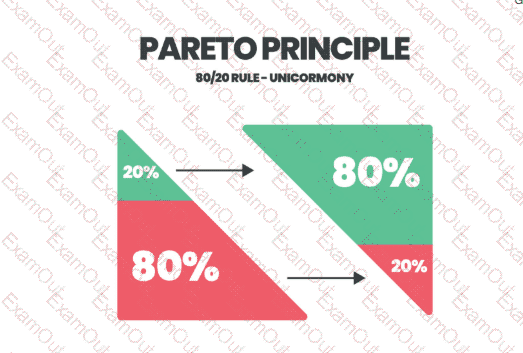
The 80/20 Principle: The Pareto chart is based on Pareto’s Law (the 80/20 rule), which posits that a relatively small number of causes (20%) typically result in the majority (80%) of the problems or defects.
Functionality: In a Pareto chart, categories are ordered by the frequency of occurrence. This helps the project team focus their corrective actions on the " vital few " problems that are having the greatest impact, rather than the " useful many " minor issues.
Visual Representation: It usually displays both bars (representing individual frequencies) and a line graph (representing the cumulative percentage of the total).
Analysis of Other Options:
A. Ishikawa diagram: Also known as a Fishbone or Cause-and-Effect diagram. It is used to identify the root causes of a problem by mapping out various contributing factors, but it does not rank them by frequency or illustrate the 80/20 rule.
B. Control chart: Used to determine whether or not a process is stable or has predictable performance. It uses " Control Limits " to identify " Special Cause " variation.
C. Run chart: A line graph that shows data points plotted in the order in which they occur. It is used to identify trends and shifts in a process over time but does not categorize or rank causes of defects.
Which term refers to the work performed to deliver results with specified features and functions?
Project scope
Product scope
Change request
Acceptance criteria
The Answer Is:
BExplanation:
According to the PMBOK® Guide and the Standard for Project Management, it is vital to distinguish between " Project Scope " and " Product Scope, " as they represent different dimensions of the work.
Product Scope: This refers specifically to the features and functions that characterize a product, service, or result. It is measured against the product requirements to determine if the result meets the intended design and utility.
Project Scope: This refers to the work performed to deliver a product, service, or result with the specified features and functions. It includes the administrative and management work required to ensure the product scope is successfully completed.
Analysis of other options:
A. Project Scope: While closely related, the " Project Scope " focuses on the effort and processes (the " how " ), whereas the question specifically asks about the results defined by " features and functions " (the " what " ).
C. Change Request: This is a formal proposal to modify any document, deliverable, or baseline. While it may impact the scope, it is not a definition of the scope itself.
D. Acceptance Criteria: These are a set of conditions that must be met before deliverables are accepted. They are used to verify the product scope but do not define the work/features themselves.
In PMI standards, " Product Scope " is considered the subset of the overall project that defines the technical and functional requirements of the final deliverable. Evaluation of the completion of the product scope is measured against the product requirements, while completion of the project scope is measured against the project management plan.
What three strategies are used to respond to threats?
Escalate, accept, and mitigate
Accept share, and avoid
Escalate, transfer, and exploit
Mitigate, accept, and prioritize
The Answer Is:
AExplanation:
According to the PMBOK® Guide, specifically within the Plan Risk Responses process, risks are categorized as either threats (negative risks) or opportunities (positive risks). There are five specific strategies for responding to threats.
Strategies for Threats:
Escalate: The threat is outside the scope of the project or the project manager’s authority; it is passed to a higher level in the organization.
Avoid: The team acts to eliminate the threat or protect the project from its impact (e.g., changing the project management plan).
Transfer: Shifting the impact and ownership of a threat to a third party (e.g., insurance or warranties).
Mitigate: Taking action to reduce the probability of occurrence or the impact of the threat (e.g., conducting more tests).
Accept: Acknowledging the threat exists but taking no proactive action unless it occurs (passive or active acceptance).
Analysis of other options:
Option B: Includes " Share, " which is a strategy for opportunities (positive risks), not threats.
Option C: Includes " Exploit, " which is a strategy for opportunities. It involves ensuring that the opportunity definitely happens.
Option D: Includes " Prioritize, " which is an activity performed during Qualitative Risk Analysis, not a response strategy itself.
Per PMI standards, selecting the appropriate response depends on the severity of the threat and the project ' s risk threshold. Escalate, accept, and mitigate are three of the valid strategies provided in the list of five for handling negative project risks.
The ways in which the roles and responsibilities, reporting relationships, and staffing management will be addressed and structured within a project is described in the:
Human resource management plan.
Activity resource requirements.
Personnel assessment tools,
Multi-criteria decision analysis.
The Answer Is:
AExplanation:
According to the PMBOK® Guide, specifically within the Project Resource Management knowledge area (formerly focused specifically on Human Resources), the Human Resource Management Plan (or Resource Management Plan in the 6th and 7th editions) is the primary document that provides guidance on how project resources should be categorized, allocated, managed, and released.
Roles and Responsibilities: This section of the plan identifies the functions assumed by or assigned to persons on the project, including their authority, responsibility, and competency levels.
Project Organization Charts: This is a graphic display of project team members and their reporting relationships.
Staffing Management Plan: A component of the resource management plan that describes when and how team members will be acquired and how long they will be needed (staffing management).
Analysis of Distractors:
B. Activity resource requirements: This is an output of the Estimate Activity Resources process. It identifies the types and quantities of resources required for each activity in a work package, but it does not define reporting structures or management strategies.
C. Personnel assessment tools: These are tools (such as attitude surveys or focus groups) used to give the project management team insight into the strengths and weaknesses of the team. They are a tool/technique, not a descriptive plan.
D. Multi-criteria decision analysis: This is a technique used during the Acquire Resources process to rate or score potential team members based on criteria like availability, cost, or experience. It is not a document that describes the project structure.
A community project with a large number of stakeholders is scheduled for delivery in six months. The project manager asked the business analyst to ensure effective requirements elicitation. What should the business analyst do?
Ask the project coordinator to facilitate some of the workshops.
Invite both internal and external stakeholders to the workshops.
Engage a consultant that is familiar with the community needs.
Organize a workshop with the sponsor and major stakeholders.
The Answer Is:
BExplanation:
According to the PMBOK® Guide and the PMI Guide to Business Analysis, the Collect Requirements process requires a comprehensive approach to identify the needs and expectations of everyone involved in or affected by the project.
Broad Stakeholder Representation: In a " community project, " the stakeholder base is naturally diverse. It includes internal stakeholders (project team, sponsor, organization) and external stakeholders (community members, local government, regulatory bodies, and end-users).
Effective Elicitation: To ensure " effective requirements elicitation, " a Business Analyst must gather a balanced view of the project ' s requirements. If only major stakeholders or internal staff are consulted, the project risks missing critical community needs or facing resistance from external groups later in the project life cycle.
Workshops as a Tool: Facilitated workshops are a key tool and technique (specifically, Focused Groups or Joint Application Design/Development - JAD) used to bring diverse stakeholders together to reach a consensus on the project ' s requirements. By inviting both internal and external parties, the Business Analyst ensures that the requirements traceability matrix is comprehensive and representative of the total project scope.
Analysis of other options:
Option A: While a project coordinator can help with logistics, the facilitation of a requirements session is a core competency of the Business Analyst. Delegation doesn ' t solve the core issue of ensuring the right information is gathered.
Option C: Engaging a consultant can provide expertise, but it does not replace the direct elicitation of requirements from the stakeholders themselves. The stakeholders ' own voices are necessary for project buy-in.
Option D: This is a " limited scope " approach. Focusing only on the sponsor and major stakeholders (often called " the powerful " ) ignores the broader community (the " affected " ). In community-driven projects, ignoring the wider stakeholder group often leads to project failure or significant rework.
Per PMI standards, the Business Analyst must ensure that the requirements reflect the needs of the entire stakeholder landscape. Inviting both internal and external stakeholders to workshops is the most effective way to ensure all perspectives are captured, leading to a more robust and accepted project deliverable.
" Tailoring " is defined as the:
effort of addressing each process to determine which are appropriate and their appropriate degree of rigor.
act of creating a project team with the specialized skills required to produce a required product or service.
action taken to bring a defective or nonconforming component into compliance with requirements or specifications.
adjustment of the respective influences of time, cost, and quality in order to most efficiently achieve scope.
The Answer Is:
AExplanation:
According to the PMBOK® Guide, Tailoring is a necessary element of project management because every project is unique; not every process, tool, technique, input, or output identified in the standard is required on every project.
Definition: Tailoring is the deliberate adaptation of the selected project management processes, inputs, tools, techniques, outputs, and life cycle phases to create a management approach that is appropriate for the specific project environment and the work at hand.
The Project Manager ' s Role: The project manager, in collaboration with the project team, sponsor, or organizational governance, is responsible for tailoring. They must decide what is necessary to manage the project effectively without adding unnecessary " bureaucracy " or " overhead. "
Factors for Tailoring: When tailoring, the project manager considers:
Project size and complexity.
Organizational culture and governance.
Stakeholder needs.
Regulatory and safety requirements.
The project’s physical location.
Analysis of Other Options:
B. Act of creating a project team...: This describes Acquire Resources, which focuses on staffing the project with the right skill sets, not the adaptation of management processes.
C. Action taken to bring a defective...: This is the definition of Defect Repair, which is a type of change request specifically aimed at correcting nonconforming components.
D. Adjustment of the respective influences...: This describes the management of the Triple Constraint (Scope, Schedule, Cost/Quality). While related to decision-making, it does not define the systemic " tailoring " of the project management methodology itself.
A project reports an earned value (EV) of USS45 for work completed with an actual cost (AC) of US$40. What is the cost performance index (CPI)?
0.88
1.12
0.58
1.58
The Answer Is:
BExplanation:
According to the PMBOK® Guide, the Cost Performance Index (CPI) is a measure of the cost efficiency of budgeted resources, expressed as the ratio of earned value to actual cost. It is one of the most critical metrics in Earned Value Management (EVM) for determining if a project is under or over budget.
The Formula: The formula for calculating CPI is:
$$CPI = \frac{EV}{AC}$$
Where:
EV (Earned Value): The value of the work actually performed (US$45).
AC (Actual Cost): The actual cost incurred for the work performed (US$40).
The Calculation:
$$CPI = \frac{45}{40} = 1.125$$
Rounding to two decimal places, the result is 1.12.
Interpretation:
A CPI greater than 1.0 (like 1.12) indicates that the project is under budget or performing better than planned regarding costs. For every dollar spent, the project has earned $1.12 worth of work.
A CPI equal to 1.0 indicates the project is exactly on budget.
A CPI less than 1.0 indicates the project is over budget.
Analysis of other options:
A. 0.88: This would be the result if the calculation were inverted ($AC / EV$ or $40 / 45$), which is incorrect. A value below 1.0 indicates poor cost performance.
C. 0.58 and D. 1.58: These values do not correspond to the mathematical relationship between the provided EV and AC figures.
Per PMI standards, the CPI is a primary indicator used to forecast the final project cost at completion (Estimate at Completion), making it a vital tool for the Control Costs process.
Which Manage Communications tool or technique focuses on identifying and managing barriers?
Communication methods
Information technology
Communication models
Information management systems
The Answer Is:
CExplanation:
According to the PMBOK® Guide, specifically within the Project Communications Management knowledge area, Communication models are the specific tool and technique used to facilitate the efficient and effective transfer of information between the sender and the receiver.
Identifying and Managing Barriers: The primary purpose of a communication model (such as the basic sender-receiver model) is to represent how information is sent, received, and interpreted. This process explicitly includes the identification of noise or barriers that can interfere with the message.
The Model Components:
Encode: Translating thoughts into language.
Transmit Message: Sending the info via a channel.
Decode: The receiver translating the message back into meaningful thoughts.
Acknowledge/Feedback: Confirming receipt or understanding.
Managing Noise: Barriers can include distance, unfamiliar terminology, cultural differences, or inadequate technology. By using formal communication models, the project manager can systematically address these barriers to ensure the " receiver " perceives the message as intended by the " sender. "
Comparison with other options:
A. Communication methods: These refer to the systematic procedures used to share information (e.g., push, pull, or interactive communication) but do not inherently focus on the mechanics of overcoming internal barriers/noise.
B. Information technology: This refers to the physical tools (computers, software, networks) used to facilitate communication, which is a sub-component but not the theoretical framework for managing barriers.
D. Information management systems: These are the facilities and processes used to capture, store, and distribute information to stakeholders, focusing on organization rather than the interpersonal/structural barriers of the message itself.
A project ' s business analyst has to understand the newly acquired technology and the impact it will have on the organization. Which tool should be used to understand the new technology?
Must have, should have, could have, won ' t have (MoSCoW)
Strengths, weaknesses, opportunities, threats (SWOT)
Work breakdown structure (WBS)
Responsible, accountable, consulted, informed (RACI)
The Answer Is:
BExplanation:
According to the PMBOK® Guide and the PMI Guide to Business Analysis, a Business Analyst (BA) must perform environmental scanning and situational analysis when a new technology is introduced to understand its internal and external implications.
Why Choice B is correct: SWOT Analysis is a strategic planning tool used to identify the Strengths and Weaknesses (internal to the technology or organization) and the Opportunities and Threats (external factors) related to a specific situation. In this case, to understand the " impact it will have on the organization, " the BA uses SWOT to evaluate what the technology does well, where it falls short, how it can be leveraged for growth, and what risks it might introduce. It provides a high-level view of the technology’s viability and integration challenges.
Analysis of other options:
A (MoSCoW): This is a prioritization technique used to manage requirements (Must have, Should have, etc.). While useful later in the project, it does not help in understanding the fundamental impact of a new technology.
C (WBS): The Work Breakdown Structure is a deliverable-oriented decomposition of the work to be executed by the project team. It defines the " what " of the project scope but is not an analytical tool for evaluating the nature of a technology.
D (RACI): This is a responsibility assignment matrix used to illustrate the connections between work packages or activities and project team members. It defines roles, not the impact of technical solutions.
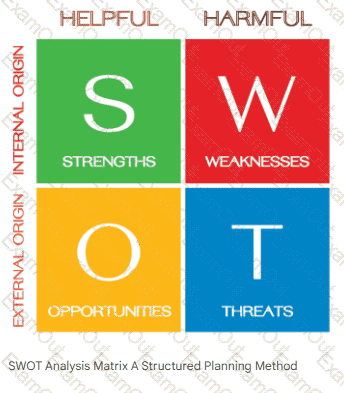
By performing a SWOT analysis, the Business Analyst can effectively communicate the strategic value and potential hurdles of the newly acquired technology to the stakeholders, ensuring the organization is prepared for the transition.
Which tools or techniques are used in the Plan Schedule Management process?
Benchmarking, expert judgment, and analytical techniques
Statistical sampling, benchmarking, and meetings
Negotiations, pre-assignment, and multi-criteria decision analysis
Expert judgment, analytical techniques, and meetings
The Answer Is:
DExplanation:
According to the PMBOK® Guide, the Plan Schedule Management process is the first process in the Project Schedule Management knowledge area. It establishes policies, procedures, and documentation for planning, developing, managing, executing, and controlling the project schedule.
Expert Judgment: This involves individuals or groups with specialized knowledge or training in schedule development, management, and control. This expertise is used to decide which scheduling methodology to use (e.g., critical path or agile) and how to combine various tools and techniques.
Analytical Techniques: These are used to provide a strategic basis for the schedule. They may include choosing among various options such as:
Scheduling methodology.
Scheduling tools and techniques.
Estimating approaches (e.g., PERT, analogous).
Formats for the schedule (e.g., Gantt charts, milestone charts).
Meetings: Project teams hold planning meetings to develop the Schedule Management Plan. Attendees may include the project manager, the project sponsor, selected team members, and any stakeholders with responsibility for schedule planning or execution.
Why the other options are incorrect:
A. Benchmarking, expert judgment, and analytical techniques: While expert judgment and analytical techniques are correct, benchmarking is primarily a tool used in Plan Quality Management or Collect Requirements to compare planned or actual practices to those of comparable organizations.
B. Statistical sampling, benchmarking, and meetings: Statistical sampling is a specific tool used in Control Quality to inspect a portion of a population for inspection. It is not used in high-level schedule planning.
C. Negotiations, pre-assignment, and multi-criteria decision analysis: These are tools and techniques used in the Acquire Resources process. They focus on obtaining the human and physical resources needed for the project, rather than defining the schedule management methodology.
Which of the following tasks focuses on decomposing work packages?
Adjust duration estimates
Define activities
Complete rolling wave planning
Develop milestone list
The Answer Is:
BExplanation:
According to the PMBOK® Guide, the process of Define Activities is the specific process of identifying and documenting the actions to be performed to produce the project deliverables.
The Mechanism of Decomposition: In the Create WBS process, the project is broken down into deliverables known as " Work Packages. " In the Define Activities process, the project manager further decomposes those Work Packages into smaller components called Activities.
The Difference: While a Work Package is a deliverable (a " noun " ), an Activity is the actual work or effort required to create that deliverable (a " verb " ).
Output: The primary outputs of this decomposition are the Activity List, Activity Attributes, and the Milestone List. This provides the necessary detail for estimating durations and developing the project schedule.
Analysis of Other Options:
A. Adjust duration estimates: This occurs during the Estimate Activity Durations or Develop Schedule processes. It is a refinement of time based on known work, not the act of breaking work packages down.
C. Complete rolling wave planning: Rolling Wave Planning is a technique used within the Define Activities process (and others) where work in the near term is planned in detail, while work in the future is planned at a higher level. While it involves decomposition, it is the approach used, whereas " Define Activities " is the specific task/process focused on the decomposition itself.
D. Develop milestone list: A milestone list is an output of the Define Activities process. It is a list of significant points or events in a project, not the task of decomposing the work packages.
In an organization with a projectized organizational structure, who controls the project budget?
Functional manager
Project manager
Program manager
Project management office
The Answer Is:
BExplanation:
According to the PMBOK® Guide, the organizational structure significantly influences how resources are assigned and who holds the power over project constraints, including the budget.
Projectized Organizational Structure: In this type of structure, the organization is arranged by projects rather than functional departments.
Authority: The Project Manager (PM) has a high to almost total level of authority.
Budget Control: Because the project is the primary unit of the organization, the Project Manager has full control over the project budget and the resources assigned to the project.
Reporting Lines: Team members are often co-located and report directly to the Project Manager. There are usually no functional managers, or if they exist, their role is minimal and focused on administrative support rather than project direction.
The " Varying Degrees " of Authority:
Functional Structure: The Functional Manager has full control of the budget; the PM has little to no authority (often just a coordinator).
Matrix Structure: Authority is shared between the Functional Manager and the PM. In a Strong Matrix, the PM has more control; in a Weak Matrix, the Functional Manager maintains control.
Projectized Structure: This is the opposite of the Functional structure. The PM is the primary decision-maker for the budget.
Comparison with other options:
A. Functional manager: In a functional organization, this individual controls the budget. In a projectized organization, functional managers typically do not exist in a way that interferes with project-level financial decisions.
C. Program manager: While a Program Manager oversees a group of related projects and may allocate funds to those projects, the day-to-day control and management of a specific project ' s budget within a projectized structure rests with the Project Manager.
D. Project management office (PMO): A PMO provides support, templates, and governance. While they may monitor budget performance or provide the framework for financial reporting, they do not " control " the individual project ' s budget in the same direct capacity as the Project Manager in this structure.
Completion of the product scope is measured against the product:
prototypes
requirements
analyses
benchmarks
The Answer Is:
BExplanation:
According to the PMBOK® Guide, a clear distinction is made between Project Scope and Product Scope regarding how completion is measured:
Product Scope: The features and functions that characterize a product, service, or result. Completion of the product scope is measured against the product requirements to ensure that the delivered product has all the specified characteristics and functions.
Project Scope: The work performed to deliver a product, service, or result with the specified features and functions. Completion of the project scope is measured against the project management plan, specifically the scope baseline (which includes the scope statement, WBS, and WBS dictionary).
Validation: During the Validate Scope process, the formalized acceptance of the completed project deliverables is obtained. This involves inspecting the deliverables to ensure they meet the documented requirements and acceptance criteria.
Comparison with other options:
A. Prototypes: These are a tool used in the Collect Requirements process to provide a working model of the expected product. While they help define requirements, they are not the formal metric against which final completion is measured.
C. Analyses: Data analysis is a technique used throughout the project to make decisions or identify trends, but it is not the baseline for scope completion.
D. Benchmarks: Benchmarking involves comparing actual or planned practices to those of comparable organizations to identify best practices or provide a basis for measuring performance. It helps set the standard for requirements but is not the requirements document itself.
The definition of when and how often the risk management processes will be performed throughout the project life cycle is included in which risk management plan component?
Timing
Methodology
Risk categories
Budgeting
The Answer Is:
AExplanation:
According to the PMBOK® Guide and the Standard for Project Management, specifically within the Plan Risk Management process, the Timing component of the Risk Management Plan defines when and how often the risk management processes will be performed throughout the project life cycle.
As per PMI standards, the Risk Management Plan is a subsidiary of the project management plan that describes how risk management activities will be structured and performed. The Timing section specifically addresses:
Frequency: How often risk identification, analysis, and monitoring will occur (e.g., weekly status meetings, monthly deep dives).
Project Life Cycle Integration: Establishing risk management activities at specific milestones or phases.
Timeline for Responses: Establishing how quickly a risk response must be implemented once a trigger is identified.
The other options are incorrect based on the following PMI definitions of Risk Management Plan components:
Methodology: This defines the specific approaches, tools, and data sources that will be used to perform risk management. It answers " how " the work will be done technically, rather than " when. "
Risk categories: This provides a means for grouping potential causes of risk. This is often documented using a Risk Breakdown Structure (RBS).
Budgeting: This establishes a budget for the project risk management activities and defines the specific protocols for the application of contingency and management reserves.
As per the PMI Lexicon of Project Management Terms, the Timing component ensures that risk management is not a one-time event but a continuous, integrated process that evolves as the project moves through its various stages.
The technique of subdividing project deliverables into smaller, more manageable components until the work and deliverables are defined to the work package level is called:
a control chart.
baseline.
Create WBS.
decomposition.
The Answer Is:
DExplanation:
According to the PMBOK® Guide, decomposition is the primary tool and technique used in the Create WBS process.
Definition: Decomposition involves dividing and subdividing the project scope and project deliverables into smaller, more manageable parts.
The Work Package Level: The process continues until the deliverables or work are defined at the work package level, which is the lowest level of the WBS. A work package is the point at which cost and activity durations for the work can be reliably estimated and managed.
Steps of Decomposition:
Identifying and analyzing the deliverables and related work.
Structuring and organizing the WBS.
Decomposing the upper WBS levels into lower-level detailed components.
Developing and assigning identification codes to the WBS components.
Verifying that the degree of decomposition of the deliverables is appropriate.
Analysis of Other Options:
A. a control chart: This is a tool used in Control Quality to determine whether or not a process is stable or has predictable performance.
B. baseline: A baseline (such as the Scope Baseline) is the approved version of a work product. While the WBS is part of the Scope Baseline, the act of subdividing is not called a baseline.
C. Create WBS: This is the name of the process itself. The question asks for the name of the technique used within that process to achieve the subdivision, which is decomposition.
The degree, amount, or volume of risk that an organization or individual will withstand is called risk:
appetite
tolerance
threshold
management
The Answer Is:
BExplanation:
According to the PMBOK® Guide and the Standard for Risk Management in Portfolios, Programs, and Projects, it is essential to distinguish between the different ways an organization views and handles risk.
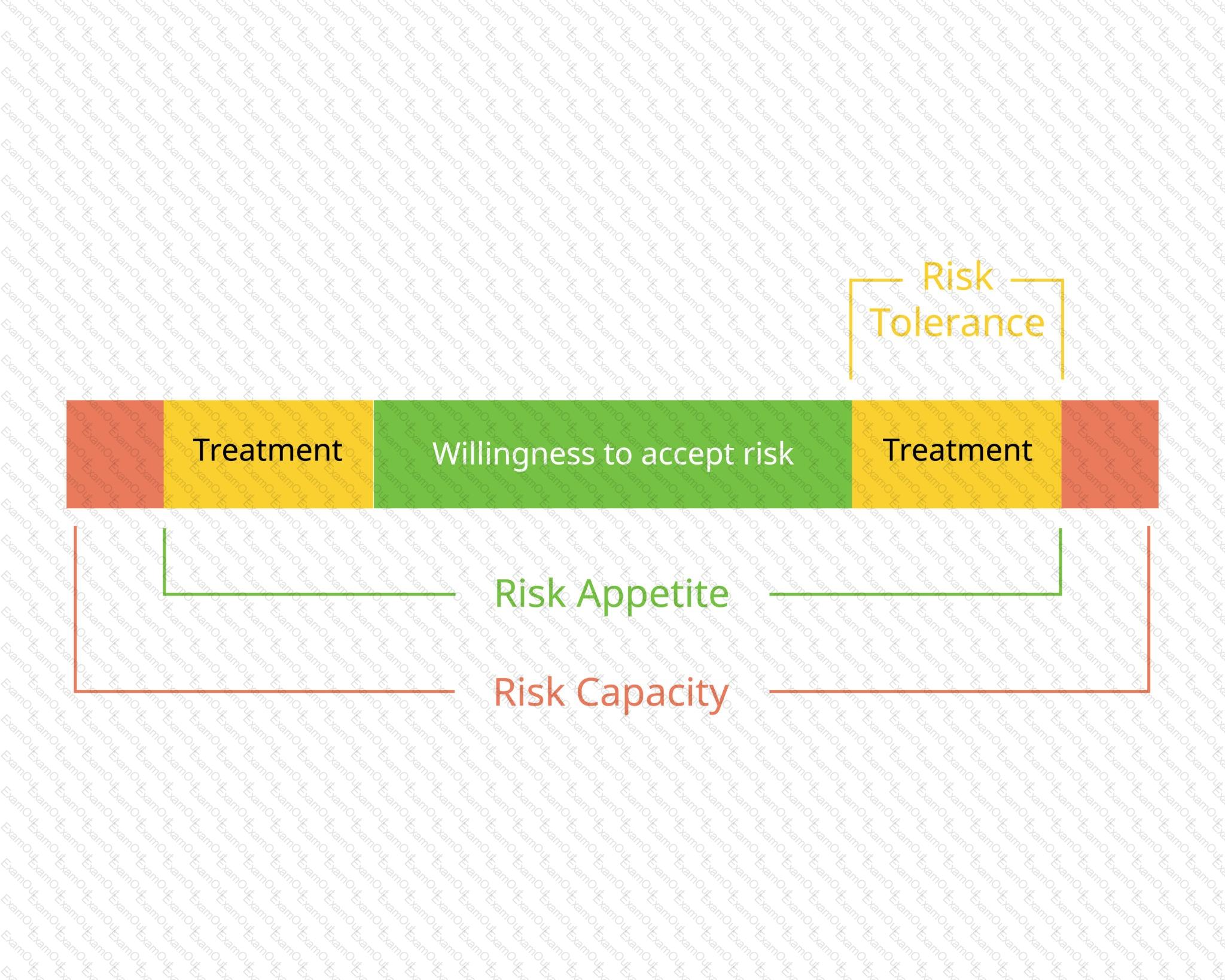
Risk Tolerance: This is defined as the specified range of acceptable results. It represents the measurable degree, amount, or volume of risk that an organization or individual is willing to withstand. For example, a project might have a budget tolerance of ±5%. If the risk exceeds this specific " withstand " level, action must be taken.
Relationship to Performance: Tolerance is often expressed in terms of measurable units (time, cost, quality, or scope) and provides a clear boundary for the project manager to operate within before escalating a risk issue.
Getty Images
Comparison with other options:
A. Risk appetite: This is a higher-level, more qualitative description of the degree of uncertainty an organization is willing to take on in anticipation of a reward. It is a " tendency " or " desire " for risk, rather than the specific measurable amount they can " withstand. "
C. Risk threshold: This refers to the specific point at which a risk becomes unacceptable. While closely related to tolerance, the threshold is the " tripwire " or the level of impact at which a stakeholder may have a specific interest. If the risk exposure is below the threshold, the organization will accept the risk; if it is above, they will not.
D. Risk management: This is the overarching Knowledge Area and process of conducting risk management planning, identification, analysis, response planning, and monitoring. It is the framework, not the measurement of the risk itself.
A key benefit of the Manage Communications process is that it enables:
The best use of communication methods.
An efficient and effective communication flow.
Project costs to be reduced.
The best use of communication technology.
The Answer Is:
BExplanation:
According to the PMBOK® Guide and the Standard for Project Management, specifically within the Project Communications Management Knowledge Area, the primary purpose of the Manage Communications process is to ensure that project information is collected, created, distributed, stored, retrieved, managed, controlled, and ultimately disposed of in an appropriate and timely manner.
As per PMI standards, the key benefit of this process is that it enables an efficient and effective communication flow between the project team and the stakeholders.
Efficiency: Refers to providing only the information that is needed (minimizing " noise " or information overload).
Effectiveness: Refers to providing the information in the right format, at the right time, to the right audience, and with the right impact.
The other options are incorrect based on the following PMI distinctions:
The best use of communication methods/technology: These are tools and techniques (e.g., communication technology, communication methods, and communication competence) used within the process to achieve the goal. While they are important, they are not the primary " key benefit " or objective of the process itself. They are the means to the end (the flow).
Project costs to be reduced: While effective communication can prevent misunderstandings that lead to rework (and thus save money), the primary objective of Manage Communications is the distribution of information, not direct cost reduction. Cost management is handled within the Project Cost Management Knowledge Area.
As per the PMI Lexicon of Project Management Terms, the Manage Communications process goes beyond just distributing information; it seeks to ensure that the communication is received and understood, thereby supporting stakeholder engagement and project alignment.
The item that provides more detailed descriptions of the components in the work breakdown structure (WB5) is called a WBS:
dictionary.
chart.
report.
register.
The Answer Is:
AExplanation:
According to the PMBOK® Guide, the WBS Dictionary is a document that provides detailed deliverable, activity, and scheduling information about each component in the Work Breakdown Structure (WBS).
The Purpose of the Dictionary: Because the WBS itself is a graphical or hierarchical chart, it often lacks the space to provide specific details. The WBS dictionary supports the WBS by providing the " narrative " or definition for each work package.
Contents of a WBS Dictionary: Information in the WBS dictionary may include, but is not limited to:
Code of account identifier.
Description of work.
Assumptions and constraints.
Responsible organization or individual.
Schedule milestones.
Associated schedule activities.
Resources required.
Cost estimates.
Quality requirements.
Acceptance criteria.
Technical references.
Scope Baseline: Together, the Project Scope Statement, the WBS, and the WBS Dictionary form the Scope Baseline for the project.
Analysis of Other Options:
B. chart: A WBS chart is simply the visual representation (the tree structure) of the work. It shows the hierarchy but does not typically contain the " detailed descriptions " required to execute the work.
C. report: While WBS information can be included in various project reports, there is no formal PMBOK® document called a " WBS report " that serves as the repository for component descriptions.
D. register: A register is typically used for tracking dynamic lists that change throughout the project (e.g., Risk Register, Stakeholder Register, Issue Log). The WBS details are considered static baseline information and are housed in the dictionary.
When executing a project, a recently hired subject matter expert (SME) who reviewed the execution progress remarked that the schedule could be crashed and that the schedule was not assessed properly. What should the project manager do next?
Update the schedule baseline
Review the schedule baseline
Initiate a change request
Update the risk register
The Answer Is:
BExplanation:
According to the PMBOK® Guide, specifically the Monitor and Control Project Work and Control Schedule processes, a Project Manager must validate information before taking corrective or preventive actions.
Validation First: When a new Subject Matter Expert (SME) provides feedback that a schedule was " not assessed properly, " the Project Manager’s first responsibility is to verify the accuracy of this claim. The PM cannot act on an opinion without first performing a technical Review of the Schedule Baseline.
Schedule Crashing Analysis: Crashing is a schedule compression technique used to shorten the duration for the least incremental cost by adding resources. Before crashing, the PM must review the baseline to identify the Critical Path. Crashing only works on critical path activities; crashing non-critical activities provides no benefit to the project end date.
Integrity of the Baseline: A baseline is a formal, approved version of the schedule. It should not be changed (Option A) or modified via a change request (Option C) until a thorough analysis proves that a change is necessary and beneficial.
Professional Judgment: By reviewing the baseline with the SME, the PM can determine if the original assumptions were flawed or if the SME has identified a legitimate opportunity to optimize the project timeline.
Analysis of other options:
Option A: Updating the schedule baseline is a premature step. A baseline is only updated after a Change Request has been formally approved by the Change Control Board (CCB).
Option C: Initiating a change request is a " doing " step. You cannot justify a change request until you have conducted the Review (Option B) to understand the impact on cost, scope, and resources.
Option D: While the SME ' s feedback might suggest a risk, the primary issue raised is about the current assessment and optimization of the schedule. Updating the risk register is a secondary administrative task that follows the technical review of the schedule itself.
Per PMI standards, when new technical expertise suggests an error or opportunity in project planning, the Project Manager must first Review the Schedule Baseline to perform an impact analysis and validate the findings before taking further action.
Which type of analysis is used to examine project results through time to determine if performance is improving or deteriorating?
Control chart
Earned value
Variance
Trend
The Answer Is:
DExplanation:
According to the PMBOK® Guide, specifically within the Monitor and Control Project Work and Control Costs processes, Trend Analysis is the analytical technique used to examine project performance over time to determine if it is improving or deteriorating.
Mechanism: Trend Analysis uses mathematical models to forecast future outcomes based on historical results. It looks at performance data in a chronological sequence to identify patterns, such as a consistent slip in the schedule or a steady increase in cost variances.
Purpose: The primary goal is to determine the " trend " of the project ' s performance. By understanding whether performance is getting better or worse, the project manager can implement proactive corrective or preventive actions before a minor variance becomes a major issue.
Application in EVM: In Earned Value Management, trend analysis is often used to calculate the Estimate at Completion (EAC), which predicts the final cost of the project based on the current spending trends.
Analysis of other choices:
Choice A (Control chart): While a control chart tracks data over time, its primary purpose is to determine if a process is " in control " or stable within defined specification limits (typically used in Quality Management), rather than simply tracking if general project performance is improving.
Choice B (Earned value): This is a broad methodology that uses a suite of metrics (CPI, SPI, CV, SV) to measure project performance at a specific point in time. While you can perform trend analysis on earned value data, " Earned Value " itself is the data set, not the specific analysis technique for time-based improvement.
Choice C (Variance): Variance analysis focuses on the difference between the baseline and the actual performance (e.g., " We are US$5,000 over budget " ). It tells you how much you are off-track right now, but it doesn ' t inherently describe the direction of performance over a period of time.
Organizational planning impacts projects by means of project prioritization based on risk, funding, and an organizations:
Budget plan
Resource plan
Scope plan
Strategic plan
The Answer Is:
DExplanation:
According to the PMBOK® Guide, specifically within the sections on Project Management and Strategy, projects are the primary means by which an organization achieves its strategic goals. Organizational planning dictates how projects are selected and prioritized.
Strategic Alignment: Projects are typically authorized as a result of one or more strategic considerations. The Strategic Plan serves as the highest-level roadmap for the organization, and any potential project must be evaluated against how well it aligns with these long-term goals.
Prioritization Factors: When an organization conducts its planning, it looks at several variables to decide which projects to fund and initiate:
Risk: The potential for negative impacts or failure.
Funding: The availability of capital and expected Return on Investment (ROI).
Strategic Goals: Market demand, technological advance, legal requirements, or social need as defined in the Strategic Plan.
Portfolio Management: This is the level where organizational planning most directly impacts projects. Portfolio managers use the Strategic Plan to ensure that the " right " work is being done to move the company toward its vision.
Analysis of other choices:
Choice A (Budget plan): While funding is a constraint mentioned in the question, the " Budget Plan " is usually a subset of the broader strategic and operational plans. It tells you if you can afford a project, but the Strategic Plan tells you why you should do it.
Choice B (Resource plan): Resource planning (human and physical) is a critical operational component, but prioritization is driven by the value the project brings to the organization ' s strategy, not just the availability of staff.
Choice C (Scope plan): Scope planning is project-specific. It defines what the project will do once it has already been selected. It does not drive the organizational-level prioritization process.
Which project management process is used by the project manager to ensure that stakeholders receive timely and relevant information?
lan Communications Management
Manage Communications
Monitor Communications
Develop Project Management Plan
The Answer Is:
BExplanation:
According to the PMBOK® Guide, the process group responsible for the actual execution of the communication strategy is Project Communications Management.
Manage Communications (Choice B): This is the process of ensuring timely and appropriate collection, creation, distribution, storage, retrieval, management, monitoring, and ultimate disposition of project information. While the Plan tells you what to do, Manage Communications is the " doing " phase. It is during this process that the project manager utilizes various tools (like communication technologies and reporting systems) to ensure that the stakeholders actually receive the information they need in a timely and relevant manner.
Plan Communications Management (Choice A): This is the process of developing an appropriate approach and plan for project communication activities based on the information needs of each stakeholder. This process happens during Planning; it identifies the need but does not perform the distribution itself.
Monitor Communications (Choice C): This is the process of ensuring the information needs of the project and its stakeholders are met. It is a Monitoring and Controlling process that assesses whether the communication activities are effective and if the plan needs to be adjusted.
Develop Project Management Plan (Choice D): This is the high-level process of defining, preparing, and coordinating all plan components. While the Communications Management Plan is a part of this, this process is too broad to be the specific answer for the distribution of information.
By effectively performing Manage Communications, a project manager minimizes the risk of misunderstandings and ensures that all stakeholders are aligned with the current status and direction of the project.
Which quality management and control tool is useful in visualizing parent-to-child relationships in any decomposition hierarchy that uses a systematic set of rules that define a nesting relationship?
Interrelationship digraphs
Tree diagram
Affinity diagram
Network diagram
The Answer Is:
BExplanation:
According to the PMBOK® Guide, specifically within the Manage Quality process (formerly Perform Quality Control/Assurance), Tree Diagrams are one of the " Quality Management and Control Tools " used to visualize data and relationships.
Decomposition Hierarchy: A tree diagram is used to represent a hierarchy of tasks or relationships. It is particularly useful for visualizing parent-to-child relationships in any decomposition hierarchy (such as the Work Breakdown Structure (WBS), Resource Breakdown Structure (RBS), or Organizational Breakdown Structure (OBS)).
Nesting Relationships: The tool uses a systematic set of rules to define how one element " nests " or sits within another. It starts with a single root (the parent) and branches out into multiple levels of detail (the children), ensuring that the horizontal or vertical flow represents the logic of the decomposition.
Application in Quality: In a quality context, tree diagrams can be used to link high-level quality goals to the specific, granular activities required to achieve them, or to map out the potential results of a decision-making process (such as a decision tree).
Why the other options are incorrect:
A. Interrelationship digraphs: These are used to identify complex underlying causes or relationships in a problem. They show " many-to-many " relationships rather than a strict, nested parent-to-child hierarchy.
C. Affinity diagram: This is a grouping technique used to organize large numbers of ideas or " post-it notes " into logical categories. It is used for brainstorming and sorting ideas rather than formal hierarchical decomposition.
D. Network diagram: This is primarily a Schedule Management tool used to show the logical sequence and dependencies (Finish-to-Start, etc.) between project activities. It shows the " flow " of time and logic, not a " nested " parent-to-child hierarchy.
Which of the following risk response strategies involves allocating ownership of a positive risk to a third party?
Mitigate
Transfer
Share
Avoid
The Answer Is:
CExplanation:
According to the PMBOK® Guide, specifically within the Plan Risk Responses process, risk response strategies are categorized based on whether the risk is a threat (negative) or an opportunity (positive).
Sharing (Positive Risk/Opportunity): This strategy involves allocating some or all of the ownership of an opportunity to a third party who is best able to capture the opportunity for the benefit of the project.
Mechanism: It often involves forming risk-sharing partnerships, teams, special-purpose companies, or joint ventures established with the express purpose of managing the opportunity.
Goal: To share the potential benefits with a third party who has specialized skills or resources that the project team lacks, thereby increasing the probability of the opportunity occurring or the magnitude of the benefit if it does.
Examples of Sharing:
A joint venture between two construction firms to bid on a massive infrastructure project that neither could handle alone.
Profit-sharing agreements with a vendor if they manage to reduce production costs below a certain threshold.
Comparison with other options:
A. Mitigate: This is a strategy for threats (negative risks). It involves taking action to reduce the probability of occurrence or the impact of a threat.
B. Transfer: This is a strategy for threats (negative risks). It involves shifting the impact of a threat to a third party, together with ownership of the response (e.g., buying insurance or using performance bonds). While it involves a third party, it is specifically for negative impacts.
D. Avoid: This is a strategy for threats (negative risks). It involves changing the project management plan to eliminate the threat entirely, such as changing the scope or extending the schedule to bypass a risky period.
Which of the following is an example of facit knowledge?
Risk register
Project requirements
Expert judgment
Make-or-buy analysis
The Answer Is:
CExplanation:
According to the PMBOK® Guide (6th Edition), specifically within the Manage Project Knowledge process, knowledge is split into two distinct categories: Explicit and Tacit.
Tacit Knowledge: This is personal knowledge that is difficult to articulate or codify. It includes beliefs, insights, experience, " know-how, " and Expert Judgment. It is stored within the minds of individuals and is typically shared through conversations, shadowing, and interpersonal interaction.
Explicit Knowledge: This is knowledge that can be codified using symbols such as words, numbers, and pictures. It can be easily documented and shared.
Why Expert Judgment is Tacit Knowledge: Expert judgment relies on the specialized knowledge or expertise of an individual or group. It is built through years of experience and involves intuition and professional " gut feeling " that cannot be fully captured in a manual or a database. When a project manager consults a subject matter expert, they are tapping into that expert ' s tacit knowledge.
Analysis of Distractors:
A (Risk register): This is a formal document that records identified risks and their characteristics. Because it is written down and stored in a database, it is Explicit Knowledge.
B (Project requirements): These are documented descriptions of what is needed for the project. Since they are codified in a Requirements Documentation or Traceability Matrix, they are Explicit Knowledge.
D (Make-or-buy analysis): This is a specific tool/technique (often resulting in a documented decision) used to determine whether work can be accomplished by the project team or should be purchased from outside sources. The resulting data and criteria are Explicit Knowledge.
Projects can be divided into phases to provide better management control. Collectively, what are these phases known as?
Complete project phase
Project life
The project life cycle
Project cycle
The Answer Is:
CExplanation:
According to the PMBOK® Guide, a project is a temporary endeavor with a definite beginning and end. To provide better management control and appropriate links to the ongoing operations of the performing organization, projects are often divided into several project phases.
Definition of Project Life Cycle: The project life cycle is the series of phases that a project passes through from its start to its completion. It provides the basic framework for managing the project, regardless of the specific work involved.
Phase Characteristics: Each phase is a collection of logically related project activities that culminates in the completion of one or more deliverables. Breaking a project into phases allows the project manager and the organization to perform " phase gates " or " kill points, " where the project ' s performance is reviewed against the business case before moving to the next phase.
Generic Structure: While specific life cycles vary by industry (e.g., software development vs. construction), the PMBOK® Guide identifies a generic life cycle structure:
Starting the project (Initiating).
Organizing and preparing (Planning).
Carrying out the work (Executing).
Ending the project (Closing).
Adaptability: The project life cycle can be predictive (plan-driven), iterative, incremental, or adaptive (agile/change-driven), depending on the degree of certainty regarding the scope and the frequency of delivery.
Comparison with other options:
A. Complete project phase: This is not a standard PMI term. While a project has phases, the collective group of phases is not called a " complete phase. "
B. Project life: While colloquially used, " Project Life " is incomplete. The formal standard term for the management framework is the Project Life Cycle.
D. Project cycle: This is a vague term. PMI specifically uses " Life Cycle " to denote the progression from initiation to closure.
A project team is working on a complex product and the work breakdown structure (WBS) is finalized. The team determines that the best approach is to use an adaptive delivery method and is now tasked with converting the WBS for adaptive delivery.
How can the team manage the conversion of the existing WBS to an adaptive approach?
Generate use cases for each WBS element and prepare a requirements document.
Produce a release plan for each WBS element and organize them into iterations for delivery.
Create themes for each WBS element and organize them into iterations for delivery.
Organize the WBS into a set of related themes, epics, and user stories.
The Answer Is:
DExplanation:
According to the Agile Practice Guide and the PMBOK® Guide, moving from a predictive (Waterfall) framework to an adaptive (Agile) framework requires a shift from " task-oriented " structures to " value-oriented " structures.
Why Choice D is correct:
Structural Alignment: In a predictive approach, the Work Breakdown Structure (WBS) is a hierarchical decomposition of the total scope. In an adaptive approach, the equivalent hierarchy is the Product Backlog, which is organized by value.
The Conversion Process:
Themes: High-level functional areas or business goals (often corresponding to the top levels of a WBS).
Epics: Large bodies of work that can be broken down into smaller tasks (corresponding to WBS work packages).
User Stories: The smallest units of work that deliver a specific value to the end user (corresponding to the activities derived from work packages).
Outcome: By mapping WBS elements into these categories, the team ensures that the original scope is preserved while making it " consumable " for iterative development.
Analysis of other options:
A (Generate use cases and requirements document): This is a traditional requirements gathering approach. While use cases are helpful, simply writing a requirements document does not " convert " the WBS into a delivery framework; it just creates more documentation.
B (Release plan for each element): A release plan is a timeline. While you eventually need one, you cannot build a release plan directly from a raw WBS without first translating the work into backlog items (User Stories) that the team can estimate and prioritize.
C (Create themes and organize into iterations): This is close, but it skips the necessary granularity. Iterations (Sprints) are populated by User Stories, not broad Themes. Without breaking themes down into epics and stories (as seen in Choice D), the work is too large to fit into a typical 2-week iteration.
Key Concept: The Project Management Institute (PMI) emphasizes that in an adaptive environment, work must be decomposed by value rather than just by " work type. " Choice D provides the necessary structural bridge to take a finalized scope (WBS) and turn it into a living Product Backlog that an Agile team can actually execute.
Which risk management strategy seeks to eliminate the uncertainty associated with a particular upside risk by ensuring that the opportunity is realized?
Enhance
Share
Exploit
Accept
The Answer Is:
CExplanation:
According to the PMBOK® Guide and the Standard for Project Management, the strategy described is Exploit. This is a specific response strategy for Opportunities (positive risks/upside risks) where the organization wants to ensure that the opportunity is realized.
As per PMI standards, the Exploit strategy is used for high-priority opportunities where the organization wants to eliminate the uncertainty associated with a particular upside risk by making the opportunity definitely happen. This is the most aggressive of the positive risk response strategies. Examples include:
Assigning the most talented resources: Ensuring that the best staff are working on a project to reduce the time to completion or improve quality beyond the original scope.
Using new technologies: Implementing a technological advancement to reduce cost or duration.
Providing more than requested: Delivering a higher level of service or functionality that results in a strategic advantage.
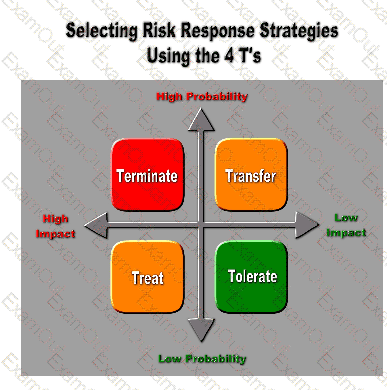
The other options are incorrect based on the following PMI definitions for opportunity responses:
Enhance: This involves taking action to increase the probability or the positive impact of an opportunity. Unlike exploit, it does not guarantee the outcome; it simply makes it more likely.
Share: This involves allocating some or all of the ownership of the opportunity to a third party who is best able to capture the benefit for the project (e.g., a joint venture).
Accept: This involves being willing to take advantage of the opportunity if it arises, but not actively pursuing it. This can be passive (no action) or active (establishing a contingency reserve).
As per the PMI Lexicon of Project Management Terms, the Exploit strategy is a proactive approach to risk management that focuses on maximizing the value and benefits that can be derived from uncertain events.
Which tool or technique is required in order to determine the project budget?
Cost of quality
Historical relationships
Project management software
Forecasting
The Answer Is:
BExplanation:
According to the PMBOK® Guide, the Determine Budget process is the process of aggregating the estimated costs of individual activities or work packages to establish an authorized cost baseline.
Historical Relationships: This is a specific tool and technique used in the Determine Budget process. It involves using project characteristics (parameters) to develop mathematical models to predict total costs. These relationships can be simple (e.g., cost per square foot for a building) or complex (e.g., software development cost based on lines of code).
Reliability: For these historical relationships to be accurate, the historical information used to build the model must be accurate, the parameters must be readily quantifiable, and the models must be scalable.
Cost Baseline: The result of applying this and other techniques (like Cost Aggregation) is the Cost Baseline, which is the approved version of the time-phased project budget, excluding any management reserves.
Comparison with other options:
A. Cost of quality: This is a tool and technique used in Plan Quality Management to find the balance between investing in prevention/appraisal and the cost of non-conformance. While it affects the budget, it is not a primary tool used to determine the total budget.
C. Project management software: While often used to assist the process, the PMBOK® Guide specifically lists " Project Management Information Systems " as a general tool. " Historical Relationships " is a more distinct, technical technique required for calculating the budget itself.
D. Forecasting: This is a tool and technique for the Control Costs process. It is used during the execution of the project to predict the Estimate at Completion (EAC) based on current performance, rather than establishing the initial budget.
A project manager managing a cross-cultural virtual project team across several time zones should be concerned about the impacts of which communication technology factor?
Urgent information need
Sensitivity of information
Project environment
Ease of use
The Answer Is:
CExplanation:
In accordance with the PMBOK® Guide (Project Communications Management), specifically within the Plan Communications Management process, the project manager must consider various factors when selecting communication technology. When a team is cross-cultural, virtual, and spread across several time zones, the primary concern is the Project Environment.
The project environment factor includes:
Geographic Distribution: The physical location of team members across different countries.
Time Zones: The challenge of scheduling synchronous communication (meetings) when team members ' working hours do not overlap.
Cultural Diversity: Differences in communication styles, languages, and social norms that affect how information is perceived and processed.
Connectivity: Ensuring that all virtual members have the necessary technological infrastructure to participate equally.
According to PMI standards, the project manager must adapt the communication technology to fit this specific environment (e.g., using asynchronous tools like email or shared portals for routine updates and carefully timed video conferencing for critical decision-making).
Analysis of Distractors:
A. Urgent information need: While urgency dictates the speed of the technology (e.g., phone call vs. letter), it is a situational factor rather than the fundamental challenge posed by a global, virtual team structure.
B. Sensitivity of information: This relates to security and confidentiality requirements (e.g., encryption). While important, it is not the defining challenge of managing a cross-cultural, multi-timezone team.
D. Ease of use: This refers to the " user-friendliness " of the tools. While a factor in technology adoption, it does not address the core environmental complexities of virtual, global project management.
A project team member is estimating the cost of activity and is checking documentation from previous similar projects. Which estimation method is the project manager using to complete this task?
Bottom-up estimating
Three-point estimating
Analogous estimating
Parametric estimating
The Answer Is:
CExplanation:
According to the PMBOK® Guide, specifically the Estimate Costs and Estimate Activity Durations processes, project managers choose from several estimation techniques depending on the available data and the required level of precision.
Analogous Estimating (Choice C): This technique uses values or attributes—such as scope, cost, budget, or duration—from a previous, similar project as the basis for estimating the same attribute for the current project. It is often used when there is a limited amount of detailed information available about the current project (e.g., in the early phases). It is generally less costly and time-consuming than other techniques but also less accurate. Because the team member is specifically " checking documentation from previous similar projects, " they are performing an analogy.
Bottom-up Estimating (Choice A): This involves estimating the cost of individual work packages or activities with the greatest level of specified detail. These costs are then summarized or " rolled up " to higher levels. This requires a detailed WBS and is much more granular than looking at past projects.
Three-point Estimating (Choice B): This technique improves accuracy by considering estimation uncertainty and risk. It uses three estimates (Most Likely, Optimistic, and Pessimistic) to calculate an expected cost. It does not inherently rely on " previous similar projects " as its primary source, though historical data can inform the three points.
Parametric Estimating (Choice D): This uses a statistical relationship between historical data and other variables (e.g., square footage in construction, lines of code in software development) to calculate an estimate. While it uses historical data, it applies a mathematical algorithm or model rather than a direct comparison to one specific previous project.
By using Analogous Estimating, the project manager can quickly develop a high-level estimate based on the organization ' s Organizational Process Assets (OPAs) and historical knowledge, provided the previous projects are truly similar in nature to the current one.