
Which input to the Identify Stakeholders process provides information about internal or external parties related to the project?
Procurement documents
Communications plan
Project charter
Stakeholder register
The Answer Is:
CExplanation:
According to the PMBOK® Guide and the Standard for Project Management, the Project Charter is a critical input to the Identify Stakeholders process because it provides the initial list of internal and external parties related to the project.
During the initiation phase, the Project Charter is developed to formally authorize the project. As per PMI standards, the charter includes high-level information such as:
Key Stakeholder List: A preliminary identification of the entities (individuals, groups, or organizations) that have a vested interest in the project ' s outcome.
Project Sponsor: The individual or group providing resources and support.
Customer/User: The entity that will receive the project ' s product, service, or result.
High-level requirements and constraints: These often point toward specific regulatory bodies or internal departments that must be considered stakeholders.
The other options are incorrect based on their sequence and definition within the PMI framework:
Procurement documents: While these provide information about external parties (sellers/contractors), they are only relevant if the project is being performed under a contract. The Project Charter is a more universal and foundational input for identifying both internal and external parties.
Communications plan: This is an output of the Plan Communications Management process, which occurs after stakeholders have been identified. You cannot plan how to communicate with people until you know who they are.
Stakeholder register: This is the primary output of the Identify Stakeholders process, not an input to it. It is the document where the information gathered from the Project Charter and other inputs is formally recorded and categorized.
As per the PMI Lexicon of Project Management Terms, the Project Charter serves as the " starting point " for stakeholder identification, ensuring that the project manager understands the landscape of influence from the very beginning of the project life cycle.
Which role does the project manager resemble best?
Orchestra conductor
Facilities supervisor
Functional manager
School principal
The Answer Is:
AExplanation:
According to the PMBOK® Guide, specifically in the section discussing the Role of the Project Manager, the most accurate analogy used by PMI to describe the project manager is that of an orchestra conductor.
The Analogy: Much like a conductor, a project manager is not expected to be an expert in every single technical skill (playing every instrument). Instead, their role is to provide the integration of all the individual parts. They ensure that the specialists (the musicians/team members) perform their specific tasks in a synchronized manner to produce a successful outcome (the music/project deliverables).
Key Responsibilities Highlighted:
Membership and Roles: The conductor ensures everyone knows their role and when to " play " their part.
Responsibility for the Result: The conductor is ultimately responsible for the performance of the whole, just as the project manager is responsible for the project ' s success.
Knowledge and Skills: While they don ' t need to play every instrument, they must possess the vision and leadership to guide the entire group toward a common goal.
Analysis of other options:
B. Facilities supervisor: This role is more focused on maintenance and operations within a specific physical environment, lacking the temporary, unique, and integrative nature of a project.
C. Functional manager: A functional manager typically focuses on providing management oversight for a functional or business unit (e.g., HR, Finance) and managing specialists within that specific domain. They are " owners " of resources, whereas the project manager is the " owner " of the project objective.
D. School principal: While a principal manages a complex environment, the role is heavily administrative and operational (ongoing) rather than focused on the completion of a specific, unique project with a defined beginning and end.
Per PMI standards, this analogy is used to underscore that the project manager’s primary value lies in Integration Management, balancing the technical, business, and leadership aspects of the project.
In which phase of team building activities do team members begin to work together and adjust their work habits and behavior to support the team?
Performing
Storming
Norming
Forming
The Answer Is:
CExplanation:
According to the PMBOK® Guide (Project Management Body of Knowledge), specifically within the Project Resource Management knowledge area, the development of a project team typically follows the Tuckman Ladder model, which consists of five stages:
Norming (Option C): In this stage, team members begin to work together and adjust their work habits and behavior to support the team. Trust begins to develop as they resolve their differences and recognize the virtues of their teammates. They begin to develop a " team identity " and establish unwritten rules or " norms " for how the work will be accomplished.
Forming (Option D): This is the initial phase where the team meets and learns about the project and their formal roles and responsibilities. Team members tend to be independent and not as open in this phase.
Storming (Option B): In this phase, the team begins to address the project work, technical decisions, and the project management approach. If team members are not collaborative or open to different ideas and perspectives, the environment can become counterproductive.
Performing (Option A): Teams that reach this stage function as a well-organized unit. They are interdependent and work through issues smoothly and effectively. The project manager ' s role shifts more toward delegation.
In the PMI framework, understanding these stages is crucial for the Develop Team process. The Project Manager must adapt their leadership style—from directing in the Forming stage to supporting in the Norming stage—to help the team transition toward high performance as quickly as possible.
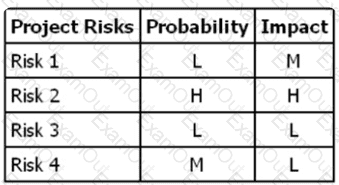
Which of the following best correspond to the organizational process assets (OPAs) that affect the project?
Policies and lessons learned from other projects
Information technology software and employee capability
Resource availability and employee capability
Marketplace conditions and legal restrictions
The Answer Is:
AExplanation:
According to the PMBOK® Guide, Organizational Process Assets (OPAs) are the plans, processes, policies, procedures, and knowledge bases specific to and used by the performing organization. These assets influence the project ' s management and are internal to the organization.
OPAs are typically grouped into two categories:
Processes, Policies, and Procedures: These are usually established by the Project Management Office (PMO) or other governing bodies. Examples include standard templates, software tool requirements, and safety or ethics policies.
Organizational Knowledge Bases: These are used for storing and retrieving information. Lessons learned from previous projects, historical information, and completed project files are the most critical assets in this category as they help the project manager avoid " reinventing the wheel. "
Analysis of other options:
B. Information technology software and employee capability: These are categorized as Enterprise Environmental Factors (EEFs). EEFs are conditions, not necessarily under the immediate control of the project team, that influence, constrain, or direct the project.
C. Resource availability and employee capability: These are also EEFs. The existing skills of the workforce and the current availability of resources are environmental constraints the project manager must work within.
D. Marketplace conditions and legal restrictions: These are classic examples of External EEFs. They originate outside the organization (e.g., industry standards, government regulations, or economic climate) and are not considered internal process assets.
Per PMI standards, OPAs are the " internal wealth " of the company, and using policies and lessons learned ensures the project benefits from the organization’s collective experience.
The Perform Integrated Change Control process occurs in which Process Group?
Initiating
Executing
Monitoring and Controlling
Planning
The Answer Is:
CExplanation:
According to the PMBOK® Guide and the Standard for Project Management, the Perform Integrated Change Control process is situated within the Monitoring and Controlling Process Group.
This process is a key component of Project Integration Management. It is the process of reviewing all change requests; approving changes and managing changes to deliverables, project documents, and the project management plan; and communicating the decisions.
Key characteristics of this process within the Monitoring and Controlling group include:
Continuity: It is conducted from project inception through completion.
Accountability: It ensures that only documented and approved changes are implemented.
Integration: It considers the impact of a change in one area (e.g., scope) on all other project constraints (e.g., schedule, cost, quality, and risk).
The other options are incorrect based on the PMI Process Group and Knowledge Area Mapping:
Initiating: This group only contains " Develop Project Charter " and " Identify Stakeholders. "
Planning: This group focuses on defining the project objective and the course of action needed to attain those objectives (e.g., Develop Project Management Plan).
Executing: This group involves the processes performed to complete the work defined in the project management plan. While changes are often identified during execution, they are processed and controlled in the Monitoring and Controlling group.
As per the PMI Lexicon of Project Management Terms, the Perform Integrated Change Control process is vital because it allows for a disciplined assessment of change, ensuring that the project remains aligned with its business objectives and baselines.
In a preliminary meeting for a project, team members decide to execute the project with methodology A finance team member wants to know how project cost will be determined at this early stage. How will the project team determine project cost?
Use a lightweight cost estimation due to the nature of angile projects.
Use a detailed cost estimation for agile projects.
Retrieve a dudget from a previous project and create a baseline of this project based on it.
Use a detailed work breakdown structure (WBS) to get cost estimation.
The Answer Is:
AExplanation:
According to the Agile Practice Guide and the PMBOK® Guide, the approach to cost estimation varies significantly depending on the project life cycle. In an agile or adaptive environment, requirements are expected to evolve, making traditional, granular estimation difficult at the start.
Lightweight Cost Estimation (Choice A): In the early stages of an agile project, the team uses " lightweight " or high-level estimation techniques (such as T-shirt sizing, Story Points, or Relative Sizing). Because the full scope is not yet decomposed into a detailed Work Breakdown Structure (WBS), the goal is to provide a " Rough Order of Magnitude " (ROM) estimate. As the project progresses and the backlog is refined, these estimates become more accurate. This allows the team to remain flexible without wasting time on detailed calculations for requirements that might change.
Detailed Cost Estimation for Agile (Choice B): This is a contradiction in terms for the early stages of an agile project. Detailed estimation requires a fixed and stable scope. In agile, detailed estimation usually only happens at the iteration (Sprint) level for the immediate work at hand, not for the entire project at a preliminary meeting.
Previous Project Budget (Choice C): While Analogous Estimating (using a previous project) is a valid technique, simply " retrieving " a budget and setting a baseline without adjusting for the current project ' s specific complexities or constraints is poor practice and leads to inaccurate budgeting.
Detailed WBS (Choice D): This is the hallmark of a Predictive (Waterfall) life cycle. Creating a detailed WBS and performing Bottom-up Estimating requires the scope to be fully defined upfront. This is not appropriate for a project following " Methodology A " if that methodology is adaptive, or for any project in its " preliminary " stages where such detail does not yet exist.
In agile environments, the focus is on Value-Based Prioritization. The finance team should understand that while a high-level budget is set early on, the specific allocation of funds is managed dynamically as the team discovers which features deliver the most value during each iteration.
The group technique that enhances brainstorming with a voting process used to rank the most useful ideas for prioritization is called the:
majority rule technique.
nominal group technique.
Delphi technique,
idea/mind mapping technique.
The Answer Is:
BExplanation:
According to the PMBOK® Guide, the Nominal Group Technique (NGT) is a structured form of brainstorming that ensures all voices are heard and results in a prioritized list of ideas or requirements.
How it Works: The process typically follows four steps:
Silent Generation: Participants write down their ideas privately.
Round Robin: Each participant shares one idea, which is recorded on a flip chart or board until all ideas are captured.
Discussion: The group discusses each idea to ensure clarity and shared understanding.
Voting: Participants privately rank or vote on the ideas (e.g., using a scale of 1 to 5). The ideas with the highest cumulative points are prioritized.
The Value of NGT: It is particularly useful in preventing " groupthink " and ensuring that a few dominant individuals do not overwhelm the session. By adding a voting process to standard brainstorming, it moves the group from mere idea generation to actionable prioritization.
Analysis of Other Options:
A. majority rule technique: This is a specific decision-making result (getting more than $50\%$ of the vote) rather than a comprehensive structured brainstorming technique that includes idea generation.
C. Delphi technique: This is a method used to reach a consensus among a group of experts who participate anonymously. The experts provide responses to a facilitator in multiple rounds; it does not involve the " round robin " or face-to-face brainstorming characteristics of NGT.
D. idea/mind mapping technique: This is a visual data representation technique used to consolidate ideas created through individual brainstorming sessions into a single map to reflect commonalities and differences in understanding. It does not inherently include a formal voting and ranking process.
What is an example of an emerging trend in procurement management?
Online technology enable projects to postpone ordering long lead items until the items are needed
Online technologies allow a project ' s progress to be viewed by all stakeholders to build better relations
Online procurement tools provide buyers with multiple sources to advertise to sellers.
Online procurement tools provide sellers with designated sources for procurement documents and the resources to complete them.
The Answer Is:
DExplanation:
According to the PMBOK® Guide, the field of Project Procurement Management is evolving to become more transparent and streamlined through the use of technology.
Emerging Trends: Modern procurement is moving away from manual, paper-based processes toward digital ecosystems. One of the key trends is the use of online procurement tools that centralize the relationship between buyers and sellers. These tools provide a " one-stop-shop " where sellers can access all necessary procurement documents (RFPs, RFQs, SOWs) and find the technical resources or templates required to complete their bids accurately.
Benefits of this Trend: This centralization increases competition, reduces administrative overhead, and ensures that all potential sellers are working from the same set of current information, which aligns with the PMI principle of fairness and transparency in bidding.
Analysis of other options:
Option A: Postponing the ordering of long-lead items is generally considered a risk or a supply chain strategy (like Just-in-Time), but it is not a specific " emerging trend " in the way procurement tools are managed. In fact, delaying long-lead items often increases project risk.
Option B: Viewing project progress is a trend in Project Communications Management and Stakeholder Engagement (e.g., using dashboards), but it is not a core function of Procurement Management.
Option C: While tools do allow advertising, the primary advancement in the trend is the structured exchange of documents and resources (Option D) rather than just the act of advertising, which has existed since the early days of the internet.
Per PMI standards, staying current with E-procurement and digital supply chain integration is essential for project managers to ensure that the Plan Procurement Management process remains efficient in a globalized market.
A sponsor asks a project manager to provide a project ' s expected total costs based on its progress. What formula should the project manager use to determine this?
Earned value (EV) / actual cost (AC)
Estimate at completion (EAC) - AC
Budget at completion (BAC) / cost performance index (CPI)
EV - planned value (PV)
The Answer Is:
CExplanation:
The sponsor is asking for the Estimate at Completion (EAC), which represents the " expected total costs based on its progress. " This is a core component of Earned Value Management (EVM) as described in the PMBOK® Guide.
Forecasting with EAC: The Estimate at Completion (EAC) is the forecasted total cost of the project at its conclusion. When the sponsor asks for this " based on progress, " they are assuming that the project ' s past performance (represented by the CPI) will continue into the future.
The Formula ($EAC = BAC / CPI$ ): This is the most common formula used to determine the total expected cost if the current cost performance is expected to persist for the remainder of the project.
BAC (Budget at Completion): The original total budget.
CPI (Cost Performance Index): A measure of cost efficiency ($EV / AC$).
Alternative Assumptions: If the remaining work is expected to be performed at the budgeted rate (regardless of past performance), the formula would be $EAC = AC + (BAC - EV)$. However, the question specifically mentions " based on its progress, " which points toward using the performance index (CPI).
Analysis of Other Options:
A. Earned value (EV) / actual cost (AC): This is the formula for the Cost Performance Index (CPI). While it measures progress/efficiency, it is a ratio, not the " expected total cost. "
B. Estimate at completion (EAC) - AC: This formula results in the Estimate to Complete (ETC), which represents the expected cost of the remaining work, not the total cost.
D. EV - planned value (PV): This is the formula for Schedule Variance (SV), which measures schedule performance in currency units, not expected costs.
A functional manager is delegating a key project to a project team without a project manager. Which communication method will be most effective?
Interactive
Push
Verbal
Oral
The Answer Is:
AExplanation:
According to the PMBOK® Guide and the Standard for Project Management, effective communication is a critical pillar of project success, especially when a formal leadership structure (like a dedicated project manager) is missing.
The three primary communication methods recognized by PMI are Interactive, Push, and Pull. In the scenario described:
Interactive Communication: This method involves a multidimensional exchange of information in real-time. It includes meetings, phone calls, video conferencing, and instant messaging. It is the most effective way to ensure a common understanding among all participants on a given topic. Because the team lacks a project manager to coordinate activities, the functional manager must ensure that the delegation is fully understood, expectations are clear, and the team can provide immediate feedback or ask clarifying questions.
Comparison with other options:
Push Communication: This involves sending information to specific recipients who need to know it (e.g., emails, memos, reports). While this ensures the information is distributed, it does not guarantee that it reached or was understood by the intended audience. Without a PM to follow up, " Push " communication risks leaving the team misaligned.
Verbal/Oral Communication: These are types of communication, but they are not categorized as " methods " in the same way Interactive, Push, and Pull are in the Communication Management Plan. Furthermore, " Verbal " and " Oral " are often used interchangeably in general conversation, but in a PMI context, Interactive is the formal method that encompasses these while focusing on the bidirectional flow of information.
In a self-managing team environment (or one where the PM role is absent), Interactive communication is essential to resolve conflicts, foster collaboration, and verify that the project ' s strategic objectives are correctly interpreted by the team members.
Which are examples of processes that may be used once or at predefined points in the project life cycle?
Develop Project Charter and Close Project or Phase
Define Activities and Acquire Resources
Control Schedule and Conduct Procurements
Monitor Communications and Control Costs
The Answer Is:
AExplanation:
According to the PMBOK® Guide, project management processes are categorized by their frequency of occurrence throughout the project life cycle.
Processes used once or at predefined points: These are processes that are not performed continuously but occur at specific milestones or phase transitions.
Develop Project Charter: This typically occurs once at the start of the project or at the beginning of each project phase to formally authorize its existence.
Close Project or Phase: This occurs only when a phase is completed or the entire project is being finalized.
Processes performed periodically as needed: Examples include Acquire Resources (whenever a team member is needed) or Conduct Procurements (when a contract needs to be signed).
Processes performed continuously: These are processes that occur throughout the entire project duration, such as Define Activities, Control Schedule, and Monitor Communications.
Analysis of Other Options:
B. Define Activities and Acquire Resources: Define Activities is a process that is typically performed continuously throughout the project, especially in adaptive environments where work is decomposed as it becomes better understood. Acquire Resources is performed periodically as resources are needed.
C. Control Schedule and Conduct Procurements: Control Schedule is a monitoring and controlling process that occurs continuously to track progress. Conduct Procurements is performed whenever a specific procurement package is ready for award.
D. Monitor Communications and Control Costs: Both of these are monitoring and controlling processes that are performed continuously throughout the project to ensure performance remains aligned with the plan.
Which tool or technique is used in Close Procurements?
Contract plan
Procurement plan
Closure process
Procurement audits
The Answer Is:
DExplanation:
According to the PMBOK® Guide, specifically within the Close Procurements process (Closing Process Group), Procurement audits are a primary tool and technique.
Definition: A procurement audit is a structured review of the procurement process from the Plan Procurement Management process through Control Procurements.
Purpose: The objective of a procurement audit is to identify successes and failures that warrant recognition in the preparation or administration of other procurement contracts on the project, or on other projects within the performing organization. It helps in capturing " lessons learned " specifically related to the vendor relationship and the legal/contractual aspects of the project.
Context in Closing: During Close Procurements, the project manager or a designated procurement administrator uses these audits to ensure all deliverables were accepted, all aspects of the contract were met, and to finalize any open claims or disputes before formal closure.
Analysis of Other Options:
A. Contract plan: This is not a standard PMI term; the relevant document is the Contract itself or the Procurement Management Plan.
B. Procurement plan: This is an input to the procurement processes (the Procurement Management Plan), not a tool/technique for closing them.
C. Closure process: This is a general description of the phase or activity, but it is not a specific tool or technique defined within the PMBOK® framework for this process.
Which process numerically analyzes the effect of identified risks on overall project objectives?
Plan Risk Management
Plan Risk Responses
Perform Quantitative Risk Analysis
Perform Qualitative Risk Analysis
The Answer Is:
CExplanation:
In accordance with the PMBOK® Guide (Project Risk Management), the process of Perform Quantitative Risk Analysis is specifically defined as the process of numerically analyzing the combined effect of identified individual project risks and other sources of uncertainty on overall project objectives.
This process quantifies overall project risk exposure and provides quantitative risk information to support decision-making in order to reduce project uncertainty. It typically follows the Perform Qualitative Risk Analysis process.
Key Inputs: Risk Register, Risk Report, and Schedule/Cost Baselines.
Key Tools and Techniques:
Representations of Uncertainty: Probability distributions (Beta, Triangular, etc.).
Data Analysis: Simulations (Monte Carlo analysis), Sensitivity Analysis (Tornado diagrams), Decision Tree Analysis, and Influence Diagrams.
Key Outputs: Project Documents Updates (specifically the Risk Report), which includes an assessment of overall project risk exposure and detailed probabilistic analysis of the project.
Analysis of Distractors:
A. Plan Risk Management: This is the process of defining how to conduct risk management activities for a project. It creates the Risk Management Plan but does not analyze specific risks.
B. Plan Risk Responses: This process involves developing options, selecting strategies, and agreeing on actions to address overall project risk exposure and treat individual project risks. It happens after analysis.
D. Perform Qualitative Risk Analysis: This process prioritizes individual project risks for further analysis or action by assessing their probability and impact. While it involves a " Probability and Impact Matrix, " it is a subjective assessment rather than a numerical/statistical calculation of overall project impact.
Which quality tool may prove useful in understanding and estimating the cost of quality in a process?
Checksheets
Histograms
Flowcharts
Control charts
The Answer Is:
CExplanation:
According to the PMBOK® Guide (Project Management Body of Knowledge), specifically within the Project Quality Management knowledge area, various tools and techniques are used to plan, manage, and control quality.
Flowcharts (Option C): These are also referred to as process maps because they display the sequence of steps and the branching possibilities that exist for a process that transforms one or more inputs into one or more outputs. Flowcharts are specifically noted in the PMI standards for their utility in understanding and estimating the cost of quality in a process. This is because they show where potential failures can occur or where quality checks are needed, allowing the team to visualize the relationship between process steps and identify where rework or inspection costs (Internal/External Failure costs) might accumulate.
Checksheets (Option A): Also known as tally sheets, these are used to organize data during the collection process. While they help identify defects, they do not provide the process-wide visualization needed to estimate the total cost of quality.
Histograms (Option B): These are bar charts that show the graphical representation of numerical data, often used to show the frequency of defects or the central tendency of a data set. They describe the state of the data but not the flow of the process.
Control Charts (Option D): These are used to determine whether or not a process is stable or has predictable performance. They monitor process variance over time but are not primarily used for initial cost estimation of the quality process itself.
In the PMI framework, the Cost of Quality (COQ) includes all costs incurred over the life of the product by investment in preventing nonconformance to requirements. Flowcharts help identify these investment points (Prevention and Appraisal) versus the potential failure points.
Which is the order of steps in the Procurement Management process?
Identifying and planning procurement requirements, obtaining quotes or proposals, negotiating with vendors, contracting with selected vendors, and controlling procurements
Identifying and planning procurement requirements, negotiating with vendors, contracting with selected vendors, obtaining quotes or proposals, and controlling procurements
Controlling procurements, identifying and planning procurement requirements, obtaining quotes or proposals, negotiating with vendors, and contracting with selected vendors
Obtaining quotes or proposals, identifying and planning procurement requirements, negotiating with vendors, contracting with selected vendors, and controlling procurements
The Answer Is:
AExplanation:
According to the PMBOK® Guide, the Project Procurement Management processes follow a logical sequence that aligns with the Project Management Process Groups (Planning, Executing, and Monitoring and Controlling).
Plan Procurement Management (Planning): The first step involves identifying and planning which project needs can best be met by acquiring products or services outside the project organization. This includes developing the procurement management plan and the procurement statement of work (SOW).
Conduct Procurements (Executing): This phase encompasses several sub-steps represented in the answer:
Obtaining quotes or proposals: Sending out RFPs (Request for Proposals) or RFQs (Request for Quotations) to potential sellers.
Negotiating with vendors: Evaluating the bids and discussing terms, conditions, and technical requirements.
Contracting with selected vendors: Selecting the seller and awarding the contract.
Control Procurements (Monitoring and Controlling): The final ongoing step involves managing procurement relationships, monitoring contract performance, and making changes and corrections as appropriate to ensure both the buyer and seller meet their contractual obligations.
Analysis of Other Options:
B: This suggests negotiating before obtaining quotes or proposals, which is illogical in a standard procurement environment where the proposal provides the basis for negotiation.
C: This starts with " Controlling, " which is a monitoring process that cannot occur before a plan is established or a contract is awarded.
D: This suggests obtaining quotes before identifying requirements. Without identifying requirements (the SOW), a project manager cannot issue an accurate RFP to obtain meaningful quotes.
A risk that arises as a direct result of implementing a risk response is called a:
contingent risk
residual risk
potential risk
secondary risk
The Answer Is:
DExplanation:
According to the PMBOK® Guide (Project Management Body of Knowledge), specifically within the Project Risk Management knowledge area and the Plan Risk Responses process, risks are categorized based on their relationship to the response strategies:
Secondary Risk (Option D): This is defined by PMI as a risk that arises as a direct result of implementing a risk response. For example, if a project team decides to mitigate the risk of a schedule delay by hiring an outside contractor, a " secondary risk " might emerge regarding the contractor ' s lack of familiarity with internal company standards. These risks must be identified and planned for just like primary risks.
Residual Risk (Option B): This is a risk that is expected to remain after the planned risk response has been implemented. It is the " leftover " risk that the project team decides to accept because it falls within acceptable risk thresholds.
Contingent Risk (Option A): This refers to a " Contingency Response Strategy, " which is a risk response that is executed only if certain predefined trigger conditions occur (also known as " fallback plans " ).
Potential Risk (Option C): This is a general term for any identified risk that has not yet occurred; it is not a technical classification within the PMI risk response framework.
In the PMI framework, the Plan Risk Responses process is iterative. When a response is chosen, the project manager must evaluate whether that response introduces new secondary risks or leaves behind residual risks that require further monitoring or a contingency reserve.
Which is used to solicit proposals from prospective sellers?
Procurement statement of work
Resource calendars
Procurement document
Independent estimates
The Answer Is:
CExplanation:
According to the PMBOK® Guide, specifically within the Plan Procurement Management process, the project manager and the procurement department create specific documents to communicate project needs to the market.
" Procurement documents " is a collective term used in the PMI framework to describe the formal instruments used to solicit proposals from prospective sellers. Depending on the complexity and nature of the requirement, these may include:
Request for Proposal (RFP): Used when there is a problem in the project and the solution is not clear. It solicits the seller ' s methodology and ideas.
Request for Quotation (RFQ): Used when the deliverables are standard or commodities, and the primary focus is on price.
Invitation for Bid (IFB): Often used in government procurement for highly standardized work.
These documents ensure that all prospective sellers have a clear and consistent understanding of the work to be performed, the terms and conditions, and the criteria by which they will be evaluated.
A. Procurement statement of work (SOW): While the SOW is a critical part of the procurement document, it is not the solicitation instrument itself. The SOW defines the portion of the project scope to be included within a related contract, providing enough detail for prospective sellers to determine if they are capable of providing the products or services.
B. Resource calendars: These are documents that identify the working days and shifts on which each specific resource is available. They are an input to several processes but are not used to solicit external sellers.
C. Procurement document: As stated, this is the overarching term for the solicitation packages (RFP, RFQ, etc.) sent to providers.
D. Independent estimates: These are often developed by the procuring organization or an outside professional to serve as a " benchmark " or " sanity check " to evaluate the reasonableness of the bids or proposals submitted by sellers. They are a Tool and Technique of Conduct Procurements, not a solicitation document.
In the PMI standard, the flow generally follows:
Requirement $\rightarrow$
Procurement SOW $\rightarrow$
Procurement Documents (Solicitation) $\rightarrow$
Seller Proposals.
Which task will a project manager undertake while conducting Project Resource Management?
Identity the different aspects of me team to manage and control physical resources efficiently.
Procure equipment, materials, facilities, and infrastructure for the project.
Train the team members in project skill sets.
Define the roles and responsibilities of each team member.
The Answer Is:
AExplanation:
According to the PMBOK® Guide, Project Resource Management includes the processes to identify, acquire, and manage the resources needed for the successful completion of the project. A key evolution in the 6th and 7th editions is the explicit distinction and integration of both Team Resources (human) and Physical Resources (equipment, materials, facilities, and infrastructure).
Integrated Management: The project manager must identify various aspects of the team—such as specialized skills, availability, and reporting structures—not only to lead people but to ensure that the physical resources they use are managed and controlled efficiently.
Control Physical Resources: This specific task involves ensuring that the assigned physical resources are available to the project at the right time and are released when no longer needed. Efficiently managing the " team aspects " (who needs what and when) is the primary driver for successful physical resource control.
Scope of Knowledge Area: This knowledge area covers:
Plan Resource Management: Defining how to estimate, acquire, manage, and use resources.
Estimate Activity Resources: Quantifying what is needed.
Acquire Resources: Obtaining the team and physical assets.
Develop/Manage Team: Improving competencies and tracking performance.
Control Resources: Ensuring physical assets are utilized as planned.
Analysis of Other Options:
B. Procure equipment, materials, facilities, and infrastructure for the project: While these are physical resources, the act of " procuring " (contracting with external vendors) specifically belongs to Project Procurement Management. Resource Management focuses on the assignment and internal management of those assets once obtained.
C. Train the team members in project skill sets: This is an activity within the Develop Team process. While it is a task within Resource Management, it is a sub-activity rather than the overarching management and control aspect described in the primary objective of the knowledge area.
D. Define the roles and responsibilities of each team member: This is part of the Plan Resource Management process (specifically the Resource Management Plan). However, identifying team aspects to control physical resources (Option A) better represents the modern, holistic view of the knowledge area which balances human and material logistics.
In the last two iterations, a project team failed to deliver all of the stories on time. What should the project manager do first in order to prevent this from recurring?
Extend the delivery time for the product since the management reserve allows it.
Temporarily use another team for the next iteration and evaluate their performance.
Observe the project team ' s performance for the next two iterations before taking any action.
Identify possible reasons for the delay and consult the risk register for corrective actions.
The Answer Is:
DExplanation:
In an adaptive (Agile) environment, failing to complete stories within an iteration is a signal that there is a gap between the team ' s planned Velocity and their actual capacity, or that external blockers are impeding progress. According to the Agile Practice Guide and the PMBOK® Guide, the Project Manager must act as a servant leader to remove impediments.
Why Choice D is correct: The first step in addressing any performance trend is Root Cause Analysis. The Project Manager must work with the team (typically during a Retrospective) to identify why the stories were not finished. Was the work too complex? Were there technical dependencies? Once the cause is identified, the PM should consult the Risk Register to see if this was a known risk with a pre-planned contingency, or update it with a new Corrective Action. This follows the Monitor and Control Project Work process, ensuring that decisions are data-driven rather than reactive.
Analysis of other options:
A (Extend delivery time): This is a last resort and violates the principle of fixed-time iterations. Using the management reserve to solve a recurring performance issue without fixing the root cause is poor governance.
B (Use another team): This is impractical and ignores the " Tuckman ' s Stages of Group Development. " A new team would likely perform even worse initially (the " Storming " phase) and doesn ' t solve the underlying issues of the project environment.
C (Observe for two more iterations): While observing is part of monitoring, " doing nothing " after two consecutive failures allows the project to slip further behind. The team needs immediate support to realign their commitments with their actual velocity.
By identifying the reasons for the delay (Choice D), the Project Manager facilitates a Continuous Improvement mindset. Common outcomes might include refining the " Definition of Ready, " reducing the amount of work taken into a sprint, or addressing technical debt that is slowing the team down.
Enterprise environmental factors are an input to which process?
Control Scope
Define Scope
Plan Scope Management
Collect Requirements
The Answer Is:
CExplanation:
According to the PMBOK® Guide, specifically the mapping of inputs, tools, techniques, and outputs (ITTOs), Enterprise Environmental Factors (EEFs) serve as a formal input to the Plan Scope Management process.
Plan Scope Management: This is the process of creating a scope management plan that documents how the project and product scope will be defined, validated, and controlled.
Role of EEFs: Because this process sets the framework for all other scope activities, it must account for external and internal factors such as the organization ' s culture, infrastructure, personnel administration, and marketplace conditions. These factors influence how scope will be managed (e.g., a highly bureaucratic organization will require more formal scope change procedures than a startup).
Consistency across Planning: In PMI methodology, EEFs are standard inputs to almost all Planning processes across different Knowledge Areas, as they provide the context and constraints within which the plans must be developed.
Why the other options are incorrect:
A. Control Scope: This is a Monitoring and Controlling process. The inputs here are typically the Project Management Plan, project documents, work performance data, and Organizational Process Assets (OPAs). EEFs are generally not an input to the " Control " phase of scope.
B. Define Scope: The inputs for this process include the Project Charter, Project Management Plan, and various project documents (like the Requirements Documentation). While EEFs influence the project, they are not listed as a standard formal input for the specific process of writing the Project Scope Statement.
D. Collect Requirements: Similar to Define Scope, this process relies on the Project Charter, Project Management Plan, and Project Documents. It focuses on gathering stakeholder needs rather than the environmental constraints provided by EEFs.
Which of the following documents allows the project manager to assess risks that may require near term action?
Probability and impact matrix
Contingency analysis report
Risk urgency assessment
Rolling wave plan
The Answer Is:
CExplanation:
In accordance with the PMBOK® Guide, specifically within the Perform Qualitative Risk Analysis process, Risk Urgency Assessment is the tool used to identify risks that require near-term action.
Definition: Risk urgency assessment reviews and determines the timing of actions that may need to occur sooner than other risk responses. It considers the time available to react to a risk, the time to implement a risk response, and the project ' s tolerance for delay.
Purpose: While the Probability and Impact Matrix helps prioritize risks based on their severity, it does not necessarily account for when those risks might occur. A high-impact risk that is scheduled to happen in two days is more " urgent " than a high-impact risk scheduled for next year.
Categorization: Risks that may occur soon or require a long lead time to implement a response are moved to the top of the priority list for immediate attention. Indicators of urgency can include " Time to Effect " or " Time to Respond. "
Output: The results of this assessment are typically documented in the Risk Register to help the project manager focus on the most pressing threats or opportunities.
Comparison with Other Options:
Probability and impact matrix (A): This identifies the importance of a risk but not necessarily the timing or urgency of the required response.
Contingency analysis report (B): This usually refers to the amount of funds or time set aside (reserves) to handle identified risks; it is a result of planning, not a tool for assessing near-term timing.
Rolling wave plan (D): This is a form of progressive elaboration used in Schedule Management where work to be accomplished in the near term is planned in detail, while future work is planned at a higher level. While it deals with " near term, " it is a scheduling technique, not a risk assessment document.
An organization that is being interviewed online has recently experienced a severe network outage. Consequently, the organization has stated that it is required to have a working data network.
Which classification should be assigned to data network requirements?
Customer requirement
Transition requirement
Solution requirement
Business requirement
The Answer Is:
DExplanation:
In the PMI Guide to Business Analysis and the PMBOK® Guide, requirements are categorized into a hierarchy to help the project team understand the " why, " the " what, " and the " how " of a project.
Why Choice D is correct:
High-Level Need: Business requirements describe the higher-level needs of the organization as a whole. They focus on the goals, objectives, and outcomes the organization wants to achieve.
Business Value: In this scenario, the organization " requires a working data network " to function and avoid the losses associated with severe outages. This is a foundational business need that justifies the existence of a project to upgrade or secure the network.
Strategic Alignment: Unlike technical specs, business requirements provide the rationale. For example: " The business must maintain 99.9% network uptime to ensure continuous operations. "
Analysis of other options:
A (Customer requirement): These are the needs and expectations of the external customer who will use the final product. While a working network benefits them, the prompt specifies the organization ' s own internal requirement following an outage.
B (Transition requirement): These are temporary capabilities needed to move from the " current state " to the " future state " (e.g., data migration or training). Once the transition is complete, these requirements are no longer needed. A " working data network " is a permanent operational need, not a temporary transition step.
C (Solution requirement): These are detailed descriptions of the features and functions of the product or service. They are divided into Functional (what the system does) and Non-functional (how the system performs, e.g., security, reliability). While " network uptime " is a solution requirement, the need for the network itself stems from the Business Requirement level.
Key Concept: The Project Management Institute (PMI) emphasizes that Business Requirements (Choice D) act as the " North Star. " They define the problem the organization is trying to solve (the network outage). All subsequent stakeholder and solution requirements must be traced back to this business requirement to ensure the project remains aligned with the organization ' s strategic health.
During the execution phase of a project a detect is found. The project manager takes responsibility and with the correct documentation, begins the task necessary to repair the defect. What process was applied?
Change request
Risk response
Risk management plan
Lessons learned
The Answer Is:
AExplanation:
According to the PMBOK® Guide, specifically within the Direct and Manage Project Work and Perform Integrated Change Control processes, the formal mechanism used to address a defect is a Change Request.
Defect Repair: This is a specific type of change request. It is an intentional activity to modify a nonconforming product or product component.
The Process Flow: When a defect is identified during execution, it must be documented. Even though the project manager is taking responsibility and the action is necessary, it must still pass through the change control system to ensure the impact on scope, schedule, and cost is assessed.
Documentation: The " correct documentation " mentioned in the question refers to the formal change request form and the subsequent update to the Change Log once the repair is approved and initiated.
Analysis of other options:
B and C. Risk response / Risk management plan: Risk management deals with uncertain future events (threats or opportunities). A defect is an issue that has already occurred (a " fact " in the present). While a risk response plan might have anticipated the possibility of defects, the actual act of repairing one that has been found is handled through change control.
D. Lessons learned: While the project manager should document the defect and how it was handled in the Lessons Learned Register to prevent future occurrences, " Lessons Learned " is a knowledge management activity, not the process used to physically perform the repair during execution.
Per PMI standards, all Defect Repairs, Corrective Actions, and Preventive Actions must be processed as Change Requests to maintain the integrity of the project baselines.
Sending letters, memos, reports, emails, and faxes to share information is an example of which type of communication?
Direct
Interactive
Pull
Push
The Answer Is:
DExplanation:
According to the PMBOK® Guide and the Standard for Project Management, specifically within the Project Communications Management Knowledge Area, the methods used to share information are categorized into three communication types: Interactive, Push, and Pull. The examples provided (letters, memos, reports, emails, and faxes) are classified as Push Communication.
As per PMI standards, Push Communication is sent to specific recipients who need to receive the information. This ensures that the information is distributed but does not certify that it actually reached or was understood by the intended audience. Key characteristics include:
One-Way Direction: Information is sent from the sender to the receiver without an immediate, integrated feedback loop.
Distribution Control: The sender decides who receives the information and when it is sent.
Common Tools: This includes reports, newsletters, emails, memos, faxes, and voice mail messages.
The other options are incorrect based on the following PMI definitions:
Direct: This is not a formal category of communication methods defined in the PMBOK® Guide. While communication can be direct, it is not a technical term for the type of distribution method like Push or Pull.
Interactive: This involves a multidirectional exchange of information in real-time. It is the most efficient way to ensure common understanding and includes meetings, phone calls, instant messaging, and video conferencing.
Pull: This is used for very large volumes of information or for very large audiences. It requires the recipients to access the content at their own discretion (e.g., web sites, intranet sites, e-learning, or central knowledge repositories).
As per the PMI Lexicon of Project Management Terms, selecting the appropriate communication method—whether Push, Pull, or Interactive—is a critical component of the Plan Communications Management process to ensure that stakeholder needs are met efficiently.
When a dynamic systems development method (DSDM) practitioner receives a new high-priority feature request, what should the practitioner do first?
Develop the feature as a parallel work package.
Shorten the current work period and begin the new work.
Ask a dedicated team member to complete it immediately.
Prioritize it in the requirements list for the next work period.
The Answer Is:
DExplanation:
Dynamic Systems Development Method (DSDM) is an Agile framework that operates on the principle that " nothing is built perfectly the first time " and focuses on frequent delivery of business value. In DSDM, time and cost are fixed, while the scope is variable.
Why Choice D is correct: In DSDM, work is organized into Timeboxes (similar to Sprints in Scrum). One of the core principles of DSDM is " Never Compromise Quality. " When a new high-priority feature arrives, the practitioner follows the formal change process within the Agile framework:
MoSCoW Prioritization: New requirements are added to the prioritized requirements list (Backlog) and categorized using MoSCoW (Must have, Should have, Could have, Won ' t have this time).
Timeboxing: DSDM does not allow for " mid-timebox " disruptions that compromise the current commitments. Instead, the new feature is evaluated and prioritized for the next work period (Timebox). This maintains the team ' s focus and ensures that the current timebox ' s " Must Haves " are delivered as promised.
Analysis of other options:
A (Parallel work package): This creates multitasking and resource contention, which DSDM aims to avoid. It compromises the focus of the current timebox.
B (Shorten the current period): Timeboxes in DSDM are fixed. Shortening them disrupts the cadence and usually results in incomplete or low-quality deliverables for the current cycle.
C (Complete it immediately): This is " reactive " management. It bypasses the prioritization process and ignores the impact on existing work. In DSDM, the Business Visionary or Business Ambassador must first agree on the priority relative to other items.
Key Concept: DSDM relies on Empowered Teams and Iterative Development. By placing the request in the requirements list for the next period (Choice D), the practitioner respects the DSDM philosophy of " fixing " the time and quality while allowing the scope to be re-prioritized based on evolving business needs.
Who should the stakeholders consult to discuss concerns about the current work package?
Project manager
Business analyst
Project coordinator
Project sponsor
The Answer Is:
AExplanation:
According to the PMBOK® Guide, specifically within the Project Communications Management and Project Stakeholder Management knowledge areas, the Project Manager (PM) is the primary point of contact for project-related concerns and the central hub for integration.
Integration and Communication: The Project Manager is responsible for managing the expectations of stakeholders and ensuring that the work being performed aligns with the project management plan. When a stakeholder has a concern regarding a specific Work Package (the lowest level of the Work Breakdown Structure), the PM is the individual authorized to investigate the status, address variances, and facilitate communication between the technical team and the stakeholders.
Issue Resolution: Per the Manage Stakeholder Engagement process, the project manager uses communication and interpersonal skills to resolve issues. Since a " concern about a work package " could imply a scope, quality, or schedule issue, the PM must be the first point of contact to ensure the issue is logged in the Issue Log and addressed through formal project channels.
Accountability: While the project team performs the work and the sponsor provides the funding, the project manager is the one accountable for the project ' s daily execution. Directing concerns to the PM prevents " scope creep " and ensures that the communication flow is controlled and documented.
Analysis of other options:
Option B: The Business Analyst focuses on requirements and business value. While they might help clarify a requirement within a work package, the overall management and concern-resolution for that package fall under the PM ' s jurisdiction.
Option C: A Project Coordinator typically has less authority than a PM and acts in a functional or weak matrix environment to assist with schedules and documentation. They generally do not have the authority to resolve stakeholder concerns regarding work package execution.
Option D: The Project Sponsor should be shielded from granular, day-to-day work package concerns. Stakeholders should only escalate to the sponsor if the project manager is unable to resolve a high-level issue that threatens the project ' s business case.
Per PMI standards, the Project Manager is the designated leader responsible for managing stakeholder relationships and ensuring that any concerns regarding project deliverables or work packages are identified, analyzed, and resolved.
A stakeholder asked the project manager to add an additional feature to the project scope. The project manager is unsure whether the project budget will allow this additional scope.
What component of the project management plan should the project manager reference to determine whether the budget will allow a new feature to be added?
Risk management plan
Cost estimate
Risk register
Cost management plan
The Answer Is:
DExplanation:
In the PMBOK® Guide, when a change to the project scope is proposed, the project manager must understand the " rules " for how financial changes are handled.
Why Choice D is correct:
The Framework for Costs: The Cost Management Plan is a subsidiary of the project management plan that describes how the project costs will be planned, structured, and controlled.
Thresholds and Procedures: It establishes control thresholds, which indicate the amount of variance allowed before some action needs to be taken. It also outlines the processes for managing contingency reserves and how to request additional funding.
Decision Making: While the plan doesn ' t contain the specific dollar amounts (that ' s the budget), it tells the Project Manager how to determine if a budget can be adjusted, who has the authority to approve a budget increase, and the protocol for integrating new features into the financial baseline.
Analysis of other options:
A (Risk management plan): This plan describes how risk management activities will be structured and performed. While adding scope involves risk, this document doesn ' t provide the guidance on budget availability or financial control.
B (Cost estimate): A cost estimate is a quantitative assessment of the likely costs of the resources required to complete project work. It is a data point for a specific activity, not a management document that dictates how to handle budget changes for new features.
C (Risk register): This is a document where results of risk analysis and risk response planning are recorded. It would tell you if " scope increase " was an identified risk, but it won ' t give you the management procedures for budget allocation.
Key Concept: The Project Management Institute (PMI) emphasizes that you should always look to the " Management Plan " (Choice D) when the question asks how to handle a situation or where to find the rules for a specific project constraint. The Cost Management Plan ensures that any addition to the scope is evaluated against the financial health of the project in a disciplined, pre-approved manner.
The project manager is distributing project communications, collecting and storing project information, and retrieving documents when required. In which process is the project manager involved?
Monitor Communications
Plan Communications Management
Manage Communications
Manage Stakeholder Engagement
The Answer Is:
CExplanation:
According to the PMBOK® Guide, the Manage Communications process is the stage where the project manager ensures that project information is collected, created, distributed, stored, retrieved, managed, controlled, and ultimately disposed of in an appropriate and timely manner.
This process is part of the Executing Process Group and focuses on the active movement of information. Key activities include:
Distribution: Getting the right information to the right stakeholders using the methods defined in the Communications Management Plan (e.g., emails, portals, or presentations).
Information Management: Ensuring that project artifacts are not just sent, but also organized and stored so they can be easily retrieved for audits, future phases, or lessons learned.
Effective Communication: Tailoring the message to the audience, including the choice of media, tone, and technical level.
Analysis of Other Options:
A. Monitor Communications: This is a Monitoring and Controlling process. Its purpose is to ensure the communication needs of the project and its stakeholders are met. It involves checking if the plan is working, rather than the act of distributing and storing the information itself.
B. Plan Communications Management: This is a Planning process. It involves developing the strategy and " rulebook " for how communications will be handled. The actual execution of that plan happens in Manage Communications.
D. Manage Stakeholder Engagement: While communication is a tool used here, this process specifically focuses on communicating and working with stakeholders to meet their needs/expectations and fostering appropriate stakeholder involvement. It is more about relationship management than the mechanical storage and retrieval of project documents.
While preparing the project management plan on a weekly basis, the project manager indicates the intention to provide an issues report to the staff via e-mail. In which part of the plan will this type of information be included?
Communications management plan
Human resource plan
Quality management plan
Procurement management plan
The Answer Is:
AExplanation:
According to the PMBOK® Guide, the Communications Management Plan is a component of the project management plan that describes how, when, and by whom project information will be administered and disseminated.
Information Distribution: The scenario describes the " who " (the staff), the " what " (an issues report), the " how " (via e-mail), and the " frequency " (weekly). All of these are core elements defined during the Plan Communications Management process.
Content of the Plan: A standard Communications Management Plan includes:
Stakeholder communication requirements.
Information to be communicated, including language, format, content, and level of detail.
Reason for the distribution of that information.
Time frame and frequency for the distribution of required information and receipt of acknowledgment or response, if applicable.
Person responsible for communicating the information.
Person responsible for authorizing release of confidential information.
Issues Reporting: Managing and communicating the status of issues is a critical part of keeping stakeholders informed and ensuring project transparency. By documenting this in the Communications Management Plan, the project manager ensures that the staff expects the report and understands the channel through which it will arrive.
Analysis of Other Options:
B. Human resource plan: This plan (now often referred to as the Resource Management Plan) focuses on how project resources (people, equipment, materials) are acquired, managed, and eventually released. It does not dictate the specific logistics of weekly reporting.
C. Quality management plan: This plan describes how the project team will implement the organization ' s quality policy. While it might include reporting on quality metrics, the general distribution of an issues report via email is a communication function.
D. Procurement management plan: This plan contains the activities to be undertaken during the procurement process, such as obtaining seller responses or selecting sellers. It does not cover internal team status reporting.
Technical capability, past performance, and intellectual property rights are examples of:
performance measurement criteria
source selection criteria
product acceptance criteria
phase exit criteria
The Answer Is:
BExplanation:
According to the PMBOK® Guide (Project Management Body of Knowledge), specifically within the Project Procurement Management knowledge area and the Plan Procurement Management process:
Source Selection Criteria (Option B): These are the specific standards used to rate or score seller proposals. During the procurement planning phase, the buyer identifies the requirements that a seller must meet to be considered for the contract. Examples of these criteria include technical capability (does the seller have the skills?), past performance (have they done this successfully before?), intellectual property rights (who owns the work produced?), as well as financial capacity, cost, and delivery dates.
Performance Measurement Criteria (Option A): These are used during the Control Procurements process to evaluate the seller ' s actual performance against the contract. While related, these are the " KPIs " used after a contract is signed, rather than the " selection " criteria used to choose a vendor.
Product Acceptance Criteria (Option C): These are defined in the Project Scope Statement and the Quality Management Plan. They represent the specific conditions or attributes that a deliverable must meet before the customer or sponsor will formally accept it.
Phase Exit Criteria (Option D): These are the requirements that must be met to successfully complete a project phase and move to the next. They are defined at the project governance level, not specifically for vendor selection.
In the PMI framework, Source Selection Criteria are a critical output of the Plan Procurement Management process. By clearly defining these criteria in the procurement documents (such as an RFP), the Project Manager ensures a fair, transparent, and objective evaluation of all potential sellers, ultimately reducing the risk of project failure due to an unqualified vendor.
What can a project1 manager review to understand the status of project?
Work breakdown structure (WBS) status
Quality and technical performance measures
Cost and scope baselines
Business case completeness
The Answer Is:
BExplanation:
To understand the actual status of a project (how well it is performing against its objectives), a project manager must look at performance data that reflects the current state of the work being done.
Quality and Technical Performance Measures (Choice B): According to the PMBOK® Guide, specifically within the Monitor and Control Project Work and Control Quality processes, performance measures are vital for understanding project status. Quality measures (like defect rates or rework cycles) and technical performance measures (like weight, transaction speed, or storage capacity) indicate whether the project result is meeting the defined requirements. If these measures are off-target, the project is technically " in trouble " regardless of what the timeline says.
Work Breakdown Structure (WBS) Status (Choice A): The WBS is a decomposition of the total scope. While you can track completion against the WBS, " WBS status " is not a standard performance metric. You generally track the status of the work packages or activities derived from the WBS, often using Earned Value Management (EVM).
Cost and Scope Baselines (Choice C): These are the standards against which performance is measured, but they do not show the status themselves. The baselines represent the " Plan. " To understand status, you would need to compare the " Actuals " against these baselines (e.g., Variance Analysis or Earned Value Analysis). Reviewing the baseline alone only tells you what you planned to do, not what is actually happening.
Business Case Completeness (Choice D): The Business Case is a pre-project document that justifies the investment. While it is reviewed during the project to ensure the project remains viable (strategic alignment), its " completeness " does not provide the day-to-day operational status of project execution.
By reviewing Quality and Technical Performance Measures, a project manager can determine if the deliverables are being produced to the required standard and if the project is effectively meeting its functional goals, which is a key component of the overall project health.
An input to the Estimate Activity Resources process is:
Activity resource requirements.
Published estimating data.
Resource calendars.
Resource breakdown structure (RBS).
The Answer Is:
CExplanation:
According to the PMBOK® Guide, the Estimate Activity Resources process involves estimating the types and quantities of material, human resources, equipment, or supplies required to perform each activity.
To perform this accurately, the project manager must know when specific resources are available.
Resource Calendars: This is a critical input to this process. It identifies the working days and shifts on which each specific resource is available. This includes information on which resources (such as human resources, equipment, and material) are potentially available during a planned activity period.
Other Key Inputs:
Project Management Plan: Specifically the Resource Management Plan.
Project Documents: Such as the Activity List and Activity Attributes.
Enterprise Environmental Factors (EEF): Such as resource location and availability.
Organizational Process Assets (OPA): Such as policies and procedures for staffing.
Analysis of Other Options:
A. Activity resource requirements: This is the primary output of the Estimate Activity Resources process, not an input.
B. Published estimating data: This is a tool and technique (specifically part of Data Analysis or expert judgment sources) used to help determine the estimates, though in some versions it is listed under EEFs. However, it is not a primary process input like the calendar.
D. Resource breakdown structure (RBS): This is an output of this process. It is a hierarchical representation of resources by category and type.
Resource calendars are included in the:
staffing management plan.
work breakdown structure (WBS).
project communications plan.
project charter.
The Answer Is:
AExplanation:
According to the PMBOK® Guide, specifically within the Plan Resource Management and Develop Schedule processes, resource calendars play a vital role in understanding the availability of human and physical resources.
Staffing Management Plan: In earlier versions of the PMBOK® Guide (which many practice questions still reference), the Staffing Management Plan is a component of the human resource management plan. It describes when and how human resource requirements will be met. Resource calendars—which document the working days and non-working days for specific resources—are logically housed within this plan to show when staff are available to be assigned to project activities.
Modern Context: In more recent editions, this is part of the broader Resource Management Plan. It includes the resource histogram, recognition and rewards, and the timetable for staff acquisition and release.
Function of the Calendar: It identifies the specific time periods (days, weeks, or months) that each resource is available. It accounts for vacations, local holidays, and commitments to other projects.
Analysis of Other Options:
B. Work breakdown structure (WBS): The WBS is a deliverable-oriented hierarchical decomposition of the work to be executed by the project team. It defines the " what " of the project, not " when " specific people are available.
C. Project communications plan: This plan defines the communication requirements for the project and its stakeholders (who needs what information, when, and how). While it might use the resource list for a contact directory, it does not include the calendars of availability.
D. Project charter: The charter is a high-level document that formally authorizes the existence of a project. It contains high-level requirements and milestones but does not contain granular details like individual resource calendars.
What can the cost management plan be established?
Cost baseline
Cost estimates
Basis of estimates
Control thresholds
The Answer Is:
DExplanation:
According to the PMBOK® Guide, the Plan Cost Management process creates the Cost Management Plan, which is a subsidiary of the Project Management Plan. This document defines how the project costs will be planned, structured, and controlled. It does not contain the actual dollar amounts (estimates) but rather the rules for managing them.
Control Thresholds (Choice D): This is a key component of the Cost Management Plan. Control thresholds are variance thresholds (typically expressed as a percentage) that specify the allowed amount of variation before some action needs to be taken. For example, the plan might state that a 5% variance in cost requires a status report, while a 10% variance requires a formal change request. Other components include units of measure, levels of precision, and organizational procedure links.
Cost Baseline (Choice A): The cost baseline is the approved version of the time-phased project budget. It is an output of the Determine Budget process, not a component of the Cost Management Plan itself. The plan describes how to develop the baseline, but does not contain it.
Cost Estimates (Choice B): These are the quantitative assessments of the probable costs required to complete project work. They are the output of the Estimate Costs process.
Basis of Estimates (Choice C): This document provides the supporting detail behind the cost estimates (assumptions, constraints, range of possible results). Like the estimates themselves, this is an output of the Estimate Costs process.
By establishing Control Thresholds in the planning phase, the project manager sets clear expectations for when a project ' s financial performance is considered " out of bounds, " allowing for efficient monitoring and controlling throughout the project life cycle.
Which of the following is an example of an internal factor that influences the outcome of the project?
Legal restrictions
Financial considerations
Commercial database
Geographic distribution of facilities
The Answer Is:
DExplanation:
According to the PMBOK® Guide, factors that influence a project are categorized as Enterprise Environmental Factors (EEFs). These are conditions, not under the immediate control of the project team, that can be either Internal or External to the organization.
Internal EEFs: These originate from within the organization itself. The Geographic distribution of facilities and resources is a prime example. If a project team is spread across different time zones or physical locations, it significantly impacts how the project manager plans for communications, resource allocation, and team development.
Other Internal Factors: These include organizational culture, structure, and governance; infrastructure (existing facilities and equipment); resource availability; and employee capability.
Analysis of other options:
A. Legal restrictions: These are External EEFs. They are imposed by government or regulatory bodies outside the organization and are not within the company ' s internal control.
B. Financial considerations: In the context of PMI ' s definitions, general " financial considerations " usually refer to External EEFs like currency exchange rates, interest rates, or inflation, which are dictated by the global or regional economy.
C. Commercial database: This is an External EEF. It refers to data that an organization must purchase from an external provider, such as benchmarking data, standardized cost-estimating data, or industry study results. (Note: A company ' s own internal database would be an OPA, but a commercial one is external).
Per PMI standards, understanding the Geographic distribution of facilities is essential for tailoring the project ' s infrastructure and communication management plans to ensure the internal environment supports the project ' s goals.
Which of the following is an output of the Perform Integrated Change Control process?
Cost-benefit analysis
Updated project charter
Approved change request
Multicriteria decision analysis
The Answer Is:
CExplanation:
According to the PMBOK® Guide, the Perform Integrated Change Control process is the central hub where all change requests are reviewed, approved, or deferred. It is the process of reviewing all change requests; approving changes and managing changes to deliverables, project documents, and the project management plan; and communicating the decisions.
The primary purpose of this process is to provide a formal " Yes " or " No " to requested modifications.
The Output: Once a change request is processed by the Change Control Board (CCB) or the Project Manager, it becomes an Approved Change Request.
Next Steps: These approved changes are then sent to the Direct and Manage Project Work process to be implemented.
Other Related Outputs: This process also results in Change Logs (tracking the status of all changes) and Project Management Plan Updates (to reflect the new baseline if the change is approved).
A. Cost-benefit analysis: This is a Tool and Technique used during the process to help the CCB or Project Manager decide if a change is worth the investment. It is an analytical tool, not an output.
B. Updated project charter: The Project Charter is an initiating document. It is rarely, if ever, changed once the project begins. If the project ' s purpose or high-level objectives change so drastically that the charter needs updating, it usually signifies the start of a " new " project or phase rather than a standard change control output.
D. Multicriteria decision analysis: This is another Tool and Technique (specifically a data representation and decision-making tool) used to evaluate and rank change requests based on various factors like cost, schedule, and risk.
Identify Change: Stakeholder identifies a need.
Document: Create a formal Change Request (Input).
Impact Analysis: PM evaluates the impact on scope, time, and cost.
CCB Review: The board uses Decision Making (Tool).
Approved/Rejected Change Request: The final decision is reached (Output).
Implement: The team performs the work.
What is the purpose of the project schedule management.
Estimates specific time and the deadline when the products, services and results will be delivered.
Determines in details the resources and time that each task will require to be done
Represents how and when the project will deliver the results defined in the project scope.
It provides the relationships among the project activities and their risks.
The Answer Is:
CExplanation:
According to the PMBOK® Guide, Project Schedule Management includes the processes required to manage the timely completion of the project. Its primary purpose is to provide a detailed plan that represents how and when the project will deliver the products, services, and results defined in the project scope.
Linking Scope to Time: The schedule serves as a communication tool that links the work to be done (Scope) with the timeline for completion. It provides a baseline against which the project manager can track progress.
The Schedule Model: The schedule is more than just a list of dates; it is a dynamic model that incorporates activities, durations, dependencies, and resource constraints.
Stakeholder Alignment: It provides a vehicle for communicating with stakeholders and managing their expectations regarding the delivery of project milestones and final results.
Analysis of other options:
A. Estimates specific time and the deadline: While the schedule does include dates and deadlines, this definition is too narrow. Schedule management is a continuous process of planning, developing, and controlling the timeline, not just a one-time estimate of a deadline.
B. Determines in details the resources and time: This description overlaps significantly with Project Resource Management. While resource requirements are an input to the schedule, determining the details of the resources themselves is not the primary purpose of schedule management.
D. Relationships among activities and their risks: While sequencing activities (relationships) is a process within schedule management and risks are considered, this statement ignores the " when " (the time element) and the " what " (the deliverables/results), making it an incomplete definition of the knowledge area ' s purpose.
Per PMI standards, Project Schedule Management is the formal mechanism for ensuring that the project scope is transformed into a logical, time-bound execution plan.
When should Project Risk Management be conducted?
Project Planning
Monitoring and Controlling
Quality Planning
Throughout the project lifecycle
The Answer Is:
DExplanation:
According to the PMBOK® Guide (6th and 7th Editions), Project Risk Management is not a one-time event but a continuous and iterative process. While significant risk identification and analysis occur during the Planning Process Group, the project environment is dynamic, and new risks can emerge at any time.
The Standard for Project Management emphasizes that risk management should be conducted throughout the project for the following reasons:
Iterative Nature: As the project progresses and more information becomes available, the team ' s understanding of risks evolves. This requires repeating the Identify Risks, Perform Qualitative Risk Analysis, and Perform Quantitative Risk Analysis processes.
Monitor Risks: This specific process, which belongs to the Monitoring and Controlling Process Group, ensures that existing risk responses are effective and that new risks are identified and analyzed promptly.
Closing: Even during the Closing Process Group, risks related to product handover, liability, or administrative closure must be managed.
Analysis of Distractors:
A (Project Planning): While a significant amount of risk management occurs here (creating the Risk Management Plan and Risk Register), limiting risk management only to the planning phase would leave the project vulnerable to risks that emerge during execution.
B (Monitoring and Controlling): Monitoring and Controlling is a crucial phase for risk management, but it relies on the foundations laid during Planning. Risk management must span both these groups and others.
C (Quality Planning): Risk and Quality are closely related (e.g., a lack of quality is a risk), but Quality Planning is a subset of the project ' s overall management. Risk management is a much broader Knowledge Area that encompasses more than just quality-related uncertainties.
A project manager is in the process of onboarding resources to start work on a project. Which of the following components of a project management plan will the project manager update after completing this activity?
Resource management plan and lessons learned register
Resource management plan and cost baseline
Resource management plan and procurement management plan
Resource management plan and preassignment
The Answer Is:
BExplanation:
According to the PMBOK® Guide, specifically the Acquire Resources process, onboarding specific team members is a critical transition from planning to execution that impacts several management artifacts.
Resource Management Plan: While the plan initially outlines how resources will be acquired, it must be updated to reflect the actual resources assigned to the project. This includes their specific roles, responsibilities, and the timing of their involvement. Onboarding also triggers updates to the Project Team Assignments and Resource Calendars, which are sub-components or closely related to the Resource Management Plan.
Cost Baseline: In many organizations, resources are planned using " average " or " standard " rates. Once the project manager completes the actual onboarding, the specific costs (actual salaries, contractor rates, or specialized equipment costs) become known. If there is a significant difference between the estimated costs and the actual costs of the onboarded resources, the Cost Baseline must be updated to reflect the true financial commitment of the project.
The Transition: Onboarding is the point where " Generic Resource A " becomes " John Doe at $\$150$/hour. " This precision is what necessitates the baseline update.
Analysis of other options:
Option A: The Lessons Learned Register is typically updated after a process is completed to capture what went well or poorly. While you might update it eventually, it is a project document, not a component of the Project Management Plan.
Option C: The Procurement Management Plan governs the process of how you buy goods or services. Once resources are onboarded, you are executing that plan, not necessarily updating it (unless the procurement strategy itself changed).
Option D: Preassignment is a tool and technique (or an input) of the Acquire Resources process, not a component of the Project Management Plan that is updated after the activity. You cannot " update " a preassignment once the person is already onboarded.
Per PMI standards, when moving from resource planning to actual acquisition and onboarding, the project manager must ensure that the Resource Management Plan reflects the current team structure and the Cost Baseline remains accurate based on actual resource expenditures.
A project manager has reached an agreement on the requirements and now needs to define the workflow for the end user. A critical step must be completed and validated by the end user before proceeding.
Which modeling tool best describes this process?
Traceability
User interface design
Use case
Wireframe
The Answer Is:
CExplanation:
According to the PMI Guide to Business Analysis and the PMBOK® Guide, once requirements are agreed upon, the project manager and business analyst must model how the system or process will actually function from the perspective of the actor (the end user).
Use Case Modeling: A Use Case describes the set of interactions between an external actor and a system to achieve a specific goal. It is the best tool for defining workflow because it captures the " happy path " (standard flow) as well as alternative and exception paths.
Validation Points: Use cases are ideal for identifying critical steps that require validation. They document the specific inputs provided by the user and the system ' s subsequent response. This allows the team to pinpoint exactly where a user must provide a sign-off or validation before the " workflow " can proceed to the next step.
Functional Focus: Unlike visual models, a Use Case focuses on the behavior of the process. It ensures that the functional requirements are translated into a logical sequence of events that meet the user ' s needs.
Analysis of other options:
Option A: Traceability (via the Requirements Traceability Matrix) is a method for linking requirements to their origin and deliverables. It tracks requirements but does not model a functional workflow or user interaction.
Option B: User interface (UI) design focuses on the visual look and feel of the product (colors, fonts, layout). While it supports the workflow, it doesn ' t define the logical steps and validation points of the process itself.
Option D: A Wireframe is a low-fidelity visual guide that represents the skeletal framework of a screen. While it shows where buttons might be, it is a static layout tool and is less effective than a Use Case for describing a complex, validated step-by-step workflow.
Per PMI standards, when the goal is to define and document the sequence of interactions and functional dependencies between a user and a system, a Use Case is the most appropriate modeling tool to use.
Processes in the Planning Process Group are typically carried out during which part of the project life cycle?
Only once, at the beginning
At the beginning and the end
Once during each phase
Repeatedly
The Answer Is:
DExplanation:
According to the PMBOK® Guide, the Planning Process Group consists of those processes performed to establish the total scope of the effort, define and refine the objectives, and develop the course of action required to attain those objectives.
A fundamental principle of project management is Progressive Elaboration, which means that as more information or even more accurate estimates become available, the project management plan is updated. Because projects are dynamic, the planning processes are carried out repeatedly throughout the project life cycle.
Rolling Wave Planning: This is a specific form of progressive elaboration where work to be accomplished in the near term is planned in detail, while future work is planned at a higher level.
Feedback Loops: As the project progresses through the Executing and Monitoring and Controlling process groups, changes often require the team to return to the planning processes to update the schedule, budget, or scope (the " Plan-Do-Check-Act " cycle).
Analysis of Distractors:
A. Only once, at the beginning: This describes a " static " plan. In reality, a plan that is never updated is rarely successful, as it does not account for changes or new information.
B. At the beginning and the end: Planning is continuous. While the Closing Process Group occurs at the end, planning is not restricted to these two bookends.
C. Once during each phase: While planning does happen within each phase, it is not restricted to a single event per phase. Within a single phase, planning processes may be revisited many times as the team refines their approach.
A project manager is monitoring and recording results of executing the quality management activities to assess performance and ensure the project outputs are complete, correct, and meet customer expectations. Which output is the project manager using?
Approved change requests
Verified deliverables
Lessons learned
Work performance data
The Answer Is:
BExplanation:
According to the PMBOK® Guide, the process described is Control Quality. This process is focused on the technical correctness of the deliverables and ensuring they meet the requirements specified by the stakeholders.
Verified Deliverables (The Output): When the project manager monitors and records results to ensure outputs are complete and correct, the successful result is a Verified Deliverable. This means the deliverable has been internally inspected and meets the quality standards and technical requirements.
The Workflow: Once a deliverable is " Verified " in the Control Quality process, it then becomes a primary input to the Validate Scope process, where the customer or sponsor provides formal acceptance.
Analysis of other options:
A. Approved change requests: These are an input to the Control Quality process. The project manager uses them to ensure that any changes previously approved have been correctly implemented in the deliverable.
C. Lessons learned: While " Lessons Learned " are documented throughout the project, they are a broader organizational output and not the specific measure of whether a deliverable is " complete and correct. "
D. Work performance data: This is an input to many monitoring and controlling processes. It represents the raw observations and measurements identified during activities being performed (e.g., actual number of defects found), rather than the completed and checked output itself.
Per PMI standards, the goal of the Control Quality process is to produce Verified Deliverables to provide a high level of confidence that the product is ready for the final customer sign-off.
When can we say that a project is completed?
When the planned time duration is completed
When the project objectives have been reached
When the project manager has left the team
When the project team decides to stop the work on the project
The Answer Is:
BExplanation:
According to the PMBOK® Guide, a project is defined as a temporary endeavor undertaken to create a unique product, service, or result. The " temporary " nature of a project indicates that it has a definite beginning and end.
The end of a project is reached when one or more of the following conditions are met:
Objectives Met: The primary condition for completion is that the project objectives have been achieved. This means the specific goals, results, or products defined in the project charter and scope statement have been delivered and accepted.
Objectives Cannot Be Met: The project is also considered ended if it is determined that the objectives cannot be met (e.g., due to lack of funding, technical impossibility, or shifting organizational strategy).
Need No Longer Exists: If the original reason for the project is no longer valid (e.g., the market changed, or a competitor released a superior product first), the project is terminated.
Termination for Cause: The project may be ended for legal or convenience reasons before the objectives are reached.
Why other options are incorrect:
Option A: When the planned time duration is completed: Reaching the end date of a schedule does not mean the project is " completed " if the deliverables have not been produced. If time runs out but work remains, the project is considered behind schedule, not finished.
Option C: When the project manager has left the team: The presence or absence of a specific individual does not define the status of the project. A project manager may be replaced, but the project continues until its objectives are met or it is formally closed.
Option D: When the project team decides to stop the work: The project team does not have the unilateral authority to declare a project completed. Completion is a formal status determined by the achievement of objectives and the formal sign-off from the project sponsor or customer.
The procurement process that documents agreements and related documentation for future reference is known as:
Plan Procurements.
Control Procurements.
Close Procurements.
Conduct Procurements.
The Answer Is:
BExplanation:
According to the PMBOK® Guide, the Control Procurements process is the process of managing procurement relationships, monitoring contract performance, making changes and corrections as appropriate, and closing out contracts.
Documentation and Future Reference: While " Closing " sounds like the final resting place for documents, the Control Procurements process is functionally responsible for the administrative activities associated with documenting agreements and performance. This includes maintaining a record of the contract, all supporting schedules, requested and approved change requests, and any related documentation for future reference.
Key Activities:
Reviewing and documenting how a seller is performing.
Ensuring that both the buyer and seller meet procurement requirements according to the terms of the legal agreement.
Managing contract-related records, which are often indexed and filed in the Records Management System.
Transition in PMBOK® 6th/7th Ed: In earlier versions of the PMBOK® Guide, there was a separate process called " Close Procurements. " However, in more recent standards, the administrative closure of a procurement is consolidated into Control Procurements. This process ensures that all deliverables have been provided, accepted, and that the final procurement file is archived for historical use.
Comparison with other options:
A. Plan Procurement Management: This is the initial process of documenting project procurement decisions, specifying the approach, and identifying potential sellers. It creates the " plan " but does not document the final agreements for future reference.
C. Close Procurements: As noted above, in current PMI standards, the functions of closing a procurement (including the archiving of documents) are handled within the Control Procurements process. If this were a question based on older standards (PMBOK® 5th Ed or earlier), " Close Procurements " might have been the distinct answer, but modern standards integrate it into Control.
D. Conduct Procurements: This is the process of obtaining seller responses, selecting a seller, and awarding a contract. It is the " action " phase where agreements are signed, but it is not the ongoing process of managing and archiving those documents for the long term.
Typical outcomes of a project include:
Products, services, and improvements.
Products, programs, and services.
Improvements, portfolios, and services.
Improvements, processes, and products.
The Answer Is:
AExplanation:
According to the PMBOK® Guide (Foundational Concepts), a project is defined as a temporary endeavor undertaken to create a unique product, service, or result. The outcomes (deliverables) of a project can be categorized into several specific types:
A Product: This can be either a component of another item, an enhancement of an item, or an end item in itself (e.g., a new smartphone or a building).
A Service or a capability to perform a service: This includes the development of a new business function or the implementation of a new system (e.g., a new customer support center).
An Improvement: This involves enhancing the effectiveness or efficiency of existing product lines or service functions (e.g., a Six Sigma project to reduce defects in a manufacturing process).
A Result: Such as an outcome or document (e.g., a research project that develops knowledge that can be used to determine whether a trend exists).
Analysis of Distractors:
B and C. Programs and Portfolios: These are not outcomes of a project; rather, they are higher-level management structures. A Program is a group of related projects, and a Portfolio is a collection of projects, programs, and operations managed as a group to achieve strategic objectives. A project is a component of these, not a creator of them.
D. Processes: While a project may result in a new process, the standard definition used by PMI in the PMBOK® Guide specifically groups the outcomes under the umbrella of " products, services, and results/improvements. " " Improvements " and " Products " are correct, but " Services " is a more standard primary category than " Processes " in this specific context.
A project manager is working with the project sponsor to identify the resources required for the project. They use a RACI chart to ensure that the team members know their roles and responsibilities. What are the four elements of a RACI chart?
Recommend, accountable, consult, and inform
Responsible, accountable, consult, and inform
Recommend, approve, coordinate, and inform
Responsible, accountable, coordinate, and inform
The Answer Is:
BExplanation:
According to the PMBOK® Guide, specifically within the Plan Resource Management process, a RACI chart is a common type of Responsibility Assignment Matrix (RAM). It is used to clarify roles and responsibilities across various project activities.
The Four Elements:
Responsible (R): The person who performs the work to achieve the task. There is typically at least one " R " for every task.
Accountable (A): The person who is ultimately answerable for the correct and thorough completion of the deliverable or task. Crucially, only one person can be " Accountable " for any given task to avoid confusion.
Consult (C): Those whose opinions are sought, typically subject matter experts (SMEs), and with whom there is two-way communication.
Inform (I): Those who are kept up-to-date on progress or completion, often via one-way communication.
Why it matters:
Clarity: It prevents " role confusion " where team members assume someone else is handling a task.
Accountability: It ensures that for every piece of work, there is a single " owner " (the Accountable person) who ensures it meets the project standards.
Efficiency: It streamlines communication by identifying exactly who needs to be consulted or informed, preventing unnecessary meetings or emails for those not involved.
Analysis of other options:
Options A, C, and D: These include incorrect terms like " Recommend, " " Approve, " or " Coordinate. " While these actions occur in projects, they are not the standard components of the RACI acronym as defined by PMI standards.
Per PMI standards, the RACI chart is an essential tool for ensuring that the Project Team and Stakeholders have a clear understanding of their specific involvement in each project activity.
In adaptive projects, who should approve the prioritization of the backlog?
Project manager
Project sponsor
Business analyst
Product owner
The Answer Is:
DExplanation:
According to the Agile Practice Guide and the Scrum Guide, the accountability for the value delivered by the team rests with a specific role responsible for managing the product ' s requirements.
The Product Owner (PO): In adaptive (Agile) frameworks, the Product Owner is the sole person responsible for managing the Product Backlog. This includes clearly expressing backlog items and, most importantly, prioritizing those items to best achieve goals and missions.
Value Maximization: The PO ' s primary goal is to maximize the value of the product resulting from the work of the Development Team. By deciding the order of the backlog, they ensure that the team is always working on the most valuable features or " highest priority " items first.
Stakeholder Representation: While the PO may listen to the project sponsor, customers, or business analysts, they are the final authority on the backlog ' s priority. For the team to work effectively, the entire organization must respect the Product Owner’s decisions regarding prioritization.
Analysis of other options:
Option A: In a purely adaptive environment, the Project Manager role is often evolved into a Scrum Master or Team Lead. These roles focus on facilitation and removing impediments, not on deciding what business value should be prioritized.
Option B: The Project Sponsor provides the funding and high-level vision. While they influence the Product Owner, they do not manage the day-to-day prioritization of the backlog.
Option C: The Business Analyst helps define and refine requirements. While they provide the data and analysis that inform priority, the ultimate decision-making authority belongs to the Product Owner.
Per PMI standards, the Product Owner is the person accountable for the " what " and the " when " of the product features, making them the only role authorized to approve the backlog prioritization.
Which of the following helps to ensure that each requirement adds business value by linking it to the business and project objectives?
Requirements traceability matrix
Work breakdown structure (WBS) dictionary
Requirements management plan
Requirements documentation
The Answer Is:
AExplanation:
According to the PMBOK® Guide, specifically within the Collect Requirements and Validate Scope processes, the Requirements Traceability Matrix (RTM) is the primary tool used to ensure that each requirement adds business value by linking it to the business and project objectives.
The RTM is a grid that links product requirements from their origin to the deliverables that satisfy them. It provides a structure for tracking requirements throughout the project life cycle.
Business Value Alignment: One of the most critical functions of the RTM is " backward traceability. " It links a specific requirement back to the high-level business objective or project goal it is intended to fulfill. If a requirement cannot be linked to an objective, it likely does not add business value and should be reconsidered.
Scope Management: It helps ensure that the scope remains " clean " by preventing gold plating (adding features that weren ' t requested) and ensuring that nothing in the requirements documentation is missed during development or testing.
Verification and Validation: The matrix provides a means to track the status of each requirement (e.g., in progress, completed, tested) and confirms that the final product meets the stakeholders ' needs.
B. Work breakdown structure (WBS) dictionary: The WBS Dictionary provides detailed deliverable, activity, and scheduling information about each component in the WBS. While it describes " what " is being built, it does not typically trace individual requirements back to high-level business goals.
C. Requirements management plan: This is a component of the project management plan that describes how requirements will be analyzed, documented, and managed. It is the " how-to " guide, but it is not the tracking document itself.
D. Requirements documentation: This is a comprehensive description of how individual requirements meet the business need for the project. While it contains the requirements, it lacks the functional " linking " or " mapping " capability that is the defining feature of the Matrix.
A robust Requirements Traceability Matrix often includes:
Requirement ID and Description.
Business Needs, Opportunities, Goals, and Objectives.
Project Objectives.
WBS Deliverables.
Product Design and Development.
Test Cases and Results.
Which additional considerations should the project manager make when managing risks in an agile/adaptive project?
Add more risk categories
Identify, analyze, and manage risk during each iteration of the project
Add new values to the probability and impact matrix
Increase the reserves because of the high variability environment
The Answer Is:
BExplanation:
According to the PMBOK® Guide and the Agile Practice Guide, risk management in agile/adaptive environments is not a one-time or infrequent event; it is integrated into the heart of the iterative cycle.
Continuous Risk Management: In adaptive environments, risk is identified, analyzed, and managed during each iteration. Because agile projects deal with high variability and uncertainty, the team reassesses the risk profile frequently—often during iteration planning and daily stand-ups.
Small Batches and Feedback: By breaking the work into small increments (iterations), the team can uncover risks early. Each iteration provides a " fail-fast " opportunity, where technical or requirements-related risks are exposed through the delivery of a working product increment.
Risk-Adjusted Backlog: The project manager and the product owner work together to prioritize the backlog. High-risk items (often called " Risk-Reducers " ) are frequently pulled into early iterations to prove concepts or tackle technical challenges before significant resources are spent.
Why other options are incorrect:
Option A: Adding more risk categories is a matter of tailoring the Risk Management Plan, but it doesn ' t address the specific behavioral or procedural change required by an agile environment.
Option C: While you might refine a probability and impact matrix, simply adding " new values " does not account for the rapid, iterative nature of an adaptive project.
Option D: Increasing reserves is a way to handle financial or schedule impact (Active Acceptance), but it is not the primary management consideration for agile. Agile projects actually aim to reduce the need for large, unknown reserves by providing transparency and frequent course correction.
A project manager is formalizing acceptance of the completed project deliverables. What is an input to this process?
Verified deliverables
Validated deliverables
Accepted deliverables
Completed change requests
The Answer Is:
AExplanation:
According to the PMBOK® Guide, the process described—formalizing acceptance of the completed project deliverables—is Validate Scope. It is critical to distinguish between the internal quality check and the external customer acceptance.
Verified Deliverables (The Input): These are project deliverables that have been completed and checked for correctness through the Control Quality process. Before you can ask the customer to formally accept a deliverable, the project team must first verify internally that it meets the technical specifications. Therefore, " Verified Deliverables " are a primary input to Validate Scope.
Accepted Deliverables (The Output): These are deliverables that meet the acceptance criteria and are formally signed off by the customer or sponsor. This is the output of the Validate Scope process.
Analysis of the process flow:
Control Quality: Internal check. Input: Deliverables. Output: Verified Deliverables.
Validate Scope: External check. Input: Verified Deliverables. Output: Accepted Deliverables.
Analysis of other options:
B. Validated deliverables: This term is often used interchangeably with " Accepted Deliverables " in general conversation, but in PMI terminology, the process is called " Validate Scope, " and the result is " Accepted. "
D. Completed change requests: While change requests are processed throughout the project, they are not the specific object being formalized for acceptance in this process; the physical or functional deliverable is.
Per PMI standards, the Validate Scope process is primarily concerned with receptivity (the customer ' s acceptance), whereas Control Quality is concerned with correctness (meeting technical requirements). Therefore, you must have a " Verified " deliverable before it can become an " Accepted " one.
