Which of the following statements is true regarding project and product lifecycles?
A single product lifecycle may consist of multiple project lifecycles.
A product lifecycle is always shorter than the project lifecycle.
A single product lifecycle can only have one project lifecycle.
A single project lifecycle may consist of multiple product lifecycles.
The Answer Is:
AExplanation:
According to the PMBOK® Guide, it is essential to distinguish between the Project Life Cycle and the Product Life Cycle.
Product Life Cycle: This represents the entire life of a product from its initial conception through development, growth, maturity, and eventually its withdrawal from the market (retirement).
Project Life Cycle: This is a series of phases that a project passes through from its start to its completion. Projects are often undertaken to create, improve, or support a product.
Relationship: A product lifecycle typically lasts much longer than a project lifecycle. In fact, a single product lifecycle can be comprised of multiple projects. For example:
Project 1: To develop and launch a new software application.
Project 2: To add a major new set of features or an update (Version 2.0).
Project 3: To perform a data migration or infrastructure upgrade for the software.
Project 4: To manage the final decommissioning of the software.
Analysis of Other Options:
B. A product lifecycle is always shorter: Incorrect; products (like a specific model of a car or a building) generally exist for years or decades, while projects are temporary endeavors with a defined start and end.
C. A single product lifecycle can only have one project: Incorrect; as shown above, multiple projects are usually needed throughout a product ' s life.
D. A single project lifecycle may consist of multiple product lifecycles: Incorrect; the project is the subset of the product ' s overarching life, not the other way around.
A project is in the planning phase and ready for plan review and approval when a sponsor switch happens. What should the next course of action be?
Plan Communications Management
Plan Stakeholder Engagement
Perform Integrated Change Control
Perform Qualitative Risk Analysis
The Answer Is:
BExplanation:
According to the PMBOK® Guide, specifically within the Project Stakeholder Management and Planning Process Group, the arrival of a new project sponsor represents a significant change in the project ' s stakeholder landscape.
Why Choice B is correct: The Project Sponsor is a key stakeholder who provides resources, support, and is responsible for the project ' s success. When a sponsor switch occurs during the planning phase, the Project Manager must immediately update the Stakeholder Register and then Plan Stakeholder Engagement. This process involves developing approaches to involve the new sponsor based on their specific needs, interests, and potential impact on project success. Since the project is ready for plan review and approval, the Project Manager must ensure the new sponsor ' s expectations are aligned with the existing plans before proceeding.
Analysis of other options:
A (Plan Communications Management): While communication is vital, it is a subset of engagement. You must first understand the new sponsor ' s engagement needs (Choice B) to determine what, when, and how to communicate.
C (Perform Integrated Change Control): This process is used to review all change requests and approve changes to deliverables or project documents. While the sponsor has changed, " Perform Integrated Change Control " is usually triggered by a formal request to change a baseline. The immediate human/relational requirement is to plan for the new stakeholder ' s engagement.
D (Perform Qualitative Risk Analysis): A new sponsor is a risk/opportunity, but the primary action in the planning phase when a key stakeholder enters is to address their engagement strategy to ensure the project plan gains their approval.
The Project Manager should treat the new sponsor as a critical addition to the project and use the Stakeholder Engagement Assessment Matrix to bridge any gaps between the new sponsor’s current level of engagement and the level required for successful plan approval.
Which statement describes the various purposes of project scheduling?
Define the policies, rules, and techniques to run a schedule; serve as a tool to manage stakeholder expectations; and serve as a base for backlog management
Define how and when deliverables will be completed, serve as communication tool, and serve as a base for performance reporting
Define the life cycle, traditional or agile approach, and tools to control schedule; serve as a reference for scope management; and serve as a base for risk management
Define activities, sequences, duration, and dependencies, serve as a reference for resource allocation, serve as a base for earned value analysis.
The Answer Is:
BExplanation:
According to the PMBOK® Guide, specifically the Project Schedule Management knowledge area, the project schedule is more than just a list of dates; it is a dynamic tool used throughout the project life cycle for multiple strategic purposes.
Defining Delivery and Timing (Choice B): The primary purpose of the schedule is to provide a detailed plan that represents how and when the project will deliver the products, services, and results defined in the project scope. It links activities, durations, and resources to a timeline.
Communication Tool: The schedule serves as a vital communication vehicle. It provides a common language for the team and stakeholders to discuss progress, milestones, and dependencies. It manages stakeholder expectations by showing when specific benefits will be realized.
Base for Performance Reporting: Without a schedule, there is no baseline. The schedule baseline is used to measure actual progress against the plan. This allows for variance analysis and provides the data necessary for status reports, such as determining if the project is ahead of or behind schedule (Schedule Variance).
Choice A: This partially describes the Schedule Management Plan (the " how-to " guide) rather than the schedule itself. While the schedule helps manage expectations, " base for backlog management " is a specific agile technique rather than a general purpose for all project scheduling.
Choice C: Defining the life cycle and approach is a function of the Project Management Plan and Development Approach, not the schedule itself.
Choice D: While this lists the steps to create a schedule (activities, sequences, etc.), it describes the inputs and methods rather than the overarching purposes described in Choice B.
By utilizing the project schedule for these purposes, the project manager ensures that the team remains focused on time-sensitive objectives and that stakeholders are kept informed through data-driven reporting.
In which domain of project management would a Pareto chart provide useful information?
Project Scope Management
Project Time Management
Project Communications Management
Project Quality Management
The Answer Is:
DExplanation:
In accordance with the PMBOK® Guide, the Pareto chart is a specific type of vertical bar chart used as a tool and technique within the Project Quality Management knowledge area, specifically in the Manage Quality and Control Quality processes.
The Pareto Principle: It is based on the 80/20 rule, which states that a relatively small number of causes (20%) typically produce the majority of the problems or defects (80%).
Purpose and Use:
Prioritization: It ranks causes from most frequent to least frequent, helping the project team identify the " vital few " problems that should be addressed first to achieve the greatest improvement in quality.
Data Visualization: The chart displays the frequency of occurrences along with a cumulative percentage line.
Application: By using a Pareto chart, a Project Manager can see which categories of defects are occurring most often. For example, if 80% of software bugs are coming from one specific module, the team knows to focus their quality improvement efforts there.
Comparison with Other Domains:
Project Scope Management (A): Uses tools like the WBS and Requirements Traceability Matrix.
Project Time Management (B): Uses Gantt charts, Network Diagrams, and Critical Path Method.
Project Communications Management (C): Uses Communication Requirements Analysis and Reporting systems.
Which key benefit can a project manager obtain by identifying stakeholders?
Identify the appropriate focus for engagement of each stakeholder.
Assess the risk exposure for each stakeholder.
Map stakeholder power and influence grid.
Identify the appropriate channels of communication with all stakeholders.
The Answer Is:
AExplanation:
According to the PMBOK® Guide, the process of Identify Stakeholders is the process of identifying project stakeholders regularly and analyzing and documenting relevant information regarding their interests, involvement, interdependencies, influence, and potential impact on project success.
The Key Benefit: The primary advantage of this process is that it enables the project team to identify the appropriate focus for engagement for each stakeholder or group of stakeholders. By understanding who the stakeholders are and what they care about early on, the project manager can tailor engagement strategies to ensure their support and minimize potential negative impacts.
Strategic Alignment: This identification allows the project manager to prioritize stakeholders based on their influence and interest, ensuring that limited project resources are spent engaging the right people at the right time.
Why other options are incorrect:
Option B: Assessing risk exposure for each stakeholder is not the primary goal of the Identify Stakeholders process. While stakeholders can source risks, " risk exposure " is specifically addressed within the Project Risk Management knowledge area.
Option C: Mapping the power and influence grid is a Tool and Technique (Data Representation) used during the Identify Stakeholders process, but it is not the ultimate " key benefit " or goal of the process itself. It is a means to reach the benefit described in Option A.
Option D: Identifying communication channels is the specific focus of the Plan Communications Management process. Identifying who they are (Identify Stakeholders) must happen before you can determine how to talk to them (Plan Communications).
The precedence diagramming method (PDM) is also known as:
Arrow Diagram.
Critical Path Methodology (CPM).
Activity-On-Node (AON).
schedule network diagram.
The Answer Is:
CExplanation:
According to the PMBOK® Guide, specifically within the Sequence Activities process, the Precedence Diagramming Method (PDM) is a technique used for constructing a schedule model in which activities are represented by nodes and are graphically linked by one or more logical relationships to show the sequence in which the activities are to be performed.
Activity-On-Node (AON): This is the alternative name for PDM. In this method, each " node " (typically a box) represents a specific project activity. The dependencies or logical relationships between these activities are represented by arrows connecting the nodes.
Logical Relationships: PDM/AON supports four types of dependencies:
Finish-to-Start (FS): The successor activity cannot start until the predecessor activity has finished.
Finish-to-Finish (FF): The successor activity cannot finish until the predecessor activity has finished.
Start-to-Start (SS): The successor activity cannot start until the predecessor activity has started.
Start-to-Finish (SF): The successor activity cannot finish until the predecessor activity has started.
Dominance in Industry: PDM is the most commonly used method in modern project management software.
Comparison with Other Options:
Arrow Diagram (A): This refers to Activity-on-Arrow (AOA) or the Arrow Diagramming Method (ADM). In this older technique, activities are represented by the arrows themselves, and nodes represent milestones or " events. " It only supports Finish-to-Start relationships.
Critical Path Methodology (CPM) (B): CPM is a schedule network analysis technique used to estimate the minimum project duration and determine the amount of scheduling flexibility. While it uses PDM/AON diagrams to perform its calculations, it is the analytical method, not the name of the diagramming technique itself.
Schedule network diagram (D): This is a general term for any graphical representation of the logical relationships among the project schedule activities. PDM is a type of schedule network diagram, but the question asks for what PDM is specifically " known as " (its synonym).
Which process identifies whether the needs of a project can best be met by acquiring products, services, or results outside of the organization?
Plan Procurement Management
Control Procurements
Collect Requirements
Plan Cost Management
The Answer Is:
AExplanation:
According to the PMBOK® Guide and the Standard for Project Management, the process that identifies whether the needs of a project can best be met by acquiring products, services, or results from outside the organization is Plan Procurement Management.
As per PMI standards, this process belongs to the Project Procurement Management Knowledge Area and occurs within the Planning Process Group. It involves documenting project procurement decisions, specifying the approach, and identifying potential sellers. A critical tool and technique used specifically for the determination mentioned in the question is Make-or-Buy Analysis.
Make-or-Buy Analysis: This technique is used to determine whether a particular work or product can be produced by the project team or should be purchased from external sources. It considers factors such as budget constraints, internal expertise, resource availability, and risk.
Procurement Management Plan: The primary output of this process, which describes how the procurement processes will be managed, from developing procurement documents through contract closure.
Procurement Strategy: Once the decision to " buy " is made, the strategy defines the delivery method, types of agreements (e.g., Fixed-price, Cost-reimbursable), and how the procurement will advance through its stages.
The other options are incorrect based on the following PMI process definitions:
Control Procurements: This is a Monitoring and Controlling process. it focuses on managing procurement relationships, monitoring contract performance, and making changes and corrections as appropriate. It occurs after the decision to procure has already been made and executed.
Collect Requirements: This is a Scope Management process. It focuses on determining, documenting, and managing stakeholder needs to meet project objectives. While it defines what is needed, it does not determine where (internally or externally) those needs will be fulfilled.
Plan Cost Management: This process establishes the policies and procedures for planning, managing, expending, and controlling project costs. While it provides the framework for financial decisions, it does not specifically address the sourcing of products or services.
As per the PMI Lexicon of Project Management Terms, the Plan Procurement Management process ensures that the project ' s external resource needs are identified early and integrated into the overall project management plan to minimize risk and maximize value.
Which process involves subdividing project deliverables and project work into smaller, more manageable portions?
Develop Schedule
Create VVBS
Estimate Activity Resources
Define Scope
The Answer Is:
BExplanation:
In accordance with the PMBOK® Guide (Project Scope Management), the process of Create WBS (Work Breakdown Structure) is the process of subdividing project deliverables and project work into smaller, more manageable components.
The key technique used in this process is Decomposition. This involves breaking down the project scope and project deliverables into smaller, more functional parts until the work is defined at the Work Package level.
Work Package: This is the lowest level of the WBS and is the point at which cost and duration can be reliably estimated and managed.
Purpose: It provides a structured vision of what has to be delivered. It organizes and defines the total scope of the project and represents the work specified in the current approved version of the project scope statement.
Output: The primary output of this process is the Scope Baseline, which includes the approved version of the scope statement, the WBS, and the associated WBS dictionary.
Analysis of Distractors:
A. Develop Schedule: This is the process of analyzing activity sequences, durations, resource requirements, and schedule constraints to create the project schedule model. It uses the work packages defined in the WBS but does not create them.
C. Estimate Activity Resources: This process involves estimating the team resources and the type and quantities of materials, equipment, and supplies necessary to perform project work.
D. Define Scope: This is the process of developing a detailed description of the project and product. While it defines what will be done, the Create WBS process is the specific step where that scope is subdivided into manageable portions.
While processes in the Planning Process Group seek to collect feedback and define project documents to guide project work, organizational procedures dictate when the project planning:
ends.
begins.
delays.
deviates.
The Answer Is:
AExplanation:
According to the PMBOK® Guide (Project Management Body of Knowledge), specifically the section on The Planning Process Group, the nature of project planning is iterative and ongoing; however, it must have a defined boundary for the transition to execution.
Ends (Option A): The PMBOK® Guide states that while the Planning Process Group involves developing the project management plan and project documents used to carry out the project, the organizational procedures (specifically the project life cycle defined by the organization) dictate when the project planning ends. This is typically marked by a " Phase Gate, " " Kill Point, " or a formal " Management Review " where the plan is baselined and authorization is given to move into the Executing Process Group.
Begins (Option B): Project planning begins after the project has been formally authorized in the Initiating Process Group (e.g., after the Project Charter is signed). While organizational procedures influence this, the primary driver for " beginning " is the output of the Initiating processes.
Delays (Option C) and Deviates (Option D): These are conditions that occur during the Monitoring and Controlling Process Group. While organizational procedures might dictate how to handle a delay or a deviation (via Change Control), they do not " dictate " when these negative occurrences happen.
In the PMI framework, the concept of Progressive Elaboration means that planning is never truly " finished " until the project is over. However, for the purpose of governance and control, organizational procedures establish the formal cutoff point where the initial planning phase ends and the execution of the baselined plan starts.
During the requirements verification process, stakeholders are finding many errors in the requirements definition. What could the business analyst have done to avoid these errors?
Asked the stakeholders to write the requirements themselves
Included the project manager in the elicitation sessions
Confirmed the elicitation results after sessions
Updated the requirements traceability matrix
The Answer Is:
CExplanation:
According to the PMI Guide to Business Analysis and the PMBOK® Guide, elicitation is an iterative process. Errors in the requirements definition often stem from " noise " or misunderstandings that occur during the initial gathering of information.
Why Choice C is correct:
The Verification Loop: Elicitation and Confirmation are two distinct but inseparable steps. After a session (like an interview or workshop), the Business Analyst (BA) should summarize the findings and review them with the stakeholders to ensure what was heard is what was actually meant.
Error Prevention: By confirming results immediately, the BA catches ambiguities, contradictions, and missing details early—before they are formalized into the requirements definition.
Stakeholder Buy-in: This step ensures that stakeholders agree with the BA’s interpretation, which dramatically reduces the number of errors discovered during the formal " Verification " or " Validation " phases later in the project.
Analysis of other options:
A (Stakeholders write requirements): Stakeholders are subject matter experts in their business domain, but they are rarely trained in technical requirement writing. This often leads to vague, non-testable, or incomplete requirements, which would likely increase the error rate rather than decrease it.
B (Include the project manager): While the Project Manager (PM) provides oversight and ensures the sessions stay within scope, the PM is not responsible for the technical accuracy of the requirements themselves. Their presence does not solve the root cause of communication gaps between the BA and the stakeholders.
D (Update the RTM): The Requirements Traceability Matrix (RTM) tracks requirements throughout the project lifecycle. However, if the requirements themselves are fundamentally incorrect or contain errors, the RTM will simply be tracking " incorrect " information. It is a tracking tool, not a verification tool for accuracy.
Key Concept: The Project Management Institute (PMI) emphasizes that the Confirmation of Elicitation Results (Choice C) is a proactive quality control measure. It closes the feedback loop between the sender (Stakeholder) and the receiver (Business Analyst), ensuring that the foundation of the project scope is accurate and agreed upon before further resources are spent on development.
A new project manager is assigned to a high-visibility project. The project manager starts with the requirements analysis process. Who should the project manager onboard to assist with the requirements traceability matrix or analysis?
Systems analyst
Business analyst
Project sponsor
Technical consultant
The Answer Is:
BExplanation:
According to the PMBOK® Guide and the PMI Guide to Business Analysis, the role of eliciting, analyzing, and documenting requirements is the primary responsibility of the Business Analyst (BA).
Requirements Traceability Matrix (RTM): This is a grid that links product requirements from their origin to the deliverables that satisfy them. The Business Analyst is specifically trained to maintain this matrix to ensure that each requirement adds business value and is accounted for at the end of the project.
Requirements Analysis: The BA acts as a bridge between the stakeholders and the technical team. They ensure that the requirements are clear, concise, and measurable. Onboarding a BA at the start of a high-visibility project ensures that the project scope remains aligned with the organization ' s strategic goals and stakeholder needs.
Relationship with the Project Manager: While the Project Manager (PM) is responsible for the project ' s overall success (schedule, budget, and resources), the BA focuses on the Product Requirements. They work in partnership to ensure that what is being built is what the business actually needs.
Analysis of other options:
Systems analyst (Option A): A systems analyst typically focuses on the technical specifications and the " how " of a system ' s design. While they use requirements, they are usually not the primary role responsible for the high-level RTM or the initial business requirements analysis.
Project sponsor (Option C): The sponsor provides the funding and high-level vision. They are an input to the requirements process, but they do not perform the technical work of requirement analysis or matrix maintenance.
Technical consultant (Option D): A consultant provides specialized expertise on a specific subject, but they do not typically own the administrative and structural process of requirements management within the project framework.
Per PMI standards, for a high-visibility project, a Business Analyst is the essential resource to ensure that the Collect Requirements process is robust and that the RTM effectively prevents scope creep by tracking every requirement to its business objective.
To ensure stakeholder satisfaction; identified stakeholder needs should all be
Vetted
Ranked from greatest to least
Qualified
Documented in the stakeholder engagement plan
The Answer Is:
BExplanation:
According to the PMBOK® Guide, specifically within the Identify Stakeholders and Plan Stakeholder Engagement processes, project managers deal with competing needs and expectations. Because resources and time are finite, it is impossible to satisfy every stakeholder desire equally.
Ranking and Prioritization (Choice B): To ensure stakeholder satisfaction and effective management, identified needs must be ranked or prioritized. This allows the project manager to focus on the requirements and expectations of the most influential stakeholders (often using tools like the Power/Interest Grid or the Salience Model). By ranking needs from greatest to least, the project manager can align project goals with the most critical expectations, ensuring that the most impactful stakeholders are satisfied.
Vetted (Choice A): While requirements are vetted during the Collect Requirements process, vetting alone does not solve the issue of conflicting interests. Ranking provides the strategic direction needed for engagement.
Qualified (Choice C): Qualitative analysis is a part of risk management and stakeholder categorization, but in the context of ensuring satisfaction through management, prioritization (ranking) is the key action.
Documented in the Stakeholder Engagement Plan (Choice D): While engagement strategies are documented here, the specific needs of stakeholders are typically documented in the Stakeholder Register or Requirements Documentation. Furthermore, documentation is a passive step; ranking is the active management step that leads to satisfaction.
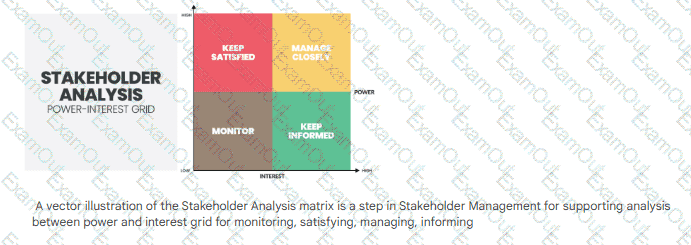
By ranking stakeholders and their needs, the project manager can create a targeted engagement strategy that addresses the most significant project influences first, which is a core principle of Project Stakeholder Management.
Project managers who lead by example and follow through on the commitments they make demonstrate the key interpersonal skill of:
influencing
leadership
motivation
coaching
The Answer Is:
BExplanation:
According to the PMBOK® Guide (Project Management Body of Knowledge), specifically within the Project Resource Management knowledge area and the section on Interpersonal and Team Skills:
Leadership (Option B): This is the ability to guide, motivate, and direct a team to achieve the project ' s objectives. A core component of effective leadership in a PMI context is leading by example and establishing trust through integrity and follow-through on commitments. Leadership involves communicating the vision and inspiring the project team to perform high-quality work.
Influencing (Option A): While related to leadership, influencing is specifically the practice of sharing power and relying on interpersonal skills to get others to cooperate toward common goals. It is often used when a Project Manager has little or no direct authority over team members (matrix environments).
Motivation (Option C): This refers to the process of providing a reason for someone to act. While leaders motivate their teams, " Motivation " as a skill focuses more on understanding what drives individual team members (using theories like Maslow or Herzberg) to keep them engaged.
Coaching (Option D): This is a specific development technique used to help team members improve their skills and competencies. It is a more targeted, one-on-one pedagogical approach rather than the broad, project-wide behavioral standard of leading by example.
In the PMI framework, Leadership is considered one of the three pillars of the PMI Talent Triangle® (alongside Technical Project Management and Strategic and Business Management). By demonstrating consistency and commitment, the Project Manager builds the necessary " referent power " to guide the team through the complexities of the project life cycle.
Which is an example of analogous estimating?
Estimates are created by individuals or groups with specialized knowledge.
Estimates are created by using information about resources of previous similar projects.
Estimates are created by analyzing data.
Estimates are created at the task level and aggregated upwards.
The Answer Is:
BExplanation:
According to the PMBOK® Guide, Analogous Estimating is a technique for estimating the duration or cost of an activity or a project using historical data from a similar activity or project. It is frequently used in the Estimate Costs and Estimate Activity Durations processes.
How it Works: It uses the values of parameters—such as scope, cost, budget, and duration—or measures of scale (size, weight, complexity) from a previous, similar project as the basis for estimating the same parameter or measure for a current project.
When to Use: It is generally used when there is a limited amount of detailed information about the project (e.g., in the early phases of a project).
Accuracy and Cost: Analogous estimating is generally less costly and time-consuming than other techniques, but it is also generally less accurate. It is most reliable when the previous projects are similar in fact and not just in appearance, and the project team members preparing the estimates have the needed expertise.
Top-Down Approach: This is often referred to as a " top-down " estimating technique because it looks at the project as a whole based on past performance rather than breaking it down into minute details.
Analysis of Other Options:
A. Estimates are created by individuals or groups with specialized knowledge: This describes Expert Judgment. While expert judgment is often used during analogous estimating to determine if a past project is a valid comparison, the definition of analogous estimating specifically hinges on the use of historical data from similar projects.
C. Estimates are created by analyzing data: This is a broad description of Data Analysis (such as Alternative Analysis or Reserve Analysis). While estimating involves data, it is not the specific definition of the analogous technique.
D. Estimates are created at the task level and aggregated upwards: This describes Bottom-Up Estimating, which is the opposite of analogous estimating. Bottom-up estimating is more detailed and accurate but requires a well-defined WBS.
Projects are separated into phases or subprojects; these phases include:
feasibility study, concept development, design, and prototype.
initiate, plan, execute, and monitor.
Develop Charter, Define Activities, Manage Stakeholder Expectations, and Report Performance.
Identify Stakeholders, develop concept, build, and test.
The Answer Is:
AExplanation:
According to the PMBOK® Guide, a Project Life Cycle is the series of phases that a project passes through from its start to its completion. It provides the basic framework for managing the project.
Project Phases: These are a collection of logically related project activities that culminates in the completion of one or more deliverables. The names and number of phases are determined by the management and control needs of the organization, the nature of the project itself, and its application area.
Common Examples of Phases: In many industries (especially technical or construction), a project is divided into technical stages such as:
Feasibility Study: Determining if the project is viable.
Concept Development: Defining the high-level idea.
Design: Creating the blueprints or technical specifications.
Prototype/Build: Creating a preliminary version or the final product.
Phase-to-Phase Relationships: Phases can be sequential (one finishes before the next starts) or overlapping (fast-tracking).
Analysis of Other Options:
B. initiate, plan, execute, and monitor: These are Process Groups, not project phases. Process groups occur within every phase of a project. For example, you " plan " the design phase and you " plan " the prototype phase.
C. Develop Charter, Define Activities...: These are specific Processes found within the PMBOK® Guide. They are actions taken by the project manager, not the chronological stages of the project ' s life cycle.
D. Identify Stakeholders, develop concept...: This option mixes a Process (Identify Stakeholders) with project phases. While identifying stakeholders is a critical activity, it is a process that begins in the Initiating Process Group, not a phase name in itself.
Which of the following technology platforms is most effective for sharing information when managing virtual project teams?
Video conferencing
Audio conferencing
Shared portal
Email/chat
The Answer Is:
CExplanation:
According to the PMBOK® Guide (6th and 7th Editions), managing virtual project teams requires a focus on centralizing project information to maintain a " single source of truth. " While all the listed tools facilitate communication, a Shared Portal (such as a project site, intranet, or cloud-based document management system) is considered the most effective for sharing information.
Why a Shared Portal is the most effective:
Asynchronous Access: Virtual teams often operate in different time zones. A shared portal allows team members to access the most recent documents, schedules, and requirements at any time without needing the sender to be online.
Information Integrity: It prevents version control issues that commonly occur with email or chat, ensuring everyone is working from the same " verified " artifacts.
Knowledge Management: It acts as a repository for Organizational Process Assets (OPAs) and project-specific documentation, supporting the Manage Project Knowledge process.
Analysis of Distractors:
A and B (Video/Audio Conferencing): These are excellent for collaboration and real-time discussion (synchronous communication), but they are less effective for sharing and storing information. Once the call ends, the information is gone unless recorded and manually shared elsewhere.
D (Email/chat): While useful for quick updates, email and chat often lead to " information silos " where critical data is buried in long threads or private conversations, making it difficult for the entire virtual team to find and use information consistently.
Key Concept: In the context of Project Communications Management, the project manager must select the right Communication Technology. For virtual teams, the emphasis is on centralization and accessibility, which is best provided by a shared workspace or portal.
A project sponsor has asked the project manager to determine how soon the project can be completed. Which of the following methods can a project manager use to find this information?
Scope baseline
Decomposition
Critical path method (CPM)
Work breakdown structure (WBS)
The Answer Is:
CExplanation:
According to the PMBOK® Guide, specifically within the Develop Schedule process, the Critical Path Method (CPM) is the primary technique used to estimate the minimum project duration and determine the amount of scheduling flexibility on the logical network paths within the schedule model.
Determining Duration: CPM calculates the theoretical start and finish dates for all activities without regard for any resource limitations. By performing a forward and backward pass analysis through the schedule network, the project manager identifies the sequence of activities that represents the longest path through the project.
The Critical Path: The " critical path " is the sequence of activities that determines the shortest time possible to complete the project. Any delay in an activity on the critical path will directly impact the project ' s finish date.
Total Float: This method also identifies the " float " or " slack " (the amount of time an activity can be delayed without delaying the project finish date) for non-critical activities.
Answering the Sponsor: When a sponsor asks " how soon " a project can be finished, the PM uses CPM to provide a data-driven completion date based on the logical sequence of work.
Analysis of other options:
Scope baseline (Option A): This is a component of the project management plan that includes the project scope statement, WBS, and WBS dictionary. While it defines what work needs to be done, it does not provide information on when or how fast that work can be completed.
Decomposition (Option B): This is a technique used in both Create WBS and Define Activities. It involves breaking down project deliverables into smaller, more manageable components. It is a prerequisite for scheduling but does not calculate the project duration itself.
Work breakdown structure (Option D): The WBS is a deliverable-oriented hierarchical decomposition of the total scope. Like the scope baseline, it identifies the work packages but does not include the logical dependencies or durations required to calculate a project ' s end date.
Per PMI standards, the Critical Path Method is the essential tool for schedule analysis, providing the project manager with the specific date the project can be completed based on the current sequence of activities.
What specific quality considerations should be examined while completing Quality Management plan?
Risk registerB Stakeholder engagement
Continuous improvement
Standards and regulatory compliance
The Answer Is:
CExplanation:
According to the PMBOK® Guide, the Plan Quality Management process involves identifying quality requirements and/or standards for the project and its deliverables, and documenting how the project will demonstrate compliance with these quality requirements.
Standards and Regulatory Compliance: This is a fundamental consideration because every project operates within a specific environment that may have legal, industry, or organizational standards.
Standards: These can be internal (company-wide quality levels) or external (ISO standards, IEEE, etc.).
Regulatory Compliance: This involves mandatory laws or regulations that the project ' s product must adhere to. Failure to examine these during the planning phase can lead to significant rework, legal issues, or project failure.
Impact on the Plan: By examining these considerations early, the project manager defines the " Quality Metrics " and " Quality Checklists " that will be used during the Control Quality process.
Analysis of other options:
Risk register / Stakeholder engagement (Option A): While these are inputs to the Plan Quality Management process (the risk register contains threats that may impact quality, and stakeholders define the quality requirements), they are not the quality considerations themselves that define the plan ' s criteria.
Continuous improvement (Option B): Also known as Kaizen, this is an overarching philosophy or a technique used within the Manage Quality process. While important, the specific considerations used to build the plan focus on the requirements and rules the project must follow (standards/compliance).
Per PMI standards, ensuring Standards and regulatory compliance is part of the " Cost of Quality " (specifically, the Cost of Conformance), ensuring the project avoids the high costs associated with non-conformance and failure.
Which statement correctly describes the value of a business case?
It provides the necessary information to determine if a project is worth the required investment.
It provides for alternative dispute resolution procedures in event of contract default.
It offers one of several alternative scenarios which assist in performing qualitative risk analysis.
It is used to help a project manager understand the scope of commercial advantages.
The Answer Is:
AExplanation:
According to the PMBOK® Guide, a Business Case is a high-level strategic document that justifies the investment in a project. It is typically created during the pre-project phase and serves as a primary input to the Develop Project Charter process.
Purpose of the Business Case: The business case lists the objectives and reasons for initiating the project. It helps the organization ' s leadership or a project steering committee determine if the expected outcomes (benefits) justify the cost and resources required.
Key Components: A standard business case usually includes:
Business Need: The problem or opportunity being addressed.
Analysis of the Situation: Identifying organizational goals, strategies, and objectives.
Recommendation: A statement of the recommended solution and the feasibility of that solution.
Evaluation: A statement describing the plan for measuring the benefits the project will deliver (linked to the Benefits Management Plan).
Economic Feasibility: It often contains financial indicators such as Net Present Value (NPV), Internal Rate of Return (IRR), and Payback Period to prove the project ' s financial viability.
Analysis of Other Options:
B. It provides for alternative dispute resolution procedures in event of contract default: This describes a component typically found in a Contract or a Procurement Management Plan, not a business case.
C. It offers one of several alternative scenarios which assist in performing qualitative risk analysis: While a business case may discuss risks, it is not a tool for Qualitative Risk Analysis. Scenario analysis is more closely related to Quantitative Risk Analysis or Plan Risk Responses.
D. It is used to help a project manager understand the scope of commercial advantages: While it does discuss advantages, this description is too narrow. The project manager uses the Project Charter (which is authorized by the business case) to understand their authority and the project goals. The business case is primarily for the Sponsor to justify the investment.
Which conflict resolution technique searches for solutions that bring some degree of satisfaction to all parties in order to temporarily or partially resolve the conflict?
Force/direct
Withdraw/avoid
Compromise/reconcile
Collaborate/problem solve
The Answer Is:
CExplanation:
In accordance with the PMBOK® Guide (Project Resource Management), specifically within the Develop Team and Manage Team processes, conflict management is a key tool and technique. There are five general techniques used to resolve conflict, each with a different impact on the relationship and the result.
Compromise/Reconcile is defined by the following characteristics:
Nature of the Solution: It involves searching for solutions that bring some degree of satisfaction to all parties.
Outcome: Because each party is required to give up something, it often results in a " lose-lose " or " partially win-partially win " scenario.
Resolution Duration: This technique is often used to temporarily or partially resolve the conflict. It is a middle-ground approach that may not address the underlying root cause but allows the project to move forward in the short term.
Context: It is typically used when the parties have equal power, when a temporary settlement is needed for a complex issue, or when a quick solution is required under time pressure.
Analysis of Distractors:
A. Force/direct: This is a " win-lose " approach where one ' s viewpoint is pushed at the expense of others. It offers a hard-fast solution but often results in resentment and is not aimed at the satisfaction of all parties.
B. Withdraw/avoid: This involves retreating from an actual or potential conflict situation or postponing the issue to be better prepared or to be resolved by others. It does not provide satisfaction to the parties involved.
D. Collaborate/problem solve: This is the preferred technique in most project situations. It incorporates multiple viewpoints and insights from differing perspectives and requires a cooperative attitude and open dialogue that typically leads to consensus and long-term commitment. Unlike compromise, it aims for a " win-win " solution.
Which process develops options and actions to enhance opportunities and reduce threats to project objectives?
Identify Risks
Control Risks
Plan Risk Management
Plan Risk Responses
The Answer Is:
DExplanation:
According to the PMBOK® Guide, the process of Plan Risk Responses is specifically defined as the process of developing options, selecting strategies, and agreeing on actions to address overall project risk exposure, as well as to treat individual project risks.
Addressing Threats and Opportunities: This process identifies specific ways to handle risks. For threats (negative risks), strategies include Avoid, Transfer, Mitigate, or Accept. For opportunities (positive risks), strategies include Exploit, Share, Enhance, or Accept.
Enhancing and Reducing: The primary goal is to " enhance opportunities " by increasing their probability or impact and to " reduce threats " by decreasing their probability or impact.
Action-Oriented: Unlike the identification or analysis phases, this process results in the Risk Response Plan, which is integrated into the Project Management Plan and includes budget and schedule allocations for the chosen responses.
Why the other options are incorrect:
A. Identify Risks: This is the process of determining which risks may affect the project and documenting their characteristics. It focuses on finding the risks, not on developing the actions to fix them.
B. Control Risks (referred to as Monitor Risks in newer editions): This is a Monitoring and Controlling process. It involves tracking identified risks, monitoring residual risks, identifying new risks, and evaluating risk process effectiveness. It does not " develop " the initial options; it ensures the developed options are working.
C. Plan Risk Management: This process defines how to conduct risk management activities for a project. It establishes the " methodology " and " rules of engagement " for risk management but does not address specific individual risks or their response actions.
Which tasks should a project manager accomplish in order to manage project scope correctly?
Define. Validate, and Control Scope. Control Schedule; Control Costs and Manage Stakeholder Engagement
Collect Requirements. Define Scope. Create WBS. Develop Schedule, and Manage Stakeholder Engagement
Plan Scope Management; Collect Requirements; Define. Validate, and Control Scope; and Create WBS
Define. Validate, and Control Scope. Control Costs. Manage Stakeholder Engagement, and keep budget under control
The Answer Is:
CExplanation:
According to the PMBOK® Guide, Project Scope Management includes the processes required to ensure that the project includes all the work required, and only the work required, to complete the project successfully. To manage scope correctly, a project manager must follow the specific sequence of processes defined within the Scope Management Knowledge Area.
The six core processes are:
Plan Scope Management: Creating a scope management plan that documents how the project and product scope will be defined, validated, and controlled.
Collect Requirements: Determining, documenting, and managing stakeholder needs and requirements to meet project objectives.
Define Scope: Developing a detailed description of the project and product.
Create WBS: Subdividing project deliverables and project work into smaller, more manageable components.
Validate Scope: Formalizing acceptance of the completed project deliverables.
Control Scope: Monitoring the status of the project and product scope and managing changes to the scope baseline.
Analysis of Other Options:
A. Control Schedule; Control Costs: These belong to the Schedule Management and Cost Management Knowledge Areas, respectively. While related to overall project health, they are not tasks used to manage scope specifically.
B. Develop Schedule: This is a Schedule Management process. Managing scope is the precursor to developing a schedule, but the schedule itself is not a scope management task.
D. Control Costs; Manage Stakeholder Engagement: These are processes from other Knowledge Areas. " Keeping budget under control " is a goal of Cost Management, not a defined process for managing Scope.
When addressing roles and responsibilities,which item ensures that the staff has the skills required to complete project activities?
Authority
Role
Competency
Responsibility
The Answer Is:
CExplanation:
According to the PMBOK® Guide, specifically within the Plan Resource Management process, defining roles and responsibilities is a critical step in ensuring the project team is equipped for success. The specific attribute that addresses the skills and capacities of the team is Competency.
In a professional project management context, roles and responsibilities are broken down into four key components:
Role: The label describing the portion of a project for which a person is accountable (e.g., Civil Engineer, Business Analyst, or Tester).
Authority: The right to apply project resources, make decisions, sign approvals, or accept deliverables.
Responsibility: The assigned duties and work that a project team member is expected to perform.
Competency: The skill and capacity required to complete project activities. If a team member does not possess the required competencies, project performance can be jeopardized.
A. Authority: This refers to the power granted to an individual to make decisions or use resources. While a person may have the authority to act, it does not guarantee they have the technical skills (competency) to do the work correctly.
B. Role: This is simply a title or designation. It describes who someone is in the project hierarchy, not their specific level of skill or ability.
D. Responsibility: This is the obligation to perform the work. A person can be responsible for a task but still lack the underlying competency needed to execute it to the required quality standards.
In PMI standards, if the team members do not have the required competencies, the project manager is responsible for initiating proactive responses, such as:
Training: To develop the necessary skills.
Hiring/Acquisition: Bringing in experts who already possess the competency.
Schedule/Scope Adjustments: Adjusting the project to align with the available skill sets of the current team.
A project manager is working in an environment where requirements are not very clear and may change during the project. In addition, the project has several stakeholders and is technically complex.
Which strategies should the project manager take into account for risk management in this environment?
Occasionally identify, evaluate, and classify risks.
Review requirements and cross-functional project teams.
Include contingency reserves and update the project management plan frequently.
Frequently review incremental work products and update the requirements for proper prioritization.
The Answer Is:
DExplanation:
In environments characterized by unclear requirements, high stakeholder density, and technical complexity, the PMBOK® Guide and the Agile Practice Guide recommend an adaptive or iterative approach to risk management.
Risk Reduction through Increments: In complex projects, the greatest risk is building the wrong product or failing to meet stakeholder expectations. By " frequently reviewing incremental work products " (e.g., through Sprint Reviews or Demos), the project manager uncovers risks related to technical feasibility and requirement alignment early.
Dynamic Prioritization: Risks in these environments are often tied to the product backlog. Constant " proper prioritization " ensures that the team addresses high-risk, high-value items first (often called a Risk-Adjusted Backlog). This allows the team to fail fast or pivot before significant resources are spent.
Stakeholder Feedback Loops: Frequent reviews engage stakeholders directly, reducing the risk of " expectation gap " and ensuring that the technical complexity is being managed in a way that provides actual business value.
Analysis of Other Options:
A. Occasionally identify, evaluate, and classify risks: In a highly complex and changing environment, " occasional " reviews are insufficient. Risk management must be continuous and integrated into every iteration.
B. Review requirements and cross-functional project teams: While having a cross-functional team is a good practice, simply " reviewing " them does not constitute a risk management strategy that addresses technical complexity or shifting requirements as effectively as incremental delivery does.
C. Include contingency reserves and update the project management plan frequently: This is a more traditional/predictive response to risk. While reserves are important, they are a reactive measure (Acceptance). In a complex/adaptive environment, the proactive strategy is to reduce uncertainty through incremental validation (Option D).
Which tool and technique is used in Conduct Procurements?
Teaming agreements
Expert judgment
Bidder conferences
Contract types
The Answer Is:
CExplanation:
In accordance with the PMBOK® Guide, the process of Conduct Procurements involves obtaining seller responses, selecting a seller, and awarding a contract. Bidder conferences (also known as contractor conferences, vendor conferences, or pre-bid conferences) are a primary tool and technique used during this phase.
Purpose of Bidder Conferences: These are meetings between the buyer and all prospective sellers before the submittal of a bid or proposal. They are used to ensure that all prospective sellers have a clear, common understanding of the procurement requirements (such as technical requirements and contract terms) and that no bidder receives preferential treatment.
Ensuring Fairness: All questions from sellers are answered publicly so that every participant has access to the same information, maintaining the integrity of the competitive process.
Comparison with Other Options:
Teaming Agreements (A): These are legal contractual documents (Outputs) or inputs established earlier in the planning phase, not a tool used during the conduct of procurements to process bids.
Expert Judgment (B): While used in many processes, in the specific context of the " Conduct Procurements " tools and techniques list in the PMBOK® Guide, Bidder Conferences, Proposal Evaluation, and Advertising are more specific key techniques.
Contract Types (D): These are part of the Procurement Management Plan (an Input) created during the Plan Procurement Management process.
On a clinical trial project, the project manager is worried about maintaining control of the project. The project manager decides to use a requirements traceability matrix.
What is the advantage of using this tool?
Scope creep will be prevented.
Resource allocation will be kept to a minimum.
Project closure will be established.
Project costs will be controlled.
The Answer Is:
AExplanation:
In the PMBOK® Guide, the Requirements Traceability Matrix (RTM) is a key output of the Collect Requirements process and a primary tool used during Control Scope. It provides a structure to ensure that every requirement adds business value by linking it to the project objectives.
Why Choice A is correct:
Preventing Scope Creep: Scope creep is the uncontrolled expansion of product or project scope without adjustments to time, cost, and resources.
The " Anchor " Effect: The RTM acts as an anchor. When a new feature is suggested, the Project Manager can check it against the RTM. If the feature doesn ' t map back to an approved business objective or requirement, it is easily identified as " out of scope. "
Maintaining Control: In highly regulated environments like clinical trials, maintaining strict control is essential. The RTM ensures that the team stays focused only on the validated requirements, preventing " gold plating " or undocumented additions.
Analysis of other options:
B (Resource allocation kept to a minimum): The RTM tracks requirements, not people or equipment. While knowing your requirements helps in planning resources, the matrix itself does not minimize or manage the allocation of staff.
C (Project closure will be established): While the RTM is used during closure to verify that all requirements were met, it does not " establish " closure. Closure is a formal process involving the transition of the product and the release of resources.
D (Project costs will be controlled): Cost control is handled through the Cost Management Plan and Earned Value Management. While the RTM helps prevent scope creep (which in turn saves money), its direct function is scope management, not financial tracking.
Key Concept: The Project Management Institute (PMI) emphasizes that the Requirements Traceability Matrix (Choice A) provides the " why " for every task. By ensuring that every work product is tied to a specific requirement, the project manager can maintain a high level of control, ensuring the project delivers exactly what was promised—no more and no less.
Which of the following is an input to Direct and Manage Project Execution?
Requested changes
Approved change requests
Work performance information
Implemented defect repair
The Answer Is:
BExplanation:
According to the PMBOK® Guide, the Direct and Manage Project Work process (formerly referred to as Direct and Manage Project Execution in older editions) is the process of leading and performing the work defined in the project management plan and implementing approved changes to achieve the project ' s objectives.
Approved Change Requests: These are a critical input to this process. Once a change request is processed through the Perform Integrated Change Control process and receives formal approval, it is sent back to the Direct and Manage Project Work process to be implemented.
Types of Changes: These can include corrective actions, preventive actions, or defect repairs.
Execution: The project team carries out the work associated with these approved changes alongside the originally planned project activities.
Other Key Inputs:
Project Management Plan: Provides the " blueprints " for all project work.
Project Documents: Such as the requirements documentation, project schedule, and risk register.
Organizational Process Assets (OPAs) and Enterprise Environmental Factors (EEFs).
Comparison with other options:
A. Requested changes: These are an output of various processes (including Direct and Manage Project Work itself) when the team identifies that a change is necessary. They do not become an input to execution until they have been " Approved. "
C. Work performance information: This is typically an output of the Control processes (like Control Schedule or Control Costs). The Direct and Manage process produces Work Performance Data (raw observations), which is then processed into Information by the controlling functions.
D. Implemented defect repair: This is an output of the Direct and Manage Project Work process. It represents the result of taking action on an approved change request regarding a defect.
A project manager is leading a project in a volatile industry. Industry standards are updated often, which requires the project team to make frequent adjustments to their work.
What should the project manager create to manage the possible changes?
Communications management plan
Cost management plan
Risk management plan
Quality management plan
The Answer Is:
DExplanation:
In a " volatile industry " where " industry standards are updated often, " the primary challenge is ensuring that the project ' s deliverables remain compliant with those changing standards. This falls directly under the umbrella of Quality Management.
Why Choice D is correct:
Compliance and Standards: The Quality Management Plan is the component of the project management plan that describes how the project will implement the organization’s quality policy and ensure the project meets its required standards.
Managing Adjustments: When standards change, the requirements for what constitutes a " high-quality " or " compliant " deliverable also change. The Quality Management Plan defines the processes for Quality Assurance (auditing the standards) and Quality Control (checking the work), providing a framework for the team to pivot and adjust their work to stay in alignment with the industry.
Prevention over Inspection: By having a robust quality plan, the project manager can build in " check-ins " to scan for updated industry regulations, preventing the team from completing work that is already obsolete.
Analysis of other options:
A (Communications management plan): While you need to communicate about the changes, this plan dictates who gets what information and when. It doesn ' t provide the technical or procedural framework for adjusting the actual work to meet new standards.
B (Cost management plan): This plan manages the budget. While changes to standards might cost more money, the cost plan doesn ' t help you manage the nature of the work adjustments—it only manages the financial fallout.
C (Risk management plan): While changing standards are a risk, the risk plan identifies and prepares for uncertain events. The prompt describes a situation that happens " often " and requires " frequent adjustments, " shifting it from a potential risk to a recurring operational quality requirement.
Key Concept: The Project Management Institute (PMI) emphasizes that Quality is the degree to which a set of inherent characteristics fulfills requirements. In a fast-moving industry, the Quality Management Plan (Choice D) is the essential tool for maintaining the integrity of the project ' s output, ensuring that the final product is not only finished on time but is actually usable and legal within its current industrial context.
After recommending to Tan (client) to leave the feature out, what should the project manager do?

Document the end user feedback and follow the change control process in order to define small-scale prototypes to test ideas and try new approaches during future iterations.
Have the end user write a user story with a brief description of an outcome of the feature.
Check with the project team that the resources needed to add this feature are made available by restructuring the timeline and reducing initial quantities.
Enable a stakeholder change in order to facilitate the project to provide the required deliverable as well as the intended outcome.
The Answer Is:
AExplanation:
In the provided comic strip, the Project Manager/Product Owner (Lucia) is faced with a client (Tan) who wants to add a " new feature that will revolutionize the industry " late in the project. Even though the project is currently on track, adding a significant feature requires a disciplined approach to avoid scope creep.
Why Choice A is correct:
Change Control Process: In any professional project environment, a new request must go through the formal Change Control Process. This ensures the impact on time, cost, and quality is assessed before any work begins.
Agile/Iterative Approach: By mentioning " future iterations " and " prototypes, " this choice aligns with Agile best practices. Instead of blindly adding a massive feature, the team tests the idea through small-scale models (prototypes) to validate the " revolutionary " claim before committing full resources.
Evidence-Based: Documenting end-user feedback ensures that the decision to include or exclude the feature is based on actual data rather than just the client ' s opinion.
Analysis of other options:
B (Have the end user write a user story): While user stories are great, simply writing one doesn ' t address the impact of the change on the current project constraints. This skips the necessary assessment and approval steps.
C (Check with the project team... restructure timeline): This is a reactive approach that assumes the feature must be added. A Project Manager should never restructure a timeline or reduce quantities until the change has been officially analyzed and approved.
D (Enable a stakeholder change): This is vague and doesn ' t follow standard project management terminology. " Enabling a stakeholder change " is not a standard procedure for handling new feature requests.
Key Concept: The Project Management Institute (PMI) emphasizes that the Project Manager must be a " guardian of the scope. " When a client proposes a " revolutionary " idea late in the game, the correct professional response is to funnel that enthusiasm through the Change Control System (Choice A) to protect the project ' s baseline while still being open to future innovation.
Which of the following is an input to Control Scope?
Project schedule
Organizational process assets updates
Project document updates
Work performance information
The Answer Is:
AExplanation:
According to the PMBOK® Guide, the Control Scope process is the process of monitoring the status of the project and product scope and managing changes to the scope baseline. To perform this process accurately, several components of the project management plan and various project documents are required as inputs.
While it may seem counterintuitive, the Project Schedule is a formal input to Control Scope because scope and schedule are inextricably linked.
Baseline Alignment: The schedule shows when specific deliverables (scope) are expected to be completed.
Impact Analysis: When a scope change is proposed or a variance is detected, the project manager must refer to the schedule to see how the change in work volume affects the timeline.
Integrated Control: In the PMI framework, you cannot effectively control scope without understanding the temporal constraints in which that scope must be delivered.
B. Organizational process assets updates: This is an output of the Control Scope process. After the process is performed, any new procedures or " lessons learned " regarding scope control are used to update the organization ' s assets.
C. Project document updates: This is a common output of almost all monitoring and controlling processes. As variances are found or changes are approved, documents like the Requirements Traceability Matrix or the Stakeholder Register may need to be updated.
D. Work performance information: This is an output of the Control Scope process. The input is Work Performance Data (raw observations). Once that data is compared against the scope baseline, it becomes " information " (e.g., " The project is currently 10% over-scoped " ).
The primary inputs defined by PMI for this process are:
Project Management Plan: Including the Scope Management Plan, Requirements Management Plan, Change Management Plan, Configuration Management Plan, Scope Baseline, and Schedule Baseline.
Project Documents: Such as Lessons Learned Register, Requirements Documentation, and the Requirements Traceability Matrix.
Work Performance Data: Raw data on which deliverables have been started, their progress, and which have been finished.
Organizational Process Assets: Policies and procedures for scope control.
A project team is closing out a phase and updating the organizational knowledge base What organizational process asset (OPA) will the team update?
Traceability matrixB Lessons learned
Change control proceduresD Resource availability
The Answer Is:
BExplanation:
According to the PMBOK® Guide, specifically the Close Project or Phase process, the project team is responsible for capturing and archiving project information for future use. This involves updating Organizational Process Assets (OPAs).
Lessons Learned Repository: This is the primary OPA updated at the end of a project or phase. It contains historical information and lessons learned from previous projects, providing insights into both successful and unsuccessful experiences.
Knowledge Transfer: By updating the organizational knowledge base, the team ensures that future project managers can benefit from the challenges and solutions encountered during this project. This is a critical component of Manage Project Knowledge.
Final Updates: During phase closure, the team summarizes the project ' s performance, identifies variances, and documents how they were addressed. This information is then transferred from the project ' s Lessons Learned Register (a project document) to the Lessons Learned Repository (an OPA).
Why other options are incorrect:
Option A: Traceability matrix: The Requirements Traceability Matrix is a project document used to link product requirements to the deliverables that satisfy them. While it is archived, it is not considered part of the " organizational knowledge base " used to improve future organizational processes.
Option C: Change control procedures: These are OPAs, but they are generally inputs to the project. While a project might suggest improvements to these procedures, the procedures themselves are not the standard information updated simply as a result of closing a phase.
Option D: Resource availability: This is typically categorized under Enterprise Environmental Factors (EEFs) or dynamic internal resource lists. While resource data might change, it is not part of the " knowledge base " or " lessons learned " being updated to capture project experiences.
Two resources are performing a peer review of an artifact. What should be the outcome of the peer review?
All business rules and data requirements for each process are documented.
All relevant business rules for each process are documented.
The resulting documentation adheres to established organizational standards.
The data requirements for each process are documented.
The Answer Is:
CExplanation:
According to the PMBOK® Guide and the PMI Guide to Business Analysis, a peer review is a specific type of quality control technique used to verify the technical accuracy and compliance of a project artifact before it is finalized.
Verification of Standards: The primary goal of a peer review is to ensure that the work product (whether it is a requirement document, a piece of code, or a design blueprint) is high quality and consistent with how the organization expects work to be done. This includes checking for formatting, clarity, and adherence to established organizational standards and templates.
Error Detection: Peer reviews are designed to catch mistakes, omissions, or inconsistencies that a single author might overlook. By having a colleague (a " peer " ) examine the work, the team ensures that the artifact is technically sound and " fit for purpose. "
Continuous Improvement: This process also facilitates knowledge sharing between team members, ensuring that the " best practices " of the organization are applied uniformly across all project documentation.
Analysis of other options:
Option A, B, and D: These options focus on the content of the documentation (business rules and data requirements). While a peer review will check if these are present, the specific outcome of a review is the confirmation of quality and compliance. Simply documenting rules or data does not guarantee that the work is correct or meets organizational standards. A peer review validates that what has been documented was done so correctly and according to the rules of the organization.
Per PMI standards, a peer review is an essential quality assurance activity where the main objective is to confirm that the artifact adheres to established organizational standards, ensuring consistency and professional rigor across the project.
Which of the following are processes associated with Project Cost Management?
Develop Costs. Estimate Costs, Determine Budget. Control Costs
Develop Budget, Determine Budget, Determine Risks, Control Costs
Plan Cost Management, Estimate Costs. Determine Budget. Control Costs
Plan Budget Management. Determine Budget, Create Cost Accounts. Control Costs
The Answer Is:
CExplanation:
According to the PMBOK® Guide (6th Edition), the Project Cost Management knowledge area is concerned with the processes involved in planning, estimating, budgeting, financing, funding, managing, and controlling costs so that the project can be completed within the approved budget.
There are exactly four processes within this knowledge area:
Plan Cost Management: The process of defining how the project costs will be estimated, budgeted, managed, monitored, and controlled.
Estimate Costs: The process of developing an approximation of the monetary resources needed to complete project work.
Determine Budget: The process of aggregating the estimated costs of individual activities or work packages to establish an authorized cost baseline.
Control Costs: The process of monitoring the status of the project to update the project costs and managing changes to the cost baseline.
Analysis of Distractors:
A (Develop Costs): " Develop Costs " is not a recognized PMI process name. The correct term is " Estimate Costs. "
B (Determine Risks): This process belongs to the Project Risk Management knowledge area. Additionally, " Develop Budget " is not a formal process name (it is " Determine Budget " ).
D (Plan Budget Management / Create Cost Accounts): While cost accounts exist within the Work Breakdown Structure (WBS), " Create Cost Accounts " is not a standalone process. " Plan Budget Management " is also incorrect; the process is " Plan Cost Management. "
Key Document Reference: Section 7.0 of the PMBOK® Guide introduces these four processes as the standard framework for ensuring financial integrity throughout the project life cycle.
In one of the project meetings during a project execution, a new stakeholder attends and highlights a new risk. What should the project manager do next?
Add this risk to the lessons learned register on project completion.
Add the stakeholder to the stakeholder register and add the risk to the risk register.
Make sure proper testing gets completed to minimize the risk highlighted.
Ignore the risk from this stakeholder as this stakeholder never showed up at the start of the project.
The Answer Is:
BExplanation:
According to the PMBOK® Guide, both stakeholder management and risk management are iterative processes that continue throughout the entire project lifecycle. Project environments are dynamic, and new information must be captured as soon as it is identified.
Why Choice B is correct:
Stakeholder Register: Since this is a " new " stakeholder, the Project Manager must first perform the Identify Stakeholders process. Adding them to the Stakeholder Register ensures their influence, interests, and communication requirements are documented and managed moving forward.
Risk Register: One of the primary responsibilities of a stakeholder is to provide expertise and perspective. If a risk is identified—regardless of when the stakeholder joined the project—it must be formally recorded in the Risk Register as part of the Identify Risks process. Once recorded, the risk can then be analyzed (qualitatively and quantitatively) to determine the appropriate response.
Analysis of other options:
A (Add to lessons learned at completion): This is a passive approach. Lessons learned are for future projects; the risk needs to be managed now to protect the current project’s success.
C (Complete proper testing): This jumps to a solution before the risk has been analyzed. Testing is a risk response (mitigation/appraisal), but the PM must first document and assess the risk before deciding that testing is the correct course of action.
D (Ignore the risk): This is a violation of professional responsibility. Stakeholders can emerge at any time (e.g., a new regulatory officer or a replacement department head), and their input is valid regardless of their presence at the project ' s start.
By following Choice B, the Project Manager ensures that project documentation reflects the current reality of the project environment, maintaining the integrity of the Project Management Plan and ensuring all potential threats are visible to the team and sponsors.
Perform Quantitative Analysis focuses on:
compiling a lsit of known risks and preparing responses to them
assessing the probability of occurrence and impact for every risk in the risk register
evaluating the contingency and management reserves required for the project
analyzing numerically the impact of individual risks on the overall project ' s time and cost objectives
The Answer Is:
DExplanation:
According to the PMBOK® Guide, the Perform Quantitative Risk Analysis process is the process of numerically analyzing the combined effect of identified individual project risks and other sources of uncertainty on overall project objectives.
Numerical Analysis: Unlike Qualitative analysis, which uses subjective scales (like High/Medium/Low), Quantitative analysis uses mathematical modeling and data to provide a statistical approach to uncertainty.
Impact on Objectives: It specifically quantifies the potential project outcomes and their probabilities. It is used to estimate the likelihood of achieving specific project targets, such as finishing on a certain date or within a certain budget.
Tools and Techniques: Common techniques used in this process include Monte Carlo simulations, Decision Tree analysis, and Sensitivity Analysis.
Why other options are incorrect:
Option A: Compiling a list of known risks is the output of the Identify Risks process. Preparing responses is part of the Plan Risk Responses process.
Option B: Assessing probability and impact for every risk in the register is a characteristic of Perform Qualitative Risk Analysis. Quantitative analysis is often only performed on high-priority risks that have already been vetted qualitatively.
Option C: While Quantitative analysis provides the data needed to justify Contingency Reserves, the actual evaluation and allocation of reserves is an output of the Determine Budget and Develop Schedule processes. Quantitative analysis is the input that informs those calculations.
Which of the following are outputs of Develop Project Team?
Human resources plan changes and project staff assignment updates
Project management plan updates and enterprise environmental factor updates
Resource calendars and project management plan updates
Team performance assessments and enterprise environmental factor updates
The Answer Is:
DExplanation:
According to the PMBOK® Guide, specifically the Develop Team process (part of the Resource Management knowledge area), the primary goal is to improve competencies, team member interaction, and the overall team environment to enhance project performance.
When a project manager successfully develops a team through training, team-building, and establishing ground rules, the following outputs are generated:
Team Performance Assessments: As the project team’s effectiveness increases, the project management team makes formal or informal assessments of the team ' s effectiveness. These measure improvements in skills, competencies, reduced staff turnover, and increased team cohesiveness.
Enterprise Environmental Factors (EEF) Updates: The " culture " or " climate " of the organization is an EEF. By developing the team, you are effectively updating the organization ' s internal factors, such as employee development records and skill updates.
A. Human resources plan changes...: " Human Resource Plan " is a term from older PMBOK versions; the current term is Resource Management Plan. While staff assignment updates are common in other resource processes, they are not the primary output of developing the existing team.
B. Project management plan updates...: While the Project Management Plan can be updated as a result of Develop Team, this option omits the most critical output (Team Performance Assessments).
C. Resource calendars...: Resource calendars are primarily an output of the Acquire Resources process, as they document when specific resources are available for work.
To reach these outputs, the project manager uses:
Colocation (Tight Matrix)
Virtual Teams
Communication Technology
Interpersonal and Team Skills (Conflict management, influencing, motivation)
Recognition and Rewards
Training
A project manager is assigned to a project during the execution phase and consults the documents created by the previous project manager.
Which document should the project manager study to identify the ownership of the project outcome?
The lessons learned repository
The project charter
The business case
The organizational plan
The Answer Is:
BExplanation:
In the PMBOK® Guide, the Project Charter is the foundational document that formally authorizes the existence of a project and provides the project manager with the authority to apply organizational resources to project activities.
Why Choice B is correct:
Authorization and Accountability: The charter explicitly identifies the Project Sponsor (the person or group providing the resources and " owning " the outcome from a high-level perspective) and the Project Manager.
Project Objectives: It defines the " success criteria " and the measurable objectives. To understand who is ultimately responsible for accepting the project outcome, one must look at who signed the charter and who is listed as the primary authority.
Scope and Authority: It establishes the boundaries of the project and names the key stakeholders who have the power to approve or reject the final deliverables.
Continuity: When a new project manager takes over during the execution phase, the Charter serves as the " Source of Truth " to understand the project ' s original intent and governance structure.
Analysis of other options:
A (The lessons learned repository): This is a database used to store historical information from previous projects or earlier phases of the current project. While it helps avoid past mistakes, it does not define the legal or organizational " ownership " of the current project’s results.
C (The business case): This document provides the financial justification and the " Why " behind the project. While it mentions the benefits to the organization, it is a pre-project document that describes the value proposition rather than the specific ownership/governance structure of the project team and outcomes.
D (The organizational plan): This is a generic term that could refer to a company ' s strategic plan or a resource management plan. It does not specifically name the owners of a specific project ' s deliverables.
Key Concept: The Project Management Institute (PMI) emphasizes that the Project Charter (Choice B) is the " contract " between the performing organization and the project team. It bridges the gap between the high-level business goals (Business Case) and the detailed planning documents, making it the primary reference for identifying the hierarchy of ownership and authority.
Which statement describes the relationship between Manage Quality process and Control process?
Manage Quality is all about following planned processes and provedures for quality, while Control Quality is about making sure that the product which is produced conforms to customer specifications.
Control Quality is all about following planned process and procedures for quality, while Manage Quality is about making sure that the product which is produced conforms to customer specifications.
Manage Quality and Control Quality are the same
Manage Quality is part of Quality Management and Control is a subset of the Stakeholder Management Process group
The Answer Is:
AExplanation:
In the PMBOK® Guide, the distinction between Manage Quality and Control Quality is fundamental to understanding how a project manager ensures excellence throughout the project life cycle.
Manage Quality (Choice A - First Part): This is the process of translating the quality management plan into executable quality activities. It is often referred to as Quality Assurance. Its primary focus is on the processes being used. By ensuring that the team follows organizational policies and defined procedures, the project manager increases the probability that the final product will meet quality standards. It is " preventative " in nature.
Control Quality (Choice A - Second Part): This process focuses on the deliverables themselves. It involves monitoring and recording the results of executed quality activities to assess performance and ensure the project outputs are complete, correct, and meet customer requirements. It is " detective " in nature, identifying defects in the actual product before it reaches the customer.
Choice B: This incorrectly swaps the definitions of the two processes.
Choice C: This is incorrect; while they are related, they have distinct objectives (Process vs. Product) and occur at different points in the workflow.
Choice D: This is incorrect because Control Quality is a core process within the Project Quality Management knowledge area, not the Stakeholder Management process group.
By balancing both processes, the project manager ensures that the project not only builds the " right thing " (Control Quality) but also builds it the " right way " (Manage Quality).
When a permitting agency takes longer than planned to issue a permit, this can be described as a risk:
event.
response,
perception.
impact.
The Answer Is:
AExplanation:
According to the PMBOK® Guide, a project risk is an uncertain event or condition that, if it occurs, has a positive or negative effect on one or more project objectives.
Risk Event: This is the specific occurrence that triggers the risk. In this scenario, the permitting agency taking longer than planned is the " occurrence. " It is the discrete event that deviates from the original plan.
The Anatomy of a Risk:
Cause: The reason the agency is slow (e.g., bureaucracy, staff shortage).
Event: The actual delay in the permit issuance.
Impact: The result of that event (e.g., the construction start date is pushed back, resulting in increased costs).
Identification: During the Identify Risks process, the project manager records these events in the Risk Register. Describing it as an event allows the team to analyze its probability and prepare a response.
Analysis of Other Options:
B. response: This refers to the action taken to manage the risk (e.g., paying for an expedited review or starting non-permitted work early). The delay itself is the problem, not the solution.
C. perception: This relates to how stakeholders view or feel about the risk. While stakeholders might perceive a long delay as a major threat, the delay itself is an objective event.
D. impact: The impact is the consequence of the event. While a delay in permitting has an impact (like a schedule delay), the act of the agency taking too long is the event that causes that impact.
In which project risk management process is the data analysis technique not used?
Plan Risk Management
Implement Risk Response
Monitor Risks
Perform Quantitative Risk Analysis
The Answer Is:
BExplanation:
According to the PMBOK® Guide, Data Analysis is a common tool and technique used across many processes to help the project manager make informed decisions based on available information. However, it is not listed as a tool for every risk process.
Implement Risk Response (Choice B): This process focuses on executing the agreed-upon risk response plans. The primary tools and techniques for this process are Expert Judgment, Interpersonal and Team Skills (such as influencing), and Project Management Information Systems (PMIS). Since this is an execution-based process rather than an analytical one, Data Analysis is not used as a formal technique.
Plan Risk Management (Choice A): Data analysis is used here in the form of Stakeholder Analysis to determine the risk appetite of project stakeholders.
Monitor Risks (Choice C): This process heavily relies on data analysis techniques such as Technical Performance Analysis and Trend Analysis to ensure that risk responses are effective and to identify new risks.
Perform Quantitative Risk Analysis (Choice D): This is a data-intensive process that uses complex data analysis techniques including Simulations (Monte Carlo), Sensitivity Analysis, Decision Tree Analysis, and Influence Diagrams.
In summary, while risk management is generally an analytical discipline, the Implement Risk Response process is categorized under the Executing Process Group, where the focus shifts from analyzing data to taking action and influencing stakeholders to perform the required responses.
Company A’s accountant sends notification about a change in the company’s tax classification.
What would a project have to be initiated?
To change business and technological strategies
To improve processes and services
To meet regulatory and legal requirements
To satisfy stakeholder requests
The Answer Is:
CExplanation:
According to the PMBOK® Guide, projects are initiated in response to factors that influence an organization. These factors are generally categorized into four primary areas of project initiation context.
Meet Regulatory, Legal, or Social Requirements (Choice C): A change in a company’s tax classification is a formal legal and financial status update mandated by government or tax authorities. To remain compliant with the law, the company may need to initiate a project to update its financial systems, reporting structures, and accounting processes. This is a classic example of a project triggered by the need to adhere to external regulations.
Change Business or Technological Strategies (Choice A): This usually refers to a project initiated because the company wants to move in a new direction—such as launching a new product line or moving to a cloud-based infrastructure—rather than reacting to a mandatory tax change.
Improve Processes and Services (Choice B): While the tax change might involve changing a process, the reason for the project is the legal requirement itself. " Improvement " implies a choice to make something better or more efficient for the sake of performance, rather than a mandatory compliance task.
Satisfy Stakeholder Requests (Choice D): While an accountant is a stakeholder, their notification is regarding a structural/legal change. Stakeholder requests as a project trigger usually refer to specific desired features or changes requested by customers or internal executives that are not necessarily legally mandated.
By initiating a project to address Regulatory and Legal Requirements, the organization avoids penalties, fines, and legal complications, ensuring that its operations remain sustainable and legitimate under the new tax classification.
Which process documents the business needs of a project and the new product, service, or other result that is intended to satisfy those requirements?
Develop Project Management Plan
Develop Project Charter
Direct and Manage Project Execution
Collect Requirements
The Answer Is:
BExplanation:
According to the PMBOK® Guide, specifically within the Project Integration Management knowledge area, the Develop Project Charter process is the foundational step of any project. It is the process of developing a document that formally authorizes the existence of a project and provides the project manager with the authority to apply organizational resources to project activities.
Documenting Business Needs: The Project Charter is where the business case and the high-level business needs are translated into project objectives. It answers the question: " Why are we doing this project? "
Intended Result: It describes the high-level product, service, or result that the project is intended to deliver. While it does not contain the granular detail found in a scope statement, it defines the " North Star " for the project ' s success.
Key Components of the Charter:
Project Purpose: The measurable objectives and related success criteria.
High-Level Requirements: The fundamental needs of the project.
High-Level Product Description: What is being built at a conceptual level.
Assigned Project Manager: Responsibility and authority levels.
Strategic Link: The charter establishes a direct link between the project and the strategic objectives of the organization. It is usually authored by the Sponsor or an external entity, rather than the project manager, although the project manager often assists in its creation.
Comparison with other options:
A. Develop Project Management Plan: This process focuses on how the project will be managed, executed, and controlled. It uses the Charter as an input but is not the document that defines the initial business need or high-level product.
C. Direct and Manage Project Execution: This is an Executing process. It is the " doing " phase where the work defined in the plan is carried out. It assumes the business needs and requirements have already been documented and approved.
D. Collect Requirements: This process occurs during Planning. While it documents requirements, it focuses on the detailed needs of stakeholders. The " intended result " and the overarching " business need " that justifies the project ' s existence must be documented in the Charter before detailed requirements can be collected.
During a virtual kick-off session, the project sponsor highlights the significance of the project to the company. What message should be conveyed to the team in this meeting?
Bonuses based on accomplishment criteria
New working contract with more benefits
Promotion opportunities with this project
Assignment of key roles and responsibilities
The Answer Is:
DExplanation:
According to the PMBOK® Guide and the PMI Standard for Project Management, the Kick-off Meeting is a vital event that typically occurs at the end of planning and the start of execution. Its primary purpose is to communicate the project objectives, gain team commitment, and explain the roles and responsibilities of each stakeholder.
Why Choice D is correct: While the sponsor provides the " big picture " (strategic significance), the team needs functional clarity to begin work. The Assignment of key roles and responsibilities ensures that every team member understands their expectations and how they contribute to the significant goals mentioned by the sponsor. This is often documented in a Responsibility Assignment Matrix (RAM), such as a RACI chart. Defining " who does what " prevents duplication of effort and ensures accountability from day one.
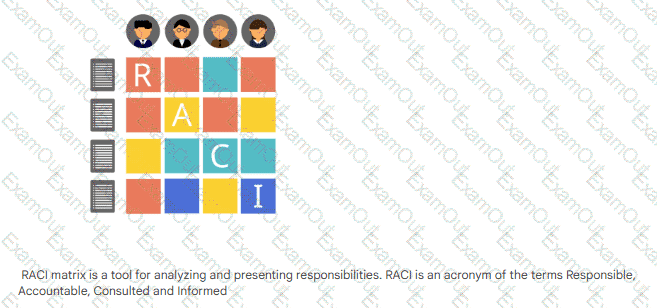
Analysis of other options:
A, B, and C: While bonuses, contracts, and promotions (Rewards and Recognition) are part of Resource Management, they are generally handled through HR or private 1-on-1 discussions between the Project Manager and functional managers. Discussing individual personal gain (bonuses or promotions) as the primary message during a kick-off meeting can distract from the project ' s collective mission and goals.
The Project Management Institute (PMI) emphasizes that a successful kick-off session should align the team around a common vision. Assigning roles (Choice D) provides the structure necessary to transform that vision into actionable results.
The approaches, tools, and data sources that will be used to perform risk management on a project are determined by the:
Methodology
Risk category
Risk attitude
Assumption analysis
The Answer Is:
AExplanation:
According to the PMBOK® Guide, specifically the Plan Risk Management process, the Methodology is a key component of the Risk Management Plan.
Definition of Methodology in Risk: It defines the specific approaches, tools, and data sources that will be used to perform risk management on a project. This ensures that the degree, type, and visibility of risk management are proportionate to both the risk and the importance of the project to the organization.
Role in Planning: During the Plan Risk Management process, the project team decides how to conduct risk management activities. The " Methodology " section of the resulting plan outlines whether the team will use qualitative analysis, quantitative modeling, specific software tools, or standardized organizational templates.
Consistency: By defining the methodology upfront, the project manager ensures a consistent approach to identifying, analyzing, and responding to risks throughout the project life cycle.
Comparison with other options:
B. Risk category: This refers to the Risk Breakdown Structure (RBS), which provides a means for grouping potential causes of risk (e.g., Technical, External, Organizational). It is a way to organize risks, not the selection of tools or data sources to manage them.
C. Risk attitude: This describes the disposition of stakeholders toward uncertainty (e.g., risk-averse, risk-seeking). While risk attitude influences the thresholds and how much risk is acceptable, it does not define the technical tools or data sources used.
D. Assumption analysis: This is a specific Tool and Technique used during the Identify Risks process to explore the validity of assumptions. It is a single activity within risk management, rather than the overarching definition of the tools and approaches for the entire project.
Which item is a cost of conformance?
Training
Liabilities
Lost business
Scrap
The Answer Is:
AExplanation:
According to the PMBOK® Guide (Project Management Body of Knowledge), specifically within the Project Quality Management knowledge area and the Cost of Quality (COQ) framework, costs are divided into Cost of Conformance and Cost of Nonconformance.
Cost of Conformance (Option A): This represents the money spent during the project to avoid failures. It is subdivided into Prevention Costs (building a quality product) and Appraisal Costs (assessing quality). Training is a primary example of a Prevention Cost. By educating the team on the correct processes and standards, the project reduces the likelihood of errors occurring in the first place. Other examples include document processes, equipment maintenance, and quality audits.
Scrap (Option D): This is a Cost of Nonconformance (specifically an Internal Failure Cost). It represents the cost of work that must be discarded because it does not meet quality standards before it reaches the customer.
Liabilities (Option B) and Lost Business (Option C): These are Costs of Nonconformance (specifically External Failure Costs). These are costs incurred after the product has reached the customer, such as warranty work, legal penalties (liabilities), and damage to the organization ' s reputation resulting in lost future revenue.
In the PMI framework, it is generally considered more cost-effective to invest in the Cost of Conformance (like Training) early in the project to minimize the much higher and more damaging Costs of Nonconformance later on.
A project has a current cost performance index (CPI) of 1.25. To date, US$10,000 have been spent on performing the project work. What is the earned value of the work completed to date?
US$S000
US$9500
US$10,000
US$12,500
The Answer Is:
DExplanation:
According to the PMBOK® Guide, specifically within the Control Costs process, the Cost Performance Index (CPI) is a measure of the cost efficiency of budgeted resources, expressed as the ratio of earned value to actual cost.
The Formula: The formula for CPI is:
$$CPI = \frac{EV}{AC}$$
Where:
EV (Earned Value): The value of the work actually performed expressed in terms of the approved budget assigned to that work.
AC (Actual Cost): The total cost actually incurred and recorded in accomplishing work performed for an activity or work breakdown structure component.
The Calculation:
Given the values from the question:
$CPI = 1.25$
$AC = \$10,000$
We rearrange the formula to solve for EV:
$$EV = CPI \times AC$$
$$EV = 1.25 \times 10,000$$
$$EV = 12,500$$
Interpretation: A CPI of 1.25 means that for every dollar spent on the project, the project has earned $1.25 worth of work. Since the CPI is greater than 1.0, the project is currently under budget (performing efficiently).
Comparison with Other Options:
A. US$8,000: This would be the result if the CPI were 0.8 ($0.8 \times 10,000$). A CPI less than 1.0 indicates the project is over budget.
B. US$9,500: This would be the result if the CPI were 0.95.
C. US$10,000: This would be the result if the CPI were 1.0 ($EV = AC$), indicating the project is exactly on budget.
D. US$12,500: This is the correct mathematical result of the provided CPI and Actual Cost.
An input to the Perform Quantitative Risk Analysis process is the:
quality management plan.
project management plan.
communications management plan.
schedule management plan.
The Answer Is:
DExplanation:
According to the PMBOK® Guide, specifically within the Project Risk Management knowledge area, the Schedule Management Plan is a vital input to the Perform Quantitative Risk Analysis process.
Process Context: Perform Quantitative Risk Analysis is the process of numerically analyzing the combined effect of identified individual project risks and other sources of uncertainty on overall project objectives.
The Role of the Schedule Management Plan: This plan provides the necessary guidance and criteria for developing and maintaining the project schedule. Quantitative analysis often involves Monte Carlo simulations to predict the probability of finishing on a specific date. To do this, the process requires the schedule management plan to understand how schedule contingencies are reported and how the schedule model is constructed.
Other Key Inputs:
Cost Management Plan: Provides the framework for how costs are structured and how quantitative analysis will be applied to the budget.
Risk Management Plan: Sets the " rules of engagement " for how risk analysis is conducted and what numerical thresholds are used.
Risk Register and Risk Report: Provides the specific list of individual risks and the current status of the overall project risk profile.
Project Schedule: The actual model used to run simulations against.
Comparison with Other Options:
Quality management plan (A): This plan describes how the team will implement the organization ' s quality policy. While quality risks exist, the plan itself is not a primary input for the numerical calculation of total project risk exposure.
Project management plan (B): This is technically incorrect in the context of specific PMI exam questions. While the Schedule Management Plan is part of the Project Management Plan, the PMBOK® Guide specifically lists the component plans (Schedule, Cost, Risk) as individual inputs to this process to highlight their specific roles.
Communications management plan (C): This describes how project information will be distributed. It does not provide the numerical data or the structural framework required to perform a statistical risk simulation.
Which three of the following are the most widely used techniques that a business analyst should implement to gather requirements? (Choose three)
Current state analysis
Facilitated workshops
Scheduled interviews
Shop floor observation
Brainstorming sessions
The Answer Is:
B, C, EExplanation:
In the Collect Requirements process, as defined by the PMBOK® Guide and the PMI Guide to Business Analysis, elicitation techniques are used to draw out information from stakeholders. While many methods exist, the industry standard focuses on those that balance depth, speed, and consensus.
Why Choices B, C, and E are correct:
B (Facilitated Workshops): These are highly effective for bringing cross-functional stakeholders together to reach a consensus. Techniques like JAD (Joint Application Design) help resolve requirements conflicts quickly and are considered one of the most powerful tools for defining product scope.
C (Scheduled Interviews): This is the most common " one-on-one " technique. It allows the Business Analyst to dive deep into a specific stakeholder ' s needs, elicit confidential information, and build individual rapport. It is the primary method for gathering detailed, specific functional requirements.
E (Brainstorming Sessions): This is a data-gathering technique used to generate and collect multiple ideas related to project and product requirements in a short period. It encourages creative thinking and is often the first step in identifying a broad range of potential features.
Analysis of other options:
A (Current state analysis): While this is a critical part of Business Analysis, it is technically an analytical process used to understand the " as-is " environment. It is a prerequisite for or a result of elicitation, rather than a primary " gathering " technique itself in the context of standard PMI toolsets.
D (Shop floor observation): Also known as " Job Shadowing " or " Observation, " this is a valid technique, especially when stakeholders find it difficult to articulate their requirements. However, it is a specialized technique (often for process improvement) and is not considered as " widely used " or foundational as workshops, interviews, or brainstorming for general project requirements.
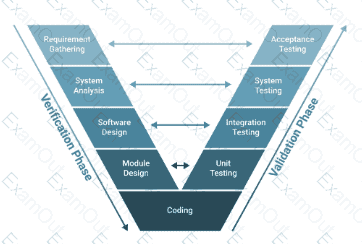
Key Concept: The Project Management Institute (PMI) categorizes these techniques under Data Gathering and Interpersonal and Team Skills. To build a robust Requirements Traceability Matrix, a Business Analyst typically starts with Brainstorming (Choice E) for ideas, conducts Interviews (Choice C) for detail, and uses Facilitated Workshops (Choice B) to align the group and finalize the scope.
A project manager can choose from several techniques to resolve conflicts between team members. Which technique can result in a win-win solution?
Collaborate/Problem Solve
Compromise/Reconcile
Smooth/Accommodate
Withdraw/Avoid
The Answer Is:
AExplanation:
According to the PMBOK® Guide, specifically within the Manage Team process, there are five general techniques for resolving conflict. Each technique has a different impact on the relationship and the project outcome.
Collaborate/Problem Solve: This technique involves incorporating multiple viewpoints and insights from differing perspectives. It requires a cooperative attitude and open dialogue that typically leads to consensus and commitment. Because it addresses the root cause of the conflict and finds a solution that satisfies all parties, it is the only technique that results in a win-win situation.
Why other options are incorrect:
Compromise/Reconcile (Option B): This involves searching for solutions that bring some degree of satisfaction to all parties in order to temporarily or partially resolve the conflict. However, because both parties must give something up, this is often viewed as a lose-lose or a " no-win " situation.
Smooth/Accommodate (Option C): This technique emphasizes areas of agreement rather than areas of difference, conceding one’s position to the needs of others to maintain harmony. This results in a lose-win situation where one party’s concerns are ignored.
Withdraw/Avoid (Option D): This involves retreating from an actual or potential conflict situation or postponing the issue to be better prepared or to be resolved by others. This is a lose-lose situation as the conflict is not resolved.
Force/Direct (Not listed but relevant): Pushing one ' s viewpoint at the expense of others. This is a win-lose situation.
A project team is starting to work on a project based on a Kanban approach. In order to frame the capacity of the team ' s workflow at any moment, the project manager will need to restrict the maximum amount of activities to be performed.
Which element will the project manager handle?
Capacity limit
Pull system
Work in progress
Virtual board
The Answer Is:
CExplanation:
In the Agile Practice Guide and Kanban methodology, the primary goal is to optimize the flow of work and increase efficiency by identifying and removing bottlenecks.
Why Choice C is correct:
WIP Limits: The project manager implements Work in Progress (WIP) limits. These are constraints placed on the number of work items that can be in a specific stage of the workflow (e.g., " In Development " or " Testing " ) at any given time.
Restricting Capacity: By restricting the maximum amount of activities, the team is forced to finish current tasks before starting new ones. This prevents the " multitasking trap " and ensures that work moves through the system faster.
Flow Management: If a column reaches its WIP limit, no new work can enter that stage. This makes bottlenecks immediately visible, allowing the team to collaborate (or " swarm " ) to clear the blockage.
Analysis of other options:
A (Capacity limit): While " capacity " is what is being managed, " Capacity limit " is not the formal technical term used in Kanban. The specific mechanism used to enforce that limit is called a WIP limit.
B (Pull system): A pull system is the result of using WIP limits. In a pull system, a team member only " pulls " new work into a column when there is available capacity (i.e., when they are below the WIP limit). It describes the movement of work, not the restriction itself.
D (Virtual board): This is simply the tool (like Jira, Trello, or a physical whiteboard) used to visualize the work. While the board displays the WIP limits, the board itself is not the element being " handled " to restrict the work.
Key Concept: The Project Management Institute (PMI) emphasizes that in a Kanban approach, the focus is on Cycle Time and Throughput. By managing Work in Progress (Choice C), the project manager ensures the team doesn ' t become overwhelmed, leading to a more predictable and sustainable pace of delivery.