Scenario 9: Techmanic is a Belgian company founded in 1995 and currently operating in Brussels. It provides IT consultancy, software design, and hardware/software services, including deployment and maintenance. The company serves sectors like public services, finance, telecom, energy, healthcare, and education. As a customer-centered company, it prioritizes strong client relationships and leading security practices.
Techmanic has been ISO/IEC 27001 certified for a year and regards this certification with pride. During the certification audit, the auditor found some inconsistencies in its ISMS implementation. Since the observed situations did not affect the capability of its ISMS to achieve the intended results, Techmanic was certified after auditors followed up on the root cause analysis and corrective actions remotely During that year, the company added hosting to its list of services and requested to expand its certification scope to include that area The auditor in charge approved the request and notified Techmanic that the extension audit would be conducted during the surveillance audit
Techmanic underwent a surveillance audit to verify its iSMS's continued effectiveness and compliance with ISO/IEC 27001. The surveillance audit aimed to ensure that Techmanic’s security practices, including the recent addition of hosting services, aligned seamlessly with the rigorous requirements of the certification
The auditor strategically utilized the findings from previous surveillance audit reports in the recertification activity with the purpose of replacing the need for additional recertification audits, specifically in the IT consultancy sector. Recognizing the value of continual improvement and learning from past assessments. Techmanic implemented a practice of reviewing previous surveillance audit reports. This proactive approach not only facilitated identifying and resolving potential nonconformities but also aimed to streamline the recertification process in the IT consultancy sector.
During the surveillance audit, several nonconformities were found. The ISMS continued to fulfill the ISO/IEC 27001*s requirements, but Techmanic failed to resolve the nonconformities related to the hosting services, as reported by its internal auditor. In addition, the internal audit report had several inconsistencies, which questioned the independence of the internal auditor during the audit of hosting services. Based on this, the extension certification was not granted. As a result. Techmanic requested a transfer to another certification body. In the meantime, the company released a statement to its clients stating that the ISO/IEC 27001 certification covers the IT services, as well as the hosting services.
Based on the scenario above, answer the following question:
Question:
Which of the options below does an internal audit program NOT allow?
Which one of the following conclusions in the audit report is not required by the certification body when deciding to grant certification?
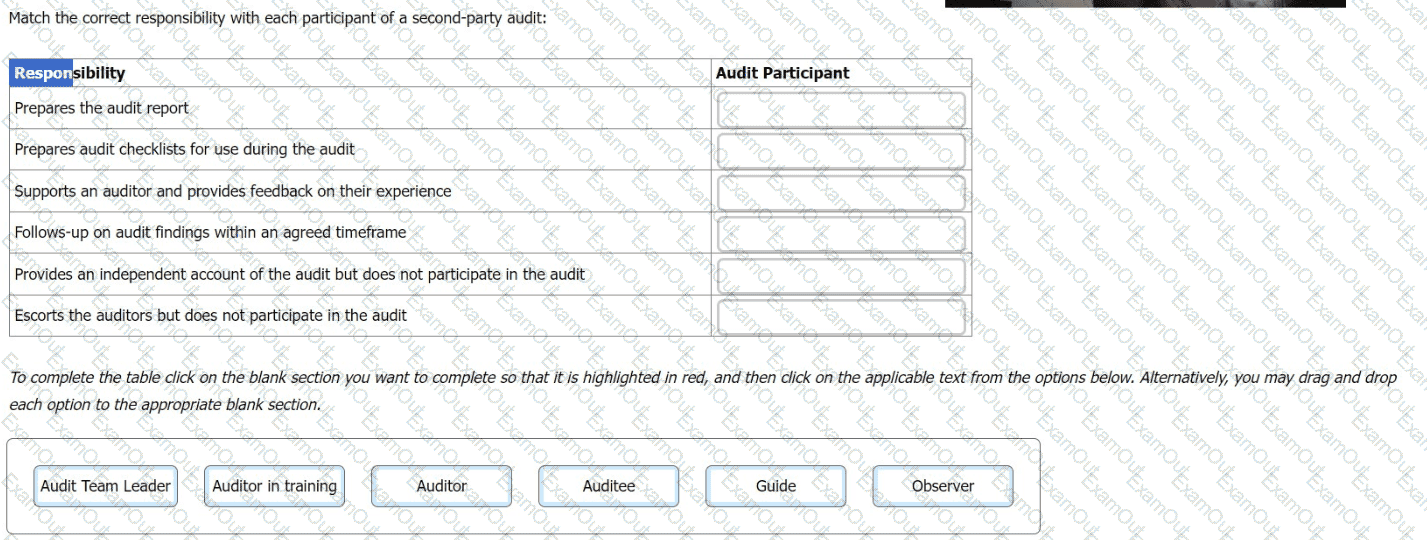
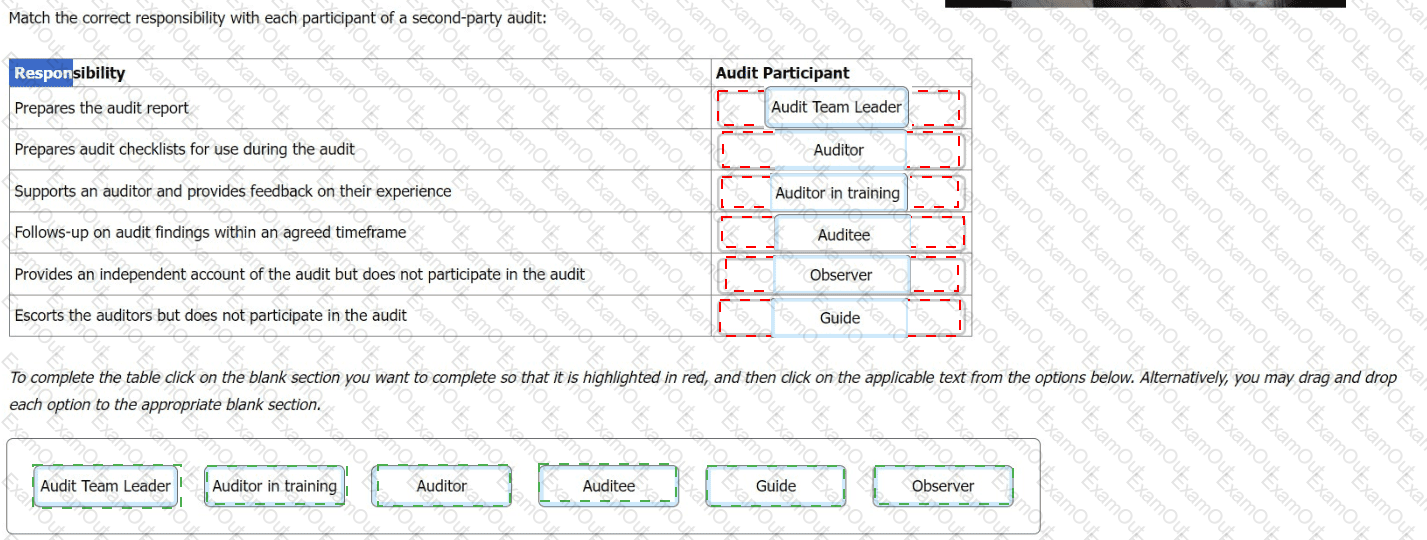
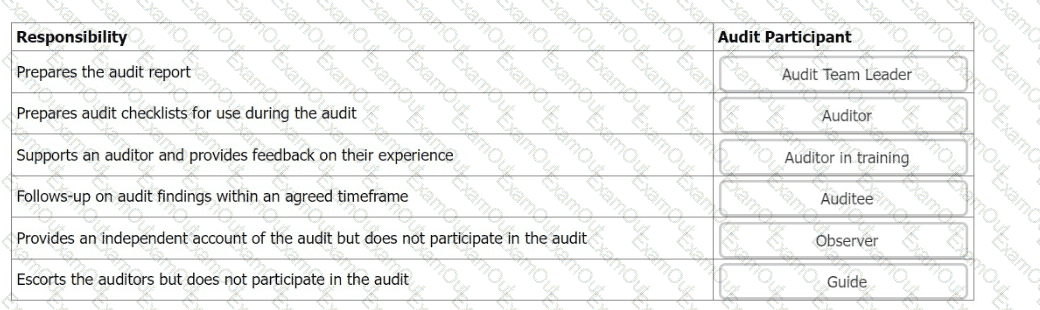
Match the correct responsibility with each participant of a second-party audit:
Which is an example of a qualitative evidence?
You are performing an ISO 27001 ISMS surveillance audit at a residential nursing home, ABC Healthcare Services. ABC uses a healthcare mobile app designed and maintained by a supplier, WeCare, to monitor residents' well-being. During the audit, you learn that 90% of the residents' family members regularly receive medical device advertisements from WeCare, by email and SMS once a week. The service agreement between ABC and WeCare prohibits the supplier from using residents' personal data. ABC has received many complaints from residents and their family members.
The Service Manager says that the complaints were investigated as an information security incident which found that they were justified.
Corrective actions have been planned and implemented according to the nonconformity and corrective action management procedure.
You write a nonconformity "ABC failed to comply with information security control A.5.34 (Privacy and protection of PII) relating to the personal data of residents' and their family members. A supplier, WeCare, used residents' personal information to send advertisements to family members."
Select three options of the corrections and corrective actions listed that you would expect ABC to make in response to the nonconformity.
ABC asks an ISMS consultant to test the ABC Healthcare mobile app for protection against cyber-crime.
You are conducting a third-party surveillance audit when another member of the audit team approaches you seeking clarification. They have been asked to assess the organisation's application of control 5.7 - Threat Intelligence. They are aware that this is one of the new controls introduced in the 2022 edition of ISO/IEC 27001, and they want to make sure they audit the control correctly.
They have prepared a checklist to assist them with their audit and want you to confirm that their planned activities are aligned with the control's requirements.
Which three of the following options represent valid audit trails?
The data centre at which you work is currently seeking ISO/IEC27001:2022 certification. In preparation for your initial certification visit, several internal audits have been carried out by a colleague working at another data centre within your Group. They secured their own ISO/IEC 27001:2022 certificate earlier in the year.
You have just qualified as an Internal ISMS auditor and your manager has asked you to review the audit process and audit findings as a final check before the external Certification Body arrives.
Which four of the following would cause you concern in respect of conformity to ISO/IEC 27001:2022 requirements?
Question
To verify conformity to control 8.15 Logging of ISO/IEC 27001 Annex A, the audit team studied a sample of server logs to determine if they could be edited or deleted. Which audit procedure did the audit team use?
Scenario 4: SendPay is a financial company that provides its services through a network of agents and financial institutions. One of their main services is transferring money worldwide. SendPay, as a new company, seeks to offer top quality services to its clients. Since the company offers international transactions, it requires from their clients to provide personal information, such as their identity, the reason for the transactions, and other details that might be needed to complete the transaction. Therefore, SendPay has implemented security measures to protect their clients' information, including detecting, investigating, and responding to any information security threats that may emerge. Their commitment to offering secure services was also reflected during the ISMS implementation where the company invested a lot of time and resources.
Last year, SendPay unveiled their digital platform that allows money transactions through electronic devices, such as smartphones or laptops, without requiring an additional fee. Through this platform, SendPay's clients can send and receive money from anywhere and at any time. The digital platform helped SendPay to simplify the company's operations and further expand its business. At the time, SendPay was outsourcing its software operations, hence the project was completed by the software development team of the outsourced company. The same team was also responsible for maintaining the technology infrastructure of SendPay.
Recently, the company applied for ISO/IEC 27001 certification after having an ISMS in place for almost a year. They contracted a certification body that fit their criteria. Soon after, the certification body appointed a team of four auditors to audit SendPay's ISMS.
During the audit, among others, the following situations were observed:
1.The outsourced software company had terminated the contract with SendPay without prior notice. As a result, SendPay was unable to immediately bring the services back in-house and its operations were disrupted for five days. The auditors requested from SendPay's representatives to provide evidence that they have a plan to follow in cases of contract terminations. The representatives did not provide any documentary evidence but during an interview, they told the auditors that the top management of SendPay had identified two other software development companies that could provide services immediately if similar situations happen again.
2.There was no evidence available regarding the monitoring of the activities that were outsourced to the software development company. Once again, the representatives of SendPay told the auditors that they regularly communicate with the software development company and that they are appropriately informed for any possible change that might occur.
3.There was no nonconformity found during the firewall testing. The auditors tested the firewall configuration in order to determine the level of security provided by
these services. They used a packet analyzer to test the firewall policies which enabled them to check the packets sent or received in real-time.
Based on this scenario, answer the following question:
Based on scenario 4, the auditors requested documentary evidence regarding the monitoring process of outsourced operations. What does this indicate?
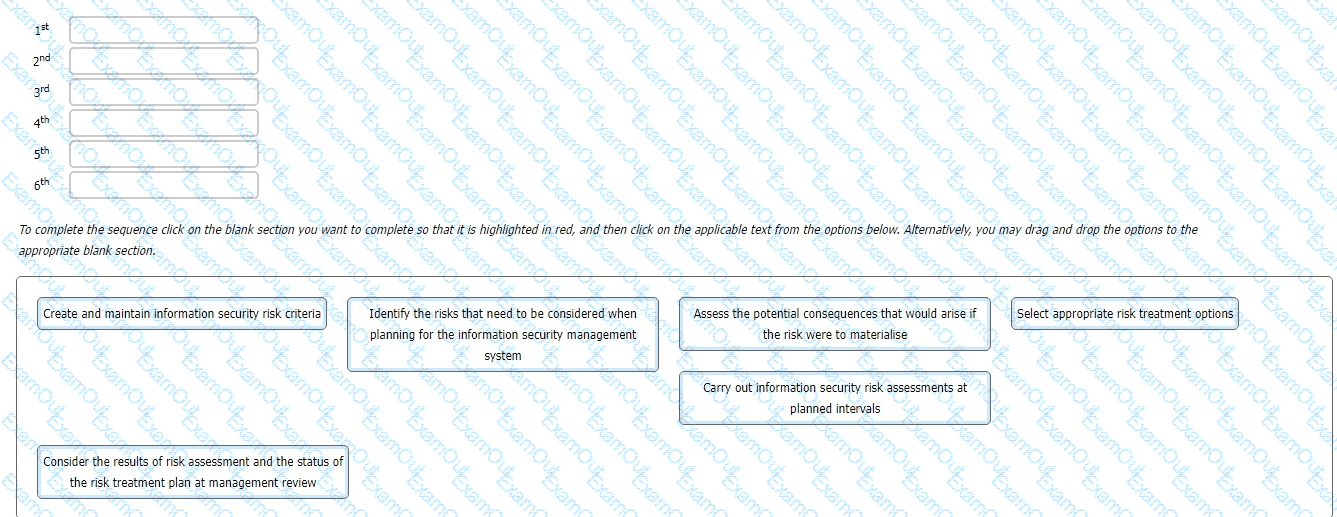
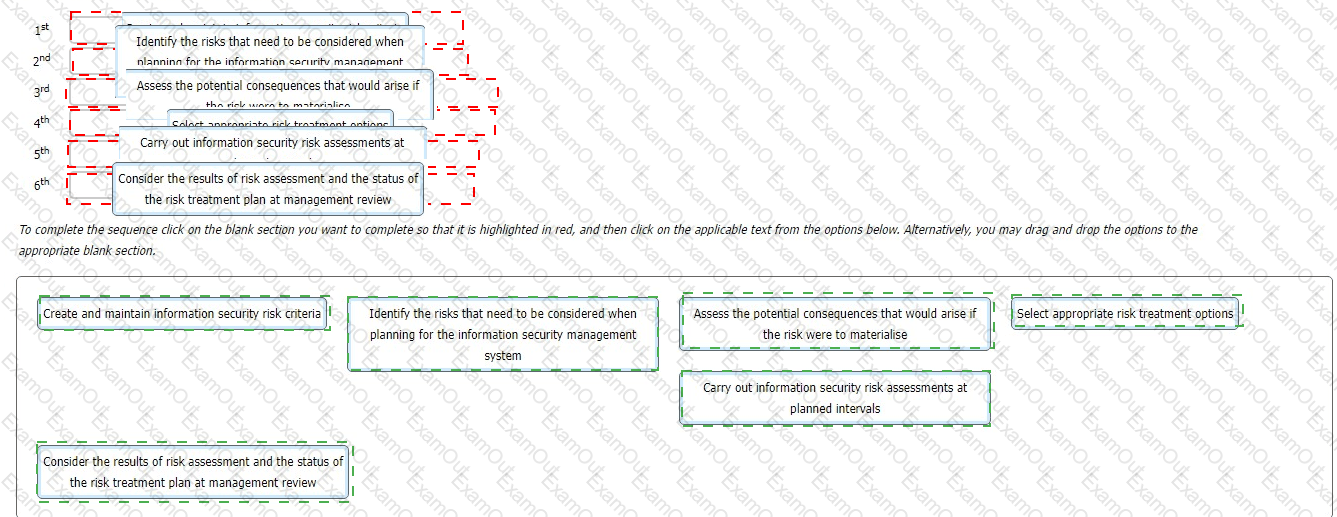
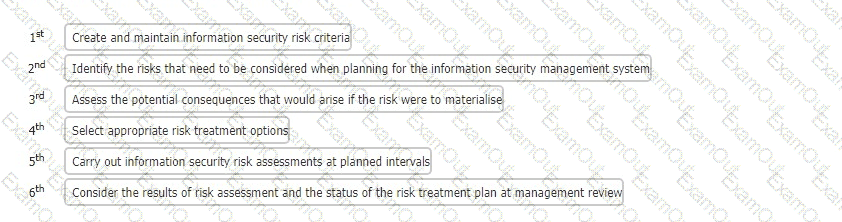
You are an experienced ISMS audit team leader providing instruction to a class of auditors in training. The subject of today's lesson is the management of information security risk in accordance with the requirements of ISO/IEC 27001:2022.
You provide the class with a series of activities. You then ask the class to sort these activities into the order in which they appear in the standard.
What is the correct sequence they should report back to you?