Select the words that best complete the sentence to describe an audit finding.


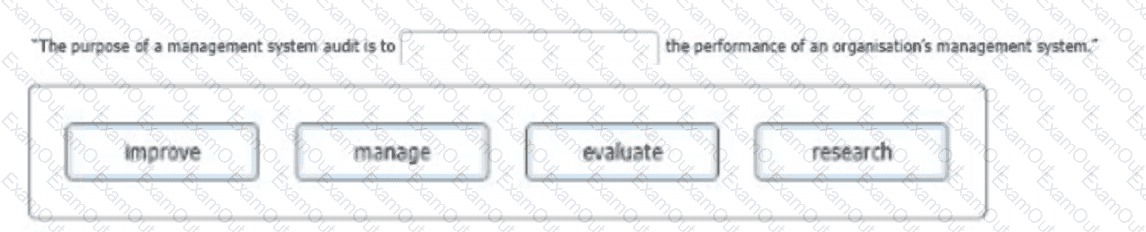
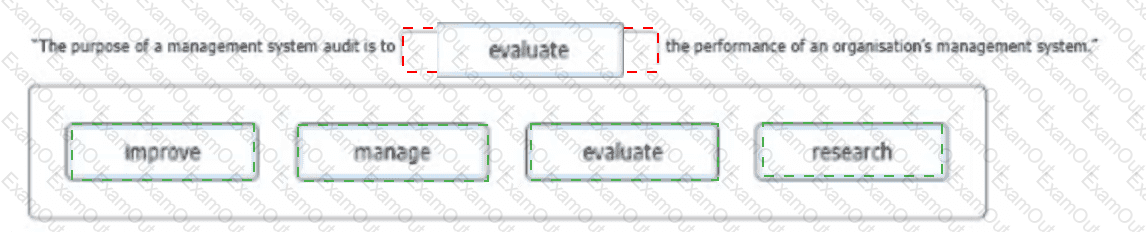
The purpose of a management system audit is to? Select 1
Question:
What is the purpose of audit test plans in the audit process?
Select a word from the following options that best completes the sentence:
To complete the sentence with the word(s) click on the blank section you want to complete so that it is highlighted in red, and then click on the application text from the options below. Alternatively, you may drag and drop the option to the appropriate blank section.

Scenario 9
CloudFort, a small networking company, provides network security, cloud computing, and virtualization solutions. The company has recently been certified in an information security management system (ISMS) based on the ISO/IEC 27001 standard, which has resulted in a spike in its recognition, confirming the maturity of CloudFort’s operations.
CloudFort continually reviewed and enhanced its security controls and the overall effectiveness and efficiency of the ISMS by conducting internal audits. Due to its size and desire for greater objectivity, top management decided to outsource the internal audit function to ensure the internal audit is independent of the audited activities and holds an advisory role in the continual improvement of the ISMS.
After the initial certification audit, the company created a new department specializing in data storage solutions. It offered routers and switches optimized for data centers and software-based networking devices, such as network virtualization and network security appliances. Because of the new department, CloudFort initiated a risk assessment process and an internal audit. Following the internal audit results, the company confirmed the effectiveness and efficiency of the new processes and controls.
After determining that the new department fully complies with ISO/IEC 27001 requirements, top management decided to include it in the certification scope. They submitted a request to the certification body for an extension of the certification scope to ensure that the department’s processes and security measures fully align with the overall ISMS.
One year after the initial certification audit, the certification body conducted another audit of CloudFort's ISMS. This audit aimed to determine CloudFort’s ISMS fulfillment of specified ISO/IEC 27001 requirements and ensure continual improvement. The audit team confirmed that the certified ISMS fulfills the standard requirements. Nonetheless, the new department introduced changes that significantly affected how the overall management system was governed, requiring updates to existing processes and controls.
Moreover, although CloudFort requested an extension of the certification scope, they failed to provide timely updates on the impact of the new department on the ISMS to the certification body. Thus, CloudFort’s certification was suspended.
Question
Based on Scenario 9, why was CloudFort’s certification suspended?
You have a hard copy of a customer design document that you want to dispose off. What would you do
You are an experienced audit team leader guiding an auditor in training,
Your team is currently conducting a third-party surveillance audit of an organisation that stores data on behalf of external clients. The auditor in training has been tasked with reviewing the TECHNOLOGICAL controls listed in the Statement of Applicability (SoA) and implemented at the site.
Select four controls from the following that would you expect the auditor in training to review.
In acceptable use of Information Assets, which is the best practice?
Scenario 6: Cyber ACrypt is a cybersecurity company that provides endpoint protection by offering anti-malware and device security, asset life cycle management, and device encryption. To validate its ISMS against ISO/IEC 27001 and demonstrate its commitment to cybersecurity excellence, the company underwent a meticulous audit process led by John, the appointed audit team leader.
Upon accepting the audit mandate, John promptly organized a meeting to outline the audit plan and team roles This phase was crucial for aligning the team with the audit's objectives and scope However, the initial presentation to Cyber ACrypt’s staff revealed a significant gap in understanding the audit's scope and objectives, indicating potential readiness challenges within the company
As the stage 1 audit commenced, the team prepared for on-site activities. They reviewed Cyber ACrypt's documented information, including the information security policy and operational procedures ensuring each piece conformed to and was standardized in format with author identification, production date, version number, and approval date Additionally, the audit team ensured that each document contained the information required by the respective clause of the standard This phase revealed that a detailed audit of the documentation describing task execution was unnecessary, streamlining the process and focusing the team's efforts on critical areas During the phase of conducting on-site activities, the team evaluated management responsibility for the Cyber Acrypt's policies This thorough examination aimed to ascertain continual improvement and adherence to ISMS requirements Subsequently, in the document, the stage 1 audit outputs phase, the audit team meticulously documented their findings, underscoring their conclusions regarding the fulfillment of the stage 1 objectives. This documentation was vital for the audit team and Cyber ACrypt to understand the preliminary audit outcomes and areas requiring attention.
The audit team also decided to conduct interviews with key interested parties. This decision was motivated by the objective of collecting robust audit evidence to validate the management system’s compliance with ISO/IEC 27001 requirements. Engaging with interested parties across various levels of Cyber ACrypt provided the audit team with invaluable perspectives and an understanding of the ISMS's implementation and effectiveness.
The stage 1 audit report unveiled critical areas of concern. The Statement of Applicability (SoA) and the ISMS policy were found to be lacking in several respects, including insufficient risk assessment, inadequate access controls, and lack of regular policy reviews. This prompted Cyber ACrypt to take immediate action to address these shortcomings. Their prompt response and modifications to the strategic documents reflected a strong commitment to achieving compliance.
The technical expertise introduced to bridge the audit team's cybersecurity knowledge gap played a pivotal role in identifying shortcomings in the risk assessment methodology and reviewing network architecture. This included evaluating firewalls, intrusion detection and prevention systems, and other network security measures, as well as assessing how Cyber ACrypt detects, responds to, and recovers from external and internal threats. Under John's supervision, the technical expert communicated the audit findings to the representatives of Cyber ACrypt. However, the audit team observed that the expert s objectivity might have been compromised due to receiving consultancy fees from the auditee. Considering the behavior of the technical expert during the audit, the audit team leader decided to discuss this concern with the certification body.
Based on the scenario above, answer the following question:
Question:
Which activity was NOT conducted correctly by the audit team during the Stage 1 audit?
Scenario 5: Data Grid Inc. is a well-known company that delivers security services across the entire information technology infrastructure. It provides cybersecurity software, including endpoint security, firewalls, and antivirus software. For two decades, Data Grid Inc. has helped various companies secure their networks through advanced products and services. Having achieved reputation in the information and network security field, Data Grid Inc. decided to obtain the ISO/IEC 27001 certification to better secure its internal and customer assets and gain competitive advantage.
Data Grid Inc. appointed the audit team, who agreed on the terms of the audit mandate. In addition, Data Grid Inc. defined the audit scope, specified the audit criteria, and proposed to close the audit within five days. The audit team rejected Data Grid Inc.'s proposal to conduct the audit within five days, since the company has a large number of employees and complex processes. Data Grid Inc. insisted that they have planned to complete the audit within five days, so both parties agreed upon conducting the audit within the defined duration. The audit team followed a risk-based auditing approach.
To gain an overview of the main business processes and controls, the audit team accessed process descriptions and organizational charts. They were unable to perform a deeper analysis of the IT risks and controls because their access to the IT infrastructure and applications was restricted. However, the audit team stated that the risk that a significant defect could occur to Data Grid Inc.'s ISMS was low since most of the company's processes were automated. They therefore evaluated that the ISMS, as a whole, conforms to the standard requirements by asking the representatives of Data Grid Inc. the following questions:
•How are responsibilities for IT and IT controls defined and assigned?
•How does Data Grid Inc. assess whether the controls have achieved the desired results?
•What controls does Data Grid Inc. have in place to protect the operating environment and data from malicious software?
•Are firewall-related controls implemented?
Data Grid Inc.'s representatives provided sufficient and appropriate evidence to address all these questions.
The audit team leader drafted the audit conclusions and reported them to Data Grid Inc.'s top management. Though Data Grid Inc. was recommended for certification by the auditors, misunderstandings were raised between Data Grid Inc. and the certification body in regards to audit objectives. Data Grid Inc. stated that even though the audit objectives included the identification of areas for potential improvement, the audit team did not provide such information.
Based on this scenario, answer the following question:
Based on scenario 5, the audit team disagreed with the proposed audit duration by Data Grid Inc. for the ISMS audit. How do you describe such a situation?