Scenario 5: Cobt. an insurance company in London, offers various commercial, industrial, and life insurance solutions. In recent years, the number of Cobt's clients has increased enormously. Having a huge amount of data to process, the company decided that certifying against ISO/IEC 27001 would bring many benefits to securing information and show its commitment to continual improvement. While the company was well-versed in conducting regular risk assessments, implementing an ISMS brought major changes to its daily operations. During the risk assessment process, a risk was identified where significant defects occurred without being detected or prevented by the organizations internal control mechanisms.
The company followed a methodology to implement the ISMS and had an operational ISMS in place after only a few months After successfully implementing the ISMS, Cobt applied for ISO/IEC 27001 certification Sarah, an experienced auditor, was assigned to the audit Upon thoroughly analyzing the audit offer, Sarah accepted her responsibilities as an audit team leader and immediately started to obtain general information about Cobt She established the audit criteria and objective, planned the audit, and assigned the audit team members' responsibilities.
Sarah acknowledged that although Cobt has expanded significantly by offering diverse commercial and insurance solutions, it still relies on some manual processes Therefore, her initial focus was to gather information on how the company manages its information security risks Sarah contacted Cobt's representatives to request access to information related to risk management for the off-site review, as initially agreed upon for part of the audit However, Cobt later refused, claiming that such information is too sensitive to be accessed outside of the company This refusal raised concerns about the audit's feasibility, particularly regarding the availability and cooperation of the auditee and access to evidence Moreover, Cobt raised concerns about the audit schedule, stating that it does not properly reflect the recent changes the company made It pointed out that the actions to be performed during the audit apply only to the initial scope and do not encompass the latest changes made in the audit scope
Sarah also evaluated the materiality of the situation, considering the significance of the information denied for the audit objectives. In this case, the refusal by Cobt raised questions about the completeness of the audit and its ability to provide reasonable assurance. Following these situations, Sarah decided to withdraw from the audit before a certification agreement was signed and communicated her decision to Cobt and the certification body. This decision was made to ensure adherence to audit principles and maintain transparency, highlighting her commitment to consistently upholding these principles.
Based on the scenario above, answer the following question:
Question:
Based on the information provided in Scenario 5, Cobt refused to provide the auditors with information on risk management. How would you, as an auditor, resolve such a situation?
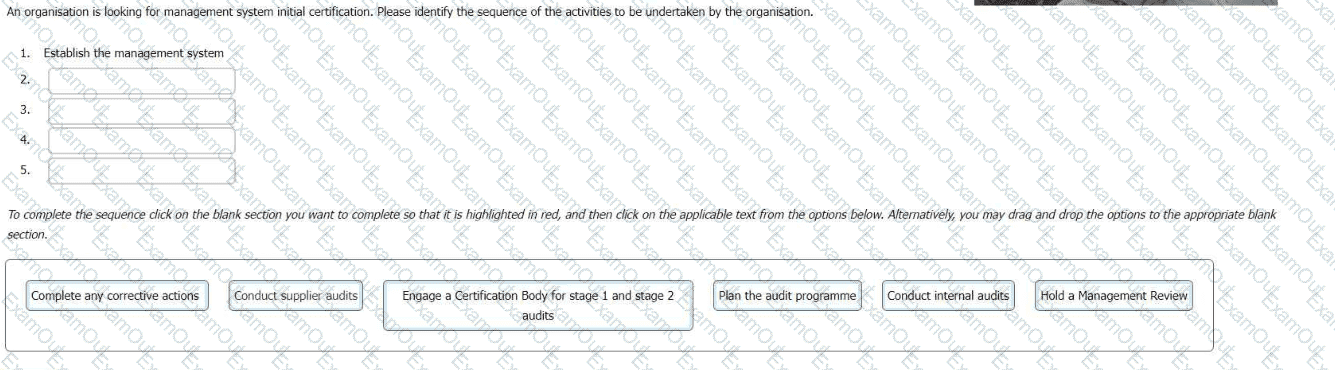
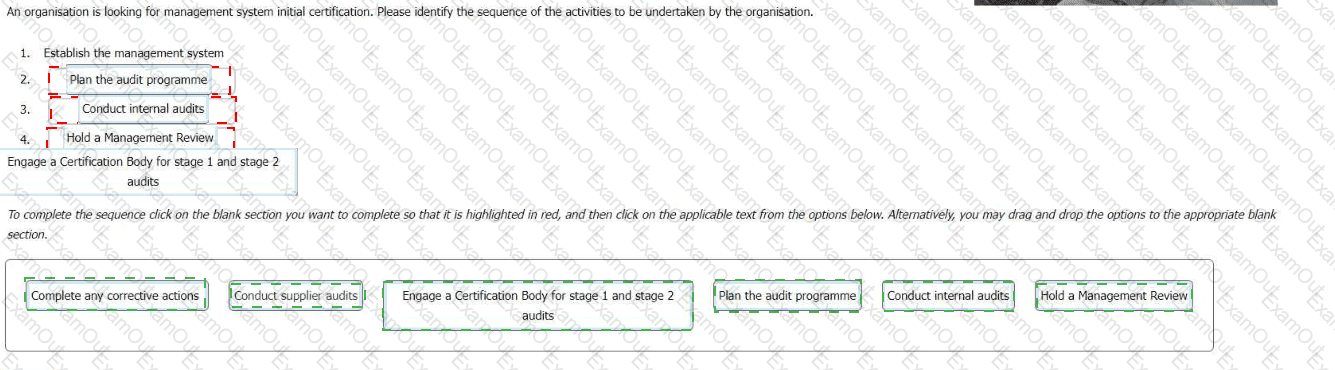
An organisation is looking for management system initial certification. Please identify the sequence of the activities to be undertaken by the organisation.
To complete the sequence click on the blank section you want to complete so that it is highlighted in red, and then click on the applicable text from the options below. Alternatively, you may drag and drop the options to the appropriate blank section.
You are conducting an ISMS audit in the despatch department of an international logistics organisation that provides shipping services to large organisations including local hospitals and government offices. Parcels typically contain pharmaceutical products, biological samples, and documents such as passports and driving licences. You note that the company records show a very large number of returned items with causes including misaddressed labels and, in 15% of cases, two or more labels for different addresses for the one package. You are interviewing the Shipping Manager (SM).
You: Are items checked before being dispatched?
SM: Any obviously damaged items are removed by the duty staff before being dispatched, but the small profit margin makes it uneconomic to
implement a formal checking process.
You: What action is taken when items are returned?
SM: Most of these contracts are relatively low value, therefore it has been decided that it is easier and more convenient to simply reprint the label and re-send individual parcels than it is to implement an investigation.
You raise a nonconformity. Referencing the scenario, which three of the following Annex A controls would you expect the auditee to have implemented when you conduct the follow-up audit?
5.11 Return of assets
CEO sends a mail giving his views on the status of the company and the company’s future strategy and the CEO's vision and the employee's part in it. The mail should be classified as
AppFolk, a software development company, is seeking certification against ISO/IEC 27001. In the initial phases of the external audit, the certification body in discussion with the company excluded the marketing division from the audit scope, although they stated in their ISMS scope that the whole company is included. Is this acceptable?