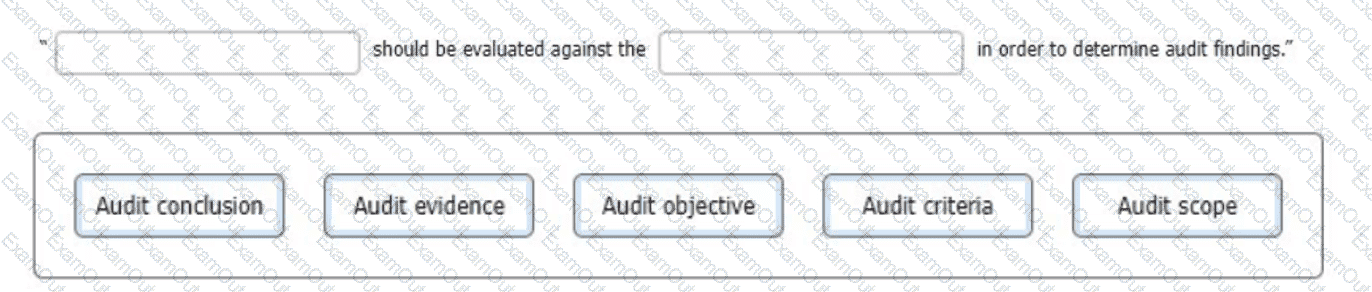
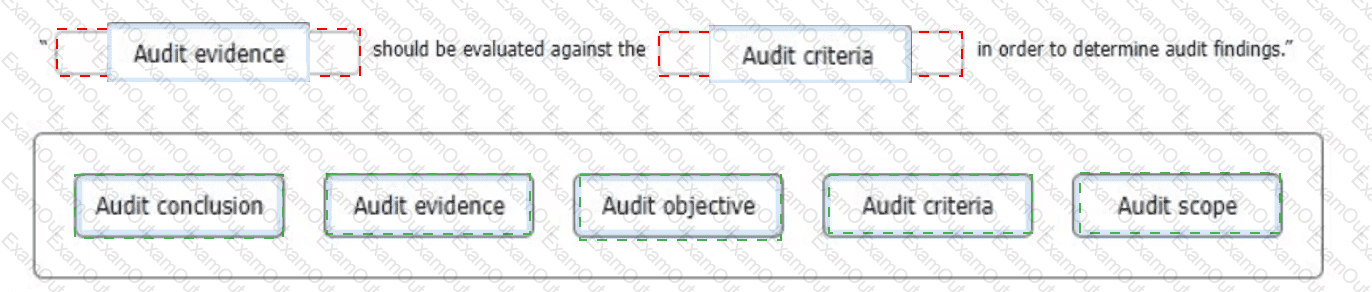
In regard to generating an audit finding, select the words that best complete the following sentence.
To complete the sentence with the best word(s), click on the blank section you want to complete so that it Is highlighted in red, and then click on the applicable text from the options below. Alternatively, you may drag and drop the option to the appropriate blank section.
You are conducting an Information Security Management System audit in the despatch department of an international
logistics organisation that provides shipping services to large organisations including local hospitals and government offices.
Parcels typically contain pharmaceutical products, biological samples and documents such as passports and driving licences.
You note that the company records show a very large number of returned items with causes including misaddressed labels
and, in 15% of cases, two or more labels for different addresses for the one package. You are interviewing the Shipping
Manager (SM).
You: Are items checked before being dispatched?
SM: Any obviously damaged items are removed by the duty staff before being dispatched, but the small profit margin makes
it uneconomic to implement a formal checking process.
You: What action is taken when items are returned?
SM: Most of these contracts are relatively low value, therefore it has been decided that it is easier and more convenient to
simply reprint the label and re-send individual parcels than it is to implement an investigation.
You raise a non-conformity against clause 8.1 of ISO 27001:2022.
Which one option below that best describes the non-conformity you have identified?
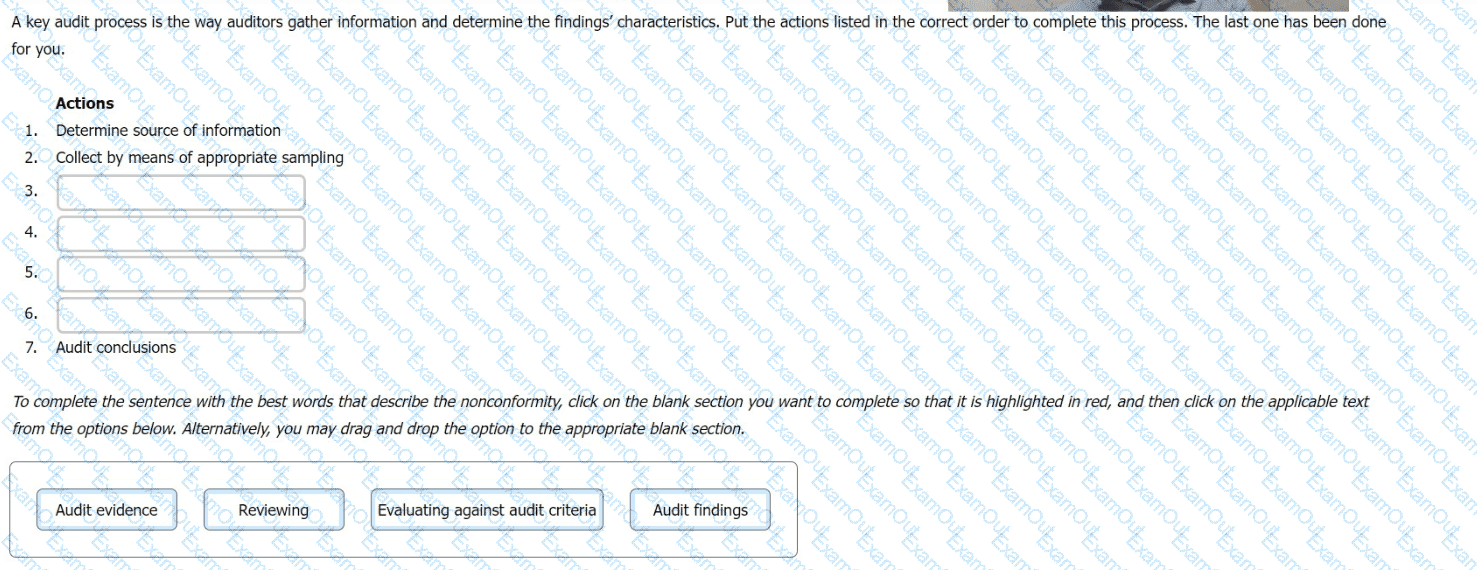
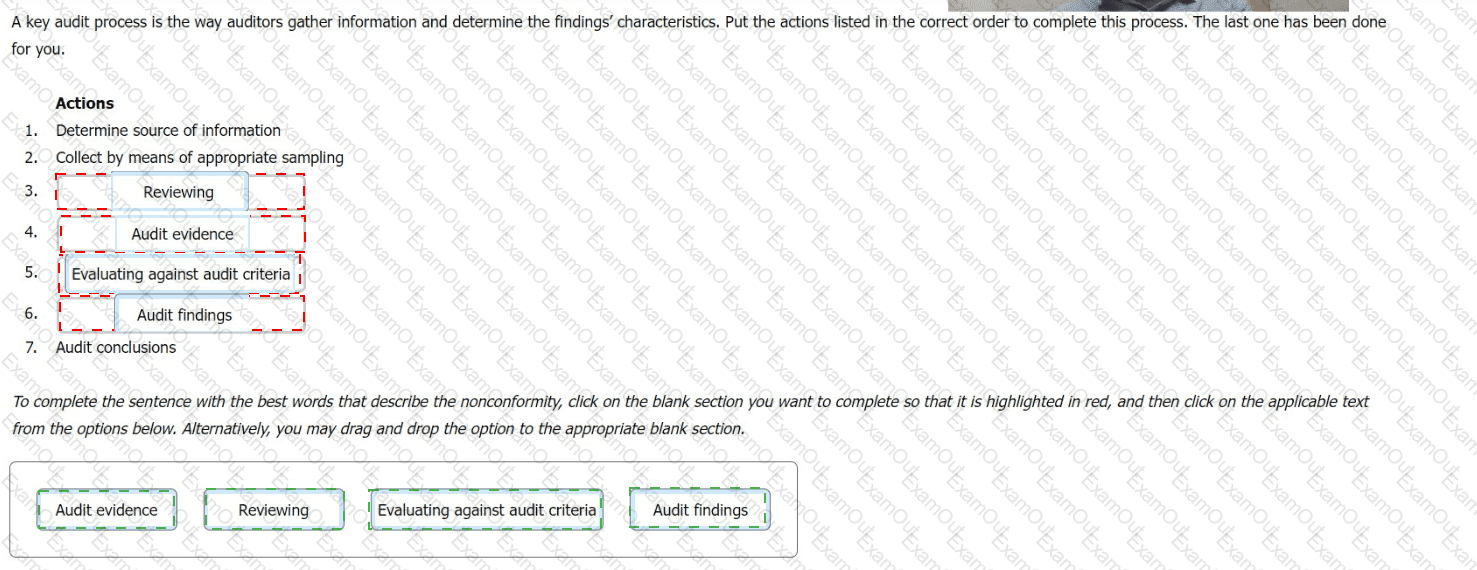
A key audit process is the way auditors gather information and determine the findings' characteristics. Put the actions listed in the correct order to complete this process. The last one has been done for you.
Scenario 9: Techmanic is a Belgian company founded in 1995 and currently operating in Brussels. It provides IT consultancy, software design, and hardware/software services, including deployment and maintenance. The company serves sectors like public services, finance, telecom, energy, healthcare, and education. As a customer-centered company, it prioritizes strong client relationships and leading security practices.
Techmanic has been ISO/IEC 27001 certified for a year and regards this certification with pride. During the certification audit, the auditor found some inconsistencies in its ISMS implementation. Since the observed situations did not affect the capability of its ISMS to achieve the intended results, Techmanic was certified after auditors followed up on the root cause analysis and corrective actions remotely During that year, the company added hosting to its list of services and requested to expand its certification scope to include that area The auditor in charge approved the request and notified Techmanic that the extension audit would be conducted during the surveillance audit
Techmanic underwent a surveillance audit to verify its iSMS's continued effectiveness and compliance with ISO/IEC 27001. The surveillance audit aimed to ensure that Techmanic’s security practices, including the recent addition of hosting services, aligned seamlessly with the rigorous requirements of the certification
The auditor strategically utilized the findings from previous surveillance audit reports in the recertification activity with the purpose of replacing the need for additional recertification audits, specifically in the IT consultancy sector. Recognizing the value of continual improvement and learning from past assessments. Techmanic implemented a practice of reviewing previous surveillance audit reports. This proactive approach not only facilitated identifying and resolving potential nonconformities but also aimed to streamline the recertification process in the IT consultancy sector.
During the surveillance audit, several nonconformities were found. The ISMS continued to fulfill the ISO/IEC 27001*s requirements, but Techmanic failed to resolve the nonconformities related to the hosting services, as reported by its internal auditor. In addition, the internal audit report had several inconsistencies, which questioned the independence of the internal auditor during the audit of hosting services. Based on this, the extension certification was not granted. As a result. Techmanic requested a transfer to another certification body. In the meantime, the company released a statement to its clients stating that the ISO/IEC 27001 certification covers the IT services, as well as the hosting services.
Based on the scenario above, answer the following question:
Question:
Is questioning the independence of the internal auditor important given the inconsistencies found in the internal audit report?
Scenario 5
CyberShielding Systems Inc. provides security services spanning the entire information technology infrastructure. It provides cybersecurity software, including endpoint security, firewalls, and antivirus software. CyberShielding Systems Inc. has helped various companies secure their networks for two decades through advanced products and services. Having achieved a reputation in the information and network security sector, CyberShielding Systems Inc. decided to implement a security information management system (ISMS) based on ISO/IEC 27001 and obtain a certification to better secure its internal and customer assets and gain a competitive advantage.
The certification body initiated the process by selecting the audit team for CyberShielding Systems Inc.'s ISO/IEC 27001 certification. They provided the company with the name and background information of each audit member. However, upon review, CyberShielding Systems Inc. discovered that one of the auditors did not hold the security clearance required by them. Consequently, the company objected to the appointment of this auditor. Upon review, the certification body replaced the auditor in response to CyberShielding Systems Inc.'s objection.
As part of the audit process, CyberShielding Systems Inc.'s approach to risk and opportunity determination was assessed as a standalone activity. This involved examining the organization’s methods for identifying and managing risks and opportunities. The audit team’s core objectives encompassed providing assurance on the effectiveness of CyberShielding Systems Inc.'s risk and opportunity identification mechanisms and reviewing the organization's strategies for addressing these determined risks and opportunities. During this, the audit team also identified a risk due to a lack of oversight in the firewall configuration review process, where changes were implemented without proper approval, potentially exposing the company to vulnerabilities. This finding highlighted the need for stronger internal controls to prevent such issues.
The audit team accessed process descriptions and organizational charts to understand the main business processes and controls. They performed a limited analysis of the IT risks and controls because their access to the IT infrastructure and applications was limited by third-party service provider restrictions. However, the audit team stated that the risk of a significant defect occurring in CyberShielding’s ISMS was low since most of the company's processes were automated. They therefore evaluated that the ISMS, as a whole, conforms to the standard requirements by questioning CyberShielding representatives on IT responsibilities, control effectiveness, and anti-malware measures. CyberShielding’s representatives provided sufficient and appropriate evidence to address all these questions.
Despite the agreement signed before the audit, which outlined the audit scope, criteria, and objectives, the audit was primarily focused on assessing conformity with established criteria and ensuring compliance with statutory and regulatory requirements.
Question
What kind of audit risk did the audit team identify? Refer to Scenario 5.
Scenario 9: Techmanic is a Belgian company founded in 1995 and currently operating in Brussels. It provides IT consultancy, software design, and hardware/software services, including deployment and maintenance. The company serves sectors like public services, finance, telecom, energy, healthcare, and education. As a customer-centered company, it prioritizes strong client relationships and leading security practices.
Techmanic has been ISO/IEC 27001 certified for a year and regards this certification with pride. During the certification audit, the auditor found some inconsistencies in its ISMS implementation. Since the observed situations did not affect the capability of its ISMS to achieve the intended results, Techmanic was certified after auditors followed up on the root cause analysis and corrective actions remotely During that year, the company added hosting to its list of services and requested to expand its certification scope to include that area The auditor in charge approved the request and notified Techmanic that the extension audit would be conducted during the surveillance audit
Techmanic underwent a surveillance audit to verify its iSMS's continued effectiveness and compliance with ISO/IEC 27001. The surveillance audit aimed to ensure that Techmanic’s security practices, including the recent addition of hosting services, aligned seamlessly with the rigorous requirements of the certification
The auditor strategically utilized the findings from previous surveillance audit reports in the recertification activity with the purpose of replacing the need for additional recertification audits, specifically in the IT consultancy sector. Recognizing the value of continual improvement and learning from past assessments. Techmanic implemented a practice of reviewing previous surveillance audit reports. This proactive approach not only facilitated identifying and resolving potential nonconformities but also aimed to streamline the recertification process in the IT consultancy sector.
During the surveillance audit, several nonconformities were found. The ISMS continued to fulfill the ISO/IEC 27001*s requirements, but Techmanic failed to resolve the nonconformities related to the hosting services, as reported by its internal auditor. In addition, the internal audit report had several inconsistencies, which questioned the independence of the internal auditor during the audit of hosting services. Based on this, the extension certification was not granted. As a result. Techmanic requested a transfer to another certification body. In the meantime, the company released a statement to its clients stating that the ISO/IEC 27001 certification covers the IT services, as well as the hosting services.
Based on the scenario above, answer the following question:
Question:
According to Scenario 9, the auditor decided to conduct the extension audit during the surveillance audit. How do you define this situation?
You are an experienced ISMS audit team leader, assisting an auditor in training to write their first audit report.
You want to check the auditor in training's understanding of terminology relating to the contents of an audit report and chose to do this by presenting the following examples.
For each example, you ask the auditor in training what the correct term is that describes the activity
Match the activity to the description.
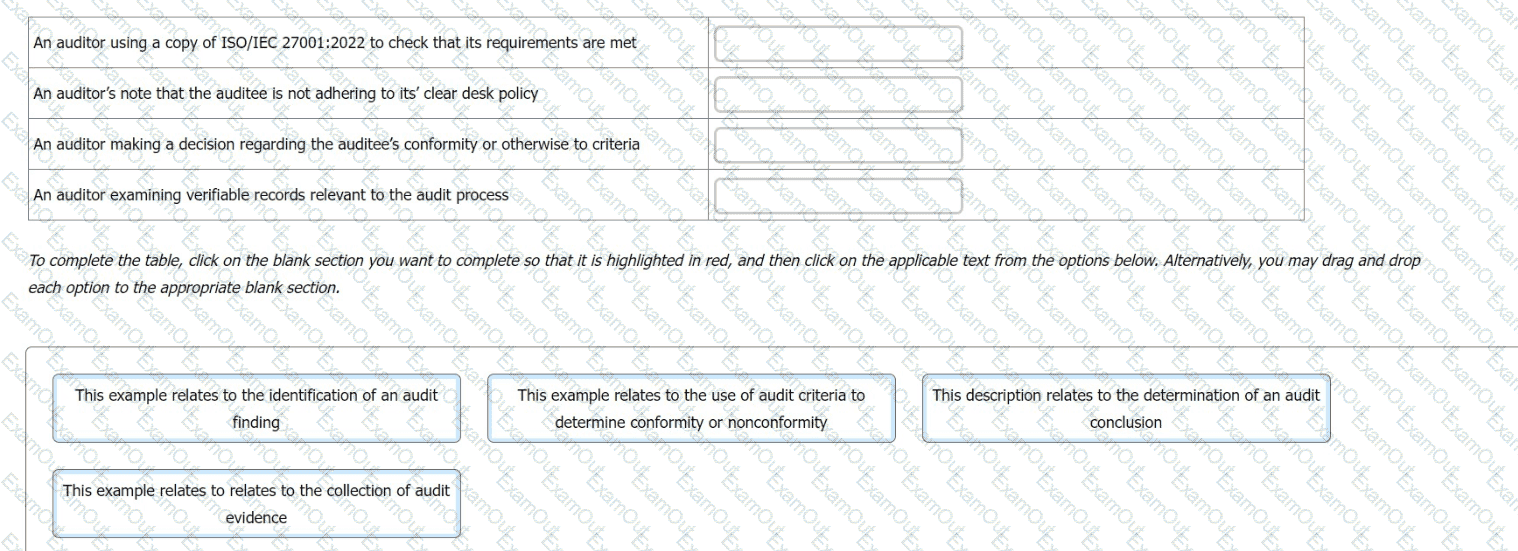
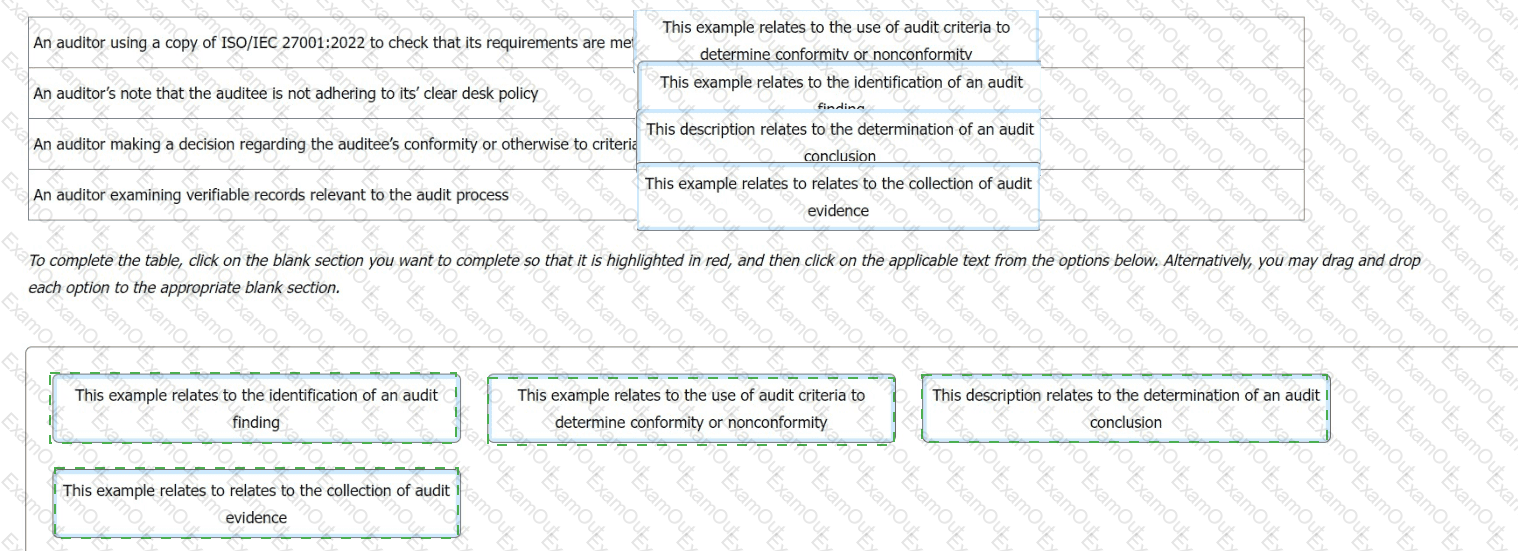

Question:
What is the purpose of using a combination of audit test plans?
Scenario 5
Scenario 5
CyberShielding Systems Inc. provides security services spanning the entire information technology infrastructure. It provides cybersecurity software, including endpoint security, firewalls, and antivirus software. CyberShielding Systems Inc. has helped various companies secure their networks for two decades through advanced products and services. Having achieved a reputation in the information and network security sector, CyberShielding Systems Inc. decided to implement a security information management system (ISMS) based on ISO/IEC 27001 and obtain a certification to better secure its internal and customer assets and gain a competitive advantage.
The certification body initiated the process by selecting the audit team for CyberShielding Systems Inc.'s ISO/IEC 27001 certification. They provided the company with the name and background information of each audit member. However, upon review, CyberShielding Systems Inc. discovered that one of the auditors did not hold the security clearance required by them. Consequently, the company objected to the appointment of this auditor. Upon review, the certification body replaced the auditor in response to CyberShielding Systems Inc.'s objection.
As part of the audit process, CyberShielding Systems Inc.'s approach to risk and opportunity determination was assessed as a standalone activity. This involved examining the organization’s methods for identifying and managing risks and opportunities. The audit team’s core objectives encompassed providing assurance on the effectiveness of CyberShielding Systems Inc.'s risk and opportunity identification mechanisms and reviewing the organization's strategies for addressing these determined risks and opportunities. During this, the audit team also identified a risk due to a lack of oversight in the firewall configuration review process, where changes were implemented without proper approval, potentially exposing the company to vulnerabilities. This finding highlighted the need for stronger internal controls to prevent such issues.
The audit team accessed process descriptions and organizational charts to understand the main business processes and controls. They performed a limited analysis of the IT risks and controls because their access to the IT infrastructure and applications was limited by third-party service provider restrictions. However, the audit team stated that the risk of a significant defect occurring in CyberShielding’s ISMS was low since most of the company's processes were automated. They therefore evaluated that the ISMS, as a whole, conforms to the standard requirements by questioning CyberShielding representatives on IT responsibilities, control effectiveness, and anti-malware measures. CyberShielding’s representatives provided sufficient and appropriate evidence to address all these questions.
Despite the agreement signed before the audit, which outlined the audit scope, criteria, and objectives, the audit was primarily focused on assessing conformity with established criteria and ensuring compliance with statutory and regulatory requirements.
Question
Based on Scenario 5, is the approach used by the audit team to assess the conformity of the ISMS to the standard requirements in line with audit recommended practices?
Scenario 8: EsBank provides banking and financial solutions to the Estonian banking sector since September 2010. The company has a network of 30 branches with over 100 ATMs across the country.
Operating in a highly regulated industry, EsBank must comply with many laws and regulations regarding the security and privacy of data. They need to manage information security across their operations by implementing technical and nontechnical controls. EsBank decided to implement an ISMS based on ISO/IEC 27001 because it provided better security, more risk control, and compliance with key requirements of laws and regulations.
Nine months after the successful implementation of the ISMS, EsBank decided to pursue certification of their ISMS by an independent certification body against ISO/IEC 27001 .The certification audit included all of EsBank’s systems, processes, and technologies.
The stage 1 and stage 2 audits were conducted jointly and several nonconformities were detected. The first nonconformity was related to EsBank’s labeling of information. The company had an information classification scheme but there was no information labeling procedure. As a result, documents requiring the same level of protection would be labeled differently (sometimes as confidential, other times sensitive).
Considering that all the documents were also stored electronically, the nonconformity also impacted media handling. The audit team used sampling and concluded that 50 of 200 removable media stored sensitive information mistakenly classified as confidential. According to the information classification scheme, confidential information is allowed to be stored in removable media, whereas storing sensitive information is strictly prohibited. This marked the other nonconformity.
They drafted the nonconformity report and discussed the audit conclusions with EsBank’s representatives, who agreed to submit an action plan for the detected nonconformities within two months.
EsBank accepted the audit team leader's proposed solution. They resolved the nonconformities by drafting a procedure for information labeling based on the classification scheme for both physical and electronic formats. The removable media procedure was also updated based on this procedure.
Two weeks after the audit completion, EsBank submitted a general action plan. There, they addressed the detected nonconformities and the corrective actions taken, but did not include any details on systems, controls, or operations impacted. The audit team evaluated the action plan and concluded that it would resolve the nonconformities. Yet, EsBank received an unfavorable recommendation for certification.
Based on the scenario above, answer the following question:
By drafting a procedure for information labeling, EsBank has: