Select two options that are corrections.
You are auditing the purchasing process of Shelf-Fit, an organisation that designs, manufactures and installs interiors for retail stores. They always employ subcontractors for the installation work.
As an audit team member, you ask the Purchase Manager about the identification of health and safety hazards for contractors on site. Having previously reviewed the hazards list (HZD-21/11 Rev.3), you found that various health and safety hazards were listed but none were associated with contractors working on site.
When you ask about the use of contractors, the response is, " We know that contractors use chemicals, such as glues, paints and varnishes. We trust them since they know more than we do about safe handling of such issues " .
The auditor made the same enquiry to an accompanying member of the health and safety team and was told that chemical safety had never been a problem with the installation process.
You raise a nonconformance against clause 8.1.4.2 of ISO 45001.
At the closing meeting, the audit team leader presents the findings of the audit and comes to the above nonconformity. The OHS Manager presents the auditors with an email from all the current contractors confirming that they always carried out a site risk assessment. He asks that the nonconformity be withdrawn.
Which two of the following responses of the audit team leader would be acceptable?
Whistlekleen is a national dry cleaning and laundry organization with 50 shops. You are conducting an OHSMS surveillance audit of the head office and are sampling health and safety performance monitoring. You find that 80 per cent of incident originate from five shops in the same region. Most of these relate to staff and customer feeling unwell due to breathing in the pungent atmosphere. Some required to be hospitalized. The OHS Manager tells you that these are the oldest shops in the organization. The cleaning equipment emits Volatile Organic Compounds (VOCs) and needs replacing but the organisation cannot afford it at the moment.
You raise the following nonconformity against clause 10.2 of ISO 45001.
‘’The organization failed to act after incidents in the five old shops involving the release of VOCs from laundry operations, which resulted in injury in some instances. The equipment used was not capable of consistently operating to the required level of safety’’
Select one of the options which would constitute the most effective corrective action for the nonconformity.
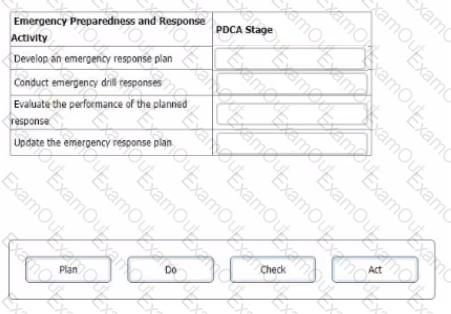
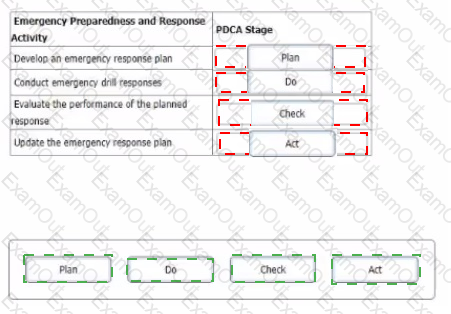
Consider the emergency preparedness and response process outlined in ISO 45001. Match each process activity to the correct stage of the PDCA cycle.
To complete the table click on the blank section you want to complete so it is highlighted in red and then click on the applicable text from the options the appropriate process. "
You are conducting a Stage 2 audit of a steel fabrication works that uses powerful presses to shape steel sheets into various car panels. You note from the accident book that more staff hours have been lost through accidents associated with the presses than those associated with any other equipment.
You question the OH and S manager who tells you, " These big presses are just inherently more dangerous than other equipment. If there is an accident, it ' s going to be more serious as a result of the forces at work. "
Which three of the following audit trails would it now be appropriate to pursue?