
A multi-level shopping centre is open every day to the public from 09:00-21:00. During an external audit of the centre to ISO 14001, you establish that there are 40 vending machines that are permanently switched on. Thirty of them do not sell perishable foodstuffs. You also note that there are eight escalators in the complex that run constantly during public access. When asked about environmental performance improvement objectives, the Centre Manager says that there are plans to increase the natural daylight by installing more skylights, thus saving on lighting costs, but the board has not yet approved the estimated budget for this.
You: I note that energy consumption is a significant environmental aspect in the centre. How do you mitigate the impacts of this?
EMS Manager: We try to reduce our energy costs by negotiating a better deal from the energy company. We are considering changing to one that only supplies electricity from renewable sources.
You: What steps have you taken to reduce overall consumption?
EMS Manager: We conducted awareness training for staff. For example, turning off lights in staff areas not being used.
You: I see that the escalators account for the highest usage of energy. Are there any objectives to try to reduce this?
EMS Manager: No, it would be too costly to change them.
You: How do you measure electricity consumption?
EMS Manager: We have meters installed on each floor of the centre. We take readings every hour, and we plot the consumption graph for every staff shift.
Select three options that would provide evidence of conformance with clause 9.1.1 of ISO 14001.
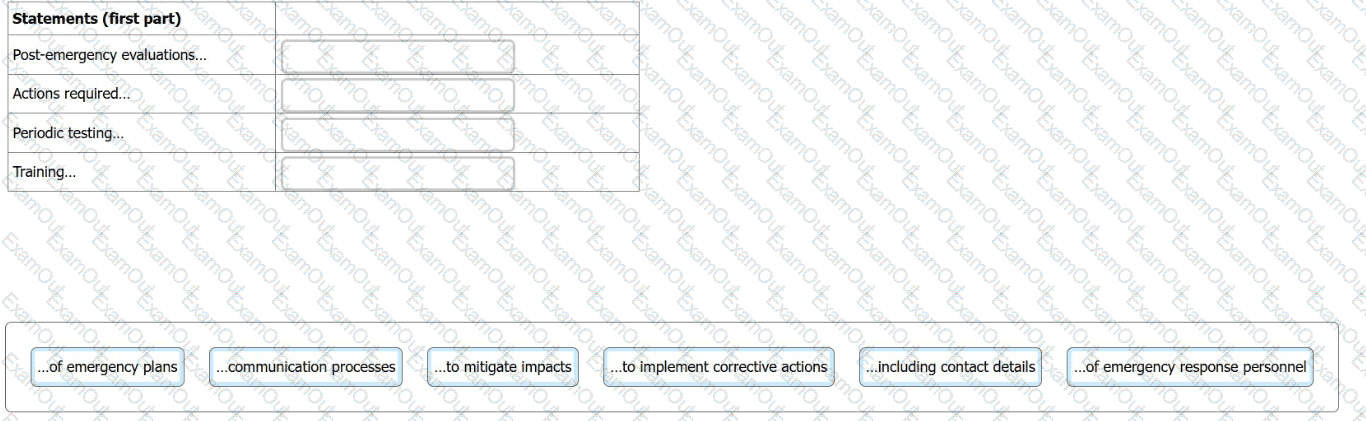
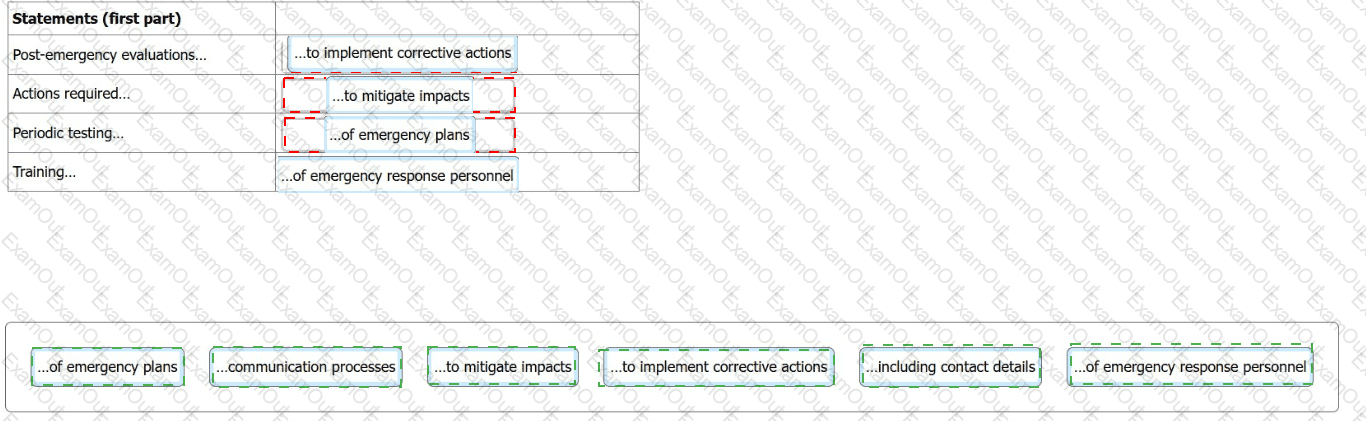
The following four statements relate to planning to respond to emergencies. Each statement is divided into two parts. Match the first part to the corresponding second part of each statement:
Just before the closing meeting of a third-party audit, the audit team leader is invited to a meeting with the EMS Manager.
He tells the audit team leader that a member of the audit team was seen taking videos on the factory floor using his mobile phone and wants him suspended from the closing meeting with any nonconformities raised by him rescinded.
When asked about this, the auditor said that he had obtained permission from the Production Manager who was escorting him around.
Select three options of how the audit team leader might respond to the EMS Manager.
The audit team leader presents the audit outcome at the closing meeting attended by the Chief Executive and the senior managers of a care home. The agenda involves the reporting of a low number of minor nonconformities in the EMS to ISO 14001. It becomes clear to the audit team leader and team members that the Chief Executive becomes increasingly agitated as the meeting progresses.
Before the audit team leader can present a summary of the audit results, the Chief Executive interrupts the report and angrily claims that the whole process is flawed and that the organisation has wasted its time on trying to get certification because it has chosen the wrong certification body.
Select the one option you would take as the audit team leader in response to the situation.
An internal auditor of a manufacturer of aluminium products for the car industry raised a nonconformity against section 6.2.2 of ISO 14001 in Report IA202. The nonconformity (NC3) stated:
" Top management has not analysed why none of the environmental objectives set for the last year have been met. "
A third-party auditor reviewing the internal audit process came across the nonconformity and found that no corrective action was documented. The EMS Manager confirmed no action had been taken, but added he expected a number of objectives to be achieved in the next three months so there was no need for further action. He explained in confidence that the organisation was fighting a takeover bid and resources for environmental projects had been cut.
From the information, select three non-conformities options that the auditor could raise to ISO 14001.
An internal auditor of a manufacturer of aluminium products for the car industry asked to see the most recent management review minutes and found no reference to the completion of some of the current environmental objectives. He raised a nonconformity against section 9.3.c of ISO 14001 in Report IA202. The nonconformity (NC3) stated:
" Top management has not analysed why some of the environmental objectives have been met since the last management review. "
When discussing the finding with the Environmental Manager, the auditor was informed that planned actions taken to complete the current environmental objectives were specifically covered in the internal audit programme and did not need any further work done.
Select one of the options which would constitute an effective response by the Environmental Manager to the nonconformity.
Which one of the following options best describes the main purpose of a Stage 2 third-party audit?
An organisation has the following environmental policy document displayed in the reception area:
" This organisation is committed to providing electric cables to customers ' requirements, in accordance with environmental regulations for their manufacture, use and disposal. The organisation will strive to increase the environmental awareness of its personnel, suppliers, subcontractors and interested parties. Continual environmental improvement is a permanent objective of the organisation. This policy shall be communicated to all employees with the opportunity for them to seek clarification where required. Where required the policy shall be communicated to all interested parties. "
Referring to the above policy statement, select three options for which the organisation is meeting ISO 14001 requirements.
Which one of the following conclusions in the audit report is not required by the certification body when deciding to grant certification?
