You are asked to ensure that a Web application your company uses is both reachable and decrypted by Netskope. This application is served using HTTPS on port 6443. Netskope is configured with a default Cloud Firewall configuration and the steering configuration is set for All Traffic.
Which statement is correct in this scenario?
Review the exhibit.
SelfSignedCert (self signed certificate in certificate chain) Blocked by SSL_SELF_SIGNED. The destination is not reachable. Contact your IT administrator with the following error.
You are the proxy administrator for a medical devices company. You recently changed a pilot group of users from cloud app steering to all Web traffic. Pilot group users have started to report that they receive the error shown in the exhibit when attempting to access the company intranet site that is publicly available. During troubleshooting, you realize that this site uses your company’s internal certificate authority for SSL certificates. Which three statements describe ways to solve this issue? (Choose three.)
You want to integrate with a third-party DLP engine that requires ICAP. In this scenario, which Netskope platform component must be configured?
You want to verify that Google Drive is being tunneled to Netskope by looking in the nsdebuglog file. You are using Chrome and the Netskope Client to steer traffic. In this scenario, what would you expect to see in the log file?
A)

B)

C)

D)

You have an NG-SWG customer that currently steers all Web traffic to Netskope using the Netskope Client. They have identified one new native application on Windows devices that is a certificate-pinned application. Users are not able to access the application due to certificate pinning. The customer wants to configure the Netskope Client so that the traffic from the application is steered to Netskope and the application works as expected.
Which two methods would satisfy the requirements? (Choose two.)
You are asked to create a Real-time Protection policy to inspect outbound e-mail for DLP violations. You must prevent sensitive e-mail from leaving the corporate mail relay.
In this scenario, which Real-time Protection policy action must be specified?
You deployed the Netskope Client for Web steering in a large enterprise with dynamic steering. The steering configuration includes a bypass rule for an application that is IP restricted. What is the source IP for traffic to this application when the user is on-premises at the enterprise?
You built a number of DLP profiles for different sensitive data types. If a file contains any of this sensitive data, you want to take the most restrictive policy action but also create incident details for all matching profiles.
Which statement is correct in this scenario?
Review the exhibit.
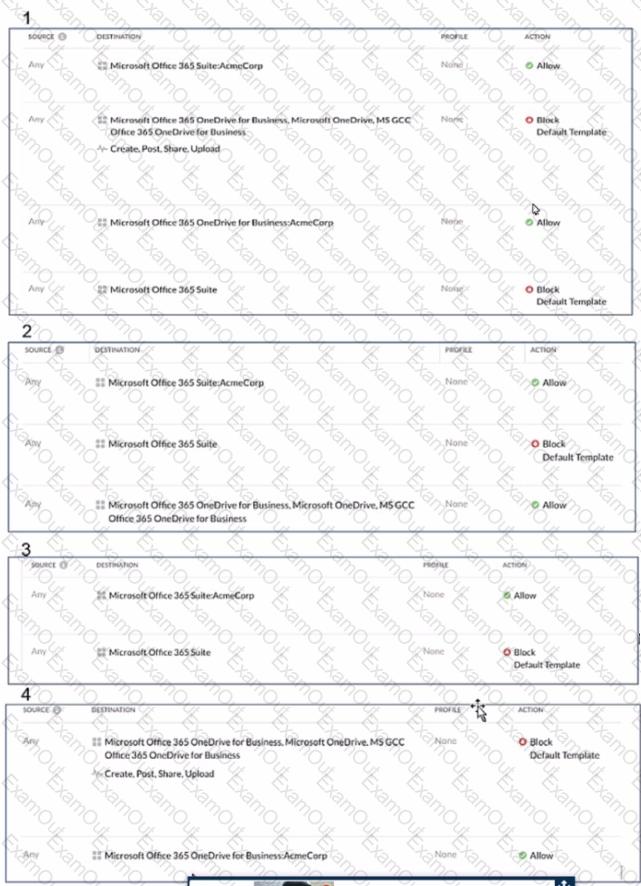
AcmeCorp has recently begun using Microsoft 365. The organization is concerned that employees will start using third-party non-AcmeCorp OneDrive instances to store company data. The CISO asks you to use Netskope to create a policy that ensures that no data is being uploaded to non-AcmeCorp instances of OneDrive.
Referring to the exhibit, which two policies would accomplish this posture? (Choose two.)
Review the exhibit.
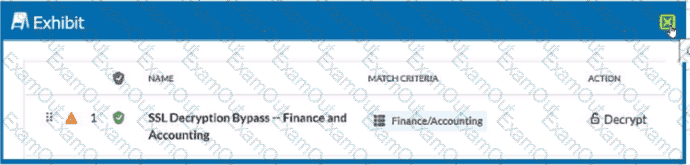
You created an SSL decryption policy to bypass the inspection of financial and accounting Web categories. However, you still see banking websites being inspected.
Referring to the exhibit, what are two possible causes of this behavior? (Choose two.)