Comprehensive and Detailed Explanation From Exact Extract Sources:
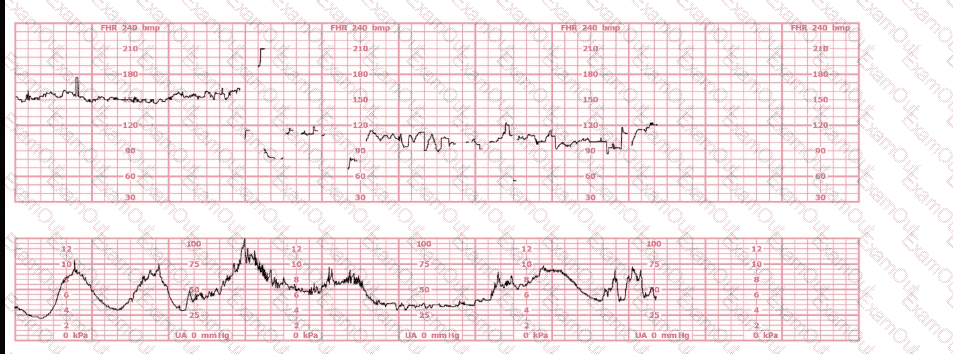
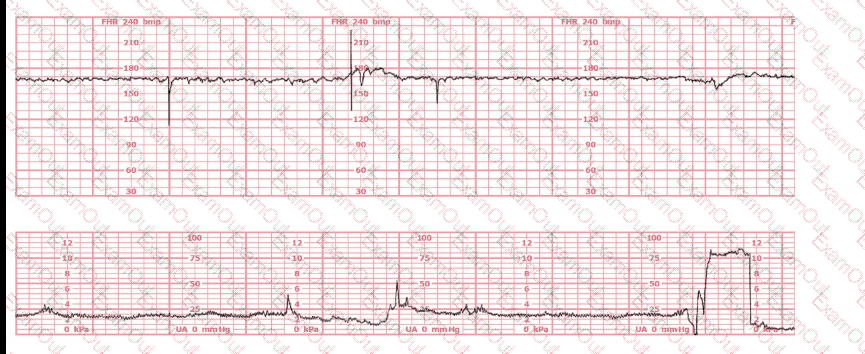
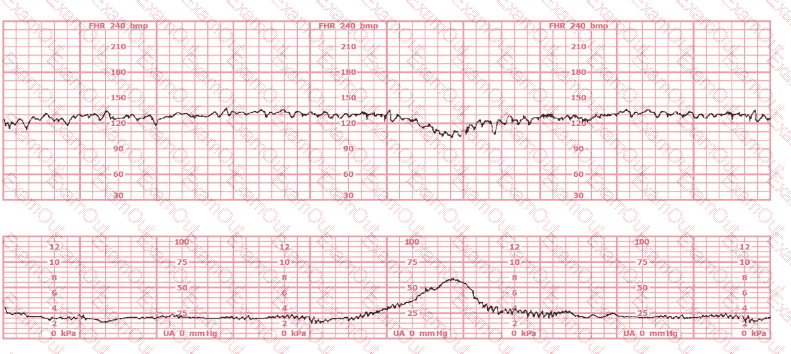
The tracing demonstrates an abrupt-onset, sharp, V-shaped deceleration, occurring simultaneously with or slightly after a contraction—classic for variable decelerations, which are caused by umbilical cord compression.
According to AWHONN Fetal Heart Monitoring Principles & Practices, variable decelerations are defined by:
“Abrupt decreases in FHR below baseline of at least 15 bpm, lasting at least 15 seconds and less than 2 minutes.”
“Most commonly associated with umbilical cord compression, whether transient or recurrent.”
Physiology reference (Simpson & Miller, Pocket Guide):
Compression of the umbilical vein causes a brief acceleration.
Compression of the umbilical arteries triggers a vagal response, producing a rapid deceleration.
This creates the characteristic sharp ‘V’, ‘U’, or ‘W’ shape on the monitor.
Placental insufficiency (Choice B) produces late decelerations, which are gradual, not abrupt.
Fetal head compression (Choice A) produces early decelerations, which mirror contractions and have a gradual pattern.
Thus, the tracing is most consistent with variable decelerations caused by umbilical cord compression.
[References:AWHONN Fetal Heart Monitoring Principles & Practices;Simpson – Fetal Monitoring;Menihan – Electronic Fetal Monitoring;Miller’s EFM Pocket Guide;NCC C-EFM Content Outline – Pattern Recognition Domain., ]