
Spring Sale Special - Limited Time 70% Discount Offer - Ends in 0d 00h 00m 00s - Coupon code: sntaclus

The healthcare quality professional is tasked with monitoring the monthly fall rates. The fall rate that requires the most immediate investigation is

A.

2 standard deviations above the fall rate average.

B.

a rate with a z-score of 1.5.

C.

2 standard deviations below the fall rate average.

D.

a rate with a z-score of -1.5.

A team at a large ambulatory surgery center is working to improve patient safety and plans to leverage technology as a strategy. Which of the following best illustrates that this is occurring?

A.

Staff are unable to proceed past a required double check without a second staff member logging in.

B.

Oral communication is replaced by communication in the electronic medical record.

C.

A decrease is noted in the number of adverse events reported in the electronic incident reporting system.

D.

An increase in workarounds is recorded by the barcode medication administration (BCMA) system.

The greatest motivator for organization leaders to use a balanced scorecard is that it

A.

Identifies potential risk liabilities

B.

Highlights accreditation standard gaps

C.

Displays financial performance outcomes

D.

Provides key performance information

The purpose of sentinel event review of never events is to

A.

engage leadership in identifying barriers to effective communication.

B.

identify individual performance gaps that resulted in the sentinel event.

C.

monitor staff and leadership involvement in the systematic analysis.

D.

specify sustainable systems-based improvements.

A healthcare quality professional has been informed of a significant medication error resulting in patient harm. A multidisciplinary team should be selected to conduct a

A.

Multiple regression analysis

B.

Variation analysis

C.

Root cause analysis

D.

Failure mode and effects analysis (FMEA)

A new pediatric psychiatric unit will open in one year. The utilization coordinator is responsible for developing the utilization management program. The program's success will depend on which of the following factors?

A.

obtaining approval from the chief psychiatrist at each stage of development

B.

developing the program and presenting it to the appropriate staff members

C.

involving the team members in the development of the program

D.

providing educational in-services to all team members involved

The desired outcome of peer review Is to

A.

evaluate process Improvement Initiatives.

B.

compare provider performance.

C.

Improve the quality of care.

D.

limit privileges of at-risk providers.

For which incident would a process improvement manager be required to perform a root cause analysis (RCA)?

A.

Incorrect critical care patient transported to radiology.

B.

Admitting a visitor who fell on hospital grounds.

C.

Wrong prescription given to a discharged patient with diabetes.

D.

Procedure performed on the wrong knee.

Complaint analysis is most useful in identifying which of the following?

A.

customer expectations

B.

quality of the services rendered

C.

adherence to standards

D.

competence of personnel

A consistent and effective communication plan for a process improvement initiative facilitates

A.

Project success

B.

Clinical relevance

C.

Buy-in from leadership

D.

Decreased costs

A quality professional has been asked to assist with prioritizing quality performance Initiatives In the surgery department. Given the Information In the matrix below, which of the following performance Initiatives should take priority?

A.

Reduce unplanned readmissions.

B.

Reduce blood transfusion reactions.

C.

Reduce urinary tract Infections.

D.

Reduce surgical site Infections.

An organization has compiled the scatter plots below:
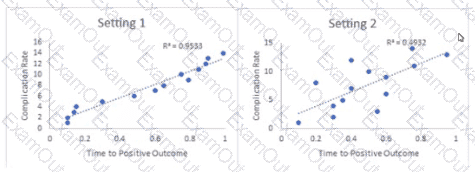
Based on these plots, which of the following conclusions can be made by the quality professional?

A.

Setting 2 has a significant correlation between complication rate and time to positive outcome.

B.

Complication rates are not causing longer time to positive outcome at setting 2.

C.

Setting 1 has a strong positive correlation between complication rate and time to positive outcome.

D.

Complication rates are causing longer time to positive outcome at settling 1.

Which of the following Is an example of a population health strategy?

A.

scheduling discharged Inpatients for follow up appointments

B.

reviewing outpatient prescribing patterns for pain management patients

C.

Implementing an employee wellness program

D.

auditingInpatient admission medications for duplicates

Cold-spotting involves identifying populations that

A.

engage in high-risk behaviors.

B.

lack access to healthcare or other community support.

C.

receive care through state and federally funded programs.

D.

utilize healthcare services frequently.

A nurse inadvertently hung an IV medication on the wrong patient’s IV pump, but discovered the error prior to initiating the infusion. Patient harm was averted, and the nurse disclosed the error to a healthcare quality professional. The quality professional should

A.

encourage the nurse to report the near-miss error through the adverse event reporting system.

B.

recommend that the nurse undergo additional medication safety training.

C.

perform no additional action since the error did not affect the patient, and the nurse disclosed the near-miss.

D.

report the nurse to the manager for not performing safety checks prior to medication administration.