
Spring Sale Special - Limited Time 70% Discount Offer - Ends in 0d 00h 00m 00s - Coupon code: sntaclus

Which of the following best describes the purpose of the nominal group technique?

A.

eliminates redundant Ideas generated by team members

B.

diffuses potential conflict between team members

C.

ensures effective communication among team members

D.

encourages equal participation from all team members

Which of the following should be presented to senior management to obtain support for a new quality improvement (QI) program?

A.

Software recommendations and the plan justification

B.

Timeline and QI committee membership roster

C.

Resources needed and software recommendations

D.

Proposed plan and resources needed

Which of thefollowing tools would best display nosocomial infection rates over time?

A.

scatter gram

B.

Pareto chart

C.

histogram

D.

run chart

Which of the following actions demonstrate an organization working towards a just culture?

A.

Repeating safety culture assessments on a regular basis

B.

Creating a balance between accountability and improving unsafe systems

C.

Prioritizing evaluation of safety events that reach the patient

D.

Balancing culture and lessons learned to create high reliability

In a healthcare organization Implementing ongoing performance Improvement (PI), which of the following will most likely benefit the PI goals of the organization?

A.

a system selected by middle and senior management resulting from proposals by consultants

B.

a comprehensive process developed. Implemented, and monitored by the quality management department

C.

cross-functional processes evaluated by multidisciplinary teams with the support of management

D.

discrete systems relevant to, and monitored by. individual departments

A Lean improvement team is examining potential improvements to room layout to reduce waste. Which of the following is the best tool to identify the baseline distance staff travel through the day to gather the materials they need to perform their job tasks?

A.

5 whys

B.

spaghetti diagram

C.

Pareto chart

D.

time observation

The national benchmark for catheter-associated urinary tract infections (CAUTI) is 1.00. An organization’s rate is 1.50. When beginning a process improvement project to reduce CAUTI, what rate should be set as the goal?

A.

1.25

B.

1.00

C.

0.50

D.

0.00

A hospital collects patient satisfaction data by mailing surveys to patients discharged home and analyzes the responses they receive. What is the most significant limitation of this sampling methodology?

A.

Patients may notrespond to all questions in the survey.

B.

Responses will be time-consuming to convert from hard copy responses to soft copies for data storage.

C.

Hospital employees have no control over which patients respond to the survey.

D.

Patients who respond to the survey may not be representative of all discharged patients.

Which of the following tools should be used to determine the root cause of variations in a process?

A.

histogram

B.

Ishikawa diagram

C.

Shewhart chart

D.

scatter plot

Which of the following is most effective to sustain knowledge gained from performance improvement training?

A.

Integrating key improvement teachings into daily work

B.

Rewarding demonstrations of performance improvement

C.

Using simulations to illustrate complex concepts

D.

Requiring repeat training and reassessments

An employee health program includes a pre-employment health assessment for all prospective employees. The assessment is to be completed and the results known prior to the assumption of duties. A retrospective study of 200 employees resulted in the following chart:
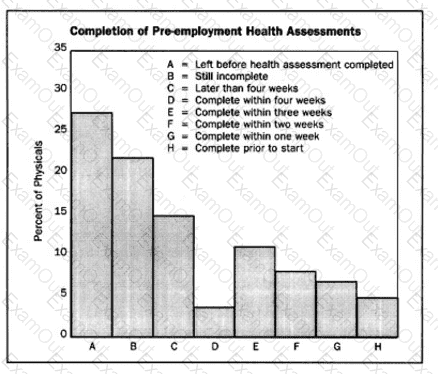
Analysis of the chart shows which of the following conclusions?

A.

The process is operating as expected.

B.

The majority of assessments are completed after the employee begins work.

C.

The assessments are being completed efficiently.

D.

Few employees fail to complete the health assessment.

An organization decides to transition from a departmental quality assurance model to a multidisciplinary quality improvement model. The first step to ensure successful change is to:

A.

Demonstrate leadership commitment to the change.

B.

Evaluate the staff members’ readiness for change.

C.

Communicate the change throughout the organization.

D.

Assess the current quality model.

In developing educational training in quality improvement, which component should be included?

A.

Discussion of incidents

B.

Performance appraisal results

C.

Quality definitions and principles

D.

Individual focus of activities

Which of the following is the quality professional's first step prior to implementing a new infection prevention protocol in the clinic?

A.

Create an education program around the protocol.

B.

Implement an audit process.

C.

Solicit support from key stakeholders.

D.

Develop a communication plan.

The preferred culture in promoting patient safety

A.

auditsstandards and promotes learning from mistakes.

B.

uses anonymous reporting and audits standards.

C.

promotes learning from mistakes and fosters collaboration.

D.

fosters collaboration and uses anonymous reporting.