
A 20-year-old woman, gravida 0, para 0, presents with increased facial hair. Her periods are regular and moderate. Her BMI is 24, and her blood pressure is 110/70 mm Hg. Which one of the following is the most likely diagnosis?
A 26-year-old woman, gravida 2, para 2, aborta 0, has just delivered a full-term newborn via spontaneous vaginal delivery after 4 hours of labor. Following oxytocin administration and placental expulsion, there continues to be a steady trickle of bright red blood from her vagina. On examination, the placenta is intact and the fundus feels firm. Her vital signs are within normal range.
Which one of the following is the most likely diagnosis?
You are treating a 78-year-old man for recent onset of diarrhea, tenesmus, and minor bleeding when he wipes. He has a history of prostate cancer that was treated by radiotherapy. Rectal examination findings are normal. Colonoscopy reveals a pale rectum with ulcerations and areas of mucosal hemorrhage. Which one of the following is the most likely explanation for this clinical presentation?
A 67-year-old man underwent his first endoscopy. He has long-term reflux and heartburn, treated intermittently with antacids. Biopsies of the distal esophagus reveal Barrett epithelium. Which one of the following is most important in determining the frequency of surveillance endoscopy?
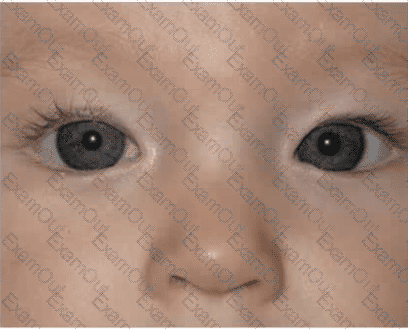
An 18-month-old boy is brought to the office by his guardians for a well-child visit. His guardians are concerned that his eyes do not look the same. On examination, his eyes appear as shown in the referenced photo.
Which one of the following best represents the patient ' s condition?
A 36-year-old woman presents to the office with a 2-month history of multiple asymptomatic bumps on her vulva. She is not currently sexually active but has had 2 male sexual partners in the past, with the most recent relationship ending 1 year ago. On examination, she appears to have genital warts. She has not received the human papillomavirus (HPV) vaccine and is not interested in any treatment that is not absolutely necessary. Which of the following is the best next step?
A 3-year-old boy is brought to your office because his daycare teachers are concerned about his language development. His parents speak both English and French at home, and he can say around 15 words combined in both languages. His history reveals that he has minimal interest in playing with other children. Which one of the following is most appropriate?
A 26-year-old man presents with pain, numbness, and weakness in his right upper extremity. He works as a computer programmer, and his BMI is 32. Symptoms have worsened since he started spending more time on the keyboard. He reports that his right hand feels clumsier while he is typing. Physical examination reveals mild weakness in the intrinsic muscles of that hand, with a positive Tinel sign at the ulnar nerve. Which one of the following is the best next step?
A 45-year-old man presents to your family practice for follow-up because he has had repeated transient ischemic attacks and had been advised not to drive. During the interview, you find out that he is still driving. He explains that he only drives to the grocery store and his wife, who also has a driver ' s license, is always a passenger with him. He insists he can drive. You think that he should no longer be driving a car. Which one of the following is the best next step?
A 26-year-old man presents to the office with a tender mass in his right neck. He was recently treated for a dental infection but is otherwise well. On examination, there is a 2-cm tender, mobile lymph node in the right anterior cervical chain. No other lymphadenopathy or abnormalities are found on physical examination. Which one of the following is the best next step?
