
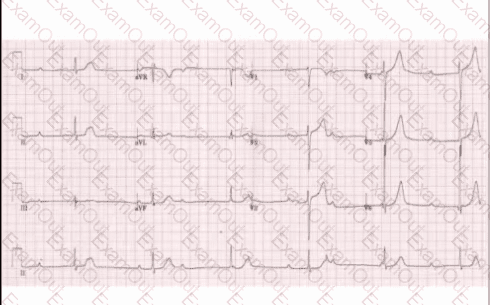
An 80-year-old woman presents to the Emergency Department with dizziness. She has a medical history of coronary artery disease. On examination, she is alert and oriented. Her vital signs are as follows:
Her electrocardiogram is shown in the image.
Which one of the following is the most likely diagnosis?
Blood pressure
80/60 mm Hg
Heart rate
40/min
Respiratory rate
12/min
Her electrocardiogram is shown in the attached image. Which one of the following is the most likely diagnosis?
A 79-year-old woman presents to the Emergency Department with sudden-onset severe chest and back pain that started 1 hour ago. She has a history of hypertension and looks unwell. Her vital signs are as follows: blood pressure 168/108 mm Hg, heart rate 110/min, respiratory rate 22/min, temperature 36.7°C. Findings of a physical examination of the chest and abdomen are normal. An urgent computed tomography (CT) scan of the chest and abdomen shows an aortic dissection extending from the descending thoracic aorta to the upper abdominal aorta. The branches of the abdominal aorta are patent. Following initial resuscitation, which one of the following is the best next step?
A 34-year-old man presents to your office with a 2-week history of headaches and double vision when he looks to the right. On physical examination, you note that he is unable to gaze laterally with his right eye. Which one of the following cranial nerves is most likely affected?
A 12-year-old boy is brought to the Emergency Department with a 2-week history of a limp with malaise, fever and left leg pain. On examination, he looks sick, has a temperature of 38.5°C and is able to weight-bear. His hip examination reveals mildly decreased range of motion. Radiographs of the hip and femur show mild sclerosis of proximal femoral metaphysis. His C-reactive protein level is 15 mg/L ( < 8). Which one of the following is the most likely diagnosis?
A 45-year-old man is brought to the Emergency Department with chest pain. He has no significant medical history. He is anxious and agitated, and he reports severe central chest pain that began about 90 minutes ago. His vital signs are as follows: blood pressure 200/110 mm Hg, heart rate 140/min, respiratory rate 30/min, oxygen saturation 98% on supplemental oxygen. Physical examination reveals a restless and slightly tremulous man. Pupils are 7 mm reactive. There are no focal neurologic signs. Cardiopulmonary examination is normal. The 12-lead electrocardiogram reveals sinus tachycardia; findings are otherwise normal. Which one of the following is the most likely cause of this clinical presentation?
You are an attending physician at a palliative care unit and are asked to see an 80-year-old woman who is dying of lung cancer. She has been unresponsive for the last 2 days and had her last dose of morphine 4 hours ago. Her son just arrived in town this afternoon and pleads with you to wake her up so she can sign her will. Which one of the following is the best next step?
An 18-year-old man presents to your clinic with a history of intermittent, dull, achy pain on the left side of his scrotum, and he has now noted left scrotal enlargement. On examination, you note a swelling in the left scrotum when he is standing that disappears when he is supine. Which one of the following is the most likely diagnosis?
A 17-year-old boy presents to your clinic with a 6-month history of recurrent headaches. The headaches are excruciating, and he describes them as a stabbing pain, usually around his right eye. They occur several times daily for 2 to 3 weeks and recur every few months. The headaches are associated with tearing from his right eye and tend to get worse when he is overtired. Which one of the following is the most likely diagnosis?
A 45-year-old woman presents to your clinic for follow-up regarding her asthma. She is planning to attend a cultural event that includes ceremonial burning of tobacco. Which one of the following is the best next step?
A 56-year-old woman with a 4-year history of fibromyalgia presents for follow-up. She reports that she is struggling with her health and daily life. She is unhappy with her lack of progress and says she feels tired all the time and stays in bed all day. When asked why, she states she is confused about why she is not getting better. Physical exam and investigations are unchanged from baseline. Which one of the following is the best next step?
