Month End Sale Special - Limited Time 70% Discount Offer - Ends in 0d 00h 00m 00s - Coupon code: sntaclus

You must add an Amazon Web Services (AWS) network access list (NACL) rule to allow SSH traffic to a subnet for temporary testing purposes. When you review the current inbound and outbound NACL rules, you notice that the rules with number 5 deny SSH and telnet traffic to the subnet.

What can you do to allow SSH traffic?

A.

You do not have to create any NACL rules because the default security group rule automatically allows SSH traffic to the subnet.

B.

You must create a new allow SSH rule anywhere in the network ACL rule base to allow SSH traffic.

C.

You must create two new allow SSH rules, each with a number bigger than 5.

D.

You must create two new allow SSH rules, each with a number smaller than 5.

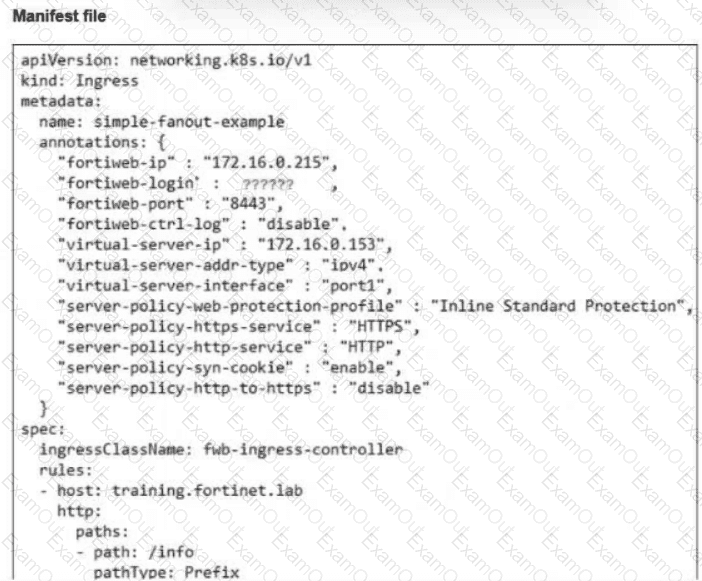
An administrator implements FortiWeb ingress controller to protect containerized web applications in an AWS Elastic Kubernetes Service (EKS) cluster.

What can you conclude about the topology shown in FortiView?

A.

The FortiWeb VM gets the latest cluster information through an SDN connector.

B.

This topology has two services and two ingress controllers deployed.

C.

Both services will be load balanced among the two nodes and the four pods.

D.

Adding a new service will update the FortiWeb configuration automatically.

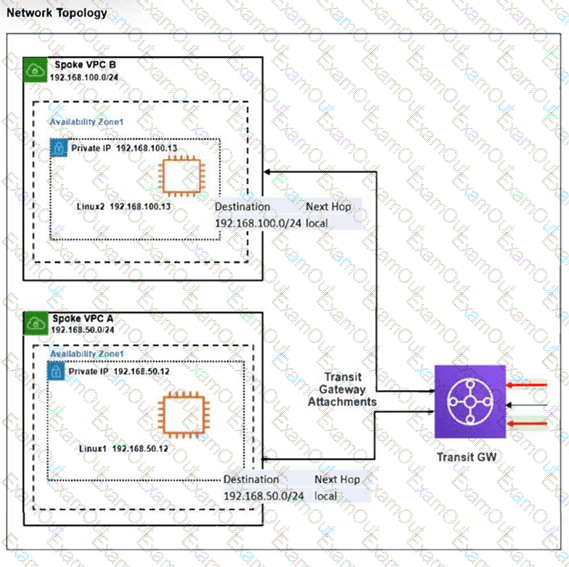
Refer to the exhibit.

In your Amazon Web Services (AWS), you must allow inbound HTTPS access to the Customer VPC FortiGate VM from the internet. However, your HTTPS connection to the FortiGate VM in the Customer VPC is not successful.

Also, you must ensure that the Customer VPC FortiGate VM sends all the outbound Internet traffic through the Security VPC.

How do you correct this issue with minimal configuration changes? (Choose three.)

A.

Add a route with your local internet public IP address as the destination and the internet gateway as the target.

B.

Add a route with your local internet public IP address as the destination and the transit gateway as the target.

C.

Add a route to the destination 0.0.0.0/0 with the transit gateway as the target.

D.

Deploy an internet gateway, associate an EIP with the Customer VPC private subnet, and then add a new route with destination 0.0.0.0/0 with the internet gateway as the target.

E.

Deploy an internet gateway, attach it to the Customer VPC, and then associate an EIP with the port1 of the FortiGate in the Customer VPC.

Refer to the exhibit.

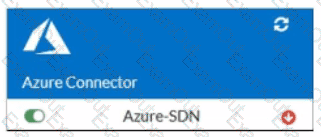
An administrator installed a FortiWeb ingress controller to protect a containerized web application. What is the reason for the status shown in FortiView? (Choose one answer)

A.

The SDN connector is not authenticated correctly.

B.

The FortiWeb VM is missing a route to the node subnet.

C.

The manifest file deployed is configured with the wrong node IP addresses.

D.

The load balancing type is not set to round-robin.

Refer to the exhibit.

An experienced AWS administrator is creating a new virtual public cloud (VPC) flow log with the settings shown in the exhibit.

What is the purpose of this configuration?

A.

To maximize the number of logs saved

B.

To monitor logs in real time

C.

To retain logs for a long term

D.

To troubleshoot a log flow issue

An administrator would like to use FortiCNP to keep track of sensitive data files located in the Amazon Web Services (AWS) S3 bucket and protect it from malware. Which FortiCNP feature should the administrator use?

A.

FortiCNP Threat Detection policies

B.

FortiCNP Risk Management policies

C.

FortiCNP Data Scan policies

D.

FortiCNP Compliance policies

The cloud administration team is reviewing an AWS deployment that was done using CloudFormation.

The deployment includes six FortiGate instances that required custom configuration changes after being deployed. The team notices that unwanted traffic is reaching some of the FortiGate instances because the template is missing a security group.

To resolve this issue, the team decides to update the JSON template with the missing security group and then apply the updated template directly, without using a change set.

What is the result of following this approach?

A.

If new FortiGate instances are deployed later they will include the updated changes.

B.

Some of the FortiGate instances may be deleted and replaced with new copies.

C.

The update is applied, and the security group is added to all instances without interruption.

D.

CloudFormation rejects the update and warns that a new full stack is required.

An administrator is relying on an Azure Bicep linter to find possible issues in Bicep files.

Which problem can the administrator expect to find?

A.

The resources to be deployed exceed the quota for a region.

B.

Some resources are missing dependsOn statements.

C.

There are output statements that contain passwords.

D.

One or more modules are not using runtime values as parameters.

Your monitoring team reports performance issues with a web application hosted in Azure. You suspect that the bottleneck might be due to unexpected inbound traffic spikes.

Which method should you use to identify and analyze the traffic pattern?

A.

Deploy Azure Firewall to log traffic by IP address.

B.

Enable Azure DDoS protection to prevent inbound traffic spikes.

C.

Use Azure Traffic Manager to visualize all traffic to the application.

D.

Enable NSG Flow Logs and analyze logs with Azure Monitor.

How does an administrator secure container environments in Amazon AWS from newly emerged security threats? (Choose one answer)

A.

Using Docker-related application control signatures.

B.

Using Amazon AWS-related application control signatures.

C.

Using distributed network-related application control signatures.

D.

Using Amazon AWS_S3-related application control signatures.