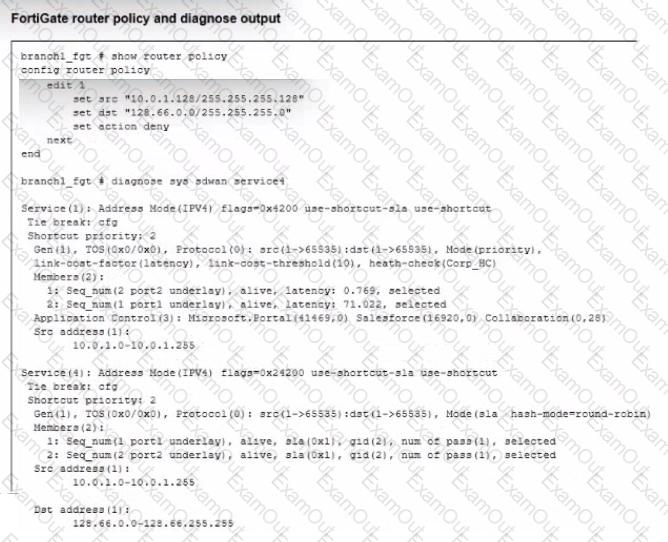
According to the SD-WAN 7.6 Core Administrator curriculum, to implement an SD-WAN solution that ensures high network availability for business-critical applications while managing costs, the administrator must configure at least two WAN links.
SD-WAN Fundamentals: SD-WAN operates by creating a virtual overlay across multiple physical or logical transport links (e.g., broadband, LTE, MPLS). Without at least two links, the SD-WAN engine has no alternative path to steer traffic toward if the primary link fails or degrades.
Cost Management: By using multiple links, administrators can implement the Lowest Cost (SLA) or Maximize Bandwidth strategies. This allows the site to use a low-cost broadband connection for primary traffic and only failover to a " pay-per-use " backup (like LTE) when the primary link ' s quality falls below the defined SLA target.
High Availability (Link Level): While a " High Availability (HA) cluster " (Option C) provides device redundancy (protecting against a hardware failure of the FortiGate itself), it does not address link redundancy or steering, which are the core functions of SD-WAN for application uptime.
Why other options are incorrect:
Option A: Using a mid-range device refers to hardware capacity but does not solve the requirement for link-level redundancy and cost-steering logic.
Option B: Dynamic routing (like BGP or OSPF) is often used with SD-WAN in large topologies, but for a small site, the primary mechanism for meeting availability and cost goals is the configuration of the SD-WAN member links and rules themselves.
Option C: HA clusters protect against hardware failure, but the question specifically asks about ensuring availability for applications while limiting backup link costs, which is a traffic-steering (SD-WAN) requirement rather than a hardware-redundancy requirement.