(Full question statement start from here)
You are deploying a FortiSwitch virtual stack in a network that contains Cisco devices. You want the Cisco devices toautomatically discover the FortiSwitch devices and exchange device information. Which two protocols must be enabled on the FortiSwitch devices to achieve this? (Choose two answers)
Refer to the exhibits.
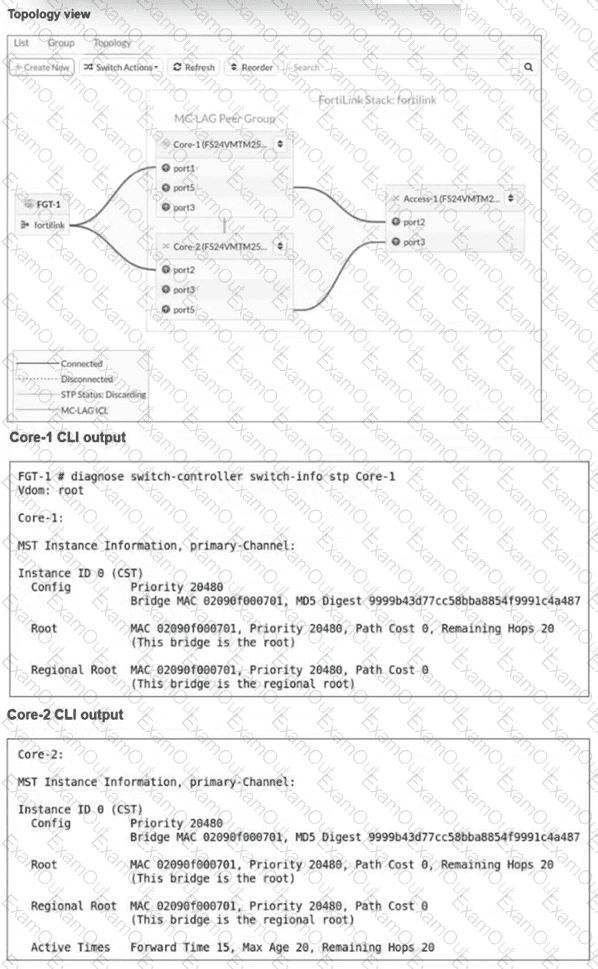
An administrator has deployed two FortiSwitch devices, Core-1 and Core-2, as multichassis link aggregation group (MCLAG) peers. These switches are connected to FortiGate for FortiLink and to an access switch (Access-1) using an inter-switch link (ISL). After configuration, the administrator notices that both Core-1 and Core-2 are claiming to be the root bridge in the Multiple Spanning Tree Protocol (MSTP) topology. What explains this behavior? (Choose one answer)
Your team is deploying a single FortiGate and a single FortiSwitch across 100 branch offices. The goal is to expedite deployment while avoiding manual configuration errors. Which method would allow you to achieve this goal most efficiently? (Choose one answer)
Which two are valid traffic processing actions that a FortiSwitch access control list (ACL) can apply to matching traffic? (Choose two answers)
Which interfaces on FortiSwitch send out FortiLink discovery frames by default in order to detect a FortiGate with an enabled FortiLink interface?
You are deploying a multitier FortiSwitch topology with redundant links between access and aggregation switches. The team is considering Multiple Spanning Tree Protocol (MSTP) to manage spanning tree across multiple VLANs. Which two Rapid STP (RSTP) features would be useful in this deployment to ensure fast convergence and predictable port roles? (Choose two answers)
(Full question statement start from here)
What is one key advantage of using a sniffer profile on FortiSwitch compared to using the sniffer command? (Choose one answer)
In which two ways can you assign a FortiSwitch port to a VDOM using a multi-tenancy setup? (Choose two answers)
You are deploying a small office network with a single FortiGate and a single FortiSwitch. The office currently has moderate traffic, but the IT team expects the network to grow in the near future, adding more FortiSwitch devices and endpoints. Which FortiLink configuration should you deploy to provide the best combination of current performance and scalability for future growth? (Choose one answer)
An administrator needs to deploy managed FortiSwitch devices in a remote location where multiple VLANs must be utilized to segment devices. No Layer 3 switch or router is present. The the only WAN connectivity is the router provided by the ISP connected to the public internet.
Which two items will the administrator need to use? (Choose two.)