Halloween Sale Special - 75% Discount Offer - Ends in 0d 00h 00m 00s - Coupon code: estly75

(Full question statement start from here)

You are planning to deploy FortiSwitch devices on your network. Your goal is to simplify management and ensure integration with the Security Fabric. Which deployment approach should you choose? (Choose one answer)

A.

Use the FortiSwitch-Manager device for centralized management.

B.

Manage FortiSwitch from FortiManager for large-scale enterprise deployments.

C.

Use FortiEdge Cloud for centralized management with advanced analytics.

D.

Manage FortiSwitch on FortiGate using FortiLink.

(Full question statement start from here)

How does enabling an IGMP snooping proxy on FortiSwitch help reduce the number of IGMP reports processed by the IGMP querier? (Choose one answer)

A.

By converting IGMP reports into broadcast packets to reach all VLAN members

B.

By converting IGMP traffic to unicast

C.

By suppressing duplicate IGMP reports within the VLAN

D.

By forwarding IGMP reports only when the first member joins and the last member leaves

Exhibit.

port1 and port2 are the only ports configured with the same native VLAN 10.

What are two reasons that can trigger port1 to shut down? (Choose two.)

A.

port1 was shut down by loop guard protection.

B.

STP triggered a loop and applied loop guard protection on port1.

C.

An endpoint sent a BPDU on port1 that it received from another interface.

D.

Loop guard frame sourced from port1 was received on port1.

You are designing a FortiSwitch backbone where every FortiSwitch device must connect to every other FortiSwitch for maximum redundancy. To maintain connectivity while preventing loops, which protocol or feature must you configure on the switches? (Choose one answer)

A.

Multichassis link aggregation group (MCLAG)

B.

Spanning Tree Protocol (STP)

C.

Full mesh high availability (HA)

D.

Link aggregation group (LAG)

Exhibit.

Which configuration change will allow the managed FortiSwitch to accept SNMP requests from any source?

A.

Create a new local access profile for SNMP only.

B.

Enable SNMP on the internal interface of the switch.

C.

Configure an SNMP host to send SNMP traps.

D.

Add SNMP service on the management interface of the switch.

Which two statements about DHCP snooping enabled on a FortiSwitch VLAN are true? (Choose two.)

A.

Enabling DHCP snooping on a FortiSwitch VLAN ensures requests and replies are seen by all DHCP servers.

B.

switch-controller-dhcp-snooping-verify-mac verifies the destination MAC address to protect against DHCP exhaustion attacks.

C.

By default, all FortiSwitch ports are set to forward client DHCP requests to untrusted ports.

D.

Settings related to DHCP option 82 are only configurable through the CLI

You are managing FortiSwitch ports from a FortiGate device with multiple VDOMs. Which two methods can you use to assign FortiSwitch ports to VDOMs? (Choose two answers)
A.

Assigning the port directly to a specific VDOM for dedicated physical isolation

B.

Use FortiGate policies to control inter-VDOM traffic for FortiSwitch ports

C.

Use interface role mapping to dynamically assign FortiSwitch ports to VDOMs based on Dynamic Host Configuration Protocol (DHCP) scope

D.

Using a virtual port pool (VPP) to create virtualized ports that can be assigned to different VDOMs

How is traffic routed on FortiSwitch?

A.

Hardware-based routing on FortiSwitch is handled by the CPU.

B.

FortiSwitch looks up the hardware routing table and then the forwarding information base (FIB).

C.

ASIC hardware routing can only handle dynamic routing, if supported.

D.

Layer 3 routing can be configured on FortiSwitch, while managed by FortiGate.

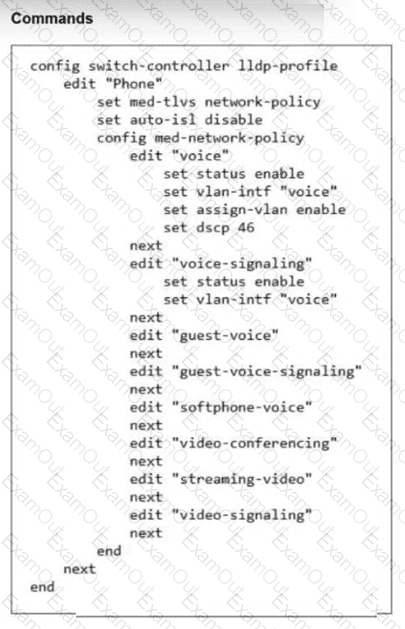
Refer to the exhibit.

question 19

The LLDP profile shown in the exhibit was configured to detect IP phones and automatically assign them to the appropriate VLAN. You apply this LLDP profile on a FortiSwitch port. Which configuration should you enable on the FortiSwitch profile to collect detailed information about all the connected IP phones? (Choose one answer)

A.

Create a new LLDP profile to handle different LLDP-MED TLVs.

B.

Configure a dedicated voice VLAN with DSCP 46.

C.

Enable LLDP-MED inventory management TLVs.

D.

Enable auto-isl.

Which two rules used by MSTP are similar to rules used by other STP methods? (Choose two.)

A.

MSTP uses port role election, similar to rapid STP on the instances.

B.

MSTP uses alternate path and primary path, similar to regular STP.

C.

MSTP uses root bridge selection, similar to rapid STP

D.

MSTP uses timers for transitioning the ports, similar to regular STP.