
Summer Sale Special - Limited Time 70% Discount Offer - Ends in 0d 00h 00m 00s - Coupon code: sntaclus

A data engineer is joining a very large events_df DataFrame containing billions of rows with a small country_lookup_df DataFrame containing fewer than 10,000 rows. The DataFrames are joined on the country_code column. The join is slow because of data shuffling.

How should the data engineer improve performance?

A.

Broadcast events_df when performing the join.

B.

Cache both DataFrames, and then run the same join.

C.

Persist both DataFrames, and then run the same join.

D.

Broadcast country_lookup_df when performing the join.

A data engineer wants to create a new table containing the names of customers that live in France.

They have written the following command:
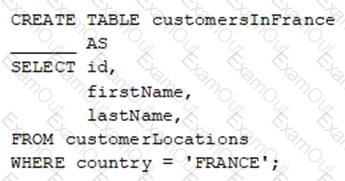
A senior data engineer mentions that it is organization policy to include a table property indicating that the new table includes personally identifiable information (PII).

Which of the following lines of code fills in the above blank to successfully complete the task?

A.

There is no way to indicate whether a table contains PII.

B.

" COMMENT PII "

C.

TBLPROPERTIES PII

D.

COMMENT " Contains PII "

E.

PII

A data engineer is attempting to drop a Spark SQL table my_table. The data engineer wants to delete all table metadata and data.

They run the following command:

DROP TABLE IF EXISTS my_table

While the object no longer appears when they run SHOW TABLES, the data files still exist.

Which of the following describes why the data files still exist and the metadata files were deleted?

A.

The table’s data was larger than 10 GB

B.

The table’s data was smaller than 10 GB

C.

The table was external

D.

The table did not have a location

E.

The table was managed

A data engineer is transforming a Bronze table containing API-response data into a Silver table. The Bronze table has a user_profile column of type STRING that contains JSON data. An example value is:

{ " user_id " : " 12345 " , " name " : " John Smith " , " age " :32, " email " : " john@example.com " }

The Silver table must make this data easily queryable for analytics without requiring JSON parsing in every downstream query.

Which approach standardizes this column for the Silver table?

A.

SELECT

from_json(

user_profile,

' user_id STRING, name STRING, age STRING, email STRING '

) AS parsed_profile

FROM bronze_table;

B.

SELECT

user_profile.user_id AS user_id,

user_profile.name AS name,

CAST(user_profile.age AS INT) AS age,

user_profile.email AS email

FROM bronze_table;

C.

SELECT

get_json_object(user_profile, ' $.user_id ' ) AS user_id,

get_json_object(user_profile, ' $.name ' ) AS name,

CAST(get_json_object(user_profile, ' $.age ' ) AS INT) AS age,

get_json_object(user_profile, ' $.email ' ) AS email

FROM bronze_table;

D.

SELECT

get_json_object(user_profile, ' user_id ' ) AS user_id,

get_json_object(user_profile, ' name ' ) AS name,

get_json_object(user_profile, ' age ' ) AS age,

get_json_object(user_profile, ' email ' ) AS email

FROM bronze_table;

The Delta transaction log for the ‘students’ tables is shown using the ‘DESCRIBE HISTORY students’ command. A Data Engineer needs to query the table as it existed before the UPDATE operation listed in the log.
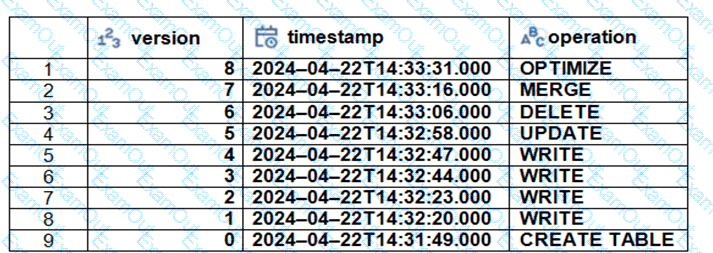
Which command should the Data Engineer use to achieve this? (Choose two.)

A.

SELECT * FROM students@v4

B.

SELECT * FROM students TIMESTAMP AS OF ‘2024-04-22T 14:32:47.000+00:00’

C.

SELECT * FROM students FROM HISTORY VERSION AS OF 3

D.

SELECT * FROM students VERSION AS OF 5

E.

SELECT * FROM students TIMESTAMP AS OF ‘2024-04-22T 14:32:58.000+00:00’

A data engineer is attempting to write Python and SQL in the same command cell and is running into an error The engineer thought that it was possible to use a Python variable in a select statement.

Why does the command fail?

A.

Databricks supports multiple languages but only one per notebook.

B.

Databricks supports language interoperability in the same cell but only between Scala and SQL

C.

Databricks supports language interoperability but only if a special character is used.

D.

Databricks supports one language per cell.

Which method should a Data Engineer apply to ensure Workflows are being triggered on schedule?

A.

Scheduled Workflows require an always-running cluster, which is more expensive but reduces processing latency.

B.

Scheduled Workflows process data as it arrives at configured sources.

C.

Scheduled Workflows can reduce resource consumption and expense since the cluster runs only long enough to execute the pipeline.

D.

Scheduled Workflows run continuously until manually stopped.

A data analysis team has noticed that their Databricks SQL queries are running too slowly when connected to their always-on SQL endpoint. They claim that this issue is present when many members of the team are running small queries simultaneously. They ask the data engineering team for help. The data engineering team notices that each of the team’s queries uses the same SQL endpoint.

Which of the following approaches can the data engineering team use to improve the latency of the team’s queries?

A.

They can increase the cluster size of the SQL endpoint.

B.

They can increase the maximum bound of the SQL endpoint’s scaling range.

C.

They can turn on the Auto Stop feature for the SQL endpoint.

D.

They can turn on the Serverless feature for the SQL endpoint.

E.

They can turn on the Serverless feature for the SQL endpoint and change the Spot Instance Policy to “Reliability Optimized.”

A data engineer is configuring Unity Catalog in Databricks and needs to assign a role to a user who should have the ability to grant and revoke privileges on various data objects within a specific schema but should not have read/write access over the schema or its objects.

Which role should the data engineer assign to this user?

A.

USE CATALOG / USE SCHEMA privilege on the schema

B.

Catalog Owner

C.

Table Owner

D.

Schema Owner

Which SQL code snippet will correctly demonstrate a Data Definition Language (DDL) operation used to create a table?

A.

DROP TABLE employees;

B.

INSERT INTO employees (id, name) VALUES (1, ' Alice ' );

C.

CRFATF tabif employees ( id INT, name suing

D.

ALTFR TABIF employees add column salary DECTMA(10,2);