Pre-Summer Sale Special - Limited Time 70% Discount Offer - Ends in 0d 00h 00m 00s - Coupon code: sntaclus

Which field in a DNS Request event points to the responsible process?

A.

ContextProcessld_readable

B.

TargetProcessld_decimal

C.

ContextProcessld_decimal

D.

ParentProcessId_decimal

Refer to the image. Which query will show file execution from a suspicious directory across all hosts?

A.

#event_simpleName=ProcessRollup2 | aid=* | ImageFileName=/\\Users\\[^\\]+\\Desktop\\/i | groupBy(aid, function=collect([SHA256HashData, ImageFileName] ), limit-max)

B.

#event_simpleName=ProcessRollup2 | aid=c28082797f7f4d81b3f869dbaf6eb712 | ImageFileName=/\$Recycle\.Bin/i | groupBy(aid, function=collect([SHA256HashData, ImageFileName]), limit-max)

C.

#event_simpleName=ProcessRollup2 | aid=* | ImageFileName=/\$Recycle\.Bin/i | groupBy(aid, function=collect([SHA256HashData, ImageFileName]), limit-max)

D.

#event_simpleName=ProcessRollup2 | aid=* | ImageFileName=/\\Users\\[^\\]+\\Downloads\\/i | groupBy(aid, function=collect([SHA256HashData, ImageFileName] ), limit-max)

You suspect one of your endpoint host systems may have a vulnerable BIOS version. Which Investigate Dashboard will confirm vulnerability information such as the type and timeline?

A.

BIOS Prevalence

B.

BIOS Analysis

C.

BIOS Search

D.

BIOS Firmware Inventory

Which hunting query's results could indicate that an adversary is performing reconnaissance from a specific host?

A.

#event_simpleName=ProcessRollup2 | aid=?aid | ImageFileName=/ (? < FileName > [^\\\/]*)$ / | FileName=/^(explorer|lsass|svchost|smss|winlogon|userinit)\.exe$/i | table([aid, UserName, ParentBaseFileName, ImageFileName, CommandLine] , limit=1000)

B.

#event_simpleName=NetworkScanEvent | aid=?aid | !cidr(RemoteAddressIP4, subnet=["224.0.0.0/4", "10.0.0.0/8", "172.16.0.0/12", "192.168.0.0/16", "127.0.0.0/8", "169.254.0.0/16", "0.0.0.0/32"]) | table([aid, UserName, ParentBaseFileName, ImageFileName, CommandLine] , limit=1000)

C.

#event_simpleName=NetworkConnect* | RemotePort=?RemotePort aid=?aid | !cidr(RemoteAddressIP4, subnet=["224.0.0.0/4", "10.0.0.0/8", "172.16.0.0/12", "192.168.0.0/16", "127.0.0.0/8", "169.254.0.0/16", "0.0.0.0/32"]) | table([aid, LocalAddressIP4, LocalPort, RemoteAddressIP4, RemotePort] , limit=1000)

D.

#event_simpleName=ProcessRollup2 | aid=?aid | ImageFileName=/ (? < FileName > [^\\\/]*)$ / | FileName=/^(net|ipconfig|whoami|quser|ping|netstat|tasklist|hostname|at)\.exe$/i | table([aid, UserName, ParentBaseFileName, ImageFileName, CommandLine] , limit=1000)

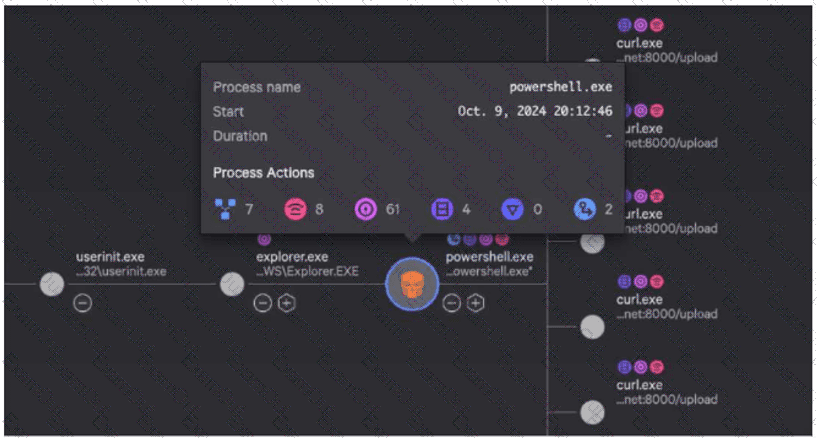
Refer to the exhibit.

While investigating a process tree, you hover over a malicious powershell.exe process. What is the correct sequence of Process Actions?

A.

7 Network Operations, 4 Disk Operations, 8 DNS Requests, 61 Process Operations

B.

8 Network Operations, 61 Disk Operations, 4 DNS Requests, 2 Process Operations

C.

7 Network Operations, 4 Disk Operations, 61 DNS Requests, 2 Process Operations

D.

7 Network Operations, 4 Disk Operations, 61 DNS Requests, 8 Process Operations

While performing triage on a detection, you notice an event with the name SyntheticProcessRollup2. What conclusion can be made about this event?

A.

The event was generated as a result of a critical detection

B.

The event was generated for a process which is not built-in to the host's Operating System

C.

The event was generated to provide context on process injection techniques being used on the host

D.

The event was generated for a process which started before the sensor did

During an investigation, you discover a Falcon host connecting from a country outside of those you normally do business with. Which built-in report would display Falcon hosts connecting from that country?

A.

Geo location activity

B.

Attack Paths

C.

Remote access graph

D.

Global connection heat map

While performing a threat hunt in your environment, you decide to identify rare occurrences of user agent strings over the past 30 days. Which query will highlight those results using CQL?

A.

groupBy(UserAgentString, function=collect([ComputerName, UserName, LocalAddressIP4])) | min(field=UserAgentString, limit=10)

B.

selectFromMin(field=UserAgentString, include=[ComputerName, UserName, LocalAddressIP4])

C.

groupBy(UserAgentString, function=[collect([ComputerName, UserName, LocalAddressIP4]), count()] ) | sort(_count, order=asc, limit=10)

D.

tail(field=UserAgentString, limit=10, include=[ComputerName, UserName, LocalAddressIP4])

Refer to the image.

What line item of the query is used to perform outlier analysis?

A.

Line 6

B.

Line 3

C.

Line 4

D.

Line 7

You've written a complex query within Advanced Event Search that is returning millions of events, making it difficult to threat hunt for particular file metadata. Which option would decrease query time and remove values that are not of interest?

A.

Aggregating the results to group by a specific value

B.

Adding a value as column within the ingested field

C.

Filtering the results to remove irrelevant events

D.

Sorting the results by timestamp in descending order