Pre-Summer Sale Special - Limited Time 70% Discount Offer - Ends in 0d 00h 00m 00s - Coupon code: sntaclus

What is a disadvantage of the traditional three-tier architecture model when east-west traffic between different pods must go through the distribution and core layers?

A.

Low bandwidth

B.

Security

C.

Scalability

D.

High latency

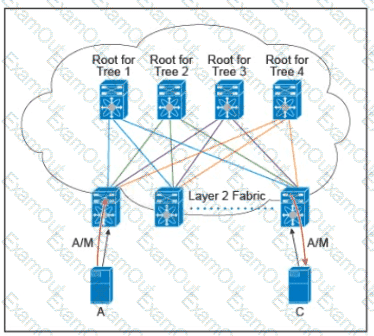
Refer to the exhibit.

There are multiple trees in the Cisco FabricPath. All switches in the Layer 2 fabric share the same view of each tree. Which two concepts describe how the multicast traffic is load-balanced across this topology? (Choose two.)

A.

A specific (S,G) traffic is not load-balanced

B.

All trees are utilized at the same level of the traffic rate

C.

Every leaf node assigns the specific (S,G) to the same tree

D.

A specific (S,G) multicast traffic is load-balanced across all trees due to better link utilization efficiency

E.

The multicast traffic is generally load-balanced across all trees

Which two pain points are the most common for container technology adoption? (Choose two)

A.

Performance

B.

Security

C.

Cost

D.

Container deployment

E.

Skilled staff

F.

Compliance

Which technology supports antispoofing and does not have any impact on encryption performance regardless of packet size?

A.

MACsec

B.

IP source guard

C.

DHCP snooping with DAI

D.

IPsec

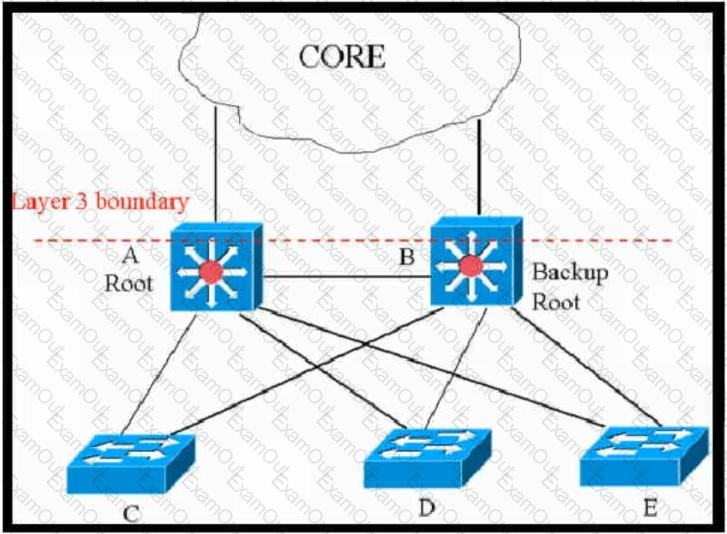
Refer to the exhibit.

This network is running legacy STP 802.1d. Assuming " hello_timer " is fixed to 2 seconds, which parameters can be modified to speed up convergence times after single link/node failure?

A.

The transit_delay=5 and bpdu_delay=20 are recommended values, considering hello_timer=2 and specified.

B.

Only the maximum_transmission_halt_delay and diameter parameters are configurable parameters in 802.1d to speed up STP convergence process.

C.

The max_age and forward delay parameters can be adjusted to speed up STP convergence process.

D.

Only the transit_delay and bpdu_delay timers are configurable parameters in 802.1d to speed up STP convergence process.

Refer to the table.

A customer investigates connectivity options for a DCI between two production data centers. The solution must provide dual 10G connections between locations with no single points of failure for Day 1 operations. It must also include an option to scale for up to 20 resilient connections in the second year to accommodate isolated SAN over IP and isolated, dedicated replication IP circuits. All connectivity methods are duplex 10 Gbps. Which transport technology costs the least over two years, in the scenario?

A.

Metro Ethernet

B.

DWDM

C.

CWDM

D.

MPLS

Which tool automates network implementation activities and shortens the implementation lifecycle?

A.

LISP

B.

Java

C.

Conclusion

D.

Python

Two enterprise networks must be connected together. Both networks are using the same private IP addresses. The client requests from both sides should be translated using hide NAT (dynamic NAT) with the overload feature to save IP addresses from the NAT pools. Which design addresses this requirement using only one Cisco IOS NAT router for both directions?

A.

This is not possible, because two Cisco IOS NAT routers are required to do dynamic NAT with overload in both directions

B.

The ip nat inside and ip nat outside commands must be configured at the interfaces with the overload option in both directions

C.

The overload feature is the default and does not have to be configured

D.

Two different NAT pools must be used for the ip nat inside source and the ip nat outside source commands for the overload feature in both directions

E.

The NAT Virtual Interface must be used to achieve this requirement

What is a disadvantage of the traditional three-tier architecture model when east-west traffic between different pods must go through the distribution and core layers?

A.

Low bandwidth

B.

Security

C.

Scalability

D.

High latency

Which feature is supported by NETCONF but is not supported by SNMP?

A.

Distinguishing between configuration data and operational data

B.

Taking administrative actions

C.

Collecting the status of specific fields

D.

Changing the configuration of specific fields