
Spring Sale Special - Limited Time 70% Discount Offer - Ends in 0d 00h 00m 00s - Coupon code: sntaclus

An engineer must connect a new host to port 1 »’1 on Leaf 101. A Cisco ACI fabric has an MOP policy configured but experience excessive Layer 2 loops The engineer wants the Cisco ACI fabric to detect and prevent Layer 2 loops m the fabric Which set of actions accomplishes these goals’?
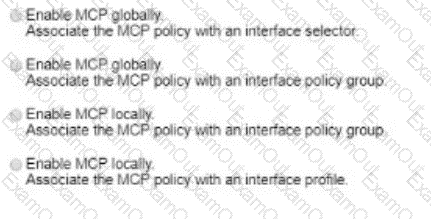
A.

Option A

B.

Option B

C.

Option C

D.

Option D

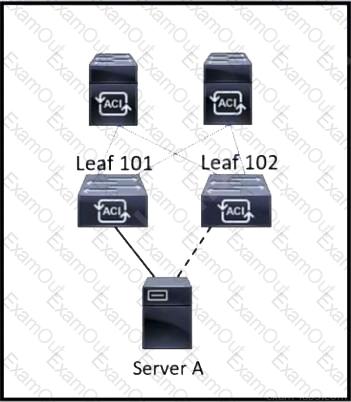
Refer to the exhibit. Server A is connected to the Cisco ACI fabric using two teamed interfaces. One interface in a team is configured as active and the other remains in standby mode. When a failover occurs and the standby interface becomes active, it uses its built-in MAC address to send traffic. Which bridge domain configuration must be applied to resolve the issue?

A.

Configure Hardware proxy.

B.

Set L2 Unknown Unicast to Flood.

C.

Enable ARP flooding.

D.

Activate Limit IP Learning to Subnet.

An engineer configured a bridge domain with the hardware-proxy option for Layer 2 unknown unicast traffic. Which statement is true about this configuration?

A.

The leaf switch drops the Layer 2 unknown unicast packet if it is unable to find the MAC address in the local forwarding tables.

B.

The Layer 2 unknown hardware proxy lacks support of the topology change notification.

C.

The leaf switch forwards the Layers 2 unknown unicast packets to all other leaf switches if it is unable to find the MAC address in its local forwarding tables.

D.

The spine switch drops the Layer 2 unknown unicast packet if it is unable to find the MAC address in the proxy database.

Cisco ACI fabric must detect all silent endpoints for the Layer 3 bridge domain. Which actions accomplish this goal?

A.

Disable Unicast Routing.

Enable L2 Unknown Unicast Hardware Proxy.

B.

Disable Unicast Routing.

Enable L2 Unknown Unicast Flood.

C.

Enable Unicast Routing. Disable ARP Flooding.

D.

Enable Unicast Routing. Enable ARP Flooding.

A Solutions Architect is asked to design two data centers based on Cisco ACI technology that can extend L2/ L3, VXLAN, and network policy across locations. ACI Multi-Pod has been selected. Which two requirements must be considered in this design? (Choose two.)

A.

ACI underlay protocols, i.e. COOP, IS-IS and MP-BGP, spans across pods. Create QoS policies to make sure those protocols have higher priority.

B.

A single APIC Cluster is required in a Multi-Pod design. It is important to place the APIC Controllers in different locations in order to maximize redundancy and reliability.

C.

ACI Multi-Pod requires an IP Network supporting PIM-Bidir.

D.

ACI Multi-Pod does not support Firewall Clusters across Pods. Firewall Clusters should always be local.

E.

Multi-Pod requires multiple APIC Controller Clusters, one per pod. Make sure those clusters can communicate to each other through a highly available connection.

A Cisco ACI environment consists of multiple silent hosts that are often relocated between leaf switches. When the host is relocated, the bridge domain takes more than a few seconds to relearn the host’s new location. The requirement is to minimize the relocation impact and make the ACI fabric relearn the new location of the host faster. Which action must be taken to meet these requirements?

A.

Set Unicast Routing to Enabled.

B.

Configure ARP Flooding to Enabled.

C.

Set L2 Unknown Unicast to Hardware Proxy.

D.

Configure IP Data-Plane Learning to No.

An ACI administrator notices a change in the behavior of the fabric. Which action must be taken to determine if a human intervention introduced the change?

A.

Inspect event records in the APIC UI to see all actions performed by users.

B.

Inspect /var/log/audit_messages on the APIC to see a record of all user actions.

C.

Inspect audit logs in the APIC UI to see all user events.

D.

Inspect the output of show command history in the APIC CLI.

Cisco ACI fabric has three different endpoints S1, S2. and S3. These endpoints must communicate with each other without contracts. These objects have been created in APIC:

•Two EPGs named DNS_EPG and Database_EPG

•Two application profiles. PROD_App and Data_App

•Two bridge domains DNS_BD and Database_BD

•PROD_APP and Database_BD mapped to Tenant PROD

•Data_App and DNS_BD mapped to Tenant Data

Which set of actions completes the fabric configuration?

A.

Add S1, S2, S3 under Database_EPG.

MAP Database_EPG under PROD_ App.

Associate Datbase_EPG with DNS_BD.

B.

Add S1, S2, S3, under DNS_EPG.

MAP DNS_EPG to Data_App.

Associate DNS_EPG with Dns_BD.

C.

Add S1, S2, S3 under DNS_EPG.

MAP DNS_EPG to Data_App.

Associate DNS_EPG with Database_BD.

D.

Add S1, S2, S3 under Database_EPG.

MAP Database_EPG under Data_App.

Associate Datbase_EPG with Database_BD.

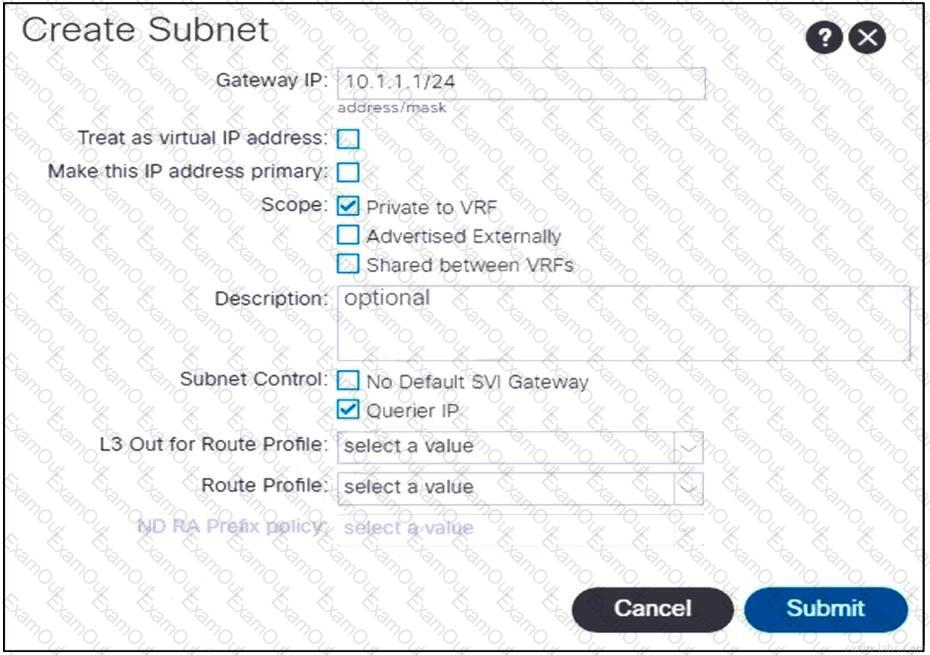
When creating a subnet within a bridge domain, which configuration option is used to specify the network visibility of the subnet?
A.

limit IP learning to subnet

B.

scope

C.

gateway IP

D.

subnet control

Refer to the exhibit. An engineer configures communication between the EPGs in different tenants. Which action should be taken to create the subnet?

A.

Change Scope to Shared between VRFs.

B.

Leave Scope set to Private to VRF.

C.

Add the L3Out for Route Profile value.

D.

Change Scope to Advertised Externally.