
Refer to the exhibit.
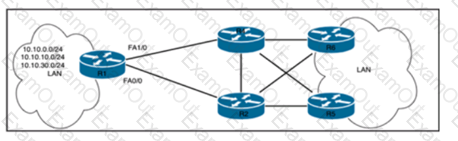
A network engineer must optimize link failures on the OSPF routing domain. The solution must follow RFC 5286. and downtime must be no more than 50 ms. All known subnets on R1 must be protected. Which solution must the engineer implement on R1?
Which two conditions must be met before separate ISPs can provide interdomain multicast routing? (Choose
two.)
Refer to the exhibit.
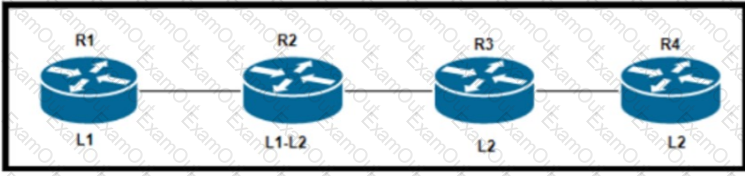
The four routers in this network have formed adjacencies. Router R2 is an IS-IS level 1-2 router that connects to other areas, and the attach bit is set in the R2 level 1 LSP advertisements to R1. According to the network design, R2 should push level 2 routes from its routing table to the R1 routing table. However, R1 installed a default route in its routing table. Which action resolves this problem?
Refer to the exhibit.
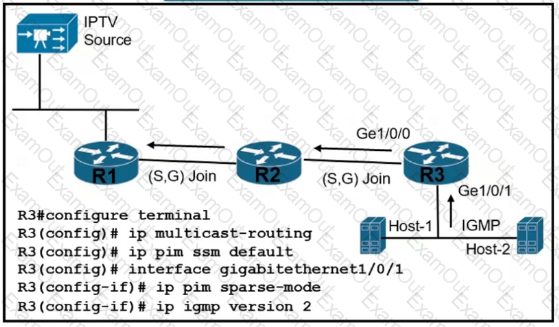
A customer reports that Host-1 is failing to receive streaming traffic from the IPTV source. The engineer has confirmed that hosts on router R2 are receiving traffic normally and that Host-1 is correctly sending subscription messages to join the IPTV stream. Which action must the engineer take to correct the problem?
An engineer is troubleshooting slow performance issues on a customer’s network after the last multicast configuration change was applied on it While checking the running configuration on the router the engineer notices there are many ip igmp join-group commands applied on several interfaces of the router which caused the high CPU utilization usage. What action must the engineer take to solve this issue?
NO: 93
Which fact must a network architect consider when implementing IGMP in a multicast routing environment?
A network engineer is troubleshooting OSPF multiarea. Which Cisco IOS XR feature should the engineer use in order to streamline OSPF issue?
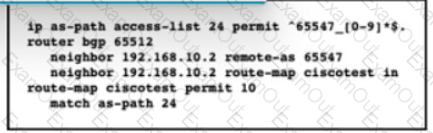
Refer to the exhibit. Router R1 is expected to receive routes that originate from AS 65547 only. However, R1 is receiving routes from AS 65547 and several other ASs that are directly attached to it. Which change to the AS path permit filter corrects the problem?
Which difference must an engineer consider when choosing whether to implement OSPF or IS-IS as the routing protocol on the network?
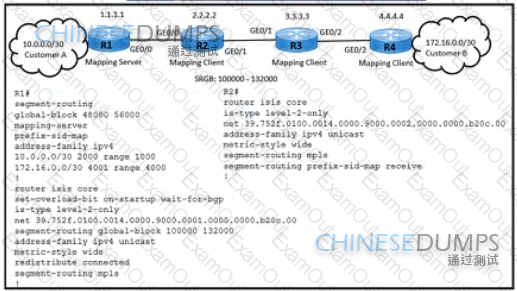
Refer to the exhibit. Customer A and customer B are connecting through a service provider network with these requirements
R1 acts as the mapping server to connect 10 0 0.0/30 and 172.16.0.0/30 networks
R1 and R2 are using nondefault SRG8 range to allocate SID.
R2 ads as the mapping client for transient traffic originating from customer A
Which configuration meets the requirements?
