You are rolling out monitoring for a Claude-based deployment and must complete the specification steps before instrumenting the deployment.
Which two steps must be completed BEFORE instrumenting the deployment to emit metrics and traces? (Select two.)
Each correct answer presents part of the solution.
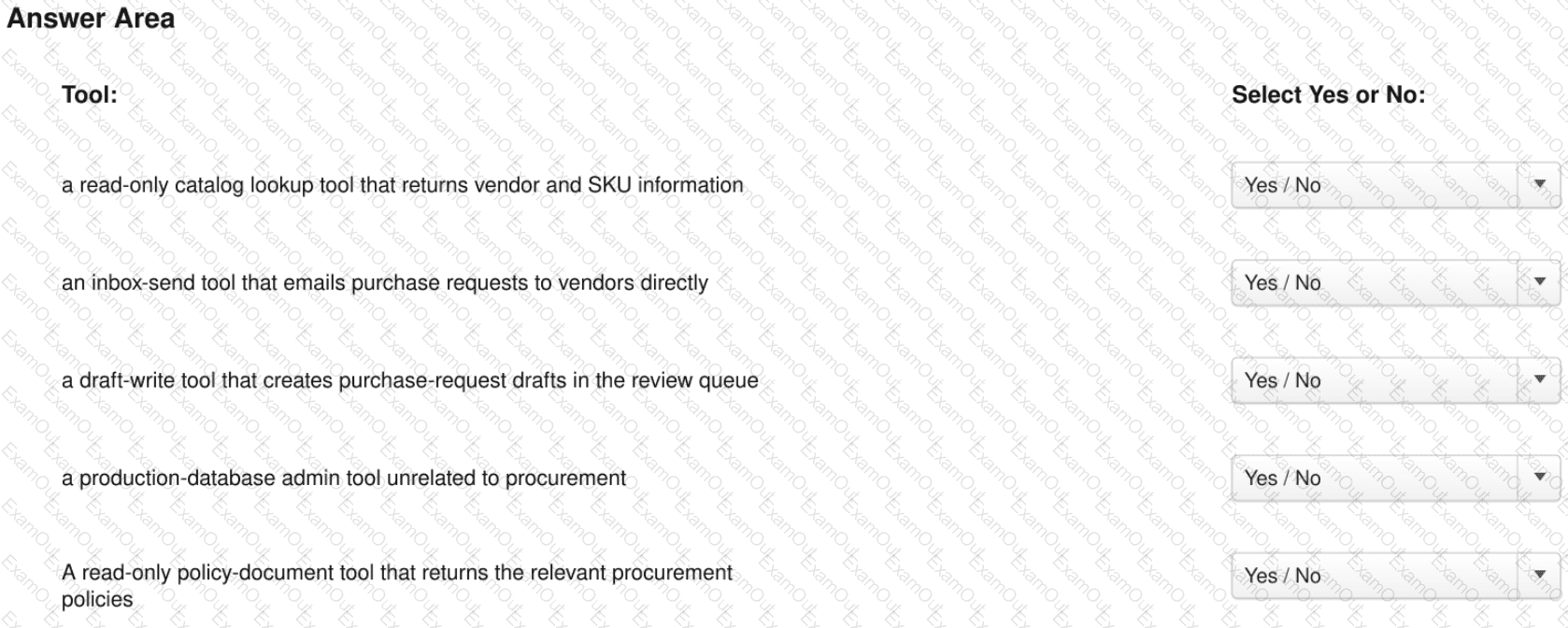
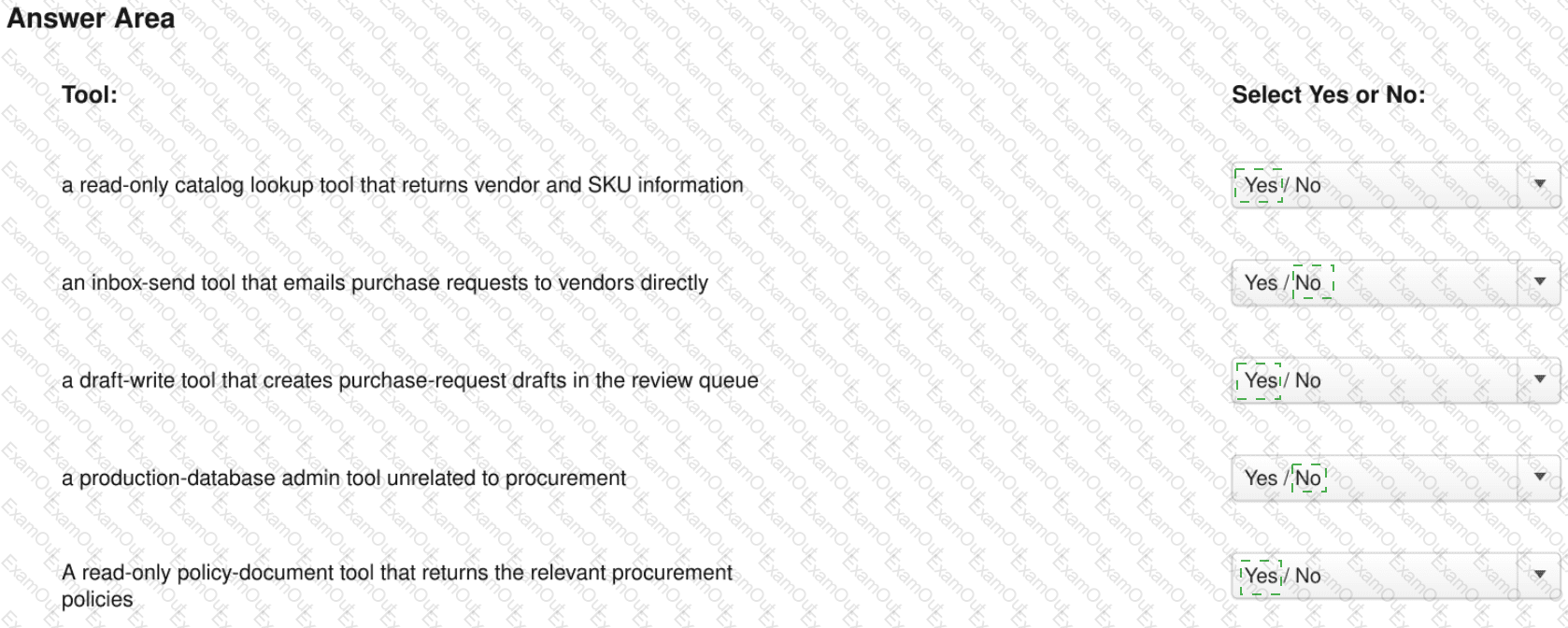
You are auditing a procurement-assistant agent whose defined responsibility is to draft purchase requests for review.
For each tool currently configured on the agent, select yes if the tool should remain after a least-privilege audit. Otherwise, select no if it should be removed.
You are preparing a HIPAA-eligible deployment for a healthcare customer.
Which configuration supports HIPAA compliance using Anthropic-offered tools?
You are building an evaluation pipeline for a Claude-based deployment and must complete the specification steps before running the deployment against the dataset.
Which two steps must be completed BEFORE running the deployment against the evaluation dataset? (Select two.)
Each correct answer presents part of the solution.
You are building an ethics-review checklist for deployments supported by artificial intelligence.
Which two checks belong on the list? (Select two.)
Each correct answer presents a complete solution.
An architect at Trenova Systems, Inc. is reviewing two draft communication packages for the same architectural decision. Package 1 contains a threat model, residual-risk register, and control-mapping table. Package 2 contains a list of capabilities delivered and feature-level roadmap dependencies.
Which two audiences are correctly matched to these packages? (Select two.)
A technical team is cataloguing risks specific to Claude’s use in a document-grounded Q & A system.
Which two items represent failure modes intrinsic to LLM-based systems rather than generic software defects? (Select two.)
You are compiling a diagnostic toolkit for Claude Code operational issues.
Which two diagnostic actions belong in the toolkit? (Select two.)
Each correct answer presents a complete solution.