
Summer Sale Special - Limited Time 70% Discount Offer - Ends in 0d 00h 00m 00s - Coupon code: sntaclus

An engineering organization is adopting Claude Code across 200 developers. A team lead proposes that AI-generated pull requests bypass standard code review for changes under 50 lines because small changes are considered low risk and review capacity is constrained.

Which two Diligence-competency objections should you raise? (Select two.)

Each correct answer presents part of the solution.

A.

Removing review eliminates the verification mechanism required for AI-generated output across the workflow.

B.

Code-review capacity should be expanded to handle every code change submitted across the team.

C.

The threshold should be increased to 200 lines to capture more changes.

D.

AI-generated pull requests should be rejected by default across the organization.

E.

Line count is a poor proxy for the actual risk introduced by a code change.

When communicating an architectural decision to a security and compliance reviewer, which content set is most aligned with that audience’s primary concerns?

A.

Feature delivery schedule, roadmap dependencies, and scope boundaries for the product manager.

B.

Implementation timeline, component interfaces, and deployment sequence for the engineering team.

C.

Threat model, control mappings, residual-risk acceptance criteria, and audit traceability.

D.

Decision rationale, business outcomes, and high-level risk summary for executive review.

You are preparing an operational runbook for a Claude-based service.

Which content is essential to include in the runbook?

A.

Dashboard and log references only, without alert definitions, triage steps, escalation paths, or rollback procedures for the on-call engineer to act on.

B.

Common alerts and their triage steps, escalation paths, rollback procedures, and references to the relevant dashboards and logs.

C.

Alert definitions and triage steps only, without escalation paths, rollback procedures, or references to dashboards and logs for on-call use.

D.

Escalation paths and rollback procedures only, without alert definitions, triage steps, or dashboard references to guide initial incident response.

You are building an ethics-review checklist for deployments supported by artificial intelligence.

Which two checks belong on the list? (Select two.)

Each correct answer presents a complete solution.

A.

Confirm that vendor licensing terms permit the planned production use of the model.

B.

Verify that outputs do not rely on generalizations about people that the underlying data does not support.

C.

Confirm that high-impact decisions retain human accountability rather than being attributed to the model.

D.

Restrict ethics review to outputs that exceed a defined model-confidence threshold.

E.

Confirm that latency and throughput targets are met across supported user populations.

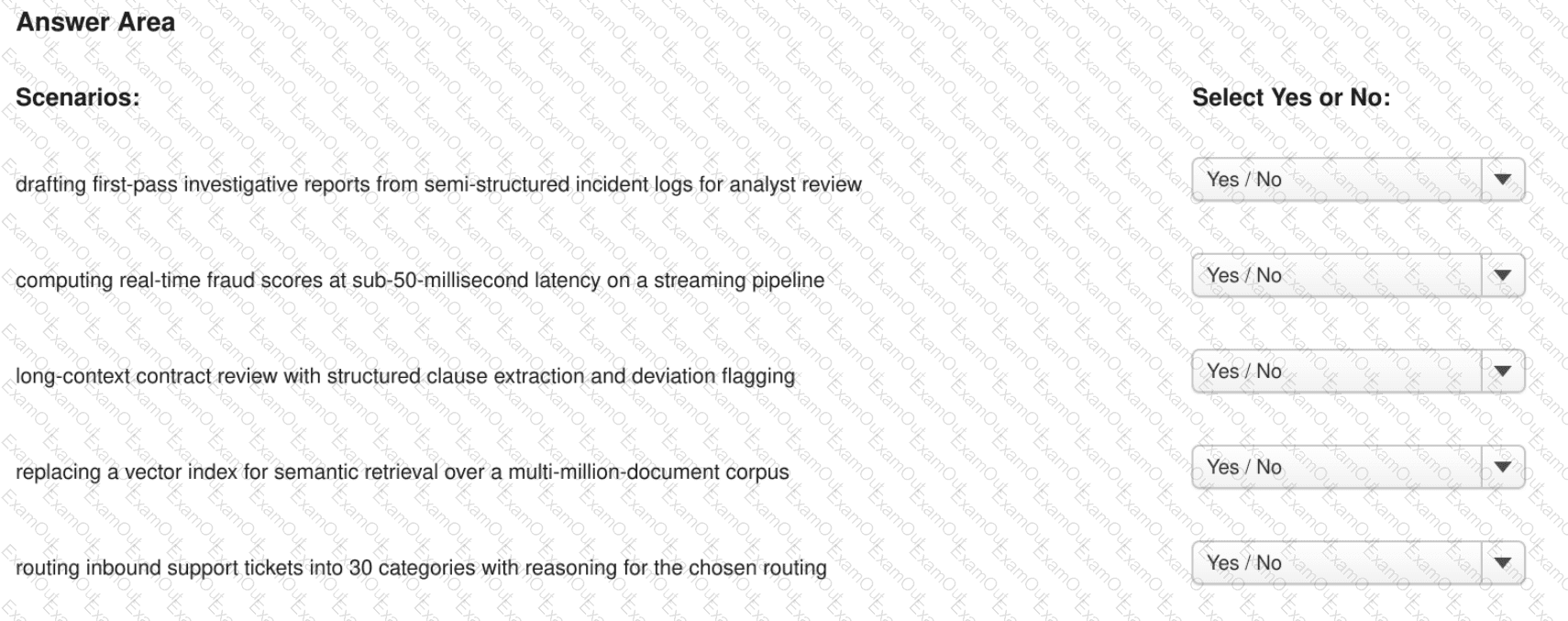
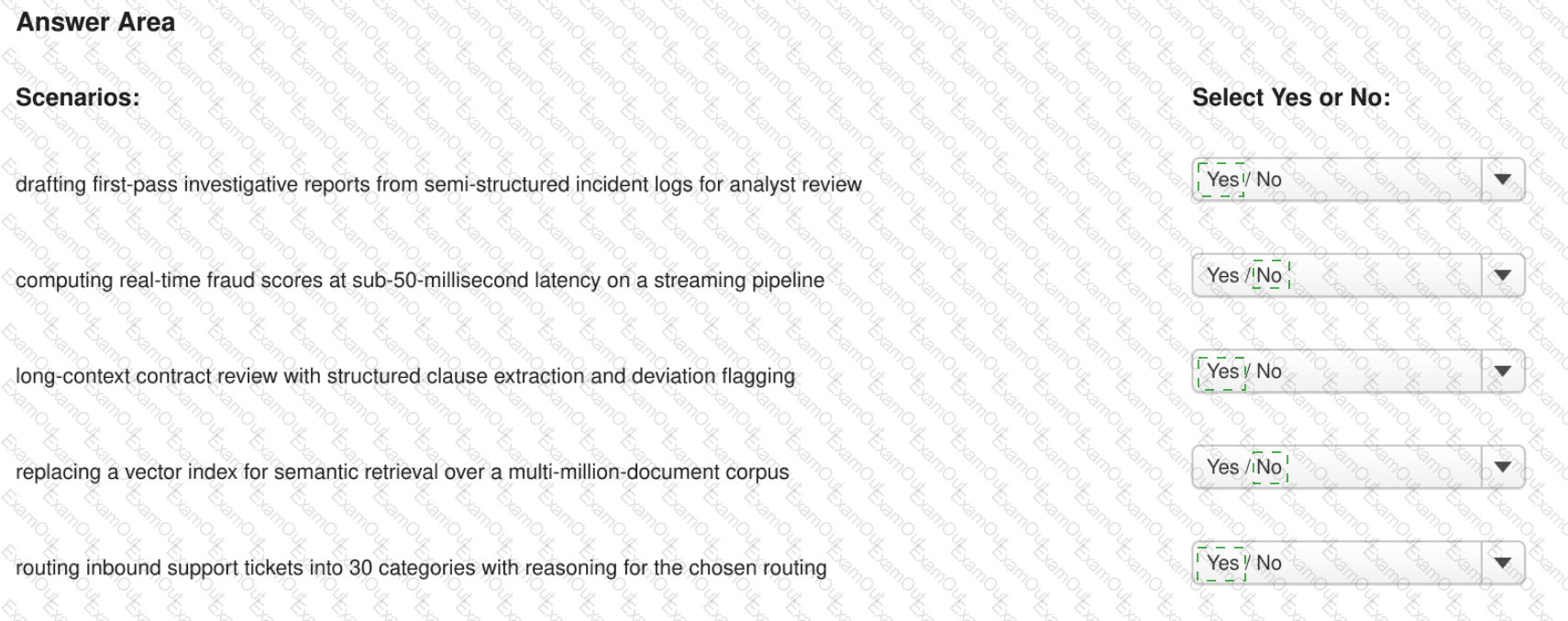
You are a solution architect evaluating candidate use cases for a Claude-based program.

For each scenario, select Yes if Claude is appropriate as the primary solution at the architectural level. Otherwise, select No.
You are building an evaluation pipeline for a Claude-based deployment and must complete the specification steps before running the deployment against the dataset.

Which two steps must be completed BEFORE running the deployment against the evaluation dataset? (Select two.)

Each correct answer presents part of the solution.

A.

Publish the aggregated metrics to a dashboard and gate releases on threshold checks.

B.

Curate and label the evaluation dataset to match the defined slices.

C.

Review failure cases with subject matter experts to refine the scoring rubric.

D.

Define the metrics and slices the framework will report across representative, edge, and adversarial cases.

E.

Score the deployment outputs against the reference labels and aggregate the metrics.

You are evaluating a Claude-based deployment for adherence to a specific regulation.

Which two steps must be completed BEFORE mapping deployment data flows to specific regulatory clauses? (Select two.)

Each correct answer presents part of the solution.

A.

Compare the in-place controls against the regulatory requirements to identify any compliance gaps.

B.

Identify the applicability of the regulation based on data types, jurisdiction, and audience.

C.

Schedule the remediation work with the engineering team based on the prioritized gap findings.

D.

Document the identified gaps along with recommended remediations and residual risk for sign-off.

E.

Inventory the vendor-provided compliance tooling and confirm which compliance affordances are in place.

A Claude architect is auditing configuration scope assignments.

Which two statements correctly identify an appropriate use of user-scope configuration versus other scopes? (Select two.)

A.

Persisting personal editor theme preferences that follow an engineer across projects.

B.

Saving a preferred Claude response language that applies to all repositories the engineer uses.

C.

Enforcing a company-wide policy that disables a feature for all engineers.

D.

Defining MCP server endpoints shared by all contributors to a specific repository.

E.

Storing API authentication keys so they are not committed to version control.

You are reviewing a peer’s Claude Code permission rules for an enterprise rollout. The rules grant unrestricted Bash access to all projects across all developers.

Which response is most appropriate?

A.

Add unrestricted access to additional tool categories as well, so that Bash is not asymmetrically more permissive than other tools, expanding the attack surface further in the name of consistency.

B.

Approve the unrestricted Bash access as written on the grounds that narrowing the rules would add configuration complexity, accepting the full attack surface for all engineers across all projects.

C.

Replace unrestricted Bash with narrowly scoped tool patterns that allow only the specific commands the workflows require, and add explicit deny rules for sensitive operations.

D.

Disable all permission rules for the enterprise rollout so every command across every project runs without any tool-pattern scoping or explicit deny rules for sensitive operations.

You are defining an SLA for a Claude-based assistant.

Which SLA definition is most operationally meaningful?

A.

A target tied to a stakeholder sentiment measure such as “the team feels satisfied,” which cannot be measured objectively or used to trigger a documented breach response.

B.

A measurable target with a defined metric, threshold, evaluation window, and consequence for breach—for example, “p95 per-request latency under 800 ms over a 28-day window.”

C.

A qualitative commitment such as “the system will be fast and reliable,” which names no metric, threshold, or evaluation window.

D.

A target that names the metric and threshold but omits the evaluation window and breach consequence, leaving compliance periods and remediation triggers undefined.
