Summer Sale Special - Limited Time 70% Discount Offer - Ends in 0d 00h 00m 00s - Coupon code: sntaclus

You are distinguishing functional from non-functional requirements during discovery.

Which item is a non-functional requirement?

A.

The system must extract a defined set of specific fields from invoice attachments and populate a downstream data record.

B.

The system must produce a draft response that a human reviewer can edit before sending.

C.

The system must classify inbound tickets into a defined set of categories.

D.

The system must respond at p95 latency under 800 milliseconds at the expected request volume.

You are responding to an adversarial input pattern in which users include text claiming admin authority and instructing the model to bypass safety restrictions.

Which combination of controls most effectively mitigates this attack pattern?

A.

Trusting that the model will intrinsically recognize and reject all bypass attempts without prompt-level instructions, runtime classifiers, scoped permissions, or audit logging.

B.

Prompt-level instructions that treat user content as untrusted data, runtime classifiers that detect override attempts, scoped tool permissions that cannot be elevated by user content, and audit logging of attempts.

C.

Removing all safety restrictions and guardrails to eliminate the attack surface that bypass attempts target, accepting that this makes the assistant unrestricted for all inputs.

D.

Granting users any privilege level they assert in their message content, on the assumption that cooperative behavior requires honoring self-declared authority without independent verification.

A security audit uncovers two issues: (1) all end users share a single API key, and (2) tool calls are executed without logging the initiating user.

Which two mitigations directly address these specific findings? (Select two.)

A.

Validate structured outputs against a schema before downstream actions are executed.

B.

Enforce RBAC at the retrieval layer before content enters the model context.

C.

Move credentials out of the prompt context and resolve them from a server-side secret store.

D.

Add actor attribution to tool-call logs so each call records the initiating user identity.

E.

Replace the shared API key with per-user OAuth tokens carrying scope-restricted permissions.

You are listing characteristics of robust guardrail design for an enterprise deployment.

Which two characteristics belong on the list? (Select two.)

Each correct answer presents a complete solution.

A.

Centralized log retention for guardrail violations with quarterly review by the security team.

B.

Per-role tool allow-lists enforced at the orchestration layer before any tool call executes.

C.

User feedback channels that route reported guardrail failures into the product backlog for triage.

D.

Periodic refresh of the system prompt wording to keep refusal language current and clear.

E.

Adversarial-input coverage in the evaluation set with regression tracking on guardrail performance.

You are identifying the highest-impact optimization for a deployment whose token cost is dominated by a long, repeated system prompt and a large retrieved context per request.

Which optimization most directly targets the dominant cost driver?

A.

Increase retrieval depth on every request to maximize recall, worsening the dominant cost driver by adding more retrieved tokens per request rather than reducing them.

B.

Add additional repeated content to the system prompt to give the model more guidance.

C.

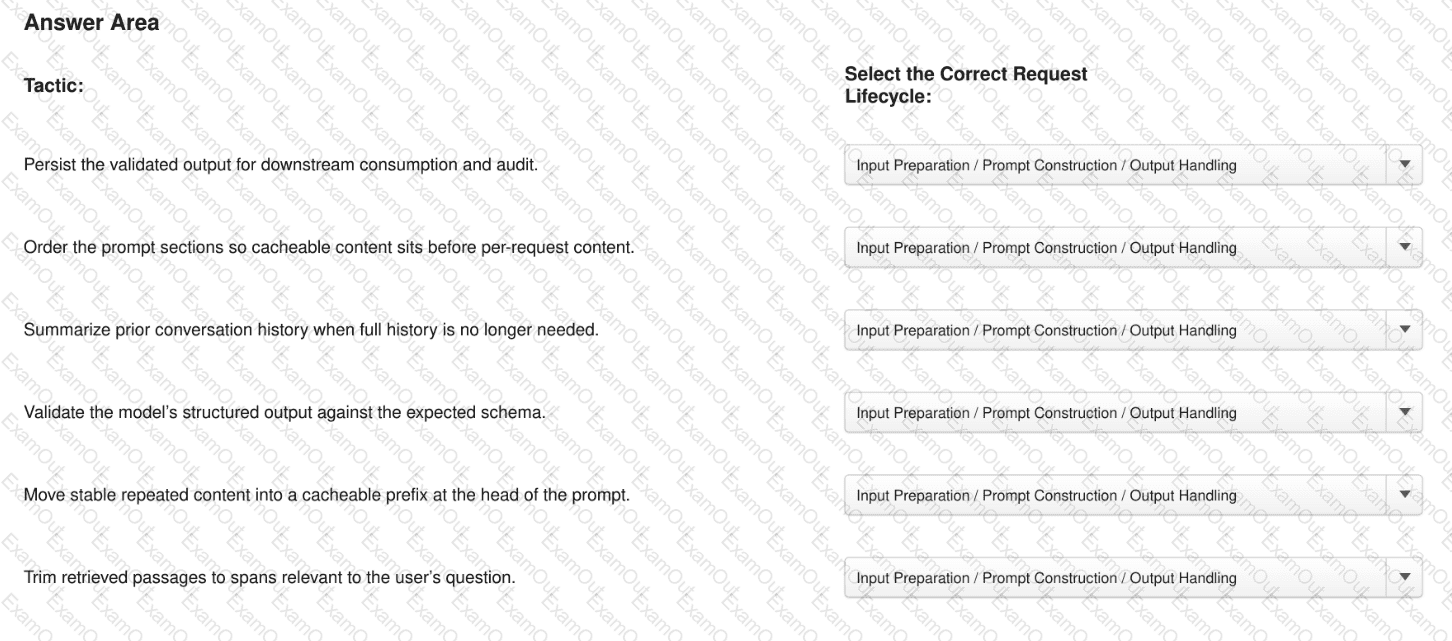
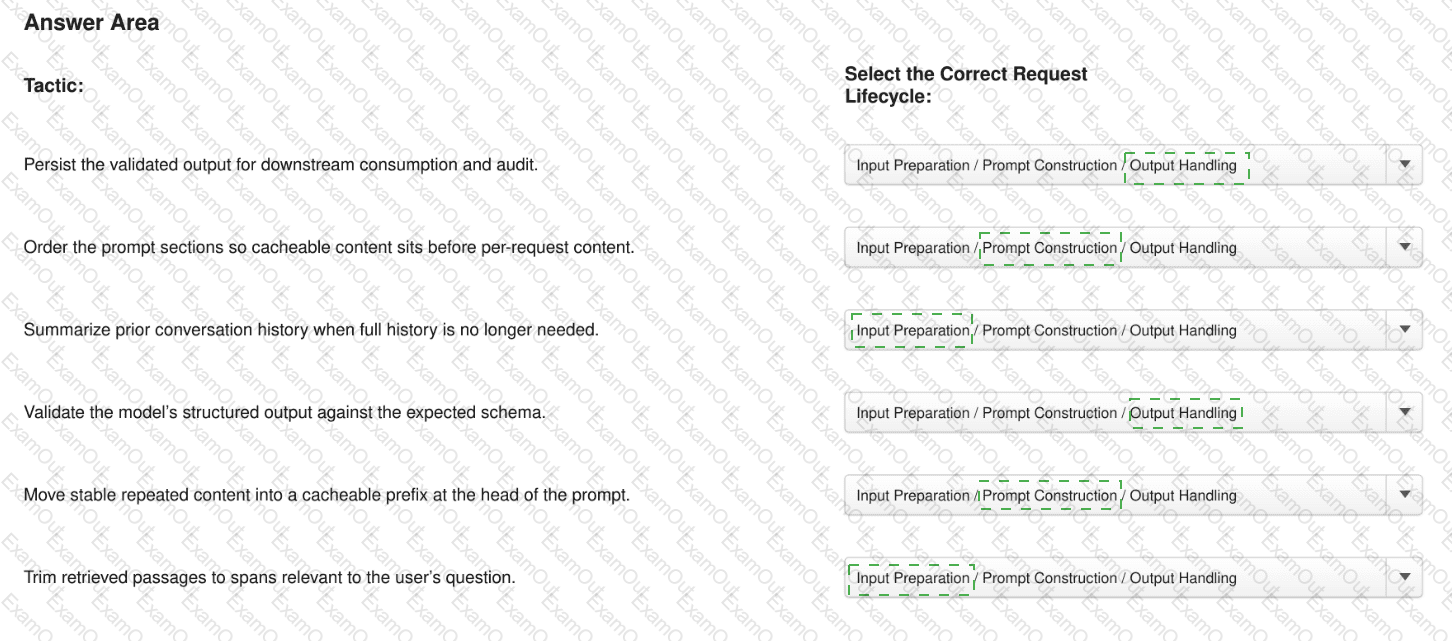
Move the long, repeated system prompt into a cacheable prefix and trim retrieved context to the spans relevant to each query.

D.

Switch every request to the heaviest available model to maximize output quality, accepting that higher per-request inference cost compounds rather than addresses the dominant cost driver.

A Claude architect at a health services organization is defining evaluation metrics for a clinical-summary pipeline. The pipeline must remain within a per-query cost ceiling and must never surface patient data to unauthorized roles.

Which two metrics directly address these requirements? (Select two.)

A.

BLEU score computed against a human-annotated reference summary set

B.

Role-based access-control enforcement rate measured on a red-team dataset

C.

Throughput measured as successful requests processed per minute

D.

Per-query token cost measured against the defined cost ceiling

E.

Response latency at the 95th percentile across a one-week sample window

The compliance team has authored a regulatory disclosure procedure that must be applied identically across customer service, sales, and onboarding workflows. The procedure changes when regulators issue updates, currently four to six times per year. You are designing how the procedure will be packaged for use by Claude across all three workflows.

Which two design decisions should you include? (Select two.)

Each correct answer presents part of the solution.

A.

Package the procedure as a Claude Skill owned directly by the compliance team.

B.

Embed the procedure text into each workflow’s system prompt at integration time.

C.

Store the procedure in a shared retrieval corpus accessed by all three workflows.

D.

Have each workflow team rewrite the procedure for its own context.

E.

Reference the same Claude Skill from all three workflow integrations.

A technical team is cataloguing risks specific to Claude’s use in a document-grounded Q & A system.

Which two items represent failure modes intrinsic to LLM-based systems rather than generic software defects? (Select two.)

A.

An expired TLS certificate blocks outbound API calls to Claude.

B.

A database connection timeout causes retrieval to return an empty result set.

C.

The model refuses a legitimate query because surface features trigger an overly broad safety pattern.

D.

A misconfigured load balancer routes requests to a deprecated API version.

E.

The model generates a plausible-sounding answer unsupported by any retrieved document.

You are reviewing instrumentation in a multi-agent system.

Which two findings constitute valid observability gaps in the instrumentation? (Select two.)

Each correct answer presents a complete solution.

A.

Trace spans for each agent step are exported to the shared distributed-tracing backend.

B.

Latency and token usage on every span are emitted to the central metrics pipeline.

C.

Tool-call payloads and outcomes are recorded with redaction applied to known sensitive fields.

D.

Model identity and version on each turn are not recorded with the turn artifacts.

E.

Request-scoped correlation identifiers do not propagate across agent and tool calls.

You are choosing the level of detail for an implementation guide. The audience is a delivery team that will build the deployment.

Which guidance composition best serves them?

A.

Component responsibilities, contracts between components, sequence diagrams of the dominant flows, configuration parameters with defaults, and operational runbooks.

B.

Component responsibilities and interface contracts only, without sequence diagrams of the dominant flows, configuration parameters with defaults, or runbooks to guide operational tasks.

C.

An architecture overview and sequence diagrams for the dominant flows, without interface contracts, configuration-parameter tables, or operational runbooks for the delivery team to follow.

D.

An architecture overview and a list of known limitations, without component-level diagrams, interface contracts, configuration parameters, or operational runbooks to support implementation.