
Elevation in conjugated bilirubin is most likely to be found in which of the following conditions:
Convert the following temperature from Celsius to Fahrenheit
-4 degrees C
A patient with tuberculosis would be placed in:
Medical ethics
Iron deficiency anemia, or IDA, is associated with an increased TIBC as there is less iron to bind to transferrin. Microcytic, hypochromic red cell morphology, a decreased serum iron level, a decreased serum ferritin level, and a decreased hemoglobin level are all characteristics associated with IDA.
All of the following are characteristic findings in patients with iron deficiency anemia EXCEPT:
Which area of the laboratory is responsible for blood coagulation studies that test for the patient's ability to clot their blood?
The correct answer is Trichophyton rubrum. The tiny microconidia are lined up in a "birds on the fence" arrangement along the hyphal strand transversing the field of view (yellow arrows). Two pencil-shaped, smooth walled macroconidia are also seen in the lower left field of view (red arrows).
Trichophyton verrucosum may produce microconidia in small quantities. However, they are irregularly arranged with little tendency to line up along the hyphae. Antler hyphae and string bean macroconidia are characteristic of this species.
One of the key characteristics in the identification of Epidermophyton floccosum is the inability of this dermatophyte to produce microconidia. Two to four-celled, club-shaped macroconidia are produced, usually in clusters of two or three.
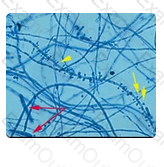
The profusion of tiny microconidia lining up along the hyphae in this photomicrograph is characteristic of which of the following organisms?
P. vivax characteristically displays Schuffner's dots and often enlarged RBCs along with brownish granules. P. vivax can also have 12-24 merozoies in each cell, actually filling the entire RBC. This parasite also has very irreglar shapes often referred to as "Ameboid".
P. falciparum and P. malariae do not display Shuffner's dots, therefore could not be the correct choice.
P. ovale does display Shuffner's dots in all stages, but characteristically has about 8-12 merozoites in rosettes or irregular clusters inside the RBC. Also, P. ovale characteristically shows enlarged, ovoid RBCs with fimbriated edges.
Identify the parasite of a patient with suspected malaria who demonstrates the following findings on a blood smear:
- Enlarged RBCs, some with fine brownish granules
- > 15 parasites in some cells
- Ameboid structures
- Schuffner's dots
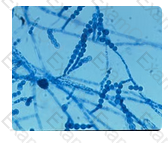
The microscopic features shown here represent Scopulariopsis species. In most instances, particularly if a patient does not have underlying immunologic or hematologic disease, Scopulariopsis species should be considered a contaminant when recovered from a sputum specimen. However, if there is clinical or X-ray evidence of mycotic pulmonary infection, additional daily induced sputum specimens should be obtained.
If Scopulariopsis species or any other hyaline mold is recovered from two or more successive specimens, its potential as a pathogenic agent should be considered. Scopulariopsis species have been reported as the agents of pulmonary fungus ball infections in patients with preexistent cavities and as a cause of pneumonia in patients with leukemia.
Invasive pulmonary disease by this agent has not been reported.
The fungus illustrated in this photomicrograph was recovered from an induced sputum specimen from a 74 year old man with chronic obstructive pulmonary disease. This isolate is most likely:
Atherosclerosis is a hardening of an artery specifically due to the build up of plaque. The risk to patients with significant atherosclerosis is that eventually a narrowing of the artery (stenosis) can cause a reduction in oxygen delivery to tissues and plaque rupture can lead to an acute coronary event.
Atherosclerosis is a hardening of an artery specifically due to which of the following?
Provide the equivalent measurement for 1 centimeter.
Question options:
Provide the equivalent measurement for 1 ounce.
The tube to the left is a slant of esculin medium, the tube to the right contains heart infusion broth with 6.5% sodium chloride. The bacterial species characteristically producing the positive reactions seen in each of these tubes is most likely:
L/S ratio <2.0 indicates an increased risk of respiratory distress syndrome (RDS) at delivery. L/S ratio <1.5 indicates a very high risk of developing RDS.
Which of the following statements regarding the L/S ratio is TRUE?
The correct answer is highlighted below
A ratio of 2:1 or greater usually indicates adequate pulmonary surfactant to prevent respiratory distress syndrome (RDS)
A ratio of 1.5:1 indicates fetal lung maturity in pregnancies associated with diabetes mellitus.
Sphingomyelin levels increase during the 3rd trimester causing the L/S ratio to fall slightly during the last two weeks of gestation.
A phosphatidylglycerol (PG) spot indicates the presence of meconium in the amniotic fluid
Lecithin is in direct ratio with sphingomyelin
Heparin contamination is characterized by an elevation in the aPTT test and can also cause an increased PT test as well. Reptilase time tests are used to elimate the effects of heparin contamination as the reagents and method are resistant to the effects of antithrombin III, unlike the PT and aPTT tests. Therefore, it would be expected that a patient sample containing pre-analytical heparin contamination will show an increased aPTT (and sometimes PT as well) while showing a normal reptilase time.
A specimen drawn from an indwelling catheter that was contaminated by heparin would be indicated by:
The term universal precautions refers to:
