
You are not confident with the assessment of the risk level and you suspect that it will be possible to find high-priority bugs in low-risk areas.
Furthermore the period for test execution is very short. Your goal is to test all the product risks in a risk-based way, while assuring that each product risk gets at least some amount of testing.
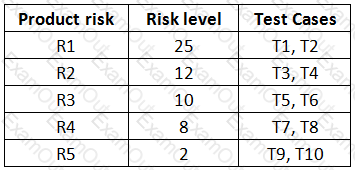
Which of the following answers describes the best test execution schedule in this scenario?
Number of correct responses: 1
K32 credits
Testing Process
Assume you are the Test Manager for a new software release of an e-commerce application.
The server farm consists of six servers providing different capabilities. Each capability is provided through a set of web services.
The requirements specification document contains several SLAs (Service Level Agreements) like the following:
SLA-001: 99.5 percent of all transactions shall have a response time less than five seconds under a load of up-to 5000 concurrent users
The main objective is to assure that all the SLAs specified in the requirements specification document will be met before system release. You decide to apply a risk-based testing strategy and an early risk analysis confirms that performance is high risk. You can count on a well-written requirements specification and on a model of the system behavior under various load levels produced by the system architect.
Which of the following test activities would you expect to be the less important ones to achieve the test objectives in this scenario?
Number of correct responses: 1
K43 credits
Testing Process
Consider an information system of a Pay-Tv company based on a SOA architecture.
The integrated system currently consists of three core systems:
- a CRM (Customer Relationship Management) system
- a BRM (Billing and Revenue Management) system
- a CAS (Conditional Access System) system
all of them communicating with SOA Middleware.
You have been asked to manage the testing activities for the integration of two additional off-the-shelf systems from two different vendors: a SMS (Short Message Service) server and an IVR (Interactive Voice Response) system.
Assume that there is a high likelihood that the two off-the-shelf systems will be low-quality and that you have a clear proof that the testing performed by the two vendors on their systems has been unsystematic and unprofessional. This obviously leads to higher quality risk for the overall integrated system.
You are the Test Manager of this project. Your main goal is to plan for testing activities to mitigate this risk.
Which of the following answers best describes the test activities (assuming it is possible to perform all of them) you should plan for?
Number of correct responses: 1
K43 credits
The following are the requirements identified as “critical”:
REQ-SEL-001. The user shall be able to combine all the three products with all the four durations to define an item to purchase
REQ-SEL-002. The user shall be able to add a maximum of six different items to the shopping cart
REQ-PUR-001. The user shall be able to purchase all the items in the shopping cart using a credit voucher
REQ-PUR-002. The user shall be able to purchase all the items in the shopping cart using the available credit already charged on the smartcard
REQ-PUR-003. The user shall be able to purchase all the items in the shopping cart using all the accepted credit cards (Visa, MasterCard and Great Wall Card)
REG-LOGO-001. The user shall be able to logout (by clicking the logout button) from both the “select” and “purchase” pages going back to the “browse” page (anonymous navigation)
Moreover the following quality risk item has been identified as “critical”:
QR-P1. The web customer portal might not be able to provide the expected response time (less than 10 sec) for the purchase transactions under a load of up-to 1000 concurrent users
Test analysis for system testing has just begun and the following test conditions have been identified:
TC-SEL-01. Test the combinations of products and durations to define an item to purchase
TC-SEL-02. Test the maximum number of items, which can be added to the shopping cart
TC-PUR-01. Test the purchase of an item
TC-PUR-02. Test the purchase of an item with the credit charged on the smartcard
Assume that you have used traceability to determine the logical test cases that cover all the requirements and the single risk item identified in that scenario.
Which of the following is a positive logical test that is complete, is correct, and covers the REG-LOGO-001 requirement?
Number of correct responses: 1
K32 credits
The following is the unique “critical” quality risk item that has been identified:
CR-RSK-1. The GUI of the application might accept non-integer values for the input field designed to get the number of bottles from the user
Test analysis for system testing has just begun and the following test conditions have been identified:
TC-SEL-2. Test the selection of the package sizes
TC-SEL-4. Test wrong numbers of bottles for an order
TC-CR-RSK-1. Test the accepted values from the input field designed to get the number of bottles from the user
What is the MINIMUM number of test conditions that must be added to fulfill both the EXCR1 and EXCR2 exit criteria?
Number of correct responses: 1
K32 credits
Improving the Testing Process
Which of the following statements about the TMMi test process improvement model is true?
Number of correct responses: 1
K21 credit
Improving the Testing Process
Which of the following statements about the STEP test process improvement model is true?
Number of correct responses: 1
K21 credit
Improving the Testing Process
Consider the following statements describing the importance of improving the test process:
I. Test process improvement is important because being focused only on the test process it can provide recommendations to improve the test process itself, but it can’t indicate or suggest improvement to areas of the development process
II. Test process improvement is important because it is much more effective than software process improvement to improve the quality of a software system
III. Test process improvement is important because several process improvement models (STEP, TPI Next, TMMi) have been developed over the years
IV. Test process improvement is important because every organization, regardless of the context, should always achieve the maximum level of maturity of testing described in the test improvement models such as TMMi
Which of the following answers is correct?
Number of correct responses: 1
K21 credit
People Skills – Team Composition
Which of the following would you expect to be most likely an example of a demotivating factor for testers?
Number of correct responses: 2
K21 credit
People Skills – Team Composition
Assume you are managing the system testing execution phase of a project.
The system test execution period for that project is scheduled for eighteen weeks and the release date is scheduled at the end of system testing.
During the sixth week of system test execution, at the staff meeting, the project manager informs you that the project deadlines are changed and the release date that is only three weeks ahead.
This new release will not allow the completion of the system tests. Suppose also that you have followed a risk-driven test approach for this project.
Which of the following statements represents the worst way to lead your test team in the next three weeks?
Number of correct responses: 1
K21 credit
![ISTQB® Certified Tester Advanced Level - Test Manager [Syllabus 2012] download free](https://www.examout.co/img/demo-image.png)