
Spring Sale Special - Limited Time 70% Discount Offer - Ends in 0d 00h 00m 00s - Coupon code: sntaclus

You can count on well-written requirements, but you can’t count on an adequate contribution of the stakeholders to the quality risk analysis. You have to mitigate the insufficient contribution of the stakeholders because the risk-based testing approach shall minimize the product risks. Your test team has one expert tester in security testing.

Which of the following test activities would you expect to be the less important in this context?

Number of correct responses: 1

K43 credits

A.

Extract from the defect tracking system of the previous project all the security defects and failures, and classify them to support design and execution of specific tests

B.

Automate all functional and non-functional system tests

C.

Apply systematic and exploratory testing for integration and system test

D.

Perform exploratory testing sessions with adequate charters covering security aspects

Test Management

You are managing the system testing for a SOA based system. The integrated system consists of several subsystems:

- a SOA middleware

- a CRM (Customer Relationship Management) system

- a BRM (Billing and Revenue Management) system

- a SMS (Subscriber Management System) system

and you performed a risk analysis based on these subsystems.

At the end of the scheduled period for test execution you produce a first classical report based on the traditional metrics of testing. Test pass/fail status and bug status (open/resolved) That table provides you a distorted picture of the quality risk, because there is no indication of the risk level of the failed tests, the tests not run, or the open bugs. Thus, you produce the following table to solve this distortion issue:
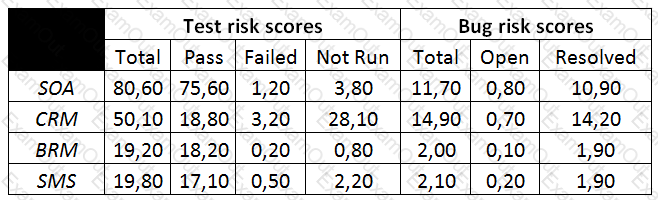
In the table above, where you have introduced the concept of risk weighting, the highest risk test or bug report has a score of 1, while the lowest risk test or bug report has a score of 0.04.

Which of the following subsystems, based on the risk scores of the table, is most risky?

Number of correct responses: 1

K43 credits

A.

SOA

B.

CRM

C.

BRM

D.

SMS

Test Management

Which of the following answers describes a factor that may reduce the effort spent when using distributed test teams without negatively affecting system quality?

Number of correct responses: 1

K21 credit

A.

Difficulties in communication between the distributed test teams due to time zone differences

B.

With several distributed test teams, every team assumes that some test conditions are covered by other teams but actually no one covers them

C.

With several distributed test teams, two or more teams assume some test conditions are covered by their team and their team alone. But all of the teams actually cover them

D.

With several distributed test teams, all of the distributed test teams use a single unified test dashboard

Test Management

You are the Test Manager of a new project aimed at developing a software system that must be certified at level B of the DO-178B standard. The project will follow a V-Model software development life cycle and it will have four formal levels of testing: component, integration, system and acceptance testing.

You must produce the test plan documentation for this project by providing an adequate coordination across the four levels of testing in order to assure auditability.

Which of the following answers would you expect to best describe how to organize the test plan?

Number of correct responses: 1

K32 credits

A.

Produce a single master test plan that covers in detail all four levels, describing the particular activities for all test levels

B.

Produce a master test plan that covers three levels (component, integration, system test) and a separate acceptance test plan

C.

Produce a master test plan describing the relationship between the four levels, and four separate detailed level test plans, one for each level

D.

Produce four separate detailed level test plans, one for each level, without a master test plan

Test Management

Which of the following statements describing how identified product quality risks should be mitigated and managed, is true?

Number of correct responses: 1

K21 credit

A.

The extent of re-testing and regression testing activities should be based on the risk level

B.

The identification of new risks, the re-assessment of the level of existing risks and the evaluation of the effectiveness of risk mitigation activities should only occur at the very beginning of a project

C.

Risk mitigation of product quality risks can be effective only after starting test execution

D.

The priority of the development and execution of tests should not be based on the risk level but only on the likelihood

Your company is installing a third-party enterprise-wide business software package. This is the first time the company has done anything like this.

Which technique would be the best one to use to estimate the testing effort? [3]

A.

Estimated developer effort and lines of code

B.

Industry averages

C.

Review of the installation guide

D.

Past experience with in-house projects

You have done a comprehensive risk analysis. You have involved the appropriate people in assessing the risks and determining the likelihood and impact of those risks. You have been testing for three months and have been able to mitigate 75% of the high risk items. You have two weeks left in testing and you now do not expect to be able to complete all the items on the high-risk

mitigation list, never mind any from the medium or low-risk lists.

What is the most effective action you should take? [3]

A.

Use a random selection algorithm to pick tests from the high, medium, and low risk mitigation lists - thereby ensuring that each risk list has some mitigation.

B.

Present your risk mitigation progress and project status to the project's stakeholders, and request additional time or assistance in re-prioritizing the remaining high-risk items.

C.

Concentrate testing in areas that have already found numerous problems.

D.

Retest the highest risk areas to ensure no regressions have occurred.

Which of the following is likely to occur if reviewers do not have an adequate level of technical knowledge? [1]

A.

There will be no impact as long as they have sufficient business knowledge.

B.

There will be no impact as long as they have sufficient process knowledge.

C.

The review is likely to be less efficient.

D.

The review will be shorter because any technical aspect can be skipped.

Which of the following statements is true regarding documentation standards? [2]

A.

Documentation standards are a lower priority than testing standards.

B.

Documentation standards can vary depending on the test level.

C.

Agile projects consistently use level test plans and documentation standards.

D.

Documentation standards are determined by the Project Manager.

Which of the following organizational structures would be considered unorthodox? [1]

A.

Developers within the same team unit test each others' code prior to handing over to a separate testing team for system testing

B.

Developers and testers are integrated within the same project team, each role focusing on a different level of testing

C.

After developers are done unit testing, business analysts alpha test the system before handing over to a separate testing team for system testing

D.

DBAs confirm the referential integrity of the database and developers complete their unit testing before handing over to

external organization for system testing