
An administrator attempts to enable vSAN Data-at-Rest Encryption on a cluster but receives the following error message:
“Key provider < vSphere Native Key Provider > is not available on host.”
The administrator configured the vSphere Native Key Provider (NKP) using the default settings.
What should the administrator validate before enabling vSAN Data-at-Rest Encryption?
An administrator has been tasked with deploying vSAN Data Protection in a VMware Cloud Foundation (VCF) Workload Domain. The administrator deploys the VMware Live Recovery OVA and logs into the management interface to start the Configure Appliance process, but the appliance fails to register with vCenter.
What are two possible causes the administrator can check to resolve the issue? (Choose two.)
An administrator has been tasked with making changes to a VMware Cloud Foundation (VCF) Workload Domain cluster that is configured with NFS for both Principal storage and Supplemental storage.
The cluster has the following configuration:
• There are 3 x ESX host servers.
• There are 3 x NFS Datastores allocated to host Virtual Machines workloads.
• There is a single NFS Datastore allocated for hosting ISO files.
The administrator has the following concerns with the existing configuration:
• Every time a new Virtual Machine is deployed to the Workload Domain, the administrator must choose which datastore should be used.
• When reviewing the Datastores in VCF Operations:
One of the datastores has no Virtual Machines running in it.
The other two datastores have an imbalance of Virtual Machines and this is causing resource contention. The administrator has the following requirements: • Virtual Machines must be placed automatically on the most appropriate datastore based on utilization. • Migration recommendations on Virtual Machine placement should be made when one datastore reaches 50% utilization. • Virtual Machines must only be migrated to another datastore after being approved by an administrator. What four actions must the administrator take to meet all of the requirements? (Choose four.)
An administrator has been tasked with suggesting storage models for a new VMware Cloud Foundation (VCF) Private Cloud. The following information has been provided:
• All existing implementations of VMware vSphere use the existing third-party block-based storage solution.
• The block-based storage solution only has sufficient scale, capacity and IOPS to cater for the new workload storage requirements.
• There is a dedicated and highly resilient storage area network connecting hosts to the provided block-based storage.
• There are 5 existing hosts with enough CPU and RAM resources and resilient Host Bus Adapters (HBAs) to cater for the new workload resource requirements only.
• There is sufficient budget to purchase some hardware, however the solution must re-use the existing hardware where possible.
The administrator suggests the following high-level solution:
• Single VCF Instance with a single Workload Domain.
• Deploy 4 new servers to create a Management Domain.
• Repurpose the 5 existing servers to create a single cluster in the Workload Domain.
Which two storage models should the administrator recommend? (Choose two.)
The security team has notified the VMware Cloud Foundation (VCF) Storage Administrator of a new security vulnerability that must be patched immediately. The vSAN Cluster uses vSphere Lifecycle Manager images.
After updating the image with the patch, what method should the administrator use to apply this patch with the least amount of disruption to the cluster?
To respect the application criticality, an administrator is configuring the Recovery Priority of protected Virtual Machines (VMs).
What does VMware Live Site Recovery leverage to mark a recovery priority as completed?
While creating a recovery plan that matches the business continuity plan, an administrator needs to add custom steps to the recovery plan.
Which three custom steps are available? (Choose three.)
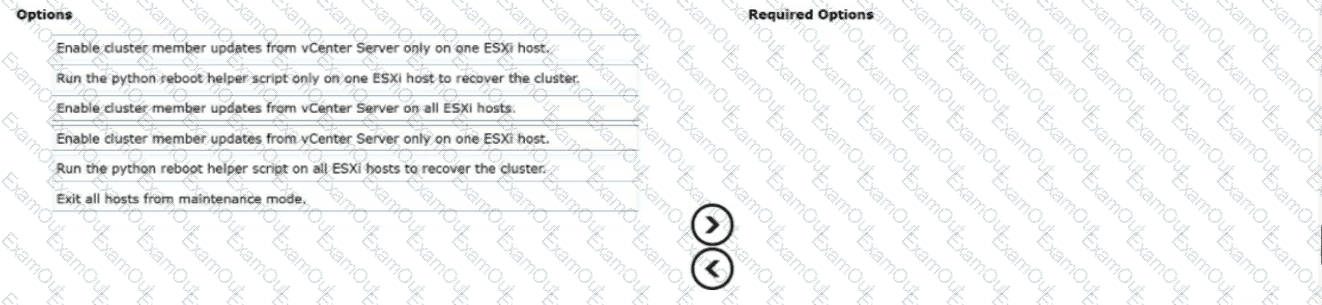
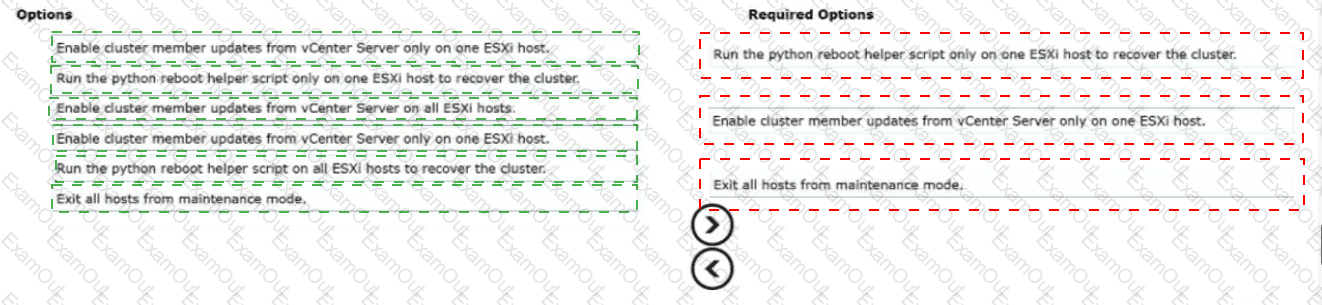
After a planned power outage, an administrator decided to restart the vSAN cluster manually.
Drag and drop the three correct options from the Options list on the left and place them into the Required Options on the right in any order. (Choose three.)
A multinational corporation is deploying a VMware Cloud Foundation (VCF) Workload Domain cluster to host tier-1 business applications with the following requirements:
• Deliver high performance to all workloads.
• Integration with automated VM placement.
• Reuse of existing infrastructure including multiple Fibre Channel (FC) arrays partitioned by business unit.
• The storage architecture must avoid vSAN.
• Meet organizational separation requirements.
Which two deployment approaches meet these requirements? (Choose two.)
A financial organization successfully deployed a new Workload Domain in VMware Cloud Foundation (VCF) using NFS storage. All ESX hosts are commissioned and connected to the same storage network. The system administrator is tasked to configure a new NFS datastore in the existing cluster.
Which two steps are correct? (Choose two.)
