
Spring Sale Special - Limited Time 70% Discount Offer - Ends in 0d 00h 00m 00s - Coupon code: sntaclus

A Data Analyst wants to transform query results. Which transformation option will incur compute costs?

A.

Showing a thousand separator for numeric columns.

B.

Sorting a column by using the column options.

C.

Increasing or decreasing decimal precision.

D.

Formatting date and timestamp columns.

A Data Analyst executes a query in a Snowflake worksheet that returns the total number of daily sales, and the total amount for each sale. How can the Analyst check the distribution of the total amount, without running the query again?

A.

Click on the column header in the results and review the histogram.

B.

Go to Chart and select a histogram that includes the two variables.

C.

Go to Chart and select a bar chart that contains the two variables.

D.

Call the WIDTH_BUCKET function.

A Data Analyst is given access to a table of inventory transfers which includes the product details, fulfillment warehouse location, and destination warehouse location. Which type of visualization should be used to illustrate the most active product transfer routes?

A.

Scatterplot

B.

Scorecard

C.

Line chart

D.

Heat grid

A Data Analyst has been analyzing customer data in several worksheets. Each worksheet contains a complex query that provides clean and prepared data for visualizations. The Analyst has also created a Customer Overview dashboard in Snowsight. How should the Analyst add the worksheets in the Customer Analysis database to the dashboard, using the LEAST amount of operational overhead?

A.

Move the worksheets into the dashboard.

B.

Copy and paste the worksheets into the dashboard.

C.

Open each worksheet, copy the query, then paste the query into the dashboard.

D.

Query the QUERY_HISTORY view to find those queries, then add the queries into the dashboard.

A Data Analyst executes a complex query. Which query will allow the Analyst to access the results a second time?

A.

SELECT * FROM TABLE(RESULT_SCAN(LAST_QUERY_ID()));

B.

SELECT * FROM TABLE(INFORMATION_SCHEMA.QUERY_HISTORY());

C.

DESC RESULT LAST_QUERY_ID();

D.

SELECT LAST_QUERY_ID(-1);

Why would a Data Analyst use a dimensional model rather than a single flat table to meet BI requirements for a virtual warehouse? (Select TWO).

A.

Dimensional modelling will improve query performance over a single table.

B.

Dimensional modelling will save on storage space since it is denormalized.

C.

Combining facts and dimensions in a single flat table limits the scalability and flexibility.

D.

Dimensions and facts allow power users to run ad-hoc analyses.

E.

Snowflake generally performs better with dimensional modelling.

A Data Analyst needs a sample of 10 rows from a table FCT_SALES that has billions of rows. Which commands can be used to accomplish this? (Select TWO).

A.

SELECT * FROM FCT_SALES SAMPLE 10;

B.

SELECT * FROM FCT_SALES SAMPLE (10 ROWS);

C.

SELECT TOP 10 ROWS * FROM FCT_SALES;

D.

SELECT TOP 10 * FROM FCT_SALES;

E.

SELECT TOP (10 ROWS) * FROM FCT_SALES;

A single variant data column table RAW_SOURCE has the following JSON records:
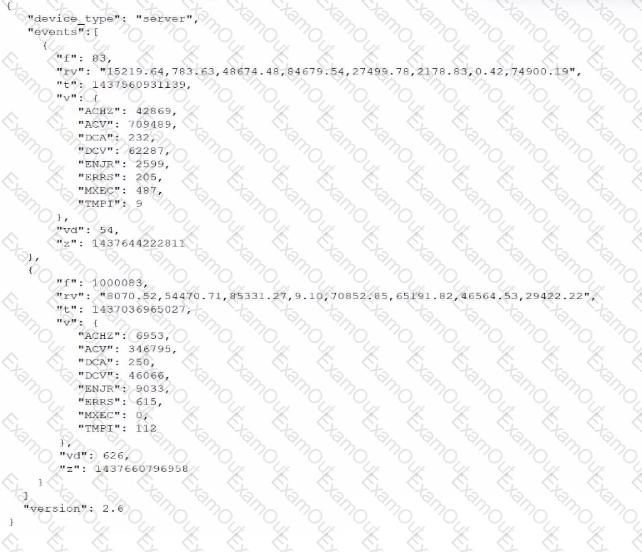
A Data Analyst needs to get the value of the "f" field and have it in a consumable, tabular format. Which query should be used to meet this requirement?

A.

select data:events:f::number from raw_source;

B.

select value:f::number from raw_source, lateral flatten( input => data );

C.

select src.events:f::number from raw_source src;

D.

select value:f::number from raw_source, lateral flatten( input => data:events );

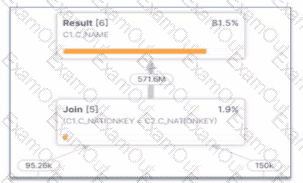
What potential problem can be identified in the Query profile below?
A.

There is query spilling.

B.

There is an exploding join

C.

There Is inefficient pruning.

D.

The query is not using a foreign Key.

When building a Snowsight dashboard that will allow users to filter data within a worksheet, which Snowflake system filters should be used?

A.

Include the :datebucket system filter in a WHERE clause, and include the :daterange system filter in a GROUP BY clause.

B.

Include the :daterange system filter in a SELECT clause, and include the :datebucket system filter in a GROUP BY clause.

C.

Include the :datebucket system filter in a WHERE clause, and include the :daterange system filter in a SELECT clause.

D.

Include the :daterange system filter in a WHERE clause, and include the :datebucket system filter in a GROUP BY clause.