With CMDB 360 / Multisource CMDB, Dynamic Reconciliation Rules are enabled. Based on management requirements, a CMDB Administrator needs to configure multiple Dynamic Reconciliation Rules.
Which are available Dynamic Rule Types within the Create Reconciliation Rule wizard? (Choose 2 options)
A Manager needs information on how to correctly establish relationships between Infrastructure CIs, Technology Management Offerings, Technical Service Offerings, and Application Services within the CMDB.
Which CSDM domain would provide this information?
A Configuration Manager wants to explore ServiceNow CMDB 360 saved queries to see if the reports can assist with managing CMDB data.
What insights are gained from CMDB 360 queries?
(Choose 2 options)
A Configuration Manager working in CMDB Workspace wants to see how CIs are connected to each other.
Which tool can be used?
A CMDB Administrator wants only the CIs of Principal Classes to appear in CI reference fields, for example the CI reference fields accessible from an Incident form.
Where does the CMDB Administrator designate Principal Classes?
The CMDB Administrator has set up two Dynamic Reconciliation Rules within the ServiceNow Production Instance. The ' Server ' class has a Dynamic
Reconciliation Rule of largest value for the RAM field. The ' Windows Server ' class has a Dynamic Reconciliation Rule of most reported for the RAM field.
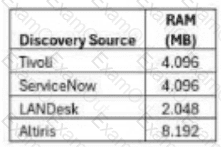
Given the above data in Multisource CMDB, which value is added to the CMDB for RAM for a Server CI?
A Service Owner needs to view related items, such as active Incidents and planned Changes, directly on the home node of the Unified Map.
Which work area would allow the Service Owner to meet this goal?
(Choose two)
A CMDB Administrator is leveraging CI data as part of an Integrated Risk Management (IRM) implementation and the Entity Scoping process. The Administrator wants to leverage the CSDM Data Foundations Dashboard playbooks under the Run tab.
Which CSDM relationships are leveraged using the CSDM playbooks?
A Configuration Manager responsible for a specific region wants to use the CMDB Health Dashboard to improve the data quality of the CMDB for that region. The Configuration Manager only sees the overall score and scores grouped by CI class.
How can the Configuration Manager get a score for regionally relevant CIs?
A CMDB Administrator identifies duplicate CIs. One was created by a manual import, and the other was created by automated discovery. The discovered CI has the latest IP address, while the manually imported CI has an accurate relationship to a critical business application.
How does the Administrator use the Duplicate CI Remediator to resolve this issue?