U+ Bank wants to offer a Gold credit card to customers who have an annual income of more than USD150000. What do you configure in the Next-Best-Action Designer to achieve this outcome7
U+- Bank uses Next-Best-Action Designer to configure engagement policies for different customer segments. A business user wants to create reusable policy conditions that can apply across multiple actions and campaigns. The user must understand when the save-to-library feature is available.
When is the save-to-library option unavailable for engagement policy conditions?
In a decision strategy, to use a customer property in an expression, you
A customer qualifies for Standard card (priority 60), Rewards card {priority 40), and Premium card {priority 30). Standard card volume is exhausted. Rewards card has remaining volume, and Premium card has remaining volume. The system uses "Return any action that does not exceed constraint" mode.
Which actions does the customer receive in this scenario?
A bank has been running traditional marketing campaigns for many years. One such campaign sends an offer email to qualified customers on day one. On day five, the bank presents a similar offer if the first email is ignored.
If you re-implement this requirement by using the always-on outbound customer engagement paradigm, how do you approach this scenario?
U+ Bank, a retail bank, has purchased Pega Customer Decision Hub. The bank currently uses an external tool to design email content and a third-party email service provider to send emails to its customers.
As a decisioning architect, how do you recommend the bank implements this requirement?
A volume constraint uses the Return any action that does not exceed
constraint mode. The following tables show the configuration of the volume constraints and the list of customers in the outbound segment:
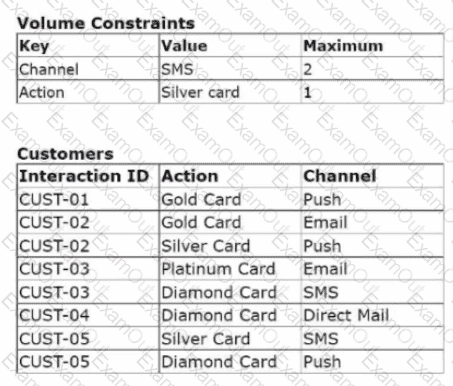
The outbound run selects customers in the following order to apply the volume constraints: CUST-01, CUST-02, CUST-03, and CUST-05.
Based on the configuration of the volume constraints for each channel, which offer does CUST-05 receive?
Regional Bank experiences an unexpected system outage affecting online banking services across multiple locations. The bank needs to immediately inform all customers about the temporary service disruption and provide alternative banking options. The communication must reach every customer simultaneously and should not be repeated.
Which communication approach should the bank use to address this urgent customer notification requirement?
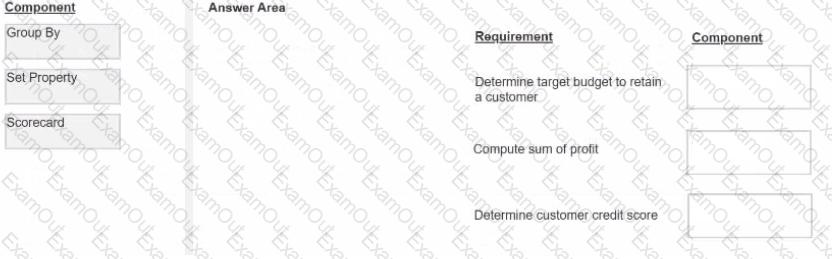
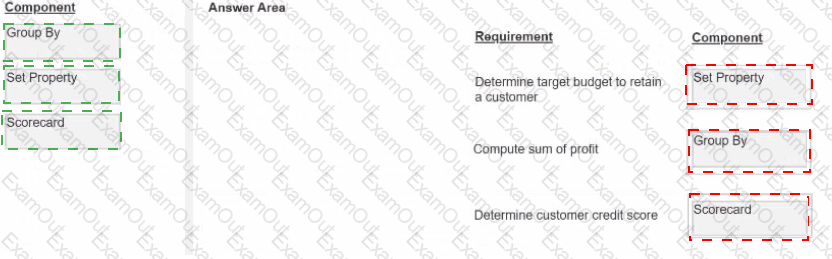
You are a decisioning architect on a next-best-action project and are responsible for designing and implementing decision strategies. Select each component on the leftand drag it to the correct requirement on the right.
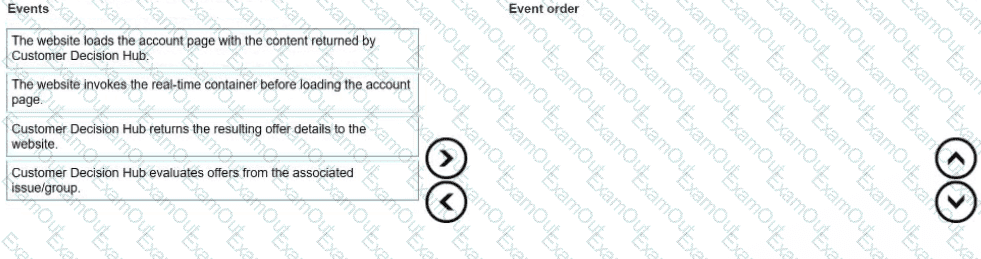
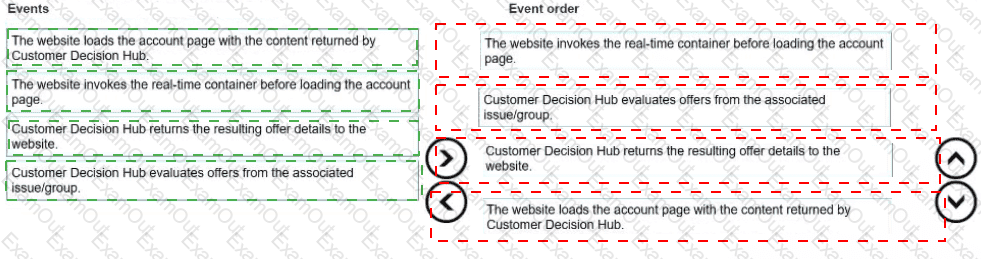
The U+ Bank marketing department wants to leverage the next-best-action capability of Pega Customer Decision Hub™ on Its website to promote new offers to each customer.
Place the events in the sequential order.