What should the team do to effectively manage this?
During backlog refinement, the team uses an online planning poker tool for estimation. The junior developers change their number of story points after they see the estimations provided by the developers. The junior developers state that the reason for this is that they do not have enough experience and do not want to be blamed for sizing it wrong.
What should the scrum master do?
A large project team of 20 people from different functional areas has just been formed and the project starts next week. The team will be working on a regulated and strictly controlled pharmaceutical product but does not have subject matter expertise.
Which two actions should the scrum master take as priorities? (Choose two.)
A large project team of 20 people from different functional areas has just been formed and the project starts next week. The team will be working on a regulated and strictly controlled pharmaceutical product but does not have subject matter expertise.
Which two actions should the scrum master take as priorities? (Choose two.)
A project team is working with an enterprise agile center of excellence (CoE) to transition to a Scaled Agile Framework (SAFe). Many of the team members are not familiar with the new methodology and are worried that it will lead to more work and scrutiny.
What should the agile team lead do to help ensure a smooth transition?
What should the agile team lead do?
An agile team is in their 2nd iteration planning session. During the session, they are debating on whether regression and integration testing should be part of every iteration or part of the hardening iteration.
What should the agile lead recommend?
A team retrospective was going well until the team lead introduced the " define the next experiment " topic; then the discussion became an argument. A new team member feels strongly that the approach used on their previous team would improve this team ' s efficiency and effectiveness. The team lead is adamant that they remain with the current approach and the discussion dissolves into a circular argument.
A project team has a senior subject matter expert (SME) who is comfortable with data integration. The SME is not inclined to perform regression testing because the SME feels that performing regression testing is more of a junior duty.
What should the Scrum Master do?
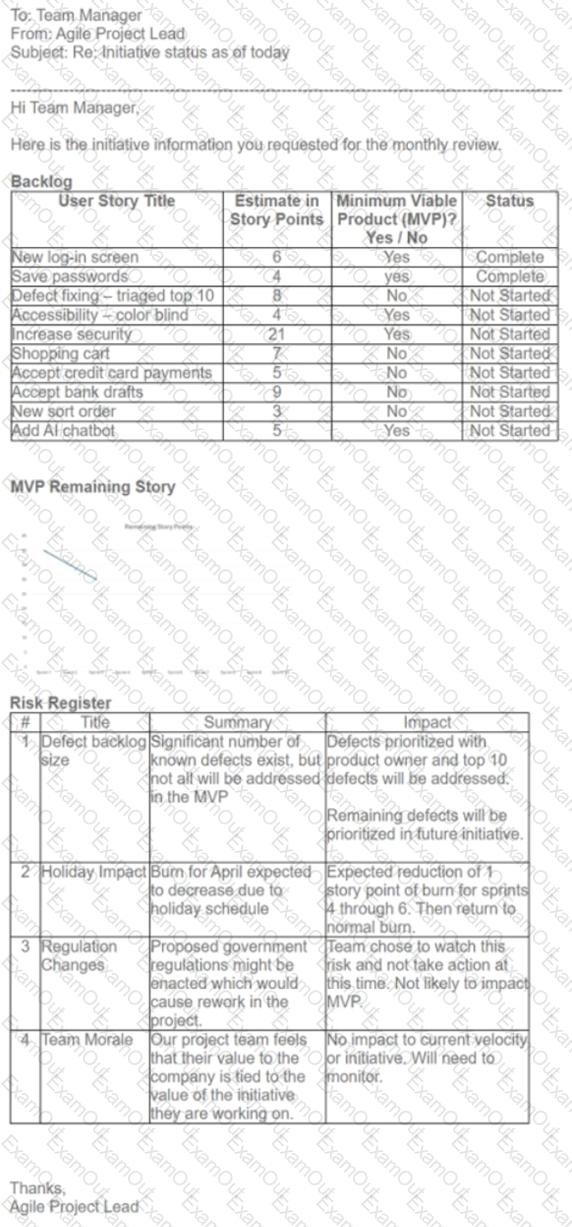
A project team ' s manager is responsible for delivering a specific initiative for the organization. They are preparing for a monthly meeting where the manager will present on the current state of this initiative. The agile project lead sends the manager the following email with the current initiative status (see Exhibit A).
How many sprints will be needed to complete the entire backlog?
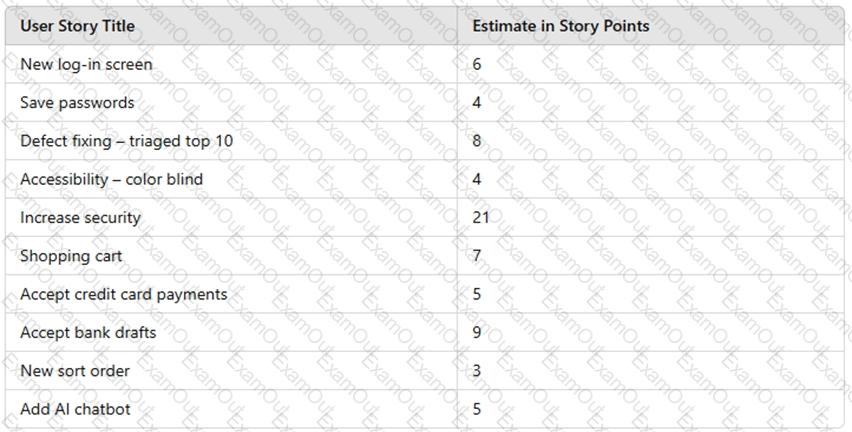
 Normal sprint velocity: 5 story points per sprint
 Reduced velocity for sprints 4-6: 4 story points per sprint
 First 3 sprints: 5 points per sprint → 5 × 3 = 15 story points completed
 Sprints 4-6: 4 points per sprint → 4 × 3 = 12 story points completed
 Remaining story points after sprint 6: 72 - (15 + 12) = 45 story points
 Remaining sprints needed at normal velocity (5 story points per sprint): 45 ÷ 5 = 9 sprints
 Sprints 1-6: Already planned.
 Additional 9 sprints needed.
What should be proposed to the team?