
Scenario 5
CyberShielding Systems Inc. provides security services spanning the entire information technology infrastructure. It provides cybersecurity software, including endpoint security, firewalls, and antivirus software. CyberShielding Systems Inc. has helped various companies secure their networks for two decades through advanced products and services. Having achieved a reputation in the information and network security sector, CyberShielding Systems Inc. decided to implement a security information management system (ISMS) based on ISO/IEC 27001 and obtain a certification to better secure its internal and customer assets and gain a competitive advantage.
The certification body initiated the process by selecting the audit team for CyberShielding Systems Inc.'s ISO/IEC 27001 certification. They provided the company with the name and background information of each audit member. However, upon review, CyberShielding Systems Inc. discovered that one of the auditors did not hold the security clearance required by them. Consequently, the company objected to the appointment of this auditor. Upon review, the certification body replaced the auditor in response to CyberShielding Systems Inc.'s objection.
As part of the audit process, CyberShielding Systems Inc.'s approach to risk and opportunity determination was assessed as a standalone activity. This involved examining the organization’s methods for identifying and managing risks and opportunities. The audit team’s core objectives encompassed providing assurance on the effectiveness of CyberShielding Systems Inc.'s risk and opportunity identification mechanisms and reviewing the organization's strategies for addressing these determined risks and opportunities. During this, the audit team also identified a risk due to a lack of oversight in the firewall configuration review process, where changes were implemented without proper approval, potentially exposing the company to vulnerabilities. This finding highlighted the need for stronger internal controls to prevent such issues.
The audit team accessed process descriptions and organizational charts to understand the main business processes and controls. They performed a limited analysis of the IT risks and controls because their access to the IT infrastructure and applications was limited by third-party service provider restrictions. However, the audit team stated that the risk of a significant defect occurring in CyberShielding’s ISMS was low since most of the company's processes were automated. They therefore evaluated that the ISMS, as a whole, conforms to the standard requirements by questioning CyberShielding representatives on IT responsibilities, control effectiveness, and anti-malware measures. CyberShielding’s representatives provided sufficient and appropriate evidence to address all these questions.
Despite the agreement signed before the audit, which outlined the audit scope, criteria, and objectives, the audit was primarily focused on assessing conformity with established criteria and ensuring compliance with statutory and regulatory requirements.
Question
Based on Scenario 5, what else should CyberShielding Systems Inc. have included when defining the audit objectives?
You are an experienced ISMS audit team leader. You are currently conducting a third-party surveillance audit of an
international haulage organisation. You have sampled four internal audit reports which state:
Report 1 - Auditor: Mr James.
Over the year the organisation has failed to meet its promised delivery dates on 23 occasions out of 100. This is against a target of '95% of deliveries on time'.
Grading - Minor
Corrective Action due: Within 9 months.
Report 2 - Auditor: Mr James.
Between January and March, it was noted 125 complaints were received about the Service Desk Team. Clients
accused them of being rude and unresponsive.
Grading - Minor
Corrective Action due: Within 12 months.
Report 3 - Auditor: Mr James.
Of the 40 customer orders received last month, 38 were correctly processed. Of the remaining 2, one was missing a
signature and one was missing a date.
Grading -
Corrections due: Within 3 weeks
Report 4 - Auditor: Mr Rogers.
Of the 30 personnel records examined, 26 were found to be fully completed whilst the remaining 4 were all missing
the individual's start date.
Grading – Major
Corrections due: Within 1 week
Which four of the options demonstrate the concerns you would have about these reports?
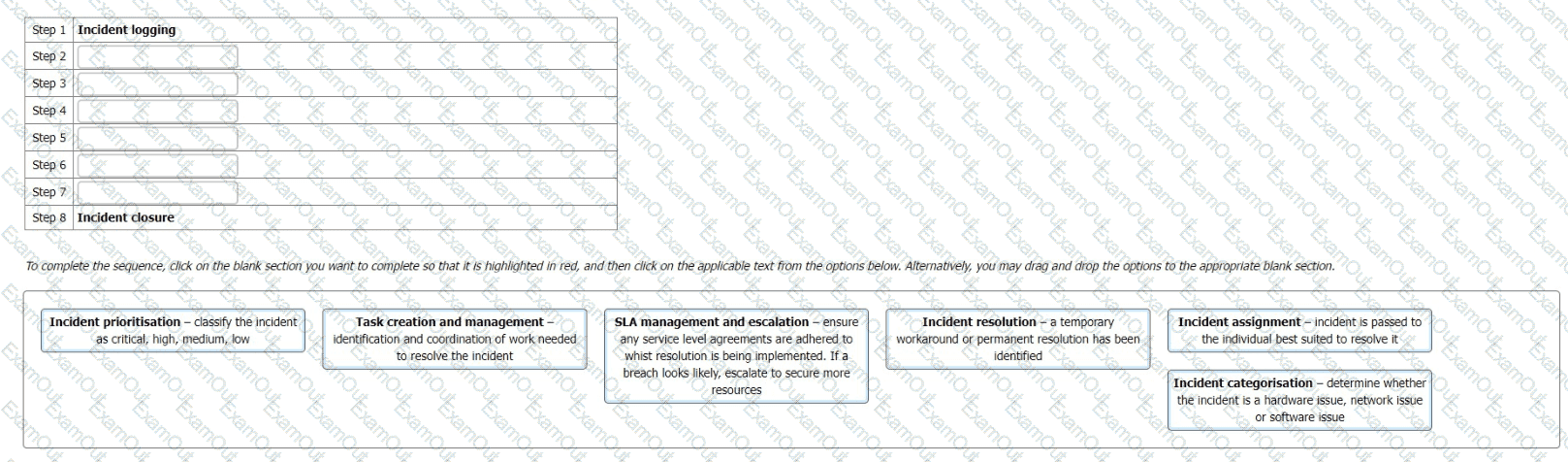
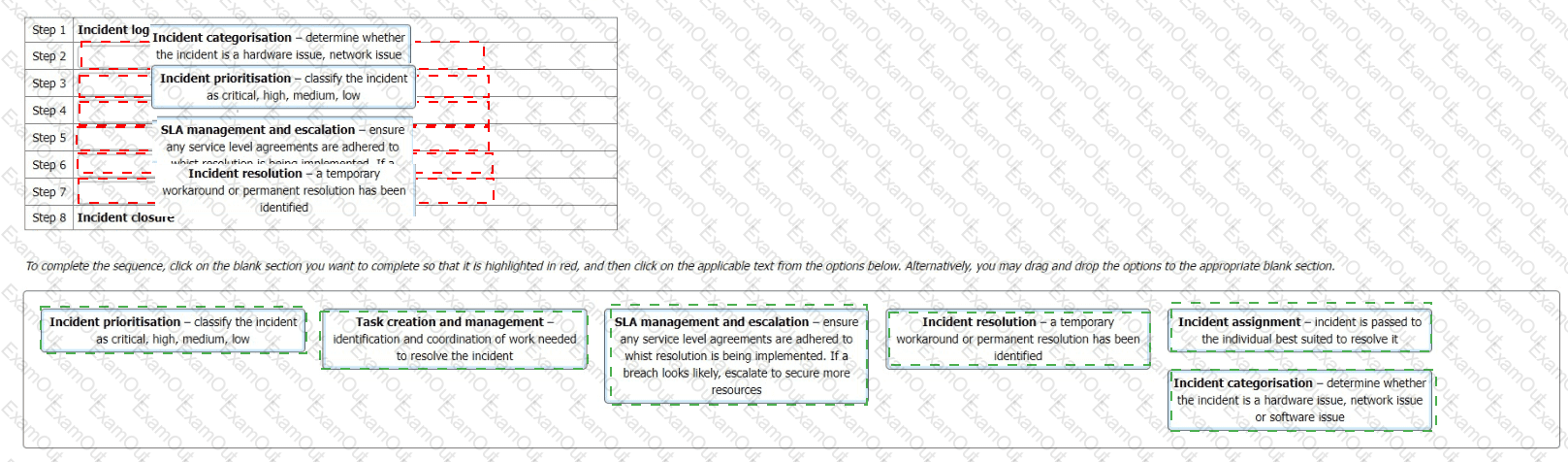
Your organisation is currently seeking ISO/IEC27001:2022 certification. You have just qualified as an Internal ISMS auditor and the ICT Manager wants to use your newly acquired knowledge to assist him with the design of an information security incident management process.
He identifies the following stages in his planned process and asks you to confirm which order they should appear in.
Auditors should have certain knowledge and skills; while audit team leaders should have some additional knowledge and skills. From the following list, select two that only apply to audit team leaders.
Question:
A marketing agency has developed its risk assessment approach as part of the ISMS implementation. Is this acceptable?
Question:
Which of the following can be considered a minor nonconformity?
Scenario 4
SendPay is a financial services company specializing in global money transfers through a network of agents and institutions. As a new company in the market, SendPay aims to deliver top-quality services with its fee-free digital platform, launched last year, enabling clients to send and receive money anytime via smartphones and laptops. At that time, SendPay outsourced software operations to an external team, which also managed the company's technology infrastructure.
Recently, the company applied for ISO/IEC 27001 certification after having an ISMS in place for almost a year.
During the audit, the auditors focused on reviewing SendPay’s outsourced operations, specifically looking at the software development and technology infrastructure maintenance handled by the outsourced company. They followed a structured approach, which included reviewing and evaluating SendPay’s processes for monitoring the quality of these outsourced operations. This included verifying if the company met its contractual obligations, ensuring proper governance procedures for engaging outsourced entities, and assessing SendPay’s plans in case of expected or unexpected termination of outsourcing agreements.
However, the auditors subtly noted that SendPay’s protocols did not fully address contingencies for unanticipated cancellations of outsourcing agreements. Additionally, a technical expert appointed by SendPay assisted the auditors, providing specific knowledge and expertise related to the outsourced operations being audited.
The audit team calculated the number of training hours employees received on ISMS to ensure alignment with established objectives. They also computed the average resolution time of information security incidents based on a sample taken during the audit, which provided valuable insights into SendPay’s incident management practices. In addition, the auditors evaluated the reliability of the evidence collected during the audit. They considered several factors influencing the reliability of audit evidence. For example, evidence from surveillance cameras provided more objective proof compared to photos. Timing also played a crucial role in reliability, with mechanisms like transaction recording enhancing the credibility of the evidence.
SendPay uses cloud-based platforms to make its operations more efficient and scalable. However, during the audit, the auditors did not request SendPay to provide an inventory of their cloud activities due to resource limitations, relying instead on SendPay’s representations.
Question
Did the audit at SendPay include all the necessary steps for auditing outsourced operations?
A marketing agency has developed its own risk assessment approach as part of the ISMS implementation. Is this acceptable?
Scenario 8: EsBank provides banking and financial solutions to the Estonian banking sector since September 2010. The company has a network of 30 branches with over 100 ATMs across the country.
Operating in a highly regulated industry, EsBank must comply with many laws and regulations regarding the security and privacy of data. They need to manage information security across their operations by implementing technical and nontechnical controls. EsBank decided to implement an ISMS based on ISO/IEC 27001 because it provided better security, more risk control, and compliance with key requirements of laws and regulations.
Nine months after the successful implementation of the ISMS, EsBank decided to pursue certification of their ISMS by an independent certification body against ISO/IEC 27001 .The certification audit included all of EsBank’s systems, processes, and technologies.
The stage 1 and stage 2 audits were conducted jointly and several nonconformities were detected. The first nonconformity was related to EsBank’s labeling of information. The company had an information classification scheme but there was no information labeling procedure. As a result, documents requiring the same level of protection would be labeled differently (sometimes as confidential, other times sensitive).
Considering that all the documents were also stored electronically, the nonconformity also impacted media handling. The audit team used sampling and concluded that 50 of 200 removable media stored sensitive information mistakenly classified as confidential. According to the information classification scheme, confidential information is allowed to be stored in removable media, whereas storing sensitive information is strictly prohibited. This marked the other nonconformity.
They drafted the nonconformity report and discussed the audit conclusions with EsBank’s representatives, who agreed to submit an action plan for the detected nonconformities within two months.
EsBank accepted the audit team leader's proposed solution. They resolved the nonconformities by drafting a procedure for information labeling based on the classification scheme for both physical and electronic formats. The removable media procedure was also updated based on this procedure.
Two weeks after the audit completion, EsBank submitted a general action plan. There, they addressed the detected nonconformities and the corrective actions taken, but did not include any details on systems, controls, or operations impacted. The audit team evaluated the action plan and concluded that it would resolve the nonconformities. Yet, EsBank received an unfavorable recommendation for certification.
Based on the scenario above, answer the following question:
According to scenario 8, the audit team evaluated the action plan and concluded that it would resolve the detected nonconformities. Is this acceptable?
Scenario 4
SendPay is a financial services company specializing in global money transfers through a network of agents and institutions. As a new company in the market, SendPay aims to deliver top-quality services with its fee-free digital platform, launched last year, enabling clients to send and receive money anytime via smartphones and laptops. At that time, SendPay outsourced software operations to an external team, which also managed the company's technology infrastructure.
Recently, the company applied for ISO/IEC 27001 certification after having an ISMS in place for almost a year.
During the audit, the auditors focused on reviewing SendPay’s outsourced operations, specifically looking at the software development and technology infrastructure maintenance handled by the outsourced company. They followed a structured approach, which included reviewing and evaluating SendPay’s processes for monitoring the quality of these outsourced operations. This included verifying if the company met its contractual obligations, ensuring proper governance procedures for engaging outsourced entities, and assessing SendPay’s plans in case of expected or unexpected termination of outsourcing agreements.
However, the auditors subtly noted that SendPay’s protocols did not fully address contingencies for unanticipated cancellations of outsourcing agreements. Additionally, a technical expert appointed by SendPay assisted the auditors, providing specific knowledge and expertise related to the outsourced operations being audited.
The audit team calculated the number of training hours employees received on ISMS to ensure alignment with established objectives. They also computed the average resolution time of information security incidents based on a sample taken during the audit, which provided valuable insights into SendPay’s incident management practices. In addition, the auditors evaluated the reliability of the evidence collected during the audit. They considered several factors influencing the reliability of audit evidence. For example, evidence from surveillance cameras provided more objective proof compared to photos. Timing also played a crucial role in reliability, with mechanisms like transaction recording enhancing the credibility of the evidence.
SendPay uses cloud-based platforms to make its operations more efficient and scalable. However, during the audit, the auditors did not request SendPay to provide an inventory of their cloud activities due to resource limitations, relying instead on SendPay’s representations.
Question
Based on Scenario 4, is the involvement of all the parties acceptable during the auditing of the outsourced operations?
