You are an experience ISMS audit team leader carrying out a third-party certification audit of an organization specialising in the secure disposal of confidential documents and removable media. Both documents and media are shredded in military grade devices which make it impossible to reconstruct the original.
The audit has gone well and you are just about to start to write the audit report, 30 minutes before the closing meeting. At
this point one of the organization's employees knocks on your door and asks if they can speak to you. They tell you that when things get busy her manager tells her to use a lower grade industrial shredder instead as the organisation has more of these and they operate faster. You were not informed about the existence or use of these machines by the auditee.
Select three options for how you should respond to this information.
Scenario 5: Cobt. an insurance company in London, offers various commercial, industrial, and life insurance solutions. In recent years, the number of Cobt's clients has increased enormously. Having a huge amount of data to process, the company decided that certifying against ISO/IEC 27001 would bring many benefits to securing information and show its commitment to continual improvement. While the company was well-versed in conducting regular risk assessments, implementing an ISMS brought major changes to its daily operations. During the risk assessment process, a risk was identified where significant defects occurred without being detected or prevented by the organizations internal control mechanisms.
The company followed a methodology to implement the ISMS and had an operational ISMS in place after only a few months After successfully implementing the ISMS, Cobt applied for ISO/IEC 27001 certification Sarah, an experienced auditor, was assigned to the audit Upon thoroughly analyzing the audit offer, Sarah accepted her responsibilities as an audit team leader and immediately started to obtain general information about Cobt She established the audit criteria and objective, planned the audit, and assigned the audit team members' responsibilities.
Sarah acknowledged that although Cobt has expanded significantly by offering diverse commercial and insurance solutions, it still relies on some manual processes Therefore, her initial focus was to gather information on how the company manages its information security risks Sarah contacted Cobt's representatives to request access to information related to risk management for the off-site review, as initially agreed upon for part of the audit However, Cobt later refused, claiming that such information is too sensitive to be accessed outside of the company This refusal raised concerns about the audit's feasibility, particularly regarding the availability and cooperation of the auditee and access to evidence Moreover, Cobt raised concerns about the audit schedule, stating that it does not properly reflect the recent changes the company made It pointed out that the actions to be performed during the audit apply only to the initial scope and do not encompass the latest changes made in the audit scope
Sarah also evaluated the materiality of the situation, considering the significance of the information denied for the audit objectives. In this case, the refusal by Cobt raised questions about the completeness of the audit and its ability to provide reasonable assurance. Following these situations, Sarah decided to withdraw from the audit before a certification agreement was signed and communicated her decision to Cobt and the certification body. This decision was made to ensure adherence to audit principles and maintain transparency, highlighting her commitment to consistently upholding these principles.
Based on the scenario above, answer the following question:
Question:
Based on Scenario 5, Cobt stated that the audit schedule did not properly reflect the recent changes they made in the audit scope. What should Sarah do in this case?
Question
During a certification audit, the auditee proved to the auditor through documented information that it had conducted a risk assessment and had selected a number of controls to ensure information security. What should the auditor verify in this case?
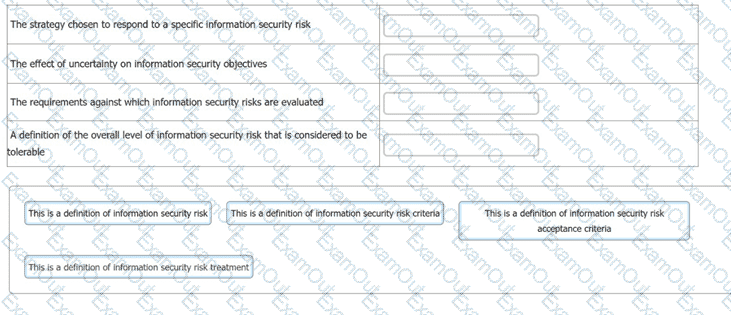
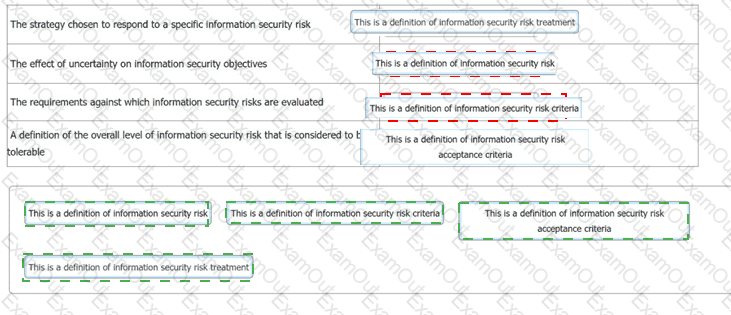
You have just completed a scheduled information security audit of your organisation when the IT Manager approaches you and asks for your assistance in the revision of the company's risk management process.
He is attempting to update the current documentation to make it easier for other managers to understand, however, it is clear from your discussion he is confusing several key terms.
You ask him to match each of the descriptions with the appropriate risk term. What should the correct answers be?
Question
During an ISO/IEC 27001 certification audit, the audit team leader failed to follow established best practices for conducting the audit. In addition, they lacked the necessary expertise to assess some of the complex areas of the ISMS, leading to suboptimal results. While the audit findings were still reported, some areas of the audit are considered weak and the audit does not fully adhere to the required procedures.
Which level of responsibility does this scenario represent in the case of tortious acts?
Select two of the following options that are the responsibility of a legal technical expert on the audit team during a certification audit.
Evaluating the auditee's legal knowledge
After conducting an external audit, the auditor decided that the internal auditor would follow-up on the implementation of corrective actions until the next surveillance audit. Is this acceptable?
Question:
Which of the following best defines managerial controls?
Question:
EquiBank is undergoing an external audit of its financial management system. The auditors evaluate the logic of transactions processed by EquiBank's financial software. To ensure accuracy, they use simulations to validate operations, calculations, and controls programmed in the software applications. What type of Computer-Assisted Audit Technique (CAAT) is used?
Question:
As an auditor, you have noticed that ABC Inc. has established a procedure to manage removable storage media. The procedure is based on the classification scheme adopted by ABC Inc.. Thus, if the information stored is classified as "confidential," the procedure applies. However, public information does not have confidentiality requirements, so only integrity and availability controls apply. What type of audit finding is this?