
New Year Sale Special - Limited Time 70% Discount Offer - Ends in 0d 00h 00m 00s - Coupon code: sntaclus

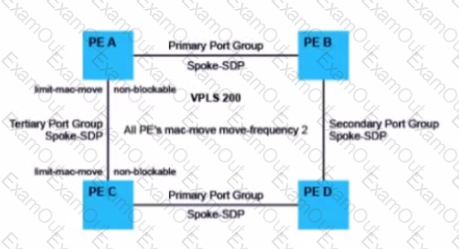
The port groups have been configured consistently on the PE routers, as highlighted in the exhibit. Which SDP connection will be blocked first when the re-learn rate is exceeded?
A.

The connection between PE-A and PE-C

B.

The connection between PE-A and PE-B

C.

The connection between PE-D and PE-C

D.

The connection between PE*D and PE-B

In the context of hierarchical scheduling, a scheduler is configured with a CIR weight of 0. Which of the following statements is TRUE?

A.

The scheduler will be allocated its "within CIR" bandwidth before all other children at the same level have received their "within CIR" bandwidth.

B.

The scheduler will be allocated its "within CIR" bandwidth after all other children at the same level have received their "within CIR" bandwidth.

C.

The scheduler will be allocated its "within CIR" bandwidth after all other children at all levels have received their "within CIR" bandwidth.

D.

The scheduler will not be allocated its "within CIR" bandwidth.

Click the exhibit button below. Each router is interconnected by a single GigE link, as shown in the diagram below.
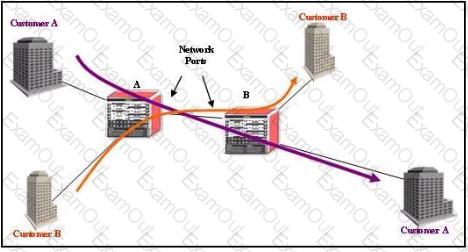
Note: The arrows show the direction of traffic flow.

Traffic from Customer A and Customer B that is classified to the same forwarding class is queued together at the ingress of Router B.

A.

True

B.

False

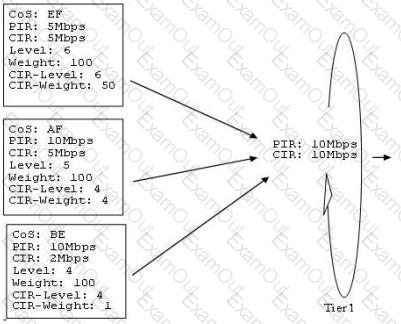
Click the exhibit button below. Given the scheduler-policy (below), how much bandwidth can the best-effort traffic receive (PIR and CIR) when the ingress rate of each queue is 10Mbps?
A.

PIR = 4Mbps. CIR = 1Mbps

B.

PIR = 1Mbps, CIR = 1 Mbps

C.

PIR = 10Mbps, CIR = 1Mbps

D.

PIR = 5Mbps, CIR = 1.25Mbps

E.

PIR = 1.25Mbps, CIR = 1.25Mbps

Real-time rate limiting on the service ingress is a feature that performs_____________. Traffic above the defined PIR is ______________.

A.

Policing, expedited

B.

Metering, marked discard eligible

C.

Marking, marked discard eligible

D.

Policing, discarded

E.

Shaping, discarded

By default, how does a hybrid port on a Nokia 7750 SR share its allocated buffer space between access and network pools?

A.

All buffer space is initially allocated to access pools, and some of it is reallocated to network pools if network interfaces are configured on it.

B.

All buffer space is initially allocated to network pools, and some of it is reallocated to access pools if service SAPs are configured on it.

C.

Buffer space is allocated 50% for access pools and 50% for network pools.

D.

Buffer space is allocated 25% for access pools and 75% for network pools.

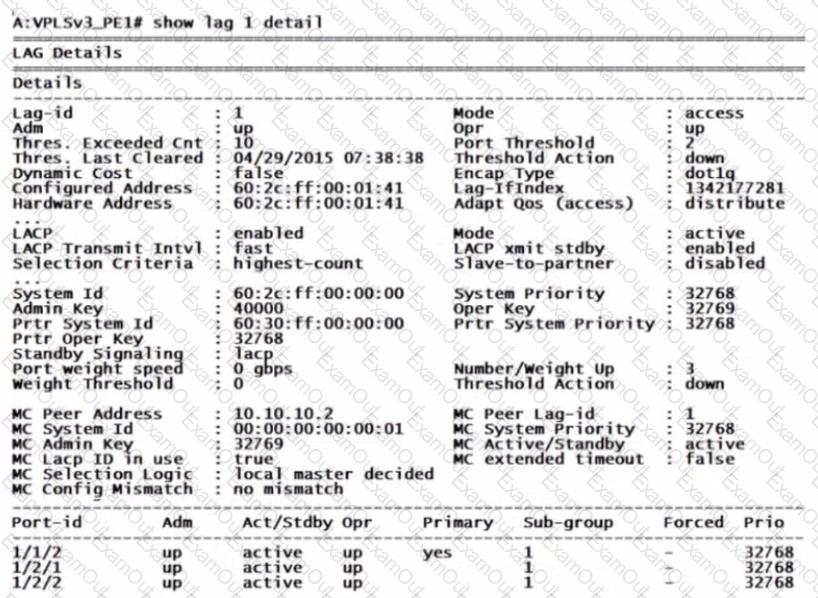
Based upon the exhibit, which of the following statements about LAG 1 is TRUE?
A.

PE1 is the master.

B.

The system-ID used by the CE device is 60:2c:ff:00:00:00.

C.

The Admin Key used by the CE device is 40000.

D.

There is a configuration error between the two MC peers.

A default network policy is applied to all router interfaces associated with network ports.

A.

TRUE

B.

FALSE

Without_______, a customer's high priority traffic can be dropped before its low priority traffic.

A.

packet filtering

B.

prioritization of traffic flows

C.

least cost routing

D.

OAM functionality

E.

separation between the data plane and the control plane

Which of the following are characteristics of 802.1p? (Choose two)

A.

802.1p adds 16 bits to the Layer 2 header,

B.

802.1p adds 16 bits to the Layer 3 header.

C.

802.1p specifies 64 different priority levels.

D.

802.1p uses a field in the 802.1Q header.

E.

802.1p uses a field in the Layer 3 IP header

F.

802.1p defines a 3-bit Class of Service field.

Which of the following statements are TRUE? (Choose two)

A.

The primary contributors to latency are distance, scheduling, and congestion.

B.

The weighted round robin scheduling algorithm will result in more delay for high priority traffic than the regular round robin algorithm.

C.

The round robin scheduling algorithm will result in less jitter for low priority traffic than a strict priority scheduler.

D.

Packet loss can be reduced by decreasing the amount of buffer space available to a queue.

E.

Latency can be reduced by increasing the amount of buffer space available to a queue.

Which of the following statements regarding the default scheduler in the Alcatel-Lucent 7750 SR are TRUE? (Choose two)

A.

There are a maximum of 8 levels of priority serviced using a round-robin algorithm.

B.

The default scheduler will spend an equal amount of time in each queue, as long as there is traffic present

C.

The H1 internal forwarding class will receive its CIR before AF traffic.

D.

Orphaned queues will be scheduled out of the BE queue.

E.

A queue servicing EF and AF traffic will require explicit configuration to set the queue to expedited.

In which of the following scenarios is the egress port scheduler useful? (Choose two)

A.

A customer is complaining that his VoIP traffic is being dropped even though it is sending the correct DSCP markings. Packets are not being dropped on ingress.

B.

A customer is complaining that his VoIP traffic is being dropped even though it is sending the correct DSCP markings. Packets are being dropped on ingress.

C.

A commercial builder has requested numerous dot1Q epipes, VPRNs, and VPLS services to a business park and is only paying up to a maximum 200Mbps.

D.

An equipment manufacturer has requested a NULL epipe service that will transparently pass dot1Q between the new location and national headquarters.

Which of the following protocols are used for service label signaling?

A.

Link LDP or MP-BGP

B.

Link LDP or RSVP-TE

C.

T-LDP or MP-BGP

D.

T-LDP or RSVP-TE

Which of the following BEST describes a SAP when regarding QoS?

A.

A point in the network where EXP bits can be mapped to one of eight predefined FCs, each one with its own queue.

B.

A logical point in a service tunnel where all of customer traffic is aggregated.

C.

A point at which the initial classification of customer traffic occurs.

D.

A point in the network where QoS parameters are discarded in favor of lower-level hardware queuing functions, such as LLI (Link Layer Interleave).

E.

A point in the network where traffic flows from multiple different services are queued together, based on forwarding class.