New Year Sale Special - Limited Time 70% Discount Offer - Ends in 0d 00h 00m 00s - Coupon code: sntaclus

Which of the following about BGP loops in a VPRN environment is FALSE?

A.

Traditional BGP loop detection mechanisms may detect a loop in the VPRN scenario, which in fact is not present.

B.

The Alcatel-Lucent 7750 SR accepts routes containing AS_PATH loops by default.

C.

When the CLI command "config>router>bgp# loop-detect discard-route" is used, the Alcatel-Lucent 7750 SR sends a notification to the remote peer and drops the BGP session.

D.

In VPRN implementations where the CE-PE protocol is BGP, it is possible for separate sites of the same customer to use the same BGP autonomous system number.

In a VPRN that uses MPLS transport tunnels, which of the following statements about P devices is TRUE?

A.

P devices participate in service provider core routing.

B.

P devices are not required to be MPLS-enabled.

C.

P devices must be aware of the VPRNs.

D.

P devices must support MP-BGP.

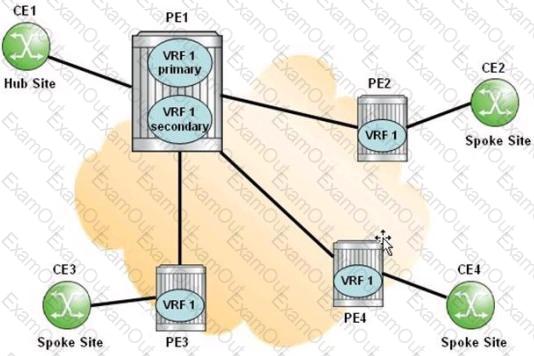
Click the exhibit.

Which of the following statements about the implementation of the CE hub and spoke topology is FALSE?

A.

PE1 advertises spoke routes to CE1.

B.

The primary VRF on PE1 is used to route data packets from the hub CE to the spoke sites.

C.

The secondary VRF on PE1 contains routes learned from the spoke sites.

D.

Spoke sites do not learn routes from other spoke sites directly.

On a PE router, the VRF table for VPRN 10 contains: one local route, two BGP routes learned from a local CE. and three tunneled routes learned from a remote site. If we execute the command "configure service vprn 10 maximum-routes 2 log-only" on this PE router, how many routes are expected to be in the VRF?

A.

Five routes: the local route, the two BGP routes learned from the local CE, and two tunneled routes.

B.

Six routes: the local route, the two BGP routes learned from the local CE, and three tunneled routes.

C.

Two routes: the local route and one tunneled route.

D.

Three routes: the local route and two tunneled routes.

E.

Two routes: the local route and one BGP route learned from the local CE.

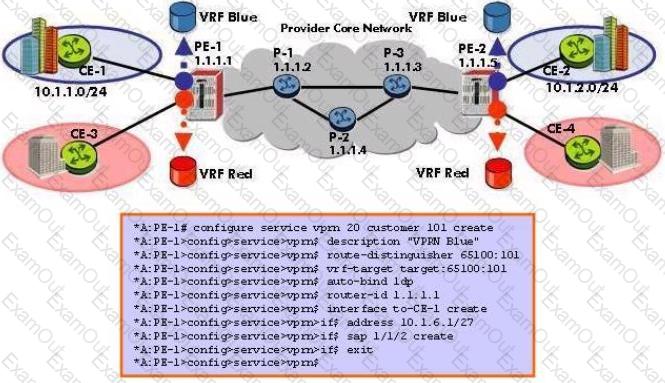
Click the exhibit.

What is wrong with the VPRN configuration applied on this Alcatel-Lucent 7750 SR?

A.

The VPRN ID must match the value used in the vrf-target command.

B.

The VPRN ID must match the value used in the route-distinguisher command.

C.

The router-id command should not be used in this context.

D.

The "no shutdown" command must be configured for the VPRN to be operationally UP.

Which of the following about inter-AS model A VPRN is FALSE?

A.

It requires the configuration of back-to-back VRFs between ASBR routers in different autonomous systems

B.

It is the most scalable of the Inter-AS models.

C.

Most routers that support VPRN functionality support model A by default.

D.

It uses conventional eBGP to distribute unlabeled IPv4 routes between ASBR routers in different autonomous systems.

When using the AS-override method to prevent BGP loops in VPRNs, where should the "as-override" CLI command be configured?

A.

On the PE facing the CE neighbor

B.

On the CE facing the PE neighbor

C.

On the P facing the PE neighbor

D.

On the PE facing the PE neighbor

Click the exhibit.

An Alcatel-Lucent 7750 SR is to be configured as a PE router that supports VPRNs using LDP as the transport protocol. Which of the following best describes this configuration?

A.

This configuration is correct and complete.

B.

This configuration is correct, except that the system interface must be added.

C.

This configuration is correct, except that the interfaces facing the CE routers must be added.

D.

MPLS configuration is not required.

What are the two primary problems the service provider must consider when providing traditional Layer 3 VPN services using only a single common routing table in the provider core? (Choose two)

A.

Memory exhaustion in the provider core

B.

Route leaking between the customer networks

C.

CPU utilization for route processing

D.

Unwanted packet forwarding between customer networks

VPN-IPv4 addressing is made unique by defining an address structure consisting of:

A.

A 64-bit Route Target followed by a 32-bit IPv4 address.

B.

A 64-bit Route Distinguisher followed by a 32-bit IPv4 address.

C.

A 32-bit Route Distinguisher followed by a 32-bit IPv4 address.

D.

A 32-bit Route Target followed by a 32-bit IPv4 address.

Which of the following protocols are supported by the Alcatel-Lucent 7750 SR for the creation of transport tunnels within an autonomous system?

A.

MP-BGP, LDP, RSVP-TE

B.

LDP, RSVP-TE, GRE

C.

MP-BGP, RSVP-TE, GRE

D.

MP-BGP, LDP

E.

MP-BGP only

Click the exhibit.

A Carrier Supporting Carrier (CSC) VPRN is configured for a customer carrier who is an Internet Service Provider (ISP). If CE1 sends an IP packet to 192.60.100.1, which of the following is FALSE?

A.

PE1 pushes an LDP transport label.

B.

CSC-CE1 pops the LDP label and pushes a BGP label.

C.

CSC-PE1 pops the BGP label and pushes two labels: a VPN label and an MPLS transport label.

D.

CSC-PE2 pops the MPLS label and pushes a BGP label.

For a Carrier Supporting Carrier (CSC) VPRN where the customer carrier is an ISP that provides Internet connectivity to its end-customers, which of the following is FALSE?

A.

Customer carrier PE routers residing in different sites must run iBGP between them to exchange customers' routes.

B.

MPLS can be used in the customer carrier network to improve scalability.

C.

The customer carrier network can be a pure IP network.

D.

A CSC VPRN is configured on the CSC-CE to forward data packets to the network provider.

Complete the following statement. In a VPRN, the label signaled by RSVP-TE is used to ______________.

A.

Identify the egress PE in the MPLS domain

B.

Signal the egress VPRN ID

C.

Identify the ingress PE in the MPLS domain

D.

Transport route updates between PEs

Where are VPN-IPv4 addresses used in a VPRN?

A.

In the routing updates exchanged from CE to PE

B.

In the routing updates exchanged from PE to PE

C.

In the routing updates exchanged from P to PE

D.

In customer packets as they traverse the provider core

E.

In all route tables of the VPRN control plane